
Quick Take
- A single overlooked measurement kept this bat hidden from science for nearly two centuries, and the reason had nothing to do with what researchers were listening for. Discover what was missed →
- 19th-century naturalists wrote about this bat in European literature, yet those records sat in scientific limbo for generations. Find out why they couldn't be confirmed or dismissed. See the unverified records →
- This bat hunts scorpions using a technique most people wouldn't associate with echolocation, and that same trick is what made it nearly undetectable to modern researchers. Explore the detection challenge →
- Finding just two bats on a remote island didn't close the case. Instead, it immediately opened a race against time that scientists weren't expecting. See the conservation urgency →
The Egyptian slit-faced bat is distributed widely across Sub-Saharan Africa. This species of microbat also appears in parts of North Africa and the Middle East. For the first time, however, scientists have found evidence of the slit-faced bat living in Europe. Thanks to meticulous tracking techniques, researchers from Germany and Italy have made progress in solving a zoological mystery that has lingered in the background for nearly two centuries.
Unlike larger bat species, Egyptian slit-faced bats operate with subtler tendencies. Weighing only a few grams, this species of microbat often evades easy detection. That’s because they fly low and emit almost imperceptible, high-frequency echolocation calls. Scientists who study bats typically place microphones higher up from the ground. Such placement fails to capture the quiet vocalizations of microbats like the Egyptian slit-faced bat. A new paper, however, lays out the findings: researchers found two slit-faced bats on the Sicilian Channel island of Pantelleria. Below, we explore how researchers found evidence of a possible population in Europe and what its location suggests about cross-continental animal movement.
Continue reading
Egyptian Slit-Faced Bat Background
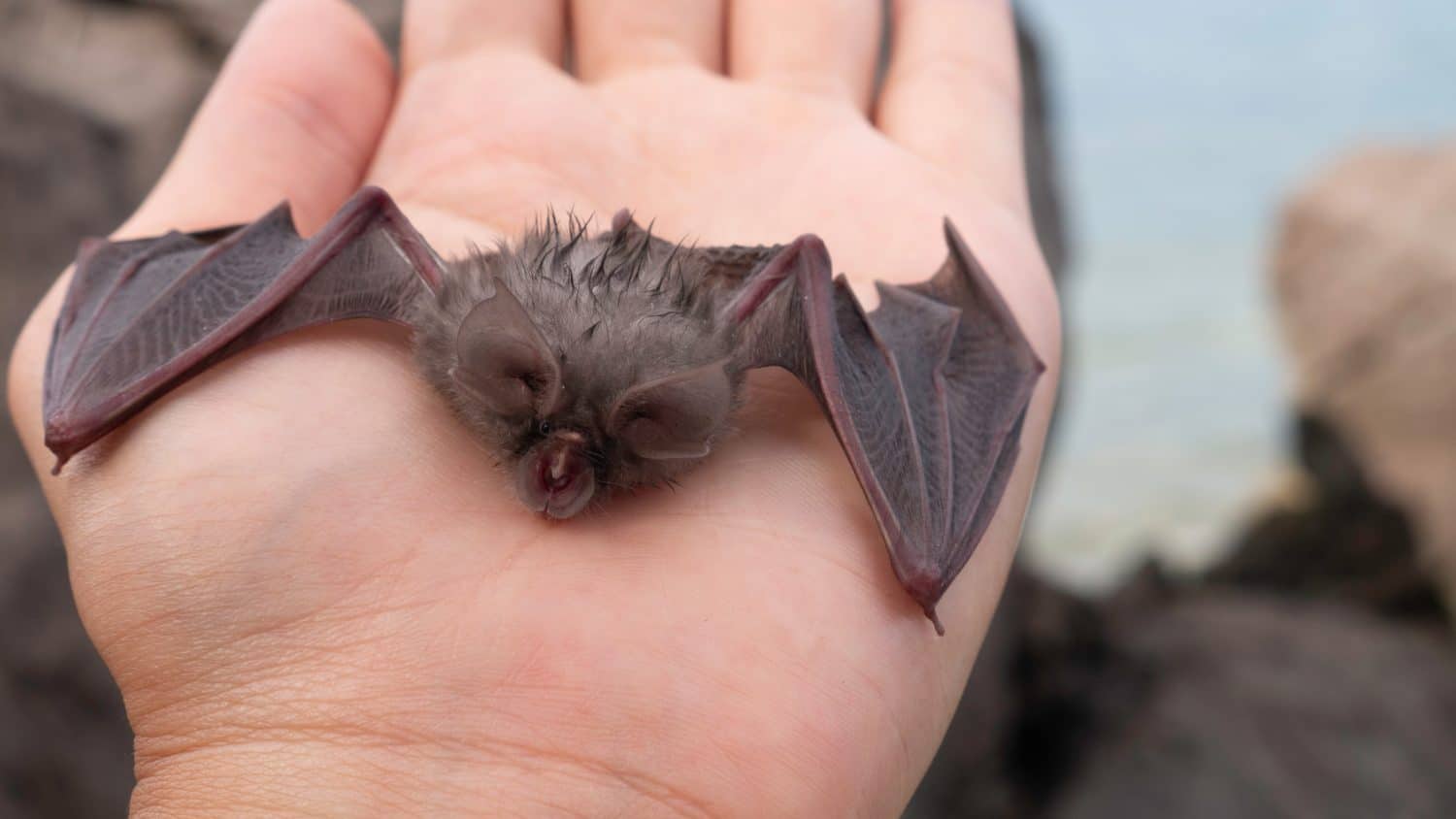
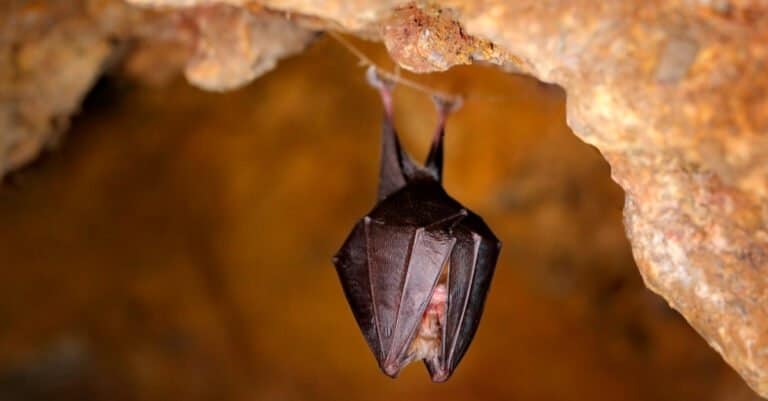
This microbat species is so small that it can fit in the palm of your hand.
©Natasa Ivancev/Shutterstock.com
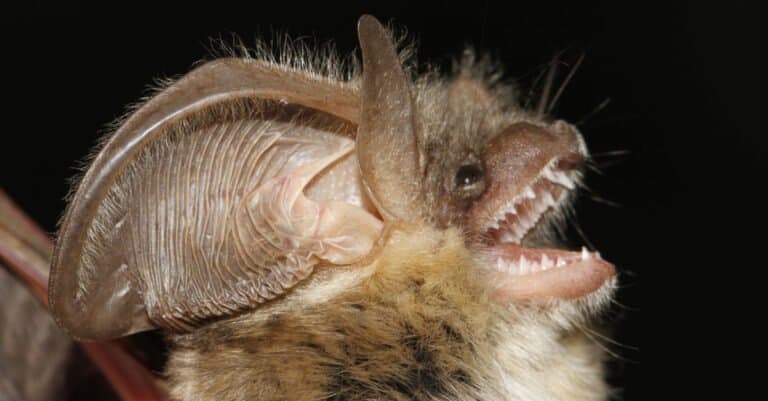
The Egyptian slit-faced bat (Nycteris thebaica) is a diminutive microbat found across Sub-Saharan Africa and the Middle East. Its name reflects its features: slit-faced bats have vertical grooves running down their snouts. They also have proportionally large ears and soft, silky fur with colorations ranging from gray to reddish-brown. The term microbat is also descriptive, as slit-faced bats are exceptionally small, typically weighing between 6.5 and 12 grams.
This microbat species uses its broad wings to fly low and glide slowly, using remarkably subtle echolocation to detect the slightest movement of prey. They rely on a process known as gleaning (which involves passive listening to prey-generated sounds alongside quiet echolocation) to find and snatch spiders, insects, and even scorpions directly off the ground or trees.
Nocturnal by nature, Egyptian slit-faced bats roost in dark, hidden places during the day. Such places include caves, hollowed-out trees, and abandoned buildings. They are social, too, preferring to roost in groups ranging from just a few individuals to several hundred. Egyptian slit-faced bats are relatively adaptable, which has helped them spread across Sub-Saharan Africa. The latest research shows that they have also been making forays into Europe.
Unconfirmed Reports
A new study, published in the journal Global Ecology and Conservation, confirmed the presence of Egyptian slit-faced bats in Europe. This comes after centuries of whispers and unverified reports of the species on the continent. As the study’s lead author, Danilo Russo, explained to Phys.org, finding evidence of the species required a fresh perspective.
He said: “Some zoological records are not lost because the animals have disappeared, but because we stopped looking for them in the right way. Nycteris thebaica had been mentioned in 19th-century Sicilian literature under uncertain names, but those records lacked specimens, locality data, or diagnostic descriptions. For almost two centuries, we could neither confirm nor dismiss those records.”
The search took scientists to the volcanic island of Pantelleria. An island in the Sicily Channel between Tunisia and Sicily, Pantelleria acts as a biological pit-stop between North Africa and Europe. It was there that researchers were able to confirm the presence of the bat, thanks to some novel observation techniques.
Hearing the Whispers
Some call the Egyptian slit-faced bat the whispering bat due to its faint, high-frequency echolocation calls. Researchers often use microphones to detect bat calls. However, this species is so quiet that they tend to elude conventional acoustic surveys. Once the team detected unusual calls during a passive monitoring session on the island of Pantelleria, they staged a targeted survey. This time, they placed microphones less than half a meter above the ground and increased the devices’ sensitivity.
Quickly, researchers captured several call sequences featuring short, multi-harmonic, frequency-modulated echolocation calls. They also captured social vocalizations and evidence of two bats flying in tandem. All recorded calls were attributable to the Egyptian slit-faced bat. By tailoring their survey to specific, subtle parameters, the researchers detected a species that standard acoustic surveys miss.
As Mirjam Knörnschild from the Museum für Naturkunde Berlin and Humboldt-Universität zu Berlin told Phys.org, “These recordings indicate that Pantelleria does not simply host an accidental individual. The presence of two bats flying together, along with social vocalizations, points to a small, previously undetected population on the island.”
Regional Transitions

The island of Pantelleria may host a larger population of Egyptian slit-faced bats than previously thought.
©Dionisio iemma/Shutterstock.com
Confirmation of the Egyptian slit-faced bat on a Sicilian Channel island supports certain biogeographical theories. For one, it supports the idea that historical periods of low sea levels made it easier for this slow-flying microbat species to extend its range.
It also turns unconfirmed reports into a confirmed conservation issue. While further research is needed, the team hopes to confirm the genetic origin of the Pantelleria population, estimate its size, and assess potential threats. As lead author Danilo Russo explained to Phys.org, this finding makes future research more focused on protection.
He said, “Our study turns a historical uncertainty into a conservation issue. While Nycteris thebaica has long persisted unnoticed on Pantelleria, we now need to determine the size of this population, identify its roosting sites, assess whether it also occurs elsewhere in Sicily or the Sicily Channel Islands, and determine how it should be protected.”