
Quick Take
- Hundreds of these fossils exist, yet scientists are missing something critical that prevents them from fully understanding the species. Surprisingly, what they lack is not more bones. Why adults matter →
- The same technique used to age trees quietly solved a dinosaur mystery that formal classification couldn't crack for two decades. See the bone analysis →
- Scientists were confident in their original classification. That confidence lasted until they looked at the bones under a microscope and found something that rewrote everything. What the microscope revealed →
Sometimes, scientists discover what they think is one species, only for later research to come to a different conclusion. A new study published in the Journal of Vertebrate Paleontology is one of the latest examples of this phenomenon.
For over twenty years, scientists assumed that a series of small dinosaur fossils might belong to a miniature species. A recent spate of analyses, however, has changed some minds. Thanks to the study of bone growth patterns, researchers recently confirmed that the remains were actually baby ankylosaurs. Let’s learn more about ankylosaurs and why scientists are pretty sure a series of fossils found in China belongs to the juvenile members of this ancient species.
Precious Specimens

China’s Liaoning Province is famous for its ancient lake beds containing well-preserved dinosaur fossils.
©Hao Wan/Shutterstock.com
Located in northeastern China, Liaoning Province is famous for its collection of remarkably well-preserved fossils from the Cretaceous Period. This era, between 145 and 66 million years ago, resulted in several fossils forming at the bottom of ancient shallow lakes. Eventually, volcanic activity covered the lake beds, preserving an impressive variety of fossils. Besides feathered dinosaurs like Microraptors and Sinornithosaurus, this area also preserved a species called Liaoningosaurus paradoxus. As you might be able to tell by the name, this species has caused confusion among paleontologists since it was first described in 2001.
Liaoningosaurus paradoxus was classified as an ankylosaur, which is a group of dinosaurs characterized by tough, almost armor-like bodies. Even so, scientists were not sure. Some thought this collection of small fossils belonged to a miniature species. Others, however, thought it might have been a partially aquatic species. In speaking to Science Daily regarding the original origin debate and subsequent findings, one of the researchers explained the lingering mystery regarding ankylosaurs. He said, “Liaoningosaurus has caused a lot of debate because there is a lot we don’t know about this species, and we haven’t managed to identify an adult.”
Tree Rings
The one problem scientists faced was that all known Liaoningosaurus fossils are of a similar size and dimension. That meant that body length alone would fail to prove whether they were adults or juveniles. To get around this knowledge gap, researchers pulled out their microscopes to look more closely at the bones. Much like tree rings, bone tissue contains a record of growth for each year of life. Plus, line spacing reveals both age and rate of growth.
To address this, scientists compared bones from both the largest and smallest known specimens. Surprisingly, neither sample had any growth lines. The smaller specimen, in particular, had bones with features found only in very early dinosaur developmental stages. This suggested that both specimens were very young, likely less than a year old.
Professor Paul Barrett, a coauthor of the study, told Science Daily: “This is a small, ring-like feature in the bone that is laid down at the time the animal hatches from the egg. So, we can say that this individual had very recently hatched at the time of its death, which would make it the first hatchling ankylosaur we’ve ever discovered.”
Published Findings
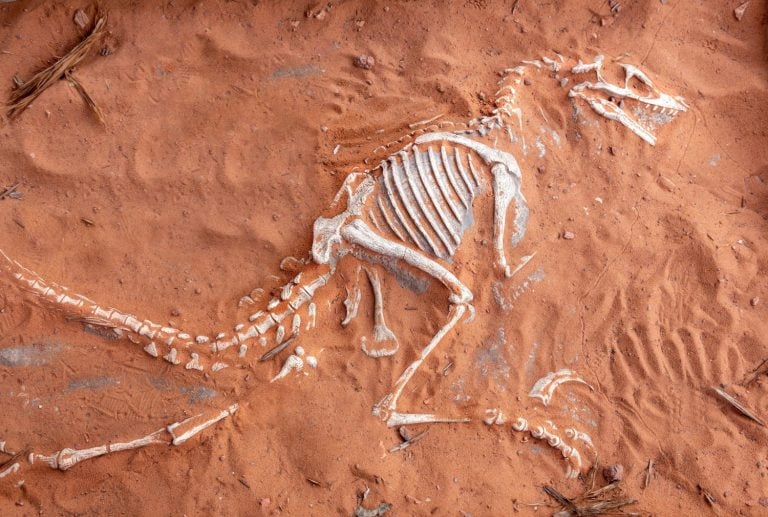
These newly examined Liaoningosaurus fossils provide one of the few good looks into the early development of ankylosaurs.
©Pecold/Shutterstock.com
The researchers’ paper, called “Bone histology of Liaoningosaurus paradoxus (Ornithischia: Ankylosauria) from the Lower Cretaceous of Liaoning Province, China,” challenges existing ideas regarding ankylosaurs. They argue that these fossils are most likely juvenile dinosaurs; one of the examined specimens showed signs of having just hatched before death.
What makes the entire situation confusing is the purported maturity of Liaoningosaurus fossils. While hundreds of these fossils have been found, they are all relatively small. They show some evidence of potential maturity, such as armored, shielded bodies. However, there are other clues suggesting younger ages, like bone fusion. Additionally, no adult Liaoningosaurus specimens have ever been found. Even so, these examined specimens provide important insights into ankylosaur development, especially at such an early age. As Professor Barrett explained to Science Daily, “As we have found so few fossil babies, Liaoningosaurus is really the only good window we have into what ankylosaurs are like just after they hatch.”
Looking Forward
The researchers may have found more definitive evidence of what juvenile ankylosaurs looked like. They also gained a better understanding of the timeline for when features like armor began to develop as the animal grew. Even so, a true comparison still eludes them. As Barrett explained to Science Daily, “But what would give us even bigger insights is if we also found an adult. Then we can find the differences between the adults and babies of the same species and see how these features are developing.”