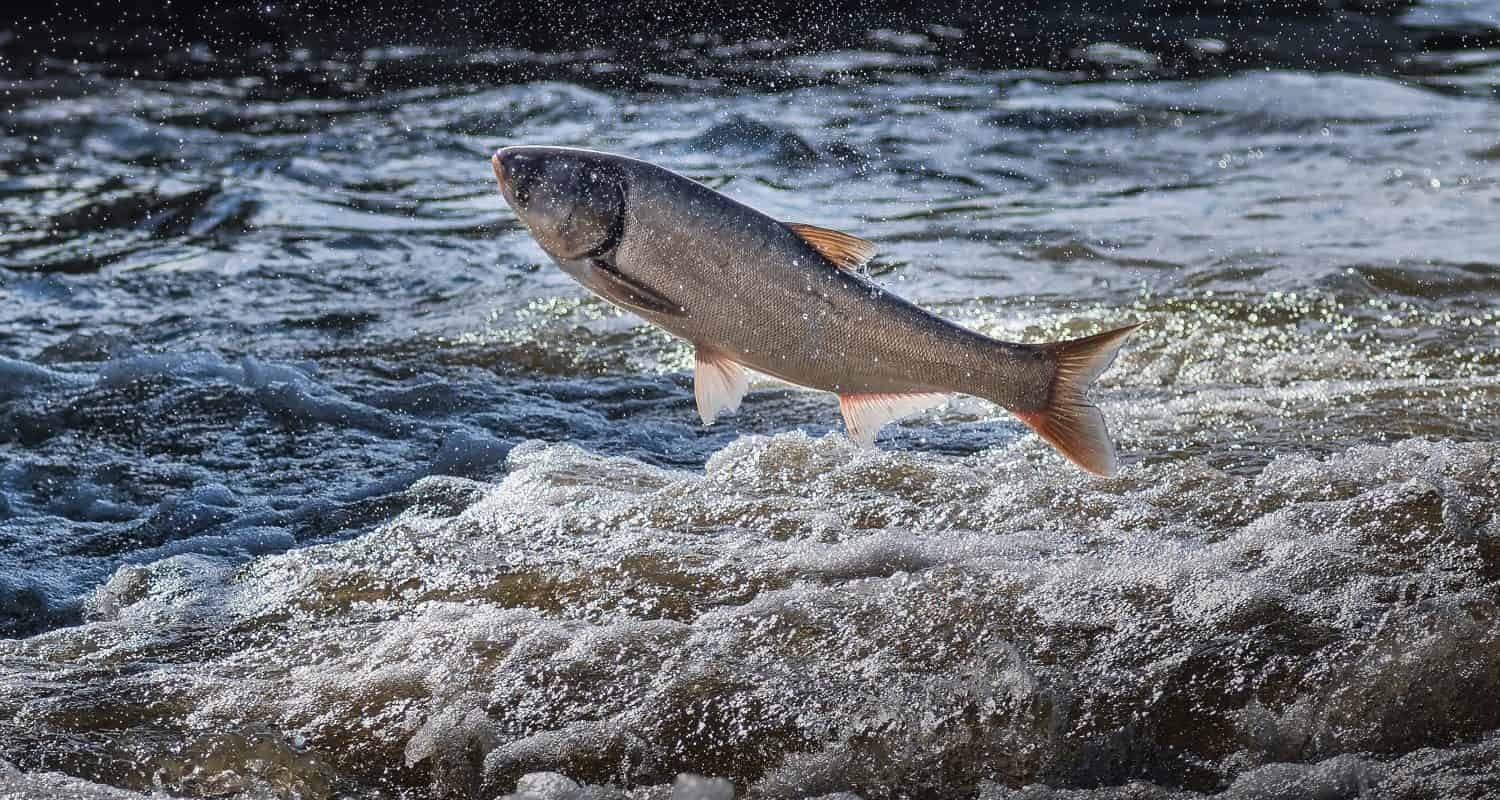

Quick Take
- Asian carp outcompete native species, comprising as much as 80 percent of the biomass in some waterways.
- The Mississippi River basin and other waterways that connect to the Great Lakes are infested with invasive Asian carp.
- Studies have identified the most likely aquatic paths for Asian carp to reach the lakes, which would cause ecological and economic damage.
- The Army Corps’ Brandon Road Interbasin Project aims to block Asian carp access to the lakes, but construction was paused for a federal review of funding.
Asian carp are large, voracious, and invasive. After their introduction to the United States during the early 1970s to control algal blooms and snails in aquaculture ponds, Asian carp escaped and gained a foothold in the wild. The four species (bighead, black, grass, and silver carp) are native to China, Vietnam, and southern Russia, where carp have been a part of human diets for thousands of years. Their popularity as tasty, nutritious fish keeps their populations in check in their native environments. But, according to a 2021 study published in Comprehensive Reviews in Food Science and Safety, Asian carp in the U.S. are not seen as good food fish, in part because they’re mistaken for their bottom-feeding cousins, common carp.
Once they reached the U.S., Asian carp spread rampantly, outcompeting native species for food. They grow fast, disperse far, and face few predators, human or otherwise. A single carp is estimated to consume 5 to 20 percent of its body weight in aquatic plants and animals every day. In the Mississippi River Basin, Asian carp—particularly silver and bighead carp—have come to dominate aquatic habitat, comprising up to 80 percent of the biomass at the expense of native species. A 2017 study published in PLOS One found that the abundance of silver carp in the Mississippi River Basin had increased relative to populations of native bigmouth buffalo and gizzard shad.
Because the Mississippi basin connects via a system of canals to the Great Lakes, experts fear that Asian carp will invade them. These fish thrive in cold, still, deep waters, such as those found in the Great Lakes, where they filter-feed on all manner of plankton using specialized gill rakers. In the newsletter of the Great Lakes Fishery Commission, former Vice-Chair Michael Hansen wrote, “As DNA confirms the presence of Asian carp within miles of Lake Michigan, the millions of people that live and work in the Great Lakes region stand strong in their commitment to protect the Great Lakes.”
On the Canadian side of the Great Lakes, people have captured just a handful of bighead and grass carp. The bighead carp (Hypophthalmichthys nobilis) showed up in 2000 to 2003, apparently having been released into Lake Erie, and has not been detected since. Grass carp (Ctenopharyngodon idella) have been caught in or near Lake Huron, Lake Ontario, and Lake Erie as recently as 2018 but most were infertile, according to a Government of Canada posting. Some juvenile grass carp found in two tributaries that empty into Lake Erie could pose a threat to the population getting established in the lake.
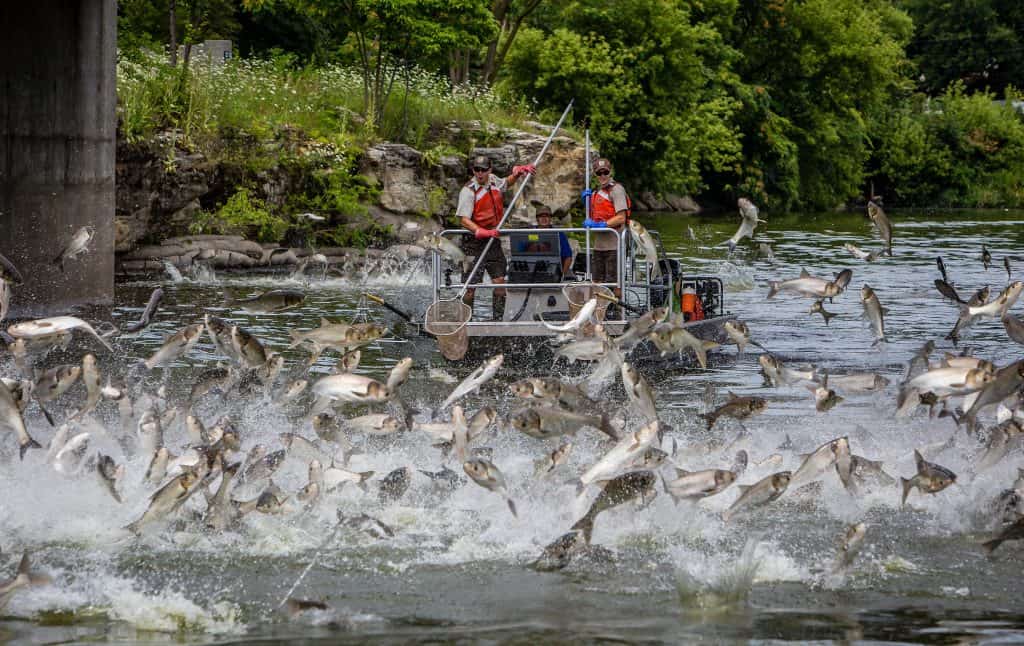
Silver carp literally catapult out of the water when they hear boat noises.
©Invasive Carp Removal Program/public domain – Original / License
But it’s the silver carp that has generated the most concern. Dubbed “flying carp,” they have a habit of leaping as high as nine feet out of the water when startled by noises. A motorboat can stir up a group of carp that weigh from 20 to 80 pounds. Not only are the massive fish alarming, but also hazardous when they smack people in the face or ribs, even knocking them off open boats. Asian carp are also known carriers of parasites, such as the Asian tapeworm (Schyzocotyle acheilognathi), which they might pass on to native species.
To control their spread, the Lacey Act listed the silver carp (Hypophthalmichthys molitrix) as “injurious wildlife” in 2007. Their import to the U.S., including at all life stages—eggs, gametes, hybrids, adults—is prohibited. Meanwhile, the National Oceanic and Atmospheric Administration (NOAA) partnered with the U.S. Fish and Wildlife Service (USFWS) and outside experts to better quantify the risks to Great Lake ecosystems if Asian carp find their way into the lakes. Using models, they’re making projections about how many individuals would have to get into the lake(s) to establish viable populations.
Their 2021 study, published in the North American Journal of Fisheries Management, predicted that bigheaded carp, if they reach the lakes, would have negligible effects on some of their food webs. But, in areas where they’d likely become abundant—including Saginaw Bay and Lake Erie—they’d depress populations of zooplankton and, therefore, impact native fishes that feed on zooplankton.
“Invasive carp are extremely efficient filter feeders,” explains Greg McClinchey, Legislative Affairs and Policy Director of the Great Lakes Fishery Commission (GLFC), in an email interview. “They consume huge amounts of plankton, which is the foundation of the Great Lakes aquatic food chain. Native fish larvae and small forage fish rely on plankton for their survival. If carp were to outcompete them for that food source, many native species could decline sharply or even be entirely extirpated. In a worst-case scenario, this could prompt a major restructuring of the ecosystem, with fewer native fish and more carp dominance.”
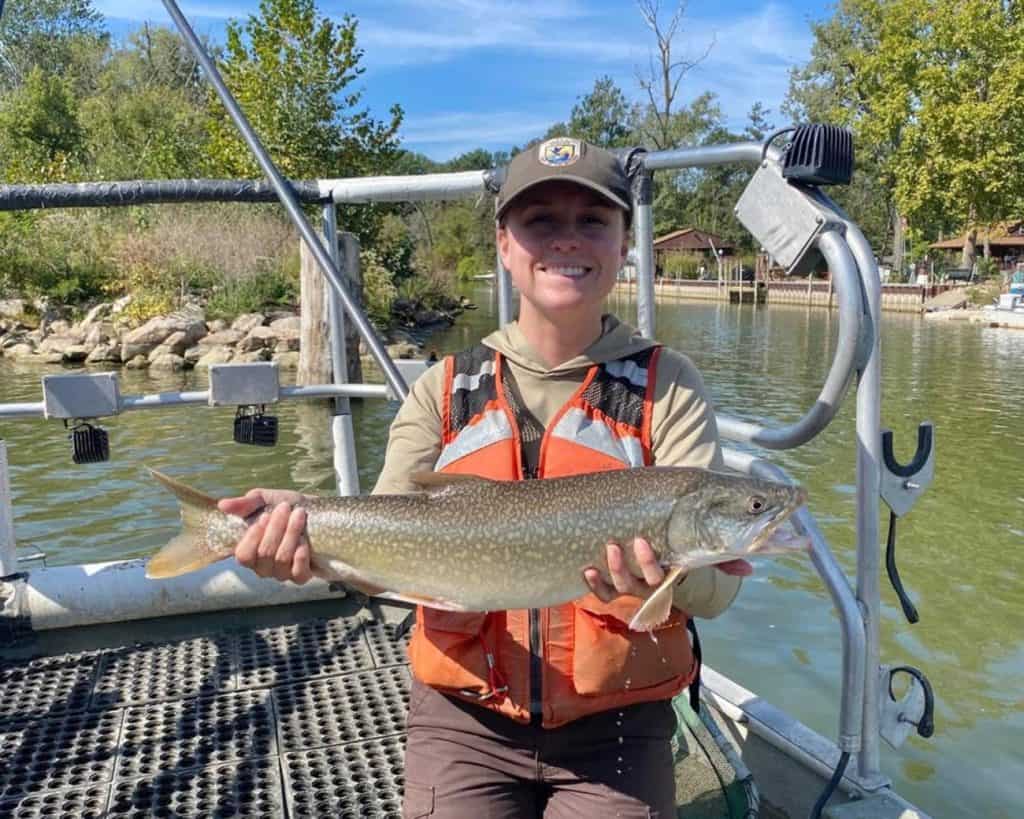
A biologist holds a lake trout during monitoring of fish native to the Great Lakes.
The GLFC, beginning more than a decade ago, has facilitated efforts to block the spread of invasive fish into the Great Lakes. As early as 2006, electric and bubble barriers were erected in the Chicago Sanitary and Ship Canal to see whether they’d effectively repel invasive Eurasian ruffe fish (Gymnocephalus cernua). A study published in the Journal of Great Lakes Research reported that even the most effective electrical settings (5 ms, 6 Hz) repelled only about half of the attempted passes by ruffe. They were significantly repelled by curtains of air bubbles, but some still got through. So, no single barrier is 100 percent effective against Asian carp, but a layered set of barriers could keep the fish out of the Great Lakes, according to the GLFC. Deploying those barriers at key points where carp might get access to the lake is critical.
In 2014, the U.S. Army Corps of Engineers (USACE) completed a study of the connections between the Great Lakes and the Mississippi River Basin to determine the most likely paths through which carp might enter the lakes. They identified more than 20 potential aquatic pathways, including manmade and natural, by which carp could travel between those bodies of water. The spot that surfaced as critical, in terms of connectivity, was Brandon Road in Illinois, part of the Chicago Area Waterway System. The Brandon Road Lock and Dam was the only single location that could provide a barricade from the Mississippi River through all the Chicago waterways.
Native fish larvae and small forage fish rely on plankton for their survival. If carp were to outcompete them for that food source, many native species could decline sharply or even be entirely extirpated.
Greg McClinchey, Legislative Affairs and Policy Director of the Great Lakes Fishery Commission (GLFC)
The Brandon Road Interbasin Project, to be completed by the Army Corps of Engineers, is specifically designed to take advantage of a natural pinch point by deploying a range of layered and innovative defenses designed to prevent invasive carp from upstream movement into the Great Lakes system. “Unlike many current electric barriers, which are helpful but imperfect,” says GLFC’s McClinchey, “Brandon Road is meant to be both structural and redundant, deploying multilayered defenses such as electric barriers, acoustic deterrents, bubble curtains, flushing lock operations, and engineered channel modifications. It may seem to some like overkill to have all these options included in a single project, but the entire effort is based on the idea that no single deterrent is perfect.”
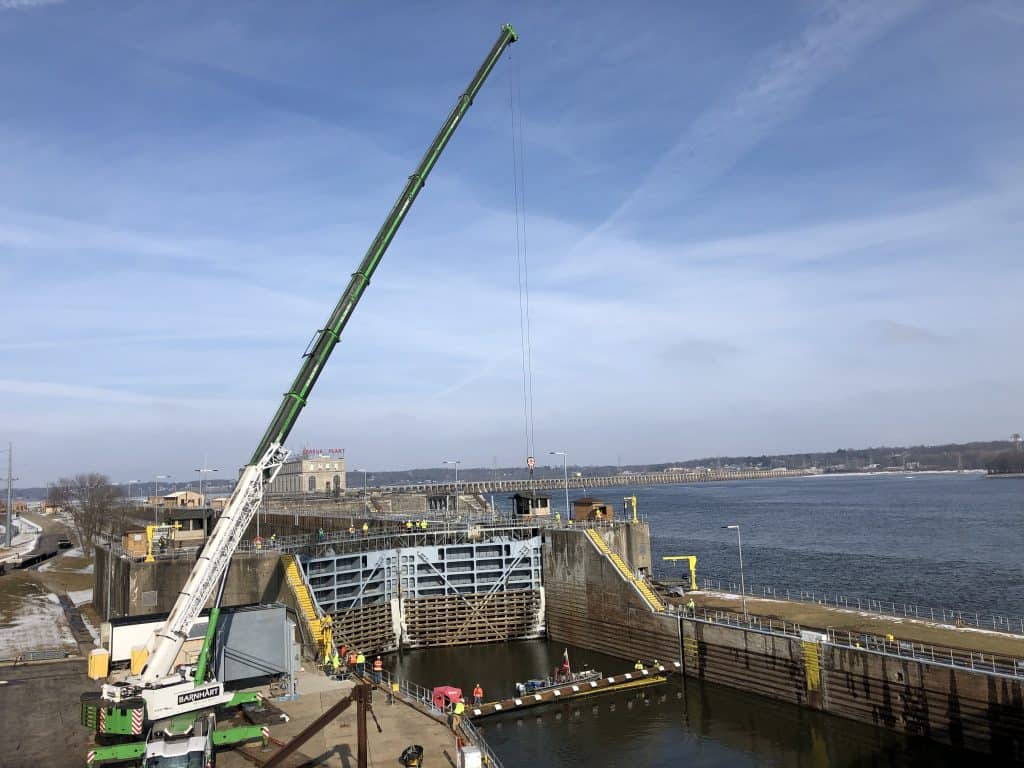
In 2024, USACE awarded the first of several construction contracts to a company that could remove riverbed rock and otherwise prepare the blockade site. Project updates for the Brandon Road Interbasin Project report that rock removal is complete, paving the way for the next steps, which include constructing the bubble curtain, the sound deterrent, and an automated system that blows pockets of air onto the bottom of barges to clear any fish off before they go through the locks. Ultimately, the barricade will also include an electric field “wall.” The design represents the culmination of more than a decade of research on how to deter Asian carp.
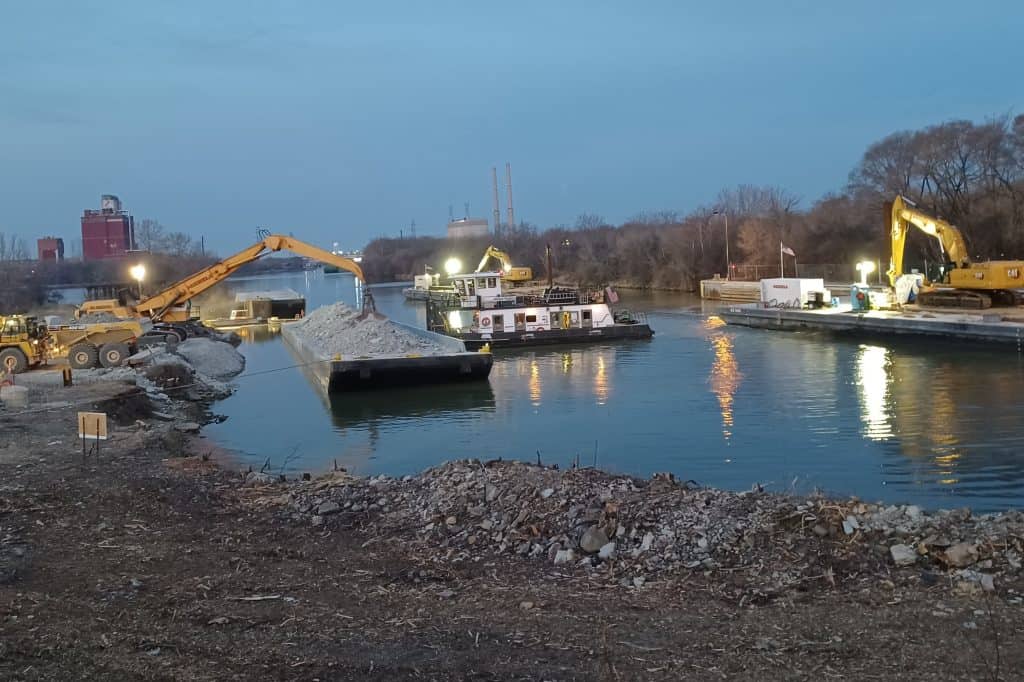
Contractors for the Brandon Road Interbasin Project work through the night to complete rock excavation.
©USACE Rock Island District/public domainn – Original / License
On May 9, 2025, a memorandum from the White House pledged to protect the Great Lakes from invasive carp: “The Administrator of the National Oceanic and Atmospheric Administration (NOAA) and the Director of the United States Fish and Wildlife Service, through their joint operation of the Aquatic Nuisance Species Task Force, shall prioritize support for research and management concerning the prevention, removal, and management of aquatic invasive species in the Great Lakes, including invasive carp.” In late 2025, the Brandon Road Interbasin Project was paused by the Administration, on the eve of its groundbreaking ceremony, according to the WGN local news, to conduct a review.
Last month, in response to the hold on funding, U.S. Senators from Michigan and Illinois sent a letter to the Office of Management and Budget to urge them to let the project move forward. Their letter explains the concerns over the disruptions to the Great Lakes ecosystems, should Asian carps invade: “If invasive carp were to become established in the Great Lakes, they would outcompete existing fish populations, permanently damage ecosystems, and significantly impair the $7 billion Great Lakes economy.”
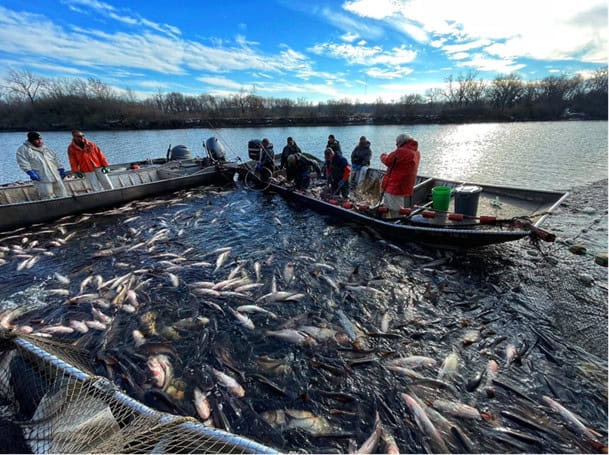
Nets are deployed to remove carp from the Illinois River.
©Illinois Department of Natural Resources/public domain – Original / License
Meanwhile, wildlife scientists and engineers continue to experiment with ways to repel the advance of invasive carp. Even if the Brandon Road barriers go forward, research and action to keep carp out of the Great Lakes should continue. “Brandon Road could buy the Great Lakes decades of effective protection. That is a very strong design philosophy for invasive species containment but should never be seen as a reason for groups like the GLFC and our partners to reduce discussions and work aimed at the ongoing protection of the Great Lakes,” explains GLFC’s McClinchey by email.
Engineers are assessing whether high-pressure bursts of water might work as barriers. Other studies are looking at the impact of pheromones (natural animal secretions used in intra-species communication) on carp behavior. Public awareness efforts aim to motivate fishermen and other citizens to participate in stemming the threat by making sure that their activities don’t accidentally give a free ride to Asian carp into the lakes.
A report from the Government of Canada listed several avenues of introduction, including:
- Live Trade – As Asian carp are traded as pets or food, they may be released into natural ecosystems
- Bait Buckets – Water discarded from bait buckets may contain carp eggs or juveniles, which can be mistaken for minnows
- Ballast Water – Ballast tanks on ships are unlikely to contain Asian carp, but may contain eggs or juveniles
Experts continue to monitor the Great Lakes and surrounding waterways for invasive carp. Michigan State University scientists, for example, use acoustic telemetry to track populations of grass carp. Especially after grass carp (Ctenopharyngodon idella) were documented spawning in Lake Erie’s watershed, researchers have tried to better understand their behavior. “Our best indicators show that the population of grass carp is still relatively low in and around the Great Lakes, which gives us a chance of maintaining this status and—if we’re really fortunate—extirpating and eliminating future reproduction events,” says wildlife biologist Scott Colborne in a news release.
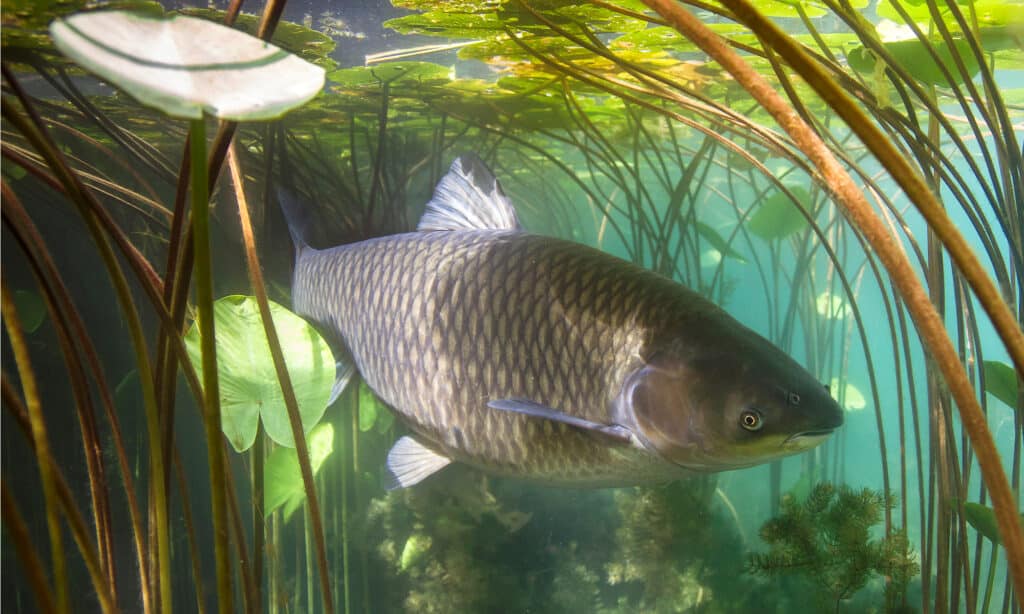
Grass carp (Ctenopharyngodon idella) have been found laying eggs near Lake Erie.
©Rostislav Stefanek/Shutterstock.com
DNA technologies have also emerged as a useful tool for monitoring the presence of carp in and around the Great Lakes. A 2025 USFWS manual describes the procedures and data analysis for detecting Asian carp using eDNA. When fish occur in low densities, traditional sampling methods may not detect their presence. But their environmental DNA (eDNA) will have entered the ecosystem through sloughed skin, feces, or secretions. By taking water samples using a standard protocol, the presence of carp, down to the species identification, can be assessed through DNA sequencing. As carp colonize new habitats, their eDNA may pick up their presence and allow for eradication measures, well before they would otherwise be caught or seen.
Keeping Asian carp out of the Great Lakes is about taking care of lake ecosystems, as well as sustaining the fishing economy and honoring cultural values. A 2014 study published in Fisheries and Oceans Canada, Policy and Economics, projected the various socio-economic impacts of Asian carp in the Great Lakes to activities from fishing to intangible experiences of nature. The study authors pointed out that the Great Lakes form a basin that’s home to millions of people, including more than 60 aboriginal communities. While some of the services provided by the lakes are difficult to quantify, it’s clear that native freshwater fisheries have played a role in conserving traditional aboriginal lifestyles.
Explains GLFC’s McClinchey, “Invasive carp, should they enter the Great Lakes, would become a direct threat to critical keystone and commercially important species such as lake whitefish, yellow perch, walleye, salmon, and trout populations. Worse still, if an invasion of this nature were to occur, carp could potentially become the dominant fish biomass in the Great Lakes, costing billions of dollars in lost economic potential and ecological damage by forever altering an already fragile Great Lakes ecosystem.”
Let’s hope that the decades of research pay off in time to keep Asian carp out of the Great Lakes.