
Quick Take
- Taking your dog to a national park and letting it chase wildlife is every ranger's nightmare. Unless, of course, that's the whole plan.
- Elk getting too cozy with tourists sounds charming until you see what it's actually doing to both the animals and the park.
- Grand Canyon picked a specific dog breed for this job, and the reason comes down to instincts that can't really be trained.
- Blue's toughest opponent on the job is not a bull elk during rut season. It's something far more mundane.
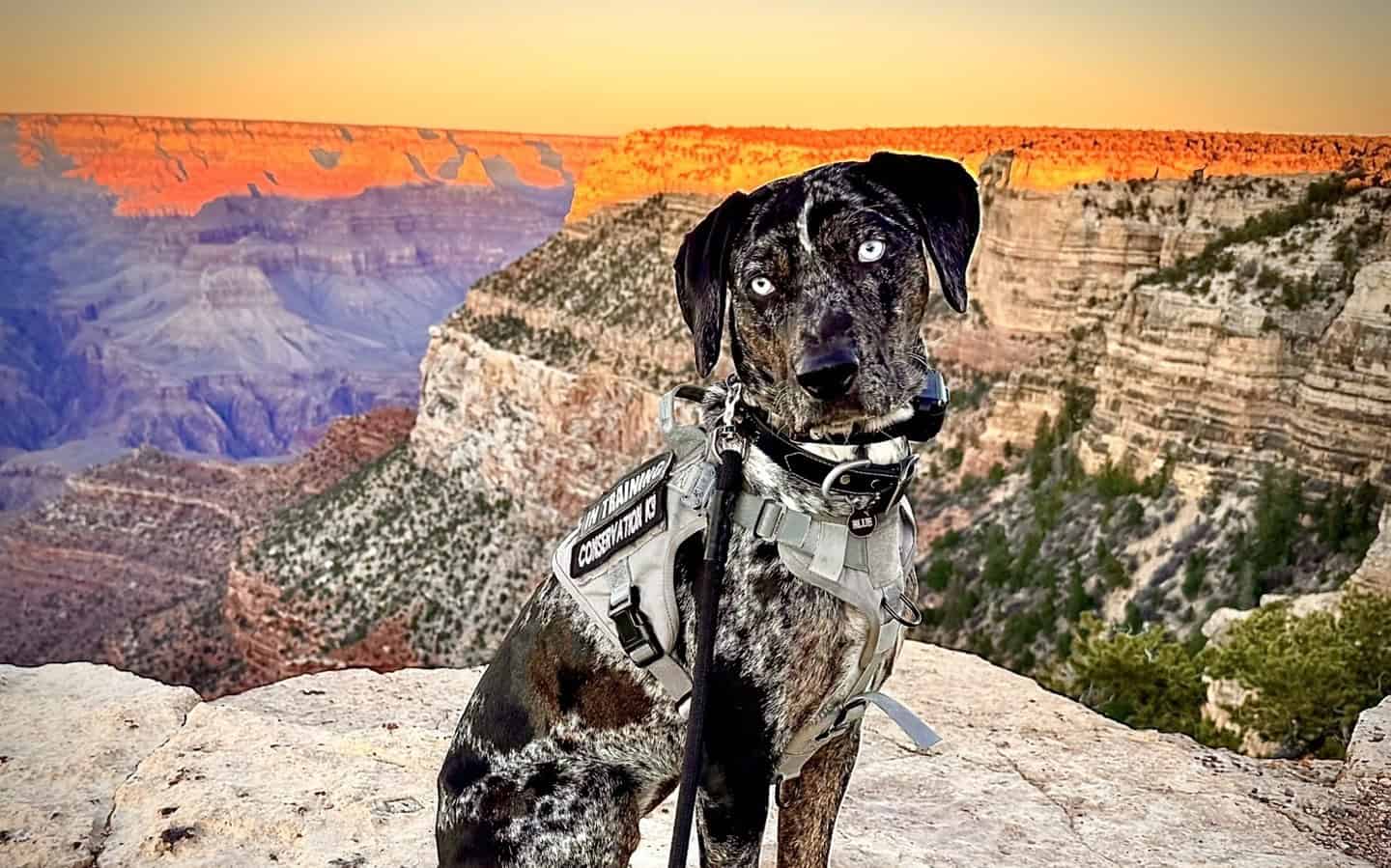
Dogs have become instrumental to our well-being in modern societies, whether as service companions, therapy visitors, search-and-rescue team members, airport drug sniffers, or otherwise. Now, in Grand Canyon National Park, the dog “Blue” pioneers a new role for canines. With the recent launch of the Conservation K-9 Project, Blue—a Catahoula leopard hound—has been trained to herd wildlife away from human areas.
Typically, people discourage their dogs from chasing wildlife in natural settings. However, in the Grand Canyon, wildlife becoming accustomed to humans (habituation) is putting both animals and people at risk. With an estimated elk population of at least 300, coupled with consistently high human visitation, contact between people and elk continues to be a concern in Grand Canyon National Park. Because elk are not particularly shy, they visit areas with people, sometimes even poking their noses into tents.
“Grand Canyon’s elk and bighorn sheep have become increasingly comfortable in developed areas over the last two decades,” explained wildlife biologist and project lead Brady Dunne in a news release from the National Park Service.
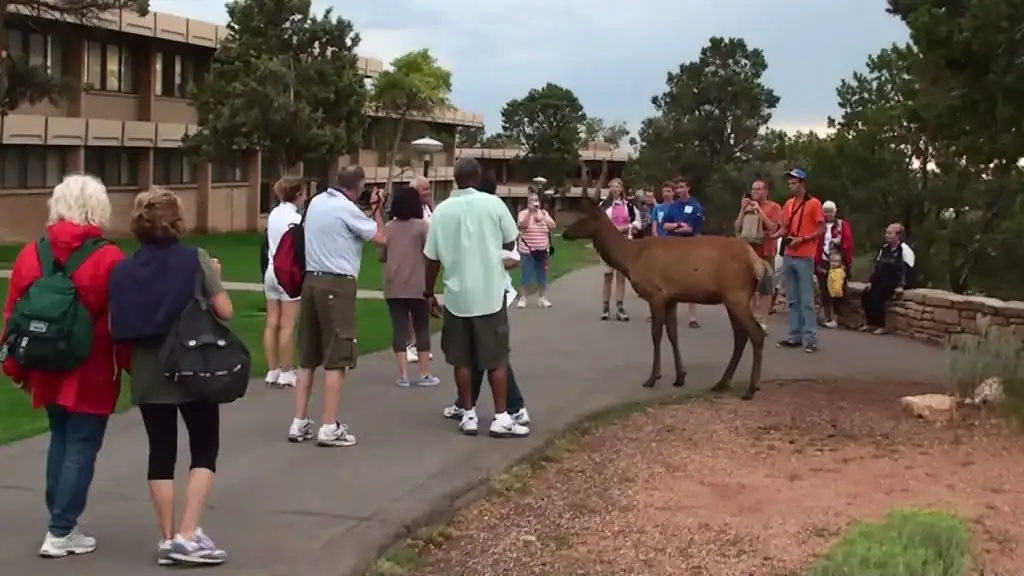
In trying to get the perfect photo, visitors crowd too close to a young elk.
About Rocky Mountain Elk
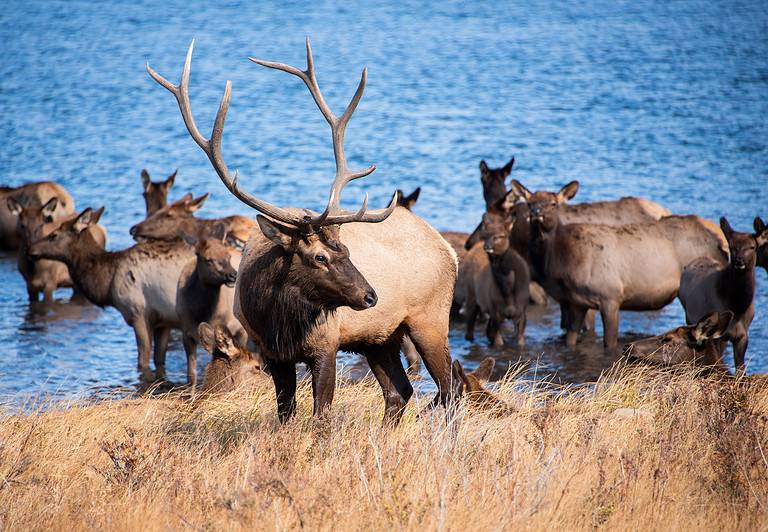
Rocky Mountain elk (Cervus canadensis nelsoni) inhabit the pine and juniper forests on the South Rim of the Grand Canyon. They were intentionally introduced from Yellowstone National Park during the early 1900s to replace the region’s native Merriam’s elk (Cervus canadensis merriami) that had been extirpated through unregulated hunting and cattle grazing by European settlers.
The Rocky Mountain elk population has been affected by people who offer water and food. A 2025 study in Proceedings of the Royal Society B found that elk and other large mammals in U.S. national parks show a wide range of responses to human presence; while elk in remote areas tend to avoid people, those in developed areas may become more habituated and less wary of humans. Elk now roam the Grand Canyon in loose groups, taking advantage of water puddles that form beneath bottle-filling stations and from water treatment runoff.
Elks are not naturally dangerous to people. However, if an elk feels cornered, it will defend itself by kicking, biting, or goring with its horns. A Grand Canyon web page advises people to use a simple rubric to determine safe distance from an elk: “A way to tell if you are too close is to hold up your hand. If the animal is far enough away, you should be able to cover it with your thumb. If it is too large to be hidden behind your thumb, you are too close and need to move away.”
Habituation is also detrimental to wildlife, changing their natural behavior and promoting reliance on human resources. Repeated exposure to people causes wildlife to stop responding defensively, for example, fleeing from roadways. As elk become more accustomed to vehicles and less wary of roads, more are dying in collisions with cars. According to the Arizona Game & Fish Department, an estimated 200 elk and deer are killed in vehicle collisions each year along the I-17 and I-40 near Flagstaff.
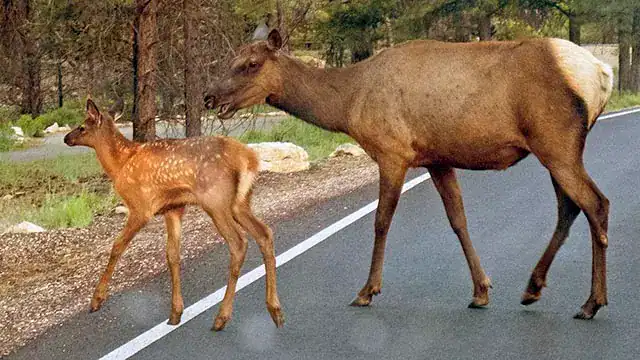
High densities of elk near roadways can lead to dangerous collisions.
What Happened When Elk Were Reintroduced?
The reintroduction of elk as grazers in the Grand Canyon has been successful—perhaps too successful. Without their natural wolf predators, elk populations have increased significantly in this park and in others, such as Grand Teton and Rocky Mountain National Park. Numerous studies (e.g., Beschta, 2005) have shown the impacts of elk on biodiversity. In the absence of natural predators, such as wolves, elk suppress the growth of native cottonwood trees, precipitating a cascade of changes to streamside ecosystems.
The goal of the Conservation K-9 Project is to avoid removing elk from the park altogether by herding them away from human-use areas. Given the density of visitors, it is impossible to completely avoid affecting elk movements in the Grand Canyon or other parks. Still, the interactions between people and elk can be minimized.
A 2005 study in Ecology and Society reported that dogs could effectively repel elk in Banff National Park, Canada, obviating the need to translocate elk from human areas. In 2016, Glacier National Park in Montana pioneered the use of a dog to reduce human-wildlife conflict when a resource manager used his border collie “Gracie” to move bighorn sheep and mountain goats away from visitor areas. She herded them just far enough away so that people could still photograph the wildlife safely. Just seeing Gracie was apparently enough to keep wildlife out of human-use areas.
Why the Catahoula Leopard Dog?
Grand Canyon National Park chose to train Catahoula leopard dogs, so named for their spotted coats, because they’re known to be good at herding. As described in an article by the Western Landowners Alliance, this dog breed successfully works alongside cattle ranchers to manage livestock. Their loud barks and strong senses of smell allow them to scout out errant cows and bring them back to the herd.
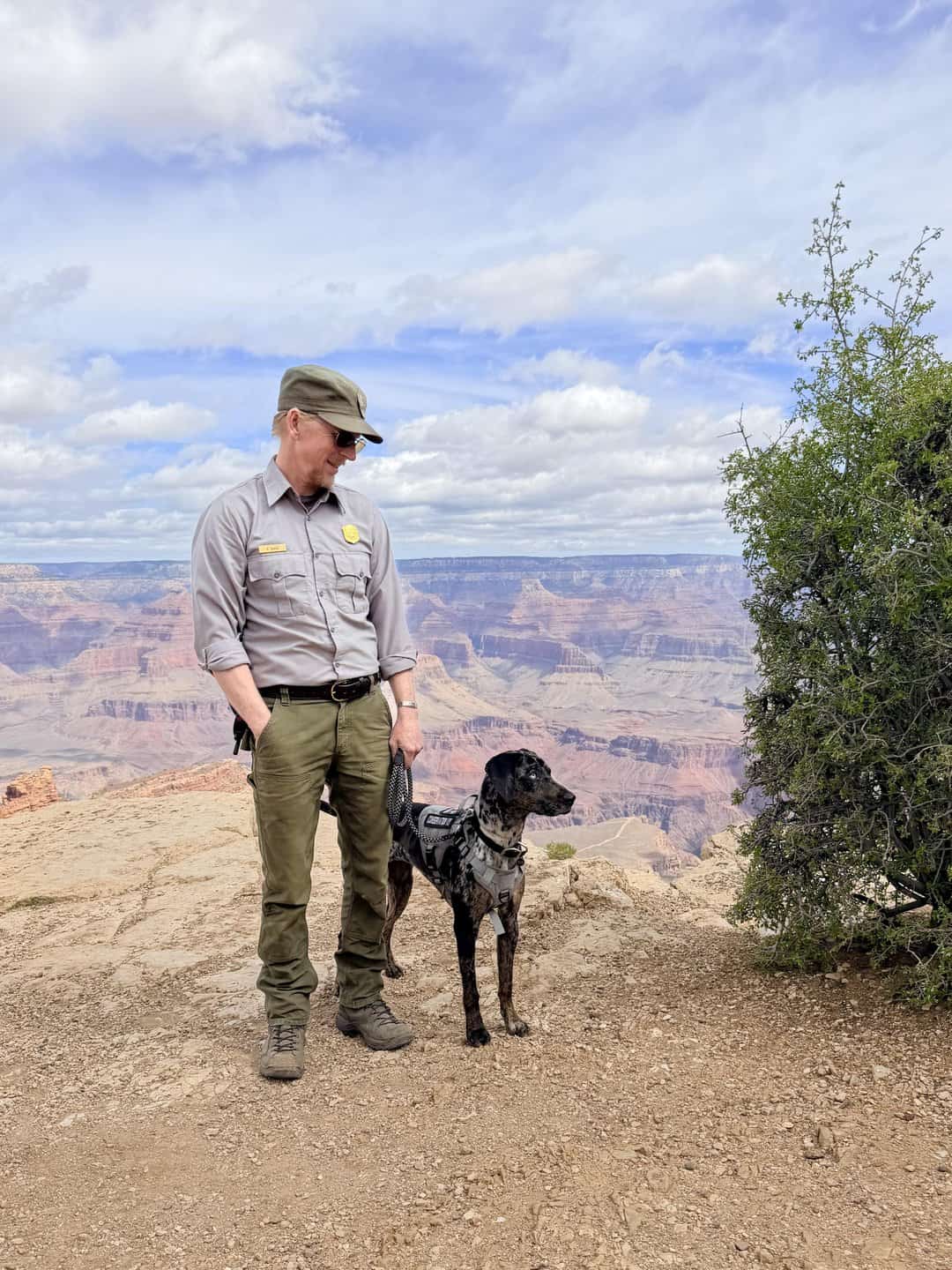
Wildlife Biologist Brady Dunne and Blue help keep wildlife and visitors a safe distance apart.
©National Park Service, public domain – License
In an email interview, Dunne explains, “Training her [Blue] to engage elk wasn’t difficult; as a Catahoula Leopard Dog, she comes from a working lineage originally bred to chase and control large animals like feral hogs and cattle, so the instinctive drive was already there.” Blue completed three training sessions in Montana with Wind River Canine Partners, followed by more than thirty specialized livestock-herding sessions with Arizona trainer Molly Wisecarver. Dunne reported that Blue emerged from training with “excellent responsiveness, focus, and pressure‑control skills.
While Blue is obviously not a wolf, her canine characteristics are similar enough to provoke fear in elk. Blue remains on a leash while working; she is trained to herd elk and bighorn sheep by applying pressure, not by actively chasing them. Beginning in 2026, elk and bighorn sheep will be fitted with GPS collars as part of a companion project to monitor how their movement patterns are influenced by Blue’s herding behavior.
Since Blue started her job on May 18, 2026, she has been working actively in high-visitor areas of the park. Of course, there are challenges in her new role. Dunne says that her “biggest challenge is being overly protective of the house and vehicles — lots of barking and growling any time someone approaches.” Still, Blue greets people she likes with enthusiastic howls, showing her capacity for non-threatening attachment.
As a Catahoula Leopard Dog, she comes from a working lineage originally bred to chase and control large animals like feral hogs and cattle, so the instinctive drive was already there.
Brady Dunne, wildlife biologist and project lead
About Blue’s Job
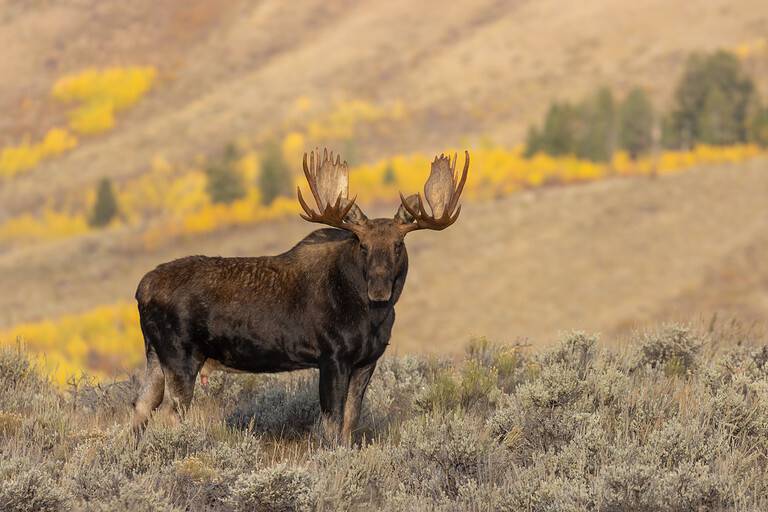
Blue’s job will become more intense from late August through October as the elk enter their rutting season, during which bulls aggressively compete for mates by clashing their antlers and bugling to show off their fitness. While rutting, bulls range further, traveling several miles a day in search of mates. A bull elk, with antlers weighing up to 40 pounds on a 700-pound body, poses a danger to anyone who crosses its path. Mothers guarding their calves during the spring may also become aggressive and dangerous.
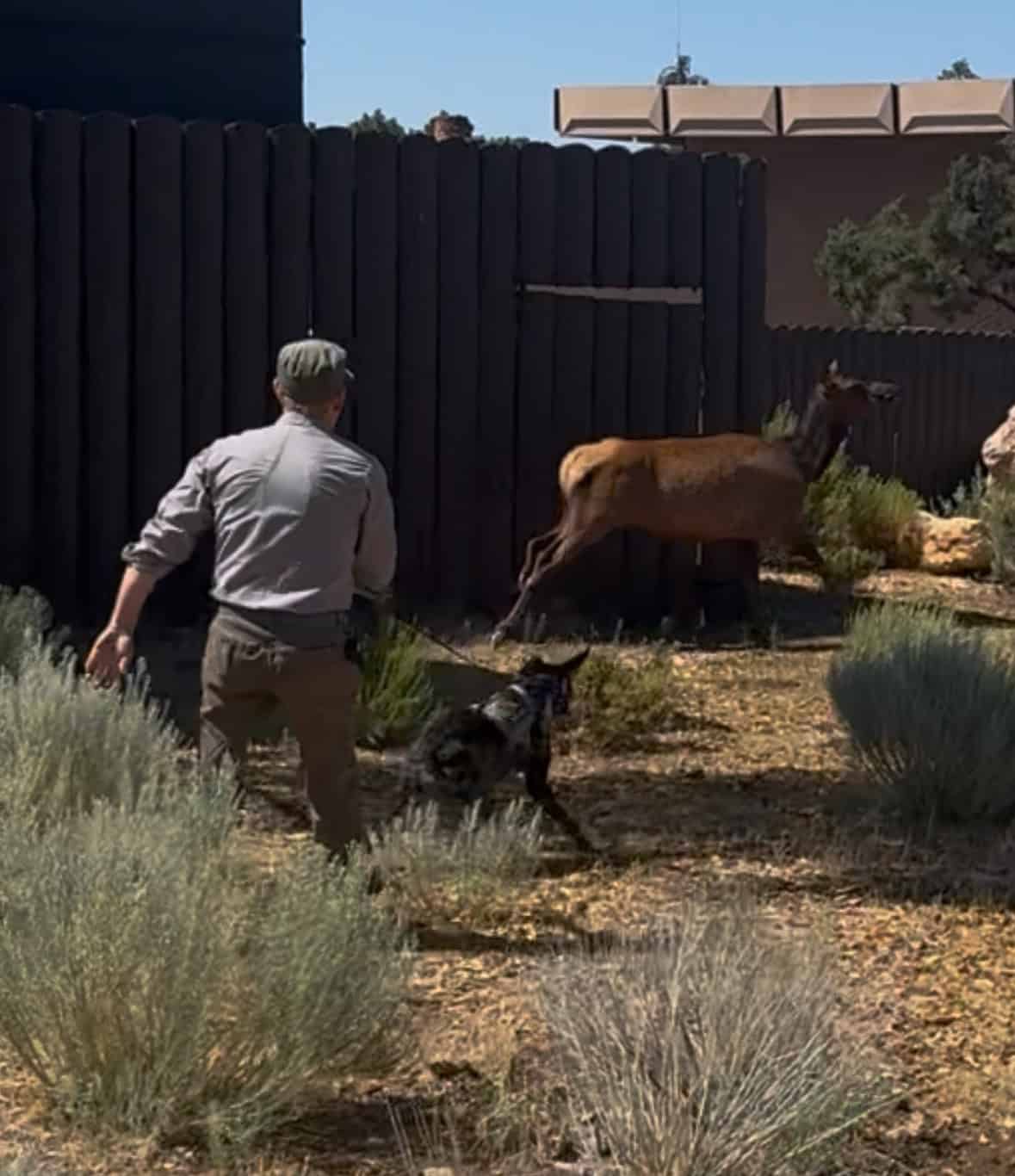
Blue and Brady Dunne chasing elk outside El Tovar on the south rim of Grand Canyon National Park.
©National Park Service, public domain – License
Keeping Blue in top shape for herding elk will require regular refresher training. Dunne says, “Advanced sessions with our training partners keep her reliable around distractions and ensure she stays sharp, safe, and effective in the dynamic environments she works in.”
Blue is the first trainee in a three-year pilot program. If it continues to yield good results, the presence of trained dogs could be formalized to keep both humans and elk safer. Meanwhile, it is illegal to approach elk or other wildlife in Grand Canyon National Park. If you see an elk grinding its teeth or flattening its ears, it is best to quietly leave the area before the animal charges. In the worst-case scenario, you could end up injured with broken bones and wounds. If you are unsure about the dangers of getting close to elk, watch this.
To see Blue at work, visit busy areas of the Grand Canyon such as the El Tovar Complex, Grand Canyon Visitor Center, Maswik Lodge, Mather Campground services area, or Grand Canyon School. Help Blue do her job by steering clear of wandering elk.