
Crocodiles are creatures that you generally associate with water and certainly not with climbing trees! Most pictures and video clips are of them lurking in a river or lake with their eyes just above the surface. Occasionally, they are seen walking on land, but descriptions of crocodiles generally only give a brief mention of their terrestrial behavior. The scientific literature does not describe this behavior in detail. Despite this, their ability to climb trees is well known by some people in some locations. We will explore the reports of crocs in trees and examine why they sometimes choose to climb.
Reports of Crocodiles Climbing
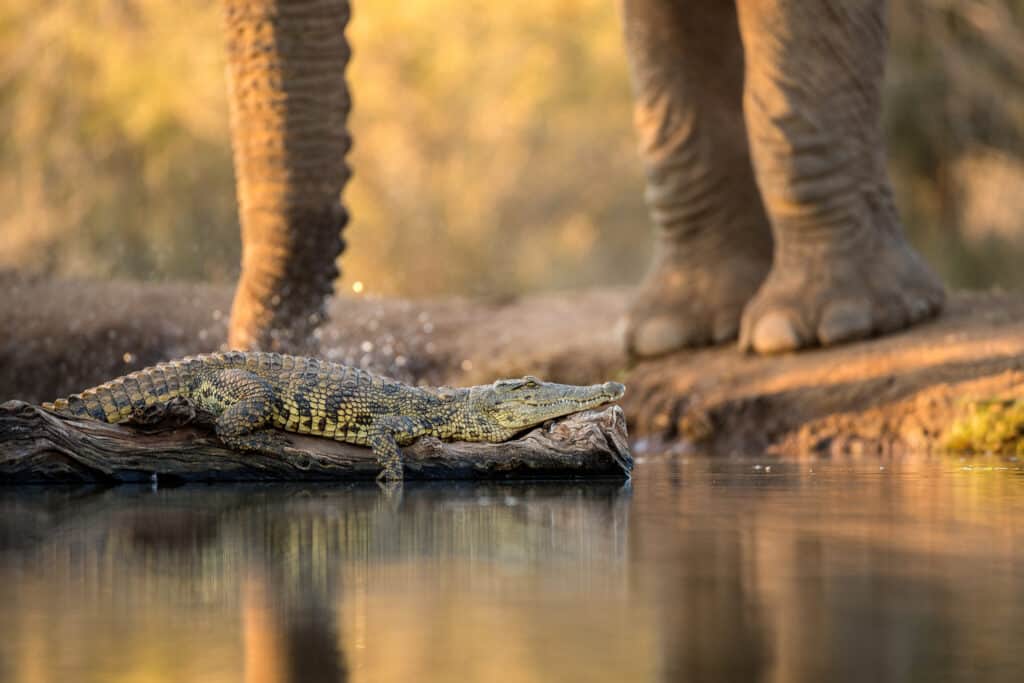
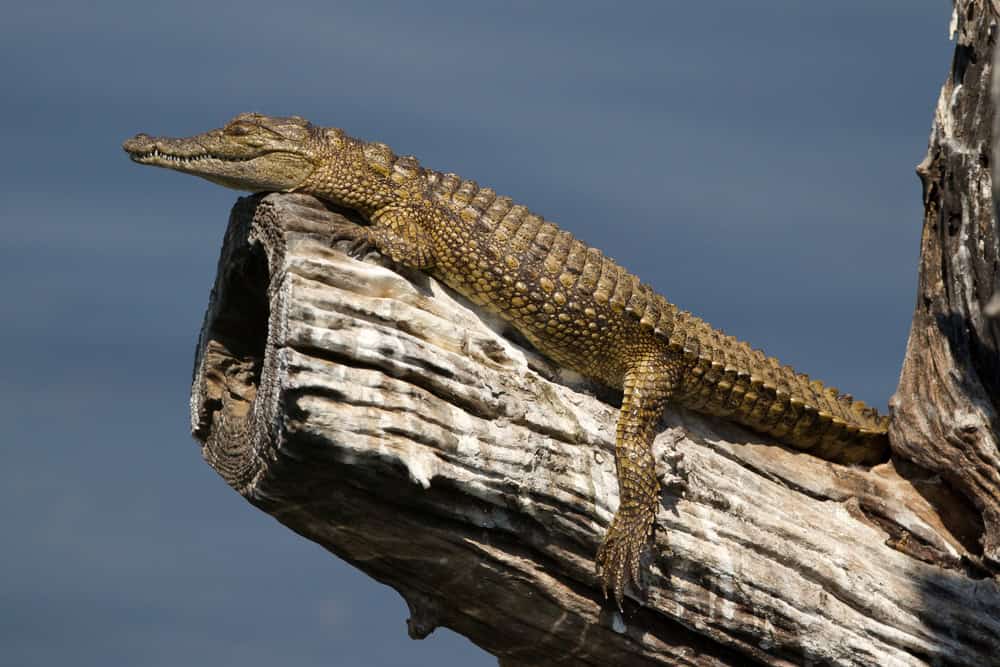
Crocodiles like to bask in trees.
©iStock.com/Udo Kieslich
You may have never seen a croc climbing a tree, but many other people have! More importantly, this behavior has been witnessed in many different locations and in several different crocodile species. There are several eye-witness reports of baby crocs climbing into bushes, climbing up trees, and even hanging on reeds. Juvenile American crocodiles (Crocodylus acutus) have been seen basking in mangrove trees near Tulum in Mexico. In Isla de Salamanca National Park in Colombia, juveniles were seen in trees up to 30 feet above the ground! Juvenile estuarine crocodiles (Crocodylus porosus) have also been spotted in trees near Sorong in West Papua, Indonesia.
Some climbing crocs have even been caught on camera. You can see for yourself in this short clip. The species captured climbing on film include the Nile crocodile (Crocodylus niloticus), New Guinea crocodile (Crocodylus novaeguineae), and the Philippine crocodile (C. mindorensis).
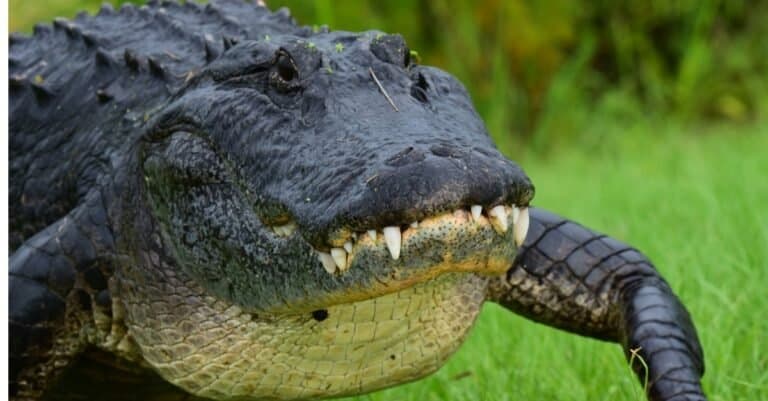
There are also reports that the Central African slender-snouted crocodile (Mecistops cataphractus) is often seen basking in trees in the dense rainforest in Odzala-Kokoua National Park in the Republic of Congo. Juvenile Siamese crocodiles (Crocodylus siamensis) have been seen on tree branches above the water in Laos. Finally, the close relative of the crocodile, the American alligator (a sub-adult), has also been spotted perched on a branch around nine feet above the water at Pearl River Delta, Mississippi.
Climbing in Captivity
Crocs do not just climb in the wild; some are happy to display this behavior in captivity. Captive dwarf crocodiles are often seen climbing tree branches. One adult dwarf crocodile escaped from its enclosure at Bristol Zoo in the UK by scaling a tree growing at an angle and climbing over a barrier. The hair-raising moment that a crocodile scaled a fence at an Australian Wildlife Park was captured on film and later reported in the media.
Researching Climbing Crocs
Researchers from the USA, Australia, and Gabon (Africa) collaborated on a detailed study of climbing behavior in crocs and published their findings in 2014. They essentially observed crocs in several different locations and reported on what they found. Overall, climbing ability appears to be related to body size. The larger and heavier the croc, the less likely they are to climb.
Australian Freshwater Crocodile Climbing Behavior
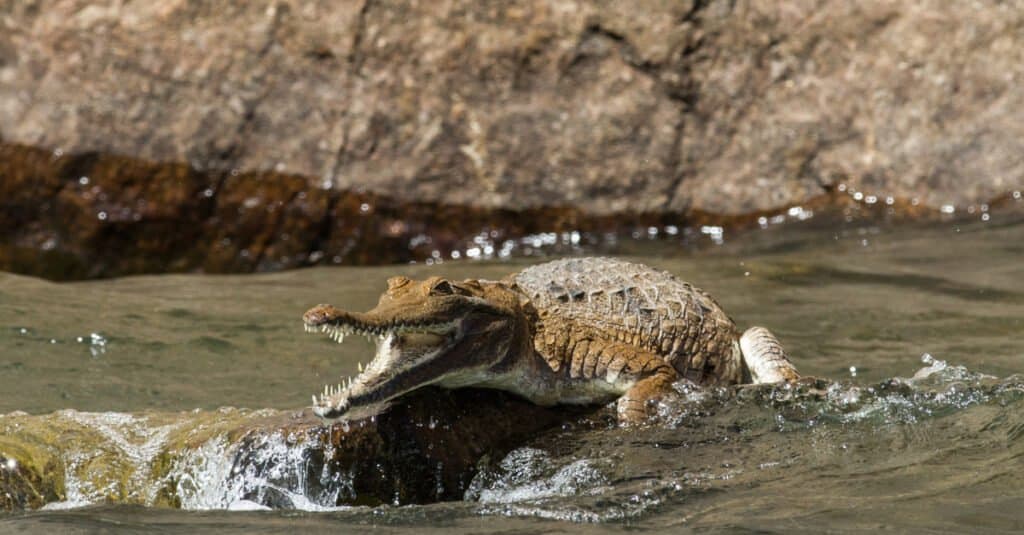
Smaller Australian freshwater crocodiles are better at climbing.
©Bildagentur Zoonar GmbH/Shutterstock.com
Australian freshwater crocodiles (Crocodylus johnstoni) are found in the Northern Territory and Queensland in Australia, as well as in northern and western Australia. They occupy lagoons, rivers, billabongs, and swamps. These crocs reach a maximum of around 9 or 10 feet. They use a sit-and-wait method to hunt fish and insects as well as small invertebrates, amphibians, birds, and mammals.
Australian freshwater crocodile hatchlings are accomplished climbers. They use their strong claws to propel their small bodies upwards and can even scale vertical brickwork. They can climb into the trees from both the water and the bank and then typically make their way along branches that are around six feet above the water. However, individuals who were longer than around five feet were not seen doing this. The behavior can be seen during the day and night, but as soon as they spotted a human, they got down.
American Crocodile Climbing Behavior
American crocodiles are found along both the Atlantic and Pacific coasts, from Central America through South America and the Caribbean Islands. However, they can also be found along the southeastern coast of Florida. Their habitats are freshwater rivers, lakes, and reservoirs. However, they can also be found in estuaries and coastal swamps. Most are around 12 feet long. They tend to bask during the day and hunt at night for fish, frogs, turtles, and the occasional bird and small mammal.
Smaller (less than around 3 feet) American crocodiles were observed lying on aerial roots and low branches of mangrove trees during the day. Their ‘roosting’ spots were all in concealed areas. One was even spotted over 9 feet above the water. To get to their resting places, they need to scale trunks, aerial roots, and branches at angles steeper than 45 degrees. Again, the crocs did not stay in the tree when they spotted humans.
Central African Slender-Snouted Crocodile Climbing Behavior
These crocs live in central Africa, primarily in tropical rainforests along the shores of shallow rivers and larger bodies of water. Most often, they are in freshwater but are occasionally found in the brackish waters of coastal lagoons. They grow to around 9 to 13 feet. Using a sit-and-wait predatory lifestyle, they hunt mammals coming to the water to drink as well as fish, reptiles, and amphibians.
This species is the most well-documented crocodilian climber. Even those that are larger (around 6 feet) have been seen basking in fallen trees during the day and night. When they are disturbed or are finished basking, they jump into the water. Some were seen as high as 15 feet above the water. A few were spotted in basking sites that they would have had to scale a vertical bank to get to!
Nile Crocodile Climbing Behavior
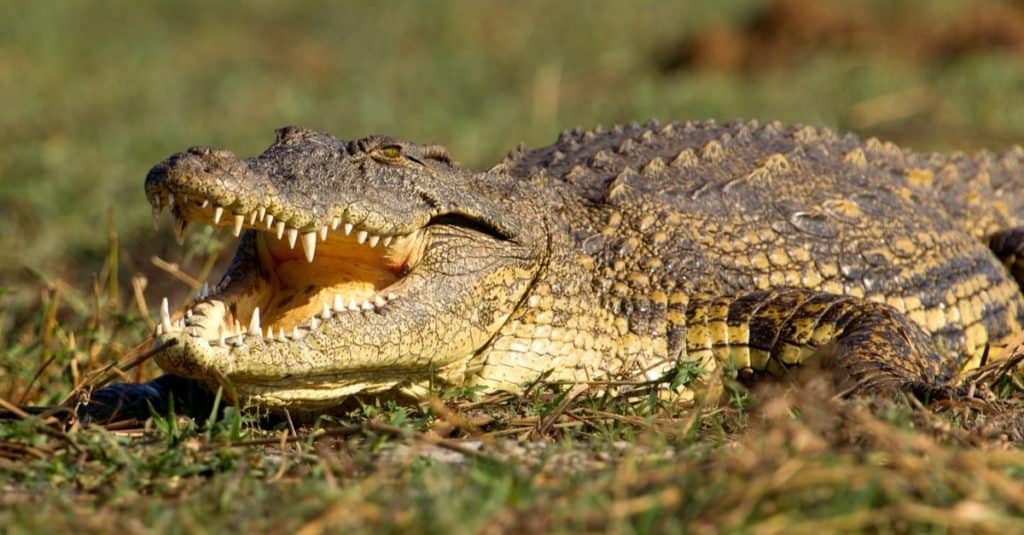
Nile crocodiles do not climb as much as other species.
©Gaston Piccinetti/Shutterstock.com
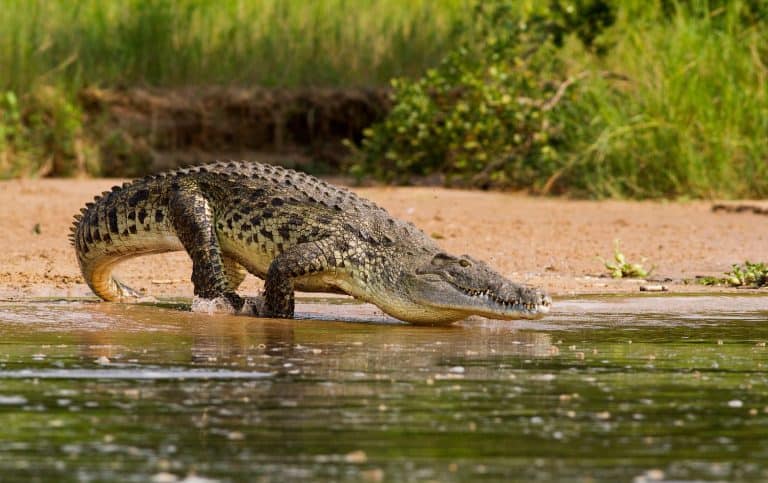
Nile crocodiles are widespread throughout Africa. They live in lakes, rivers, and streams, as well as brackish swamps. The largest grow to around 11 feet. Adult Nile crocodiles are powerful creatures that will kill just about anything that moves. That includes large terrestrial animals such as buffalo and lions!
A 7-foot-long Nile crocodile has been seen basking on a branch 1.5 feet above the water. Juvenile Nile crocs have been seen behaving in a similar way. Interestingly, most of the photographs capturing this behavior were taken in the southern part of this species’ range. Overall, however, the climbing abilities in Nile crocodiles seem to be less developed than in the other crocodile species.
Why Do Crocs Climb Trees?
You do not have to be an expert in crocodile physiology to see that they are not exactly built for climbing trees. Yet, many of them successfully navigate tree trunks and branches and spend a considerable amount of time in trees. No one is exactly sure why they do this, but there are several theories. The first is that they do it for thermoregulation. Crocs are seen climbing most often when they have fewer available basking sites. This is in areas such as dense forests or mangrove coastlines. It suggests that the crocs are using the trees to bask because they cannot find a suitable site on land. However, this theory does not explain why they frequently bask at night.
We know that it is a lot easier to approach crocodilians at night than during daylight. This is why most population surveys are carried out at night!
Crocs that are basking in trees during the day are much more skittish and flee further when they are disturbed than crocs basking on the ground or those lurking in water. However, they are just as skittish during the night as they are during the day. This suggests that they are using the elevated position to scan for threats to their safety. They can see an enemy coming from further away when they are up in a tree. If they need to get away in a hurry, water is the best option. To get into the water quickly, all they have to do is fall off the tree! This higher vantage point may also give them an advantage when it comes to looking for prey.