
Quick Take
- Many mammals, particularly cats and horses, use a flehmen response to process information through a “scent-tasting” organ (vomeronasal organ) on the roof of their mouths.
- The Jacobson’s organ helps these animals analyze chemical signals and pheromones in their environment.
- When a mammal uses its flehmen response, it might appear to have a grimace or sneer on its face.
Have you ever witnessed an animal seemingly frozen in place with a sneer on their face? This likely isn’t the result of an expressive or judgmental animal. Rather, the animal is assessing its surroundings using the flehmen response.
If you have a cat, you might have noticed it sometimes makes a strange grimace-like face. Many mammals experience this phenomenon, which is called the flehmen response. This response occurs through the Jacobson’s organ (also known as the vomeronasal organ), which is located on the roof of the mouth. This organ allows mammals to use a ‘tasting-smell’ to analyze pheromones and chemical signals left by others in their environment. The flehmen response serves a variety of purposes, from helping males check whether females are in heat to simply analyzing their environment. Keep reading to learn more about this innate behavior.
What Is the Flehmen Response?
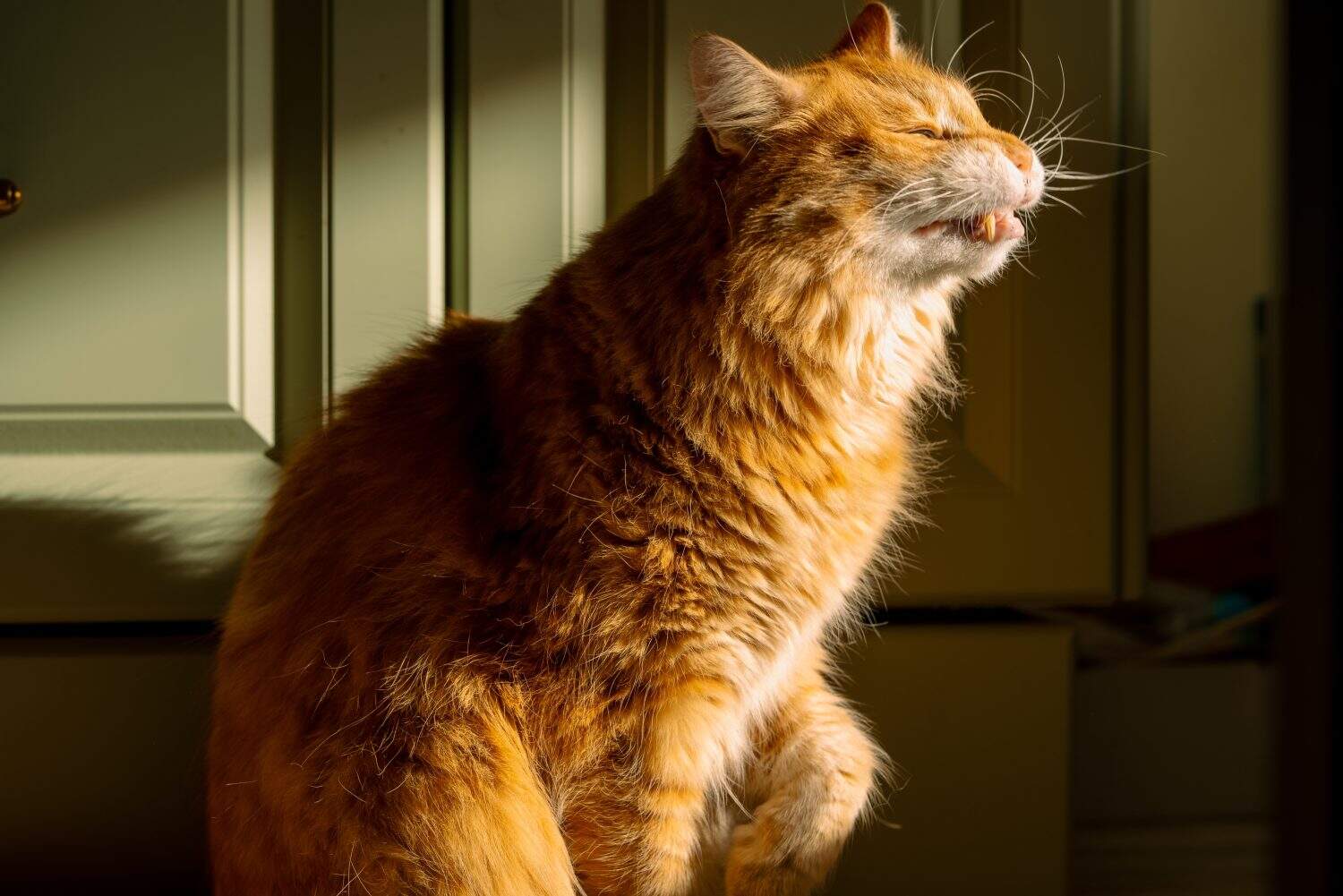
The flehmen response involves bearing the upper teeth while inhaling with the nostrils closed for several seconds. Many refer to it as the ‘tasting-smell,’ because it merges the senses of taste and smell. The animal might appear to have a sneer or grimace on its face. Sometimes, it even opens its mouth as though it’s shocked or wrinkles its nose as though it’s disgusted.
“When people notice animals making a strange ‘grimace,’ what they’re usually seeing is a behavior called the flehmen response,” says San Priy, Veterinary Service Professional and Animal Health, Care & Welfare Specialist at Weewag. “In simple terms, it helps animals pull scents toward a special sensory organ in the roof of the mouth called the Jacobson’s organ, or vomeronasal organ.”

Horses often display a flehmen response when they’re processing scents or chemical signals in their environment.
©cctm/Shutterstock.com
Using the vomeronasal organ, animals can analyze pheromones and other scents in their environment. This helps them pick up on scent markers, assess a female’s readiness for mating, and monitor their environment. It’s different from simple smelling, which is when information or scents are processed through the nose. In contrast, the flehmen response is a form of ‘scent-tasting,’ which offers a deeper analysis of chemical signals.
“In my work, I explain it as a second smell system,” says Priy. “While the nose detects everyday odors, this organ is designed specifically to process chemical signals, especially pheromones that carry social or reproductive information.”
What Animals Experience the Flehmen Response
Not all mammals exhibit the flehmen response, but many of them do. It’s most commonly observed in cats and horses. For example, you may have noticed your cat pause with its mouth open, seemingly in disgust, after smelling something. This is actually the cat’s flehmen response in action.
“I see this most often in cats, horses, and dogs, but many mammals use it,” says Priy. “It’s essentially their way of reading a chemical message left behind in the environment, far more detailed than what the nose alone can pick up.”
What Is the Flehmen Response Used For?
The flehmen response might look unusual, but it serves several important purposes for mammals. For example, it can help mammals mark, monitor, and defend their territory. It also helps the animal assess potential threats in the area. Additionally, it’s a crucial tool used in mating.
“When an animal curls its lip or opens its mouth slightly, it’s actually drawing scent particles into this organ to analyze them more deeply,” Priy explains. “This allows them to gather information about other animals, such as whether another animal is stressed, ready to mate, marking territory, or recently passed through the area.”

Sometimes, the flehmen response looks like a silly sneer or grimace.
©Shivang Mehta/Shutterstock.com
In terms of mating, the flehmen response is especially useful for males. In fact, males can use their vomeronasal organs to sense when females are ready to mate.
“It allows males to sense when a female is ‘receptive,’” Loretta Breuning, PhD, founder of the Inner Mammal Institute, explains. “For most mammals, mating only happens when a female is ovulating. This doesn’t happen often because females are pregnant or nursing most of the time, with only short intervals of ‘receptivity’ in between.”
Fortunately, the flehmen response is a quick and effective way for males to assess a female’s receptivity.
“When opportunity arrives, males typically fight to be the one,” Breuning continues. “They don’t want to risk a fight when there’s no actual prospect of reproduction. Mature males can distinguish the smell of pre-ovulation from the actual moment of fertility, so they allow the weaker males during the preliminaries.”