Outside of perhaps great white sharks and rattlesnakes, few creatures in the United States inspire as much fear as the brown recluse spider. You’ve likely heard gruesome stories of flesh-eating wounds or seen gnarly photos online showing the aftermath of a bite. Chances are, you may even know somebody (or know somebody who knows somebody…) who claims to have suffered one of these horrifying bites. But how much of that is grounded in reality, and how much is myth?
How Common Are Brown Recluse Spider Bites?
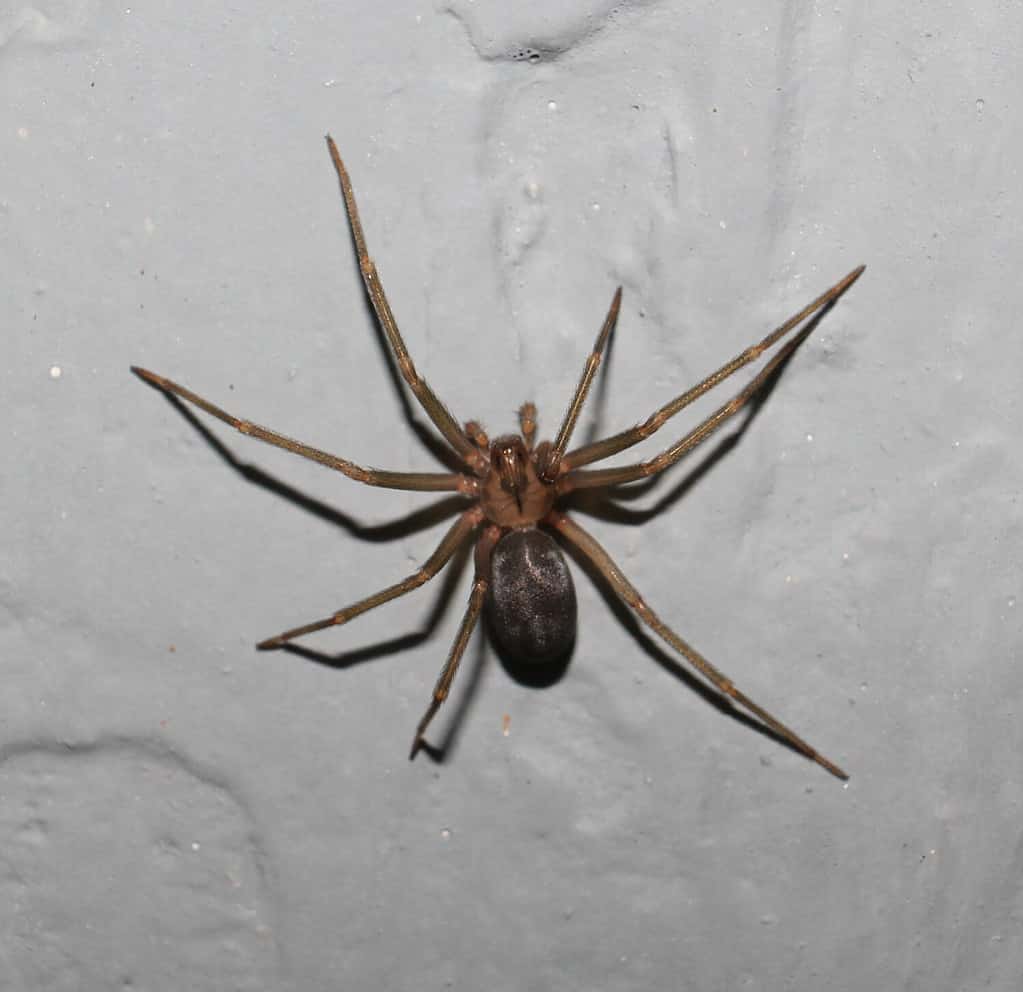
Is the brown recluse’s bite really as bad as its reputation?
©Keith Davis/Shutterstock.com
The brown recluse (Loxosceles reclusa) is found in the south-central United States, from about Nebraska to Georgia. Yet recluse bite reports occur far outside that range, including in states where the spiders don’t naturally live. Rick Vetter, a retired University of California entomologist and one of the foremost experts on brown recluses, has spent decades correcting this misconception, and it’s been working. “It used to be I’d get thirty brown recluse bite emails a year,” says Vetter, “now I don’t get any at all, because the word’s been spread, in part due to the work I’ve done to counter the misinformation.”
Actual verified bites are quite rare, even in regions where the spiders are common. For example, Vetter points to a case in Kansas, where a woman unknowingly lived with 2,000 brown recluse spiders in her house.
“People can live with hundreds or thousands of these things, and rarely does someone get a bite. Brown recluses are shy and nonaggressive, preferring to hide in undisturbed areas like closets, attics, or basements,” Vetter says.
Brown recluses usually only bite “when trapped between flesh and an object,” according to Vetter. “Something that people in the Midwest know real well is to bang out your shoes and not leave your clothes on the floor.”
What Happens If You’re Bitten?
In the unlikely event that one is actually bitten by a recluse, symptoms are usually much milder than internet legends suggest.
“Most of the time, you barely even feel the bite at all,” says Vetter. “It’s like a pin prick. People do feel it, but it’s not something that’s really painful. Not like a scorpion sting.”
Redness and tenderness may develop over several hours, but in 90% of cases, that’s about as far as it will go: a bit of inflammation and perhaps a light rash. That’s it. And it will clear up on its own with no medical intervention. In the other 10% of cases, localized tissue damage (necrosis) develops. This may appear as a slow-forming ulcer or blister with a pale center and red surrounding skin. The affected area can take weeks to heal.
Sometimes, according to Vetter, “you can develop a blackened ulcer–flat and hard–which can fall out and leave a gaping wound.” This result, however, is exceptional, not typical. Systemic reactions, such as fever, rash, or malaise, are uncommon and mostly occur in children or when a large amount of venom is injected. Bites above the neck can be extra dangerous, possibly causing swelling that compromises the breathing tubes. “Very rarely,” says Vetter, “systemic necrosis [occurs]. You get mini clots all over the body which causes kidney damage. One of the symptoms is [black urine]. This is one of the forms of envenomation that causes death.” Fatalities, however, are exceedingly rare.
How did the recluse become so feared?
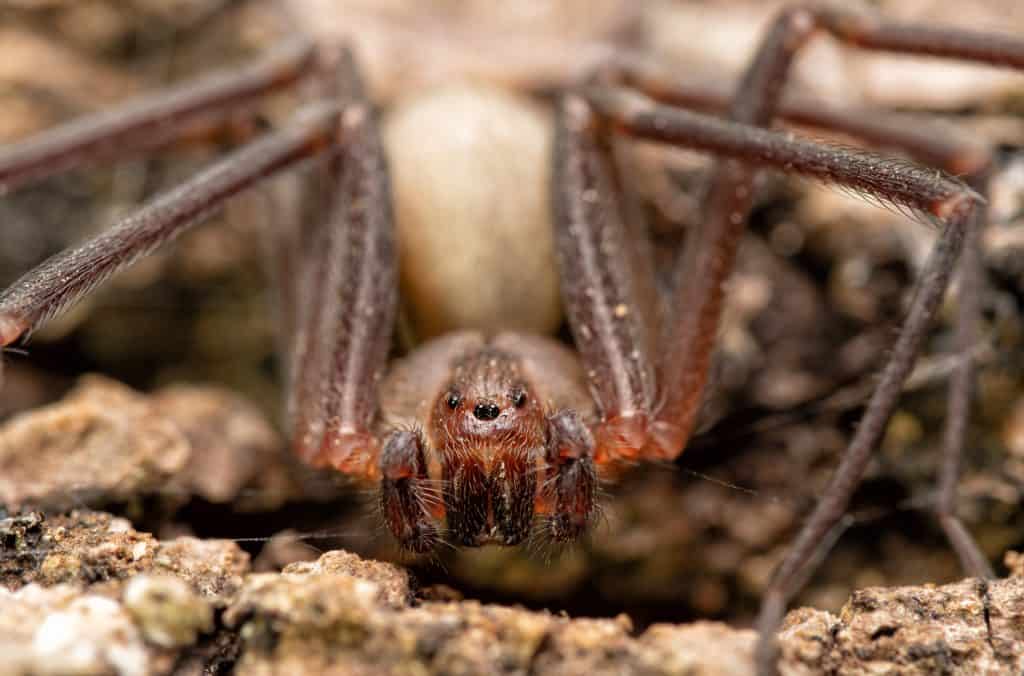
The brown recluse rarely bites; when it does, it’s seldom serious and almost never fatal.
©Sari ONeal/Shutterstock.com
So where did the recluse get this undeserved, macabre reputation? “The brown recluse was not thought to be dangerous until 1957,” says Vetter. At that time, a cluster of unexplained skin lesions was reported in Missouri and surrounding states, particularly among military personnel and residents in areas where brown recluses were common. Physicians began documenting patients who developed unusual necrotic wounds, slow-healing ulcers that didn’t match the usual patterns of bacterial infection.
Doctors at the University of Missouri School of Medicine and the U.S. Army identified the brown recluse spider as the likely culprit in several of these cases. Their reports, published in medical journals and picked up by the press (including a feature in LIFE Magazine) described a frightening new phenomenon which they called “loxoscelism,” named for the envenomation by Loxosceles spiders. “In [the following] ten years or so, there was an explosion of medical papers involving very bad reporting that inflated the symptomology of recluse bites,” laments Vetter.
What followed was a minor hysteria, as tends to happen whenever something new and intriguing comes along. “Doctors have a difficult job, but they made their job more difficult. When the first brown recluse information came out, everybody jumped on the bandwagon: ‘Oh, hey, I’ve got a brown recluse bite as well.’ It’s just one of those things. With increased exposure, they added another item to their list of possible diagnoses. The problem was there were doctors diagnosing these things when they had no experience with the spider. They don’t know where it lives, they don’t know the symptoms…”
Research like Vetter’s debunking their sinister reputation has gone a long way toward clearing the brown recluse’s name, but unless you’re an arachnologist or a doctor (and to be honest, many doctors are still misdiagnosing recluse bites, though certainly far fewer in the years since Vetter’s papers were published), you’re probably still walking around thinking of the brown recluse as a tiny, lethal monster. The main reason for this is basic lack of education; most laymen are not sitting around reading scientific journals on the lethality of Loxosceles reclusa. But Vetter suggests another reason: getting bit by a dangerous spider is sexy. “One of the most common causes of skin lesions that resemble brown recluse bites is Methicillin-resistant Staphylococcus aureus (MRSA). When people contact me and say, ‘I have a brown recluse bite,’ I tell them to go to a dermatologist and have them test you for MRSA. Now, if you get a bacterial infection, do you tell anybody? But if you get a brown recluse bite you tell everybody. You tell them at the supermarket, you tell them at the post office, you tell them at the bank, you put it in your Christmas letter.”
Why are recluse bites still being misdiagnosed?
Still, there is some physical basis for the frequent misdiagnosis. One of the biggest sources of confusion is that necrosis from a recluse bite can resemble bacterial skin infections like the aforementioned MRSA, Streptococcus, or fungal infections. But there are key differences. Recluse-related necrosis typically develops slowly over several days, not hours. The wound from a recluse bite often forms a central bluish or whitish area surrounded by a ring of redness (this is sometimes described as a “bull’s-eye”). Pain may increase slowly, unlike bacterial infections that become rapidly inflamed, hot, and tender.
Because these distinctions are subtle, doctors often misdiagnose skin lesions as recluse bites when they’re actually infections, allergic reactions, or other dermatologic issues. But the fact remains, in most cases the recluse is not the culprit, and in regions outside the spider’s natural range, nearly all supposed brown recluse bites turn out to be something else entirely.
Which is not to say recluse bites never happen. They do. And while most bites are not serious and will get better on their own, there are select cases that can be dangerous.
What to do if you’re bitten by a brown recluse
If you suspect you’ve been bitten by a recluse and the area becomes increasingly red, swollen, blistered, or painful over several days, it’s worth consulting a healthcare professional. And if you actually see the spider biting you, it’s a good idea to catch it and keep it for identification.
Seek immediate care if you develop spreading redness or streaking from the wound, fever, chills, body aches, signs of infection (such as pus, swelling, or severe tenderness), or a large or worsening ulcer. Most recluse bites heal with basic wound care: cleaning, cool compresses, and observation. Antibiotics might be necessary only if infection is suspected. Despite what was once commonly believed, surgical removal of tissue is rarely necessary, and can actually worsen outcomes if done prematurely.
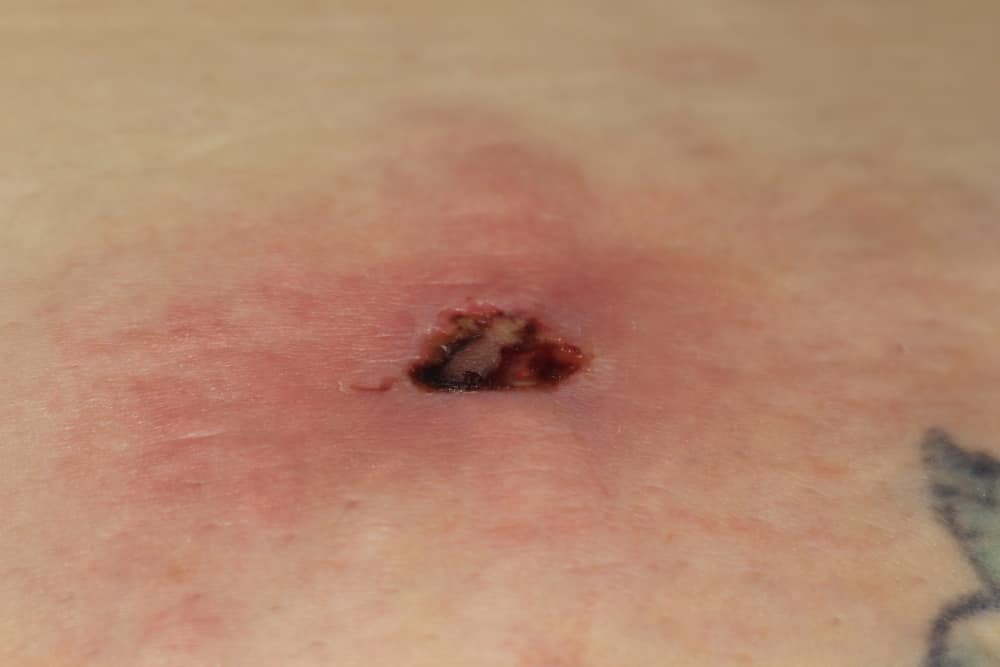
An actual Brown Recluse spider bite.
©Robert D Brozek/Shutterstock.com
Brown recluse bites can cause medically significant skin damage, but the vast majority of suspected cases are not caused by these spiders at all. Verified bites are uncommon, serious complications are rarer still, and fatal outcomes are nearly unheard of. And thanks to the research and publications of Richard Vetter and others, word is getting out, cleaning up the sinister reputation of these falsely stigmatized spiders. But if you live in one of the areas in which brown recluses are common, it’s probably still a good idea to tap out your shoes before shoving your feet inside, because while a brown recluse bite is not nearly as bad as legend will have you believe (and, yes, might make an interesting anecdote for your Christmas letter), it’s still best avoided if possible.