
Quick Take
- Feral pigs work well as horror villains because they already have a real-world reputation for strength, aggression, and unpredictability, which makes cinematic danger feel believable.
- In the movie “Send Help,” the hog is exaggerated into a near-mythic stalker, but its bloodied, relentless portrayal is rooted in real traits of wild pigs.
- Wild pigs are powerful, adaptable animals that live in many environments and are capable of causing serious injuries, especially when threatened or cornered.
- By blending real biology and behavior with heightened horror elements, the film creates a creature that feels unsettling precisely because it stays just close enough to reality to seem plausible.
Feral pigs make effective movie villains because they already carry an unsettling reputation. In the horror-comedy film Send Help, released in theaters January 30, 2026, a wild hog becomes a near-mythic threat after a plane crash strands a lone survivor on a remote island. When she attempts to kill the animal with a spear for food, the hog nearly kills her instead and repeatedly survives injuries that would seem fatal. The special-effects-enhanced animal is depicted as blood-covered, relentless, and unnervingly persistent. While the portrayal is clearly heightened for horror, it borrows heavily from real characteristics that make wild pigs genuinely dangerous.
For this article, we consulted a professional hunting guide with extensive firsthand knowledge of wild boar to compare the film’s depiction with real-world behavior. That expert perspective helps reveal where the movie remains grounded and where it crosses into exaggeration.
The Plot Without Spoilers
The movie Send Help (2026) was directed by Sam Raimi, the filmmaker known for The Evil Dead series and Spider-Man films. In it, downtrodden corporate drone Linda Liddle (Rachel McAdams) and her horrible boss Bradley Preston (Dylan O’Brien) are the only two survivors of a plane crash. Stranded on a remote island off Thailand, they find the social tables flipped. While Linda is a laughable presence in the office, in her private life, she is an amateur survivalist who has waited her whole life for this moment. Meanwhile, her injured and entitled boss depends on her for survival, with few skills of his own to offer that are of any value in this environment. Their toxic relationship spirals into a darkly comic, violent conflict that leads to an inevitable but shocking end.
Raimi’s signature gory humor is at its bloodiest in a scene where Linda follows the tracks of a wild boar, stands in a clearing as it circles her through the underbrush, and then becomes locked in a violent struggle that blurs the line between hunter and hunted. She drives a sharpened spear into the animal in what appears to be a fatal blow at least three separate times, striking the head and torso, yet the boar keeps fighting. It snaps at her face and refuses to go down until its final moments, underscoring its sheer toughness. Don’t be surprised if even a few grown men in the theater jump or squeal at the scares in this scene!
The Real Animal Behind the Movie Hog
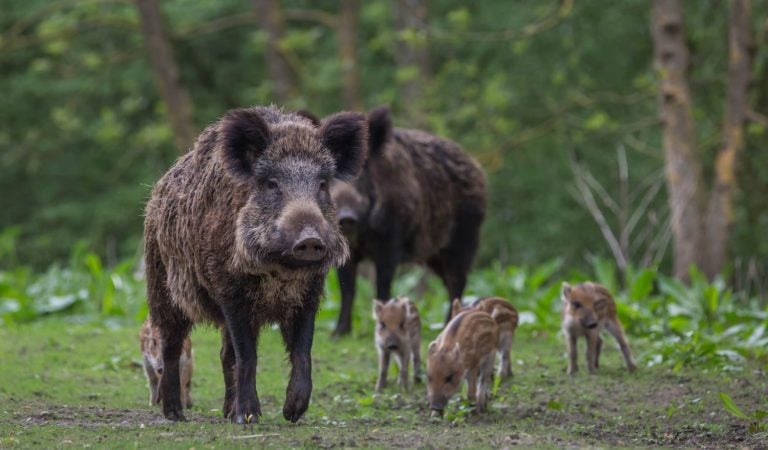
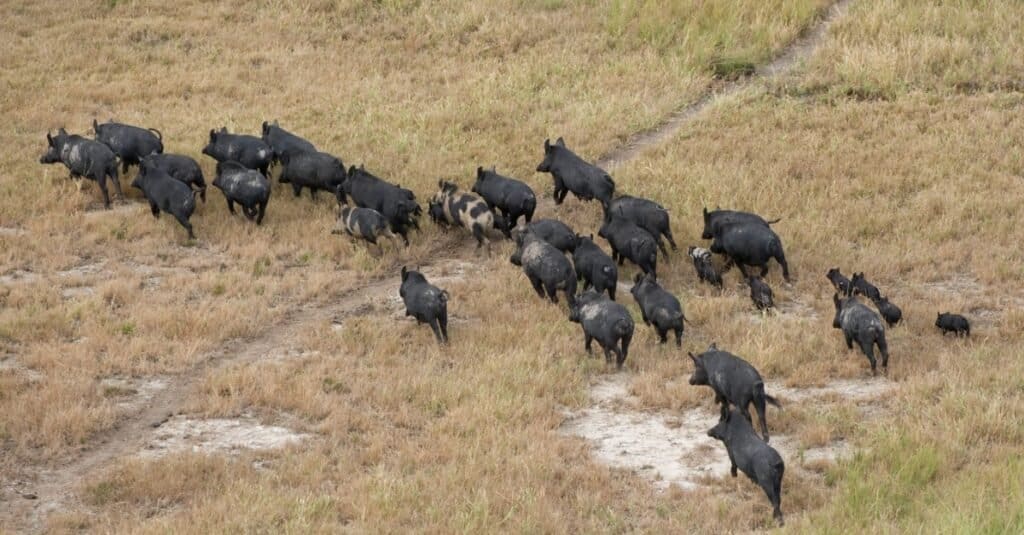
The beast shown in Send Help would most likely be a feral pig or a hybrid descended from domestic pigs and Eurasian wild boar. These animals all belong to the species Sus scrofa. Over time, escaped domestic pigs and imported wild boar have interbred, producing tough, adaptable populations capable of surviving in many environments. In Thailand, where the movie is set, wild boar are native rather than invasive and are widely distributed across forests, protected areas, and some offshore islands.
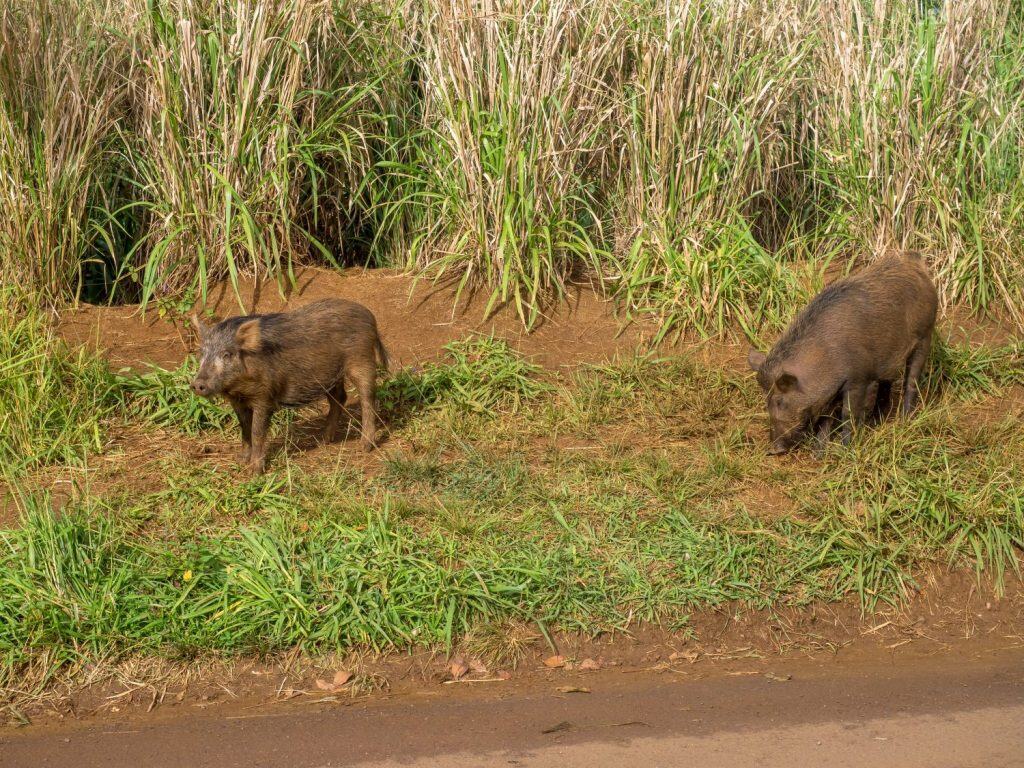
Feral pigs like these in Hawaii are widely distributed across Thailand.
©Jeff Whyte/Shutterstock.com
Feral pigs are known for their intelligence, physical strength, and remarkable adaptability. One of the main reasons they spread so successfully is their omnivorous diet. They eat roots, tubers, fruit, seeds, insects, worms, small animals, eggs, carrion, and human food scraps. This ability to consume almost anything allows them to thrive in forests, wetlands, farmland, and island ecosystems alike.
Size, Strength, and Natural Weapons
Wild pigs are built for power. Their bodies have strong necks, dense muscles, and thick skin adapted for digging, fighting, and forcing their way through heavy cover. Adult males often develop a hardened layer of tissue over the shoulders, sometimes called a shield, which helps protect vital organs during clashes with other boars. Large adults commonly weigh between 150 and 300 pounds, with some individuals growing even heavier. Despite their bulk, they can move surprisingly fast through dense vegetation and uneven terrain, making them difficult to evade at close range.
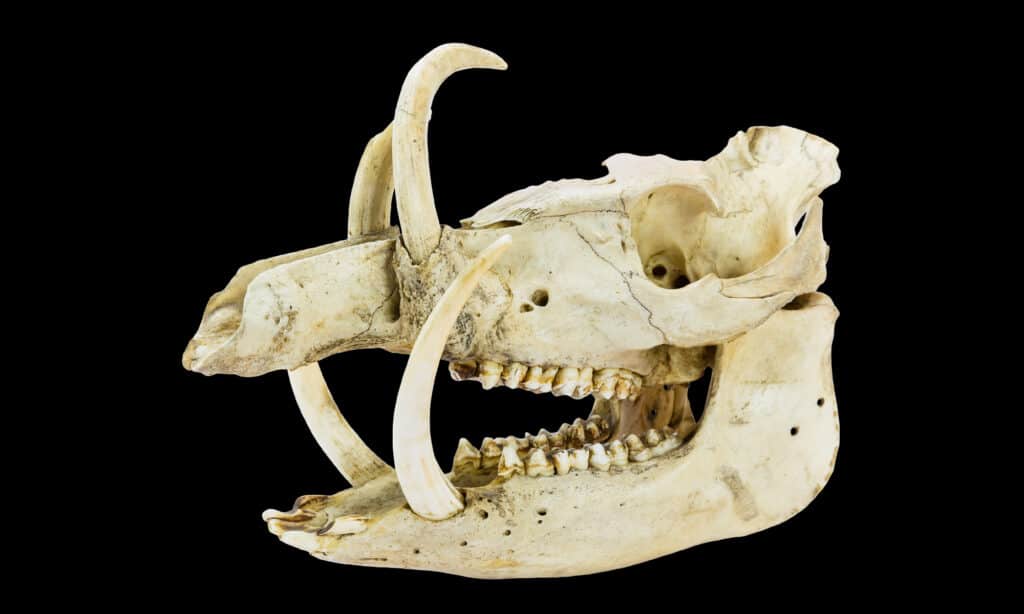
Wild boars have strong tusks that can easily inflict deep lacerations or even disembowel enemies.
©iStock.com/Ben-Schonewille
Their most dangerous feature is their tusks. These elongated canine teeth sharpen naturally through use and curve outward from the mouth. During a charge, a boar lowers its head and slashes sideways, using its tusks to cut rather than stab. Many serious injuries to people and animals come from these slicing motions, which can happen in seconds at close range.
We Asked a Professional Boar Hunter
To understand how boars really behave in hunting environments, we chatted with George Dumitru at Romania Hunting Outfitters. Wild boar hunting is a centuries-old tradition in Romania. Dumitru has hunted boar for 40 years and has professionally guided 20-30 hunts a year for the past 16 years. So if anyone knows how these formidable creatures behave during a hunt, it’s Mr. Dumitru.

This wild boar killed on a hunt in Romania is unusually large, indicating it is likely 10 years old or more.
The Wrong Subspecies and Season for Thailand
AZ: What’s the first thing you noticed about the depiction of a feral pig in the movie?
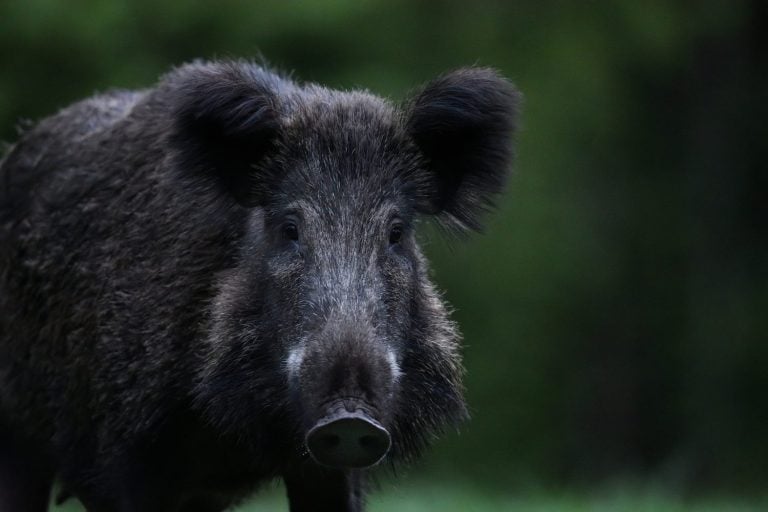
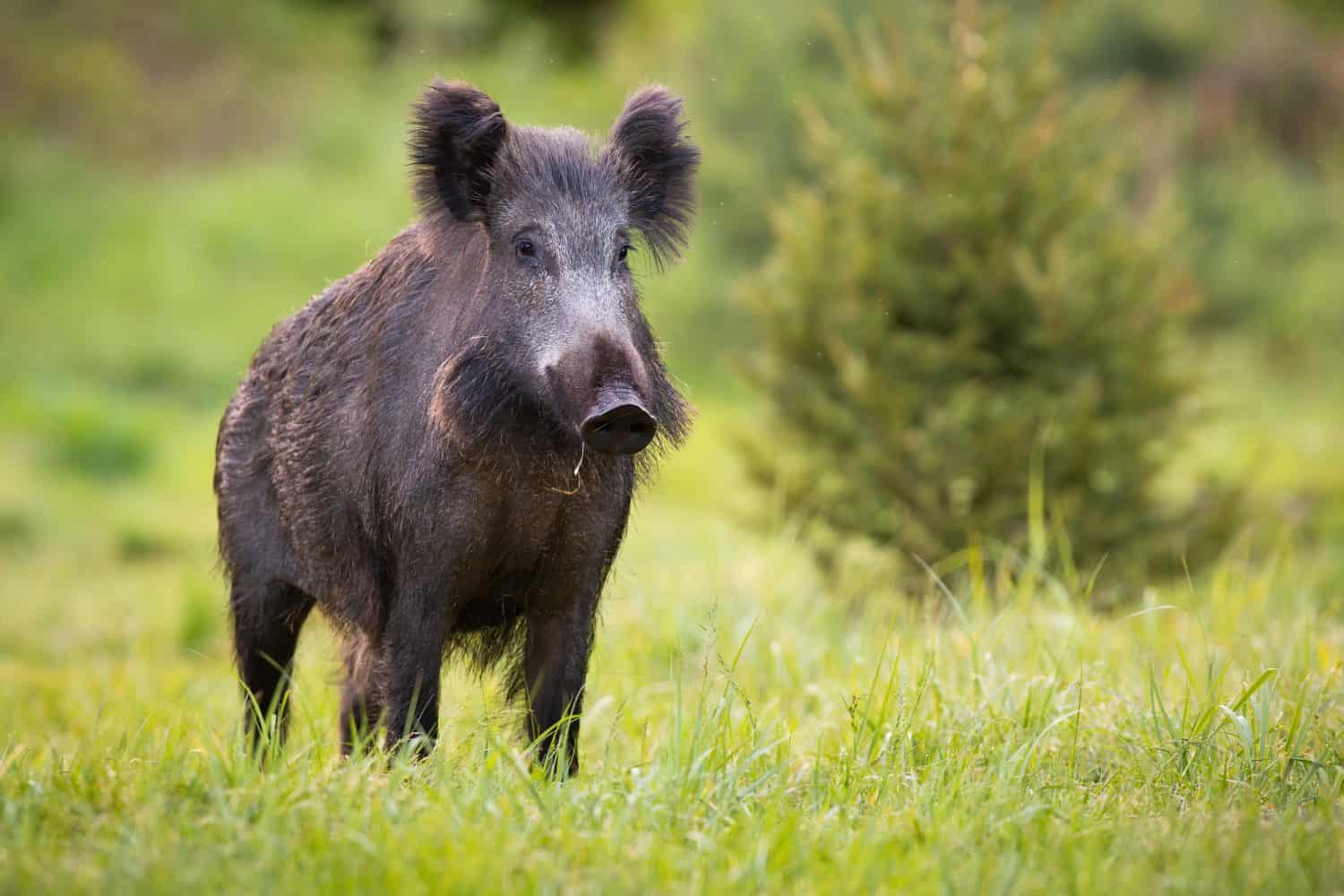
Dumitru: Well, first of all, clearly that is not a feral pig (i.e., an escaped domestic pig), that is an Eurasian boar (Sus scrofa) also known as the Russian boar. More specifically, this is Sus scrofa attila, a subspecies that lives in Turkey. I can also tell that this wild boar is depicted with a winter coat, even though the movie is set in a tropical climate. This was maybe to achieve the look they wanted, a bigger and more aggressive look. But a boar there would not have a coat like that.
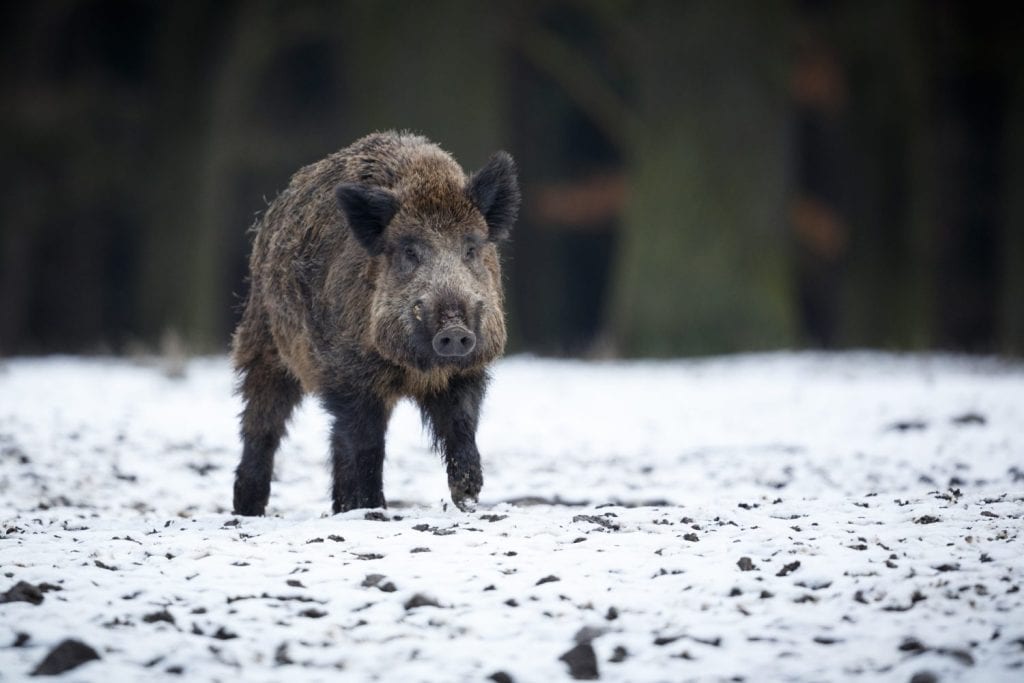
A wild boar in Europe has its shaggy winter coat for the season.
©PhotocechCZ/Shutterstock.com
How Accurate Was the Tracking Scene?
AZ: In the movie, Linda found fresh pig tracks in mud and followed them, then a boar rustled around the underbrush, making noise rather than staying quiet. Is this typical?
Dumitru: Boars are nocturnal animals. They are active during the night mostly and sometimes late evening and early morning, and they sleep during the day. So, in muddy terrain with a lot of luck, the lady might find fresh tracks from the morning when the boar returned to his sleeping place. So it’s possible to find where it is sleeping, but it would not be up and active during the day. When boars are disturbed, they do disturb the brush and make noises and grunt, so that part is true. But when they are undisturbed, they are silent like ghosts.
Would the Boar Initiate an Attack?
AZ: The boar in the movie lunged at the actress. Do they do that? And is it normal that one boar would forage alone like this, not in a herd?
Dumitru: No way. This is not a normal behavior unless the boar is a female with young babies. Even in this case, the female will not follow through with the attack to kill, just to scare off the threat. For males, also no. The boar will run. The exception is if he is wounded, then he may attack. Most of the big old boars will be alone, except if it is during a mating period. So, a single boar roaming is quite normal and true.
How Hard Are They To Kill?
AZ: How hard are they to kill? Would it be possible for an untrained person to kill one with a sharpened spear?
Dumitru: I am certain an average person working in an office will not have enough power to kill a boar with a spear, considering their unprepared physical condition and lack of experience with these animals. Boars are powerful animals. The skin is very thick. Their chest would be very hard to penetrate with a homemade implement. The only place where a spear will do a killing job is just behind the ear, where the coat is very thin. For the head, the skull is so strong that sometimes even slugs from shotguns can not penetrate it!
What Do They Taste Like?
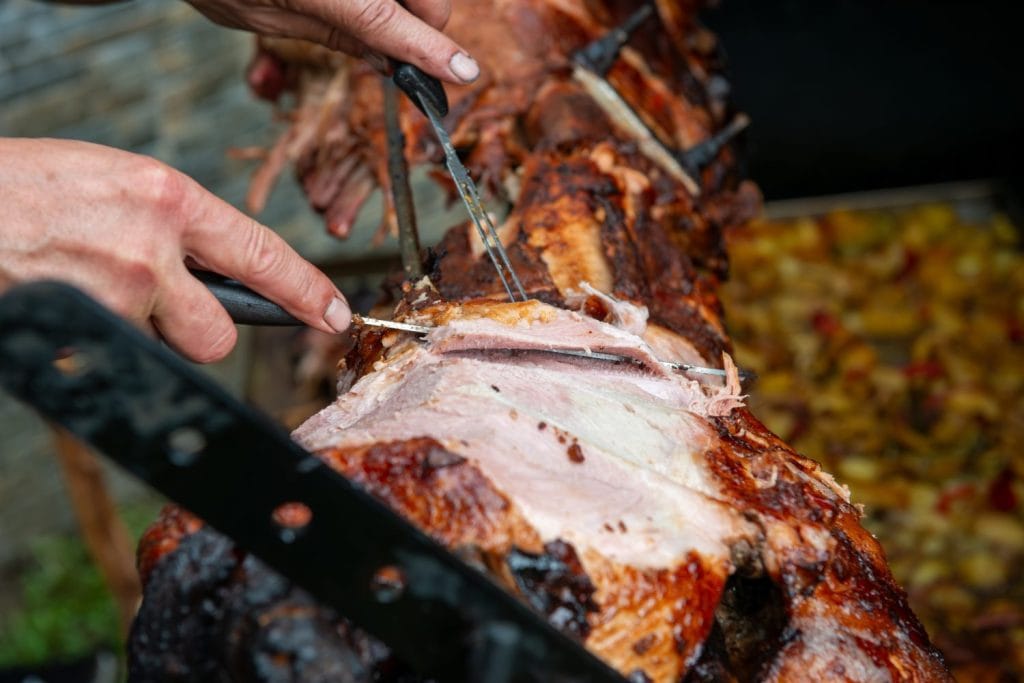
Unlike the light coloring of traditional pork, as depicted here, wild boar is darker red and has a more gamey taste.
©Petr Bonek/Shutterstock.com
AZ: When they cooked it, they looked like they were enjoying it so much, I actually bought pork chops the day after I watched the movie! What does wild boar taste like?
Dumitru: The boars we kill do not go to waste; the meat is sold and is highly appreciated here. Some people like it, some don’t. It is darker red in color and has a more “wild” taste than regular pork. I am personally not a fan because I have seen boars eating carrion, and it is not appealing to me. Wild pigs can carry a disease called trichinosis. However, the meat is safe for consumption if it is cooked to a high temperature of at least 71°C (160°F).
Wild Boar in North America
Unless you have your own survivor-style deserted island experience or go on a luxury hunting expedition in Eastern Europe, the odds of encountering a wild boar in North America depend heavily on your location and activities. As an invasive species, they are currently established in 38 U.S. states and number over 6 million. The largest populations are concentrated in the Southeast, Texas, California, and parts of the Midwest and Southwest. In Canada, there are established populations in Alberta, Saskatchewan, Manitoba, and most recently, British Columbia. In Mexico, there have been reports of feral pigs in some northern border states, including Tamaulipas, Nuevo León, and Coahuila.
Wild boars are widespread, but direct encounters remain uncommon for most people. The risk increases the more time you spend in rural or wild areas, especially in regions with established pig populations, such as forests, wetlands, farmland, and brushy edge habitats. Encounters are most likely for hunters, farmers, hikers, landowners, and others working outdoors at dawn, dusk, or night, while urban and suburban sightings remain rare, and the average person on well-used trails has a very low chance of running into one.
Environmental Damage as a Warning Sign
Feral pigs cause a lot of damage to crops and the landscape due to rooting.
©iStock.com/JohnCarnemolla
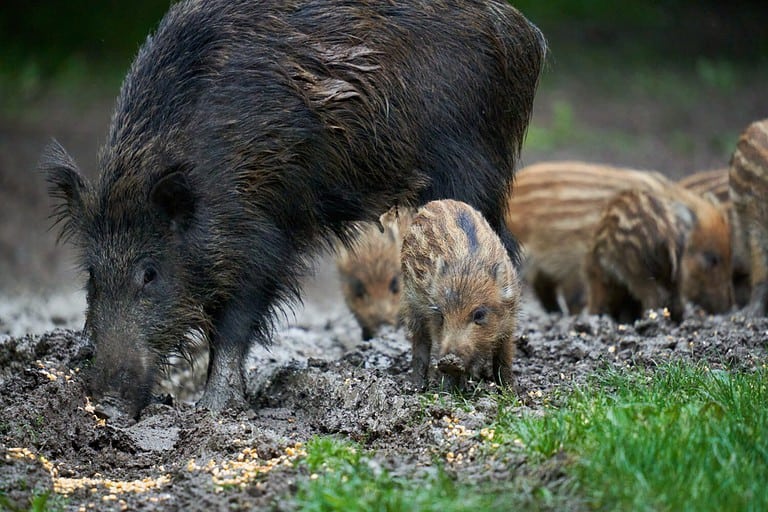
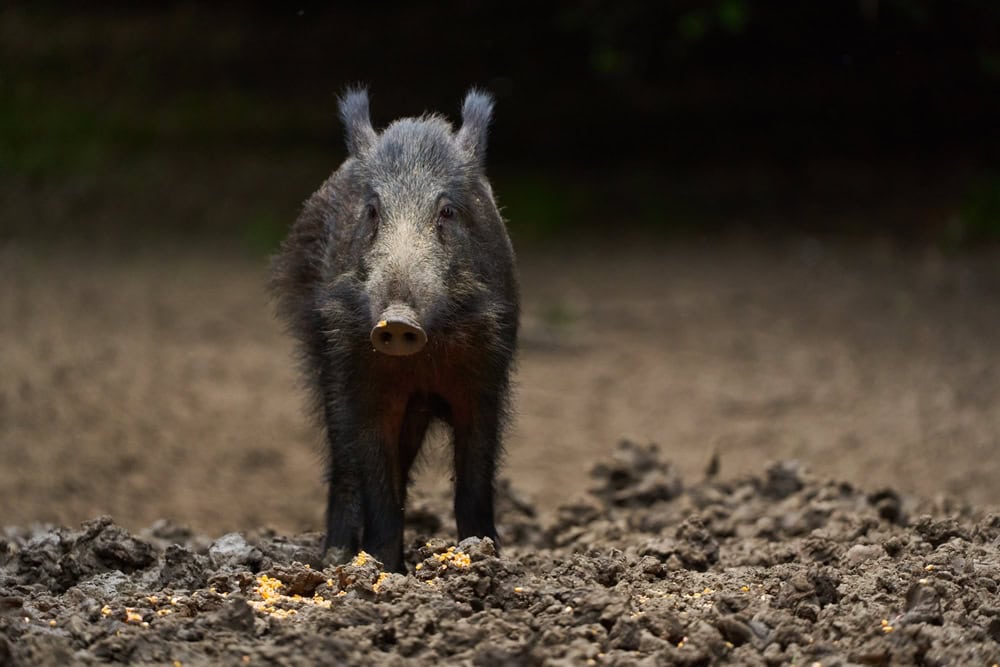
Wild pigs root through soil using their snouts to search for food such as roots, insects, and small animals. This behavior can devastate vegetation, destabilize soil, and destroy nests of ground-dwelling wildlife. In wetlands and coastal areas, wallowing behavior creates muddy pits that degrade water quality and alter drainage patterns. Tracks, trails, and disturbed areas are often the first signs of pig activity.
What to Do in the Unlikely Event…
In the unlikely event that you do encounter a wild boar while hiking or walking through a wooded area or even a suburban park, the most important thing is to stay calm and avoid provoking it. Do not approach, feed, or attempt to photograph the animal at close range. Give it as much space as possible and slowly back away while keeping your eyes on it. Sudden movements or loud noises can trigger a defensive reaction.
If you spot a feral pig, your job is to keep your distance and slowly back away to safety.
©Slatan/Shutterstock.com
If the boar notices you, make yourself appear larger, speak firmly, and continue backing away without turning your back or running. Running can trigger a chase response, and wild pigs are faster than most people over short distances. If there is cover nearby, such as a tree, large rock, or fence, try to position it between you and the animal.
In the rare case that a boar charges, try to move sideways out of its path and put an obstacle between you and the animal as quickly as possible. Boars tend to charge in a straight line. Climbing onto a solid object or getting behind a barrier can help end the encounter. Most charges are bluffs meant to drive a threat away, and once the boar feels it has created distance, it will often retreat. The key takeaway is that wild boars usually want to avoid people. Staying alert, giving them space, and not cornering or surprising them greatly reduces the risk of an aggressive encounter.
Separating Biology From Cinematic Exaggeration
At its core, the feral pig in Send Help is a real animal filtered through the lens of horror. The film accurately portrays its strength, intelligence, and potential for violence, while exaggerating its appearance, persistence, and intent. Wild pigs are dangerous, but they are not villains with motives. They react to fear, opportunity, and survival pressures. The movie assigns the pig a role that real animals do not occupy, transforming instinct into malice.
Understanding where reality ends and exaggeration begins helps ground the scene. It also highlights why the pig remains an effective antagonist. It is rooted in truth, shaped by fear, and exaggerated just enough to make the audience uneasy.