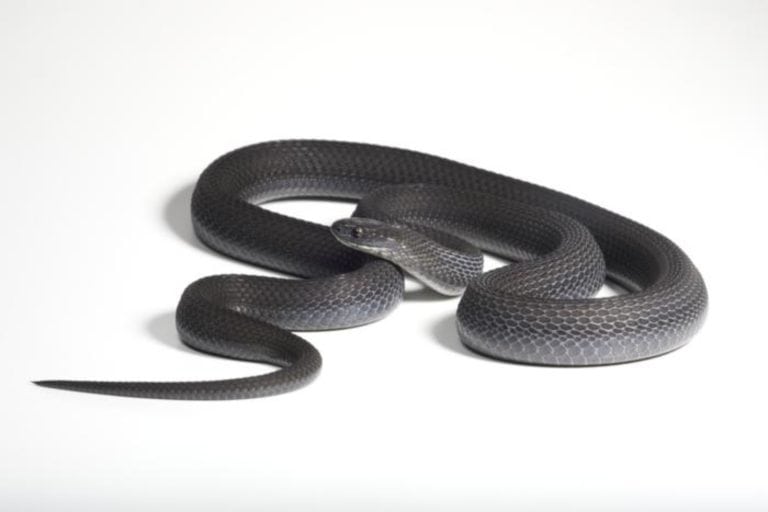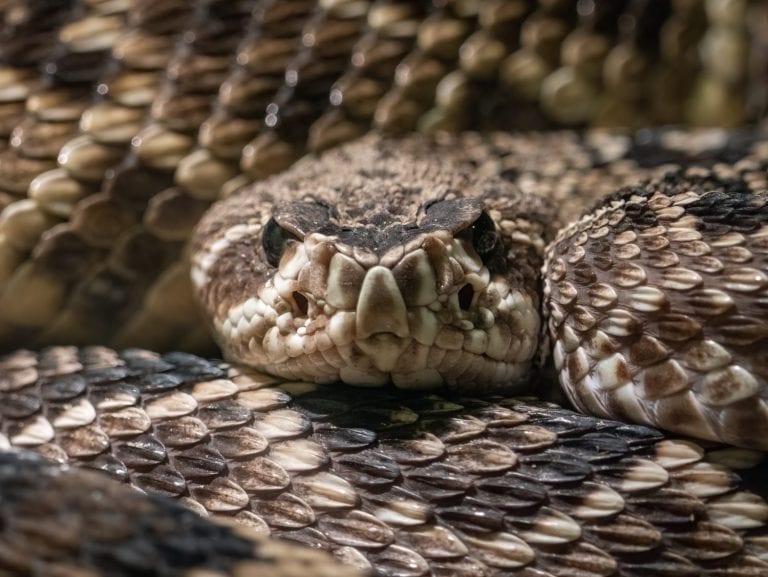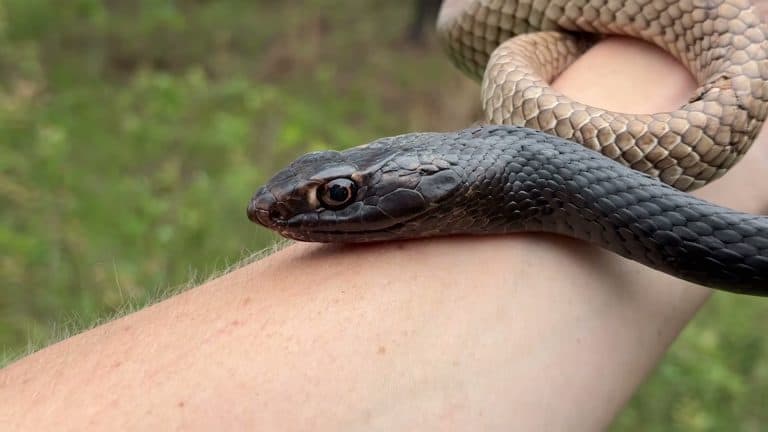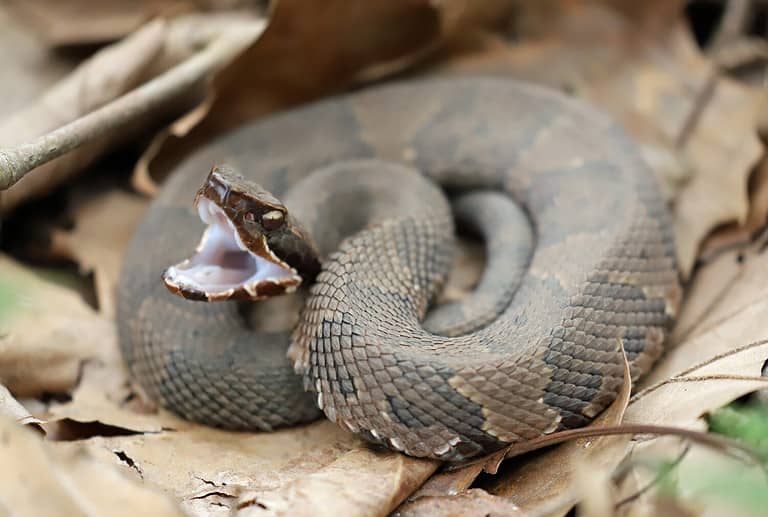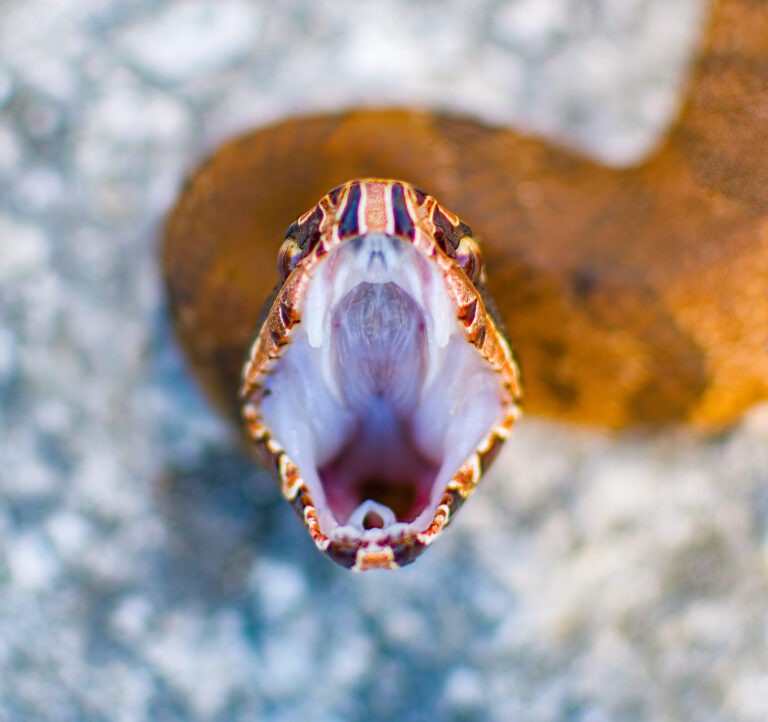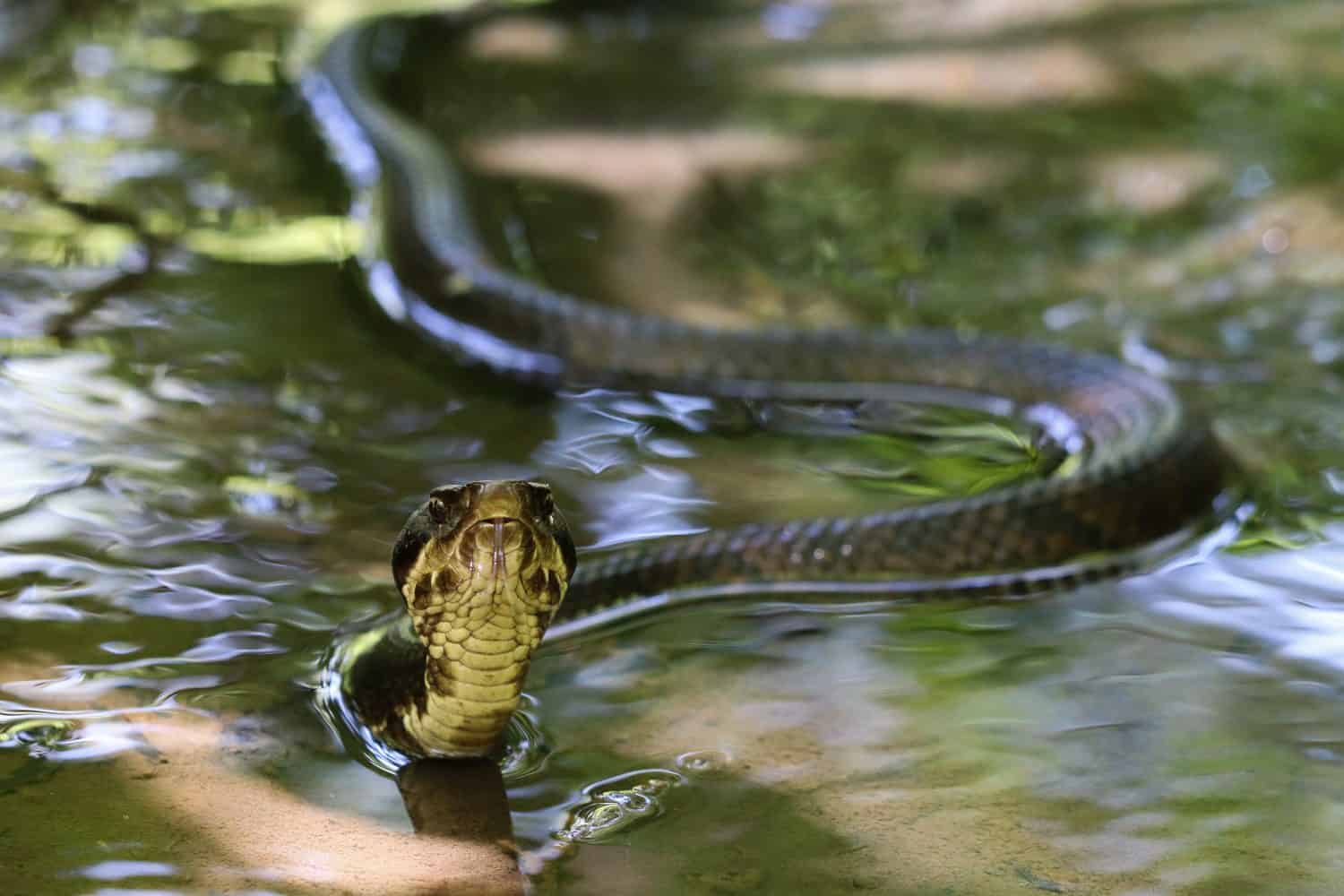

Cottonmouths (Agkistrodon piscivorus), also known as water moccasins, live in freshwater habitats across the southeastern U.S. They are semi-aquatic, venomous snakes that can be identified when they open their jaws to reveal a bright white mouth on the inside. Cottonmouth snakes live alone, except during mating season, when the males come out to compete for the females.
Curious how male and female cottonmouths differ? We spoke to Dr. Allison Sacerdote-Velat, the Curator of Herpetology at Chicago Academy of Sciences/Peggy Notebaert Nature Museum, for the fascinating details.
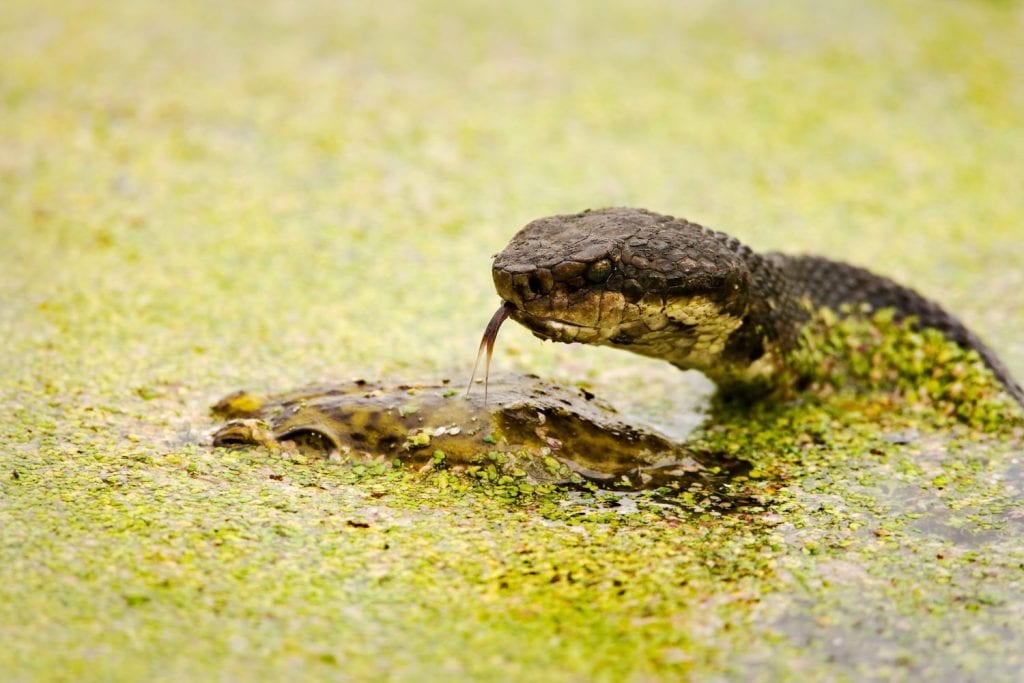
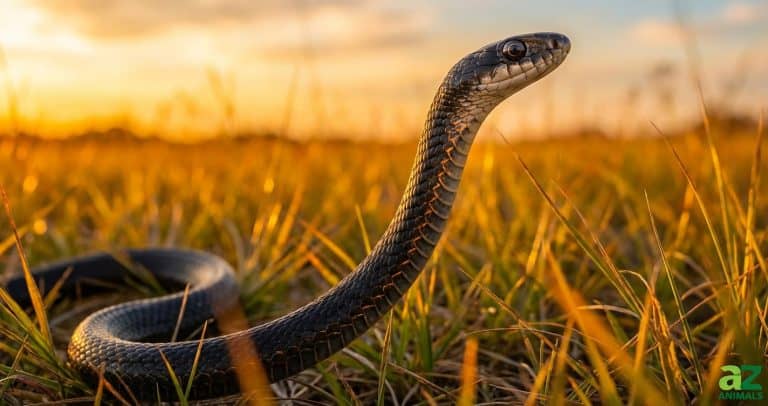
Cottonmouth snakes are strong swimmers and can be found on land and in the water.
©Paul S. Wolf/Shutterstock.com
About Cottonmouth Snakes
Before we delve into the differences between the sexes, let’s take a look at some basic characteristics of cottonmouth snakes. Cottonmouth snakes live across the eastern U.S. They are also found in eastern Texas, southern Illinois, southern Indiana, and the southeast corner of Kansas.
There are three subspecies of cottonmouth snakes:
- Florida cottonmouth (Agkistrodon piscivorus conanti)
- Western cottonmouth (Agkistrodon piscivorus leucostoma)
- Eastern cottonmouth (Agkistrodon piscivorus piscivorus)
Because they are semi-aquatic, you may find cottonmouths on land or swimming in the water. They are large snakes, reaching lengths of about 30 to 48 inches. Like all pit vipers, they hunt using heat-sensing organs (called loreal pits), which are located on each side of their head. Cottonmouths are opportunistic feeders and will eat fish, small mammals, reptiles, amphibians, and snakes smaller than themselves. Juvenile cottonmouths have many predators, and few make it to adulthood. They are often eaten by raccoons, birds of prey, and even adult cottonmouth snakes.
Both sexes would either try to escape or exhibit a defensive display such as opening their mouths for a startle effect, feigning a bite, vibrating their tails, or emitting musk.
Dr. Allison Sacerdote-Velat, the Curator of Herpetology at Chicago Academy of Sciences/Peggy Notebaert Nature Museum
Male vs. Female Cottonmouth Snakes: Size Difference
Sacerdote-Velat explains the biggest difference between males and females is in their size. “Males are generally larger and heavier than females, and males have relatively longer tail lengths than females.”

Dr. Allison Sacerdote-Velat, Curator of Herpetology at Chicago Academy of Sciences/Peggy Notebaert Nature Museum, releases a smooth greensnake.
©
“Male cottonmouths have a longer quadrate bone than females,” she continues. “The quadrate bone is an elongated bone that affects the size of prey a snake can ingest because it suspends the lower jaw from the skull. The quadrate is attached by ligaments, which allow flexibility in the jaw, enabling snakes to swallow large food items. Because male cottonmouths have a longer quadrate than females, they can swallow taller prey items relative to their body size than females are able to ingest.”
Size Matters More Than Sex in Defensive Behaviors
We were curious if there were differences in aggression or defensive behaviors between male and female cottonmouths. Sacerdote-Velat explains, “Male cottonmouths will combat each other for access to food resources, a behavior observed in other species within the Agkistrodon genus. A study by Roth and Johnson found no difference in defensive/antipredator behaviors between the sexes when they controlled for body size. They found a general decline in the frequency of defensive behaviors as body size increased. Both sexes would either try to escape or exhibit a defensive display such as opening their mouths for a startle effect, feigning a bite, vibrating their tails, or emitting musk.”
Do Males and Female Cottonmouths Hunt Differently?
According to Sacerdote-Velat, “Behavioral differences in hunting/prey capture do not generally differ between the sexes, but rather with the hunting environment and with the type of prey.” However, researchers have discovered there are some differences in what male and female cottonmouths prey upon.
Sacerdote-Velat says, “Males consumed more fish, amphibians, and arthropods than females, and females consumed more reptiles and mollusks than males.” However, she explains, both males and females have a main diet of fish. Another difference that Sacerdote-Velat notes is “males eating taller prey items than females. [However,] prey size was similar between the sexes in other aspects.”
Cytotoxic Venom
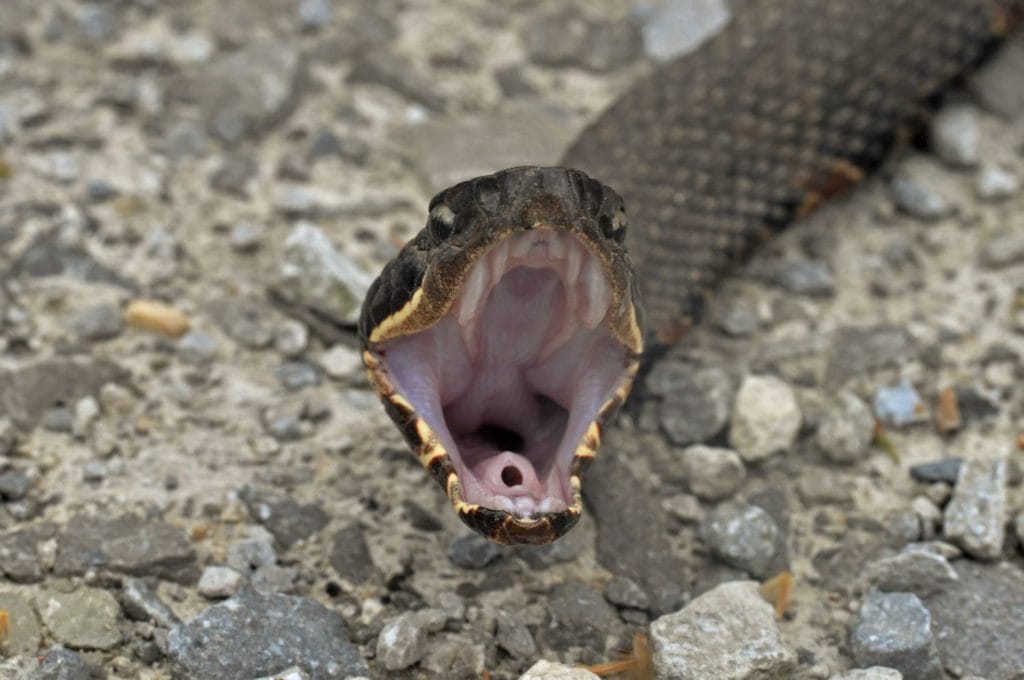
Cottonmouth snakes are named for the white interior of their mouths, which can be seen when they are warning predators away.
©Mike Wilhelm/Shutterstock.com
There are no known differences between male and female cottonmouths regarding their venom — they both produce a cytotoxic venom. Cytotoxic venom is a type of venom that destroys the tissue and cells at the site of the bite. It can cause swelling, pain, and even cell death.
“The amount of venom released does not generally vary with the sex of the snake, the prey type, or the prey size,” says Sacerdote-Velat. “However, the snake’s body temperature affects how much venom is released, with less venom injected at colder temperatures.”
Cottonmouths Prefer to Flee, Not Fight
Despite their fearsome reputation, cottonmouths would rather flee from confrontation than attack a human. And this is true regardless of sex. Sacerdote-Velat says, “Cottonmouths often have the reputation of being aggressive in encounters with humans.” A 2002 study cites that 51% of cottonmouths tried to escape and evade humans by moving in a random direction, 78% of cottonmouths exhibited a defensive display upon encountering a human (opening their mouths for a startle effect, feigning strikes, emitting musk), and only 36% attempted to bite when approached with an artificial human hand.
“The study showed that most cottonmouths will attempt to deter humans from getting close to them with defensive displays or by attempting to escape, rather than trying to issue a bite,” explains Sacerdote-Velat. “In a 20-year study of venomous snake bite medical outcomes in Florida, no patients died from cottonmouth bites after hospitalization. Most patients were adult males, one-third of whom intentionally interacted with the snakes, and in most cases, bites were preventable accidents.”
Who Would Win in a Matchup?
We wondered if the two came face to face, who would prevail? Sacerdote-Velat explains it’s more of a question of body size and age rather than sex. “Because body size will not only differ with sex, but with age and energetic condition of an individual, there is no definitive advantage for males versus females.”