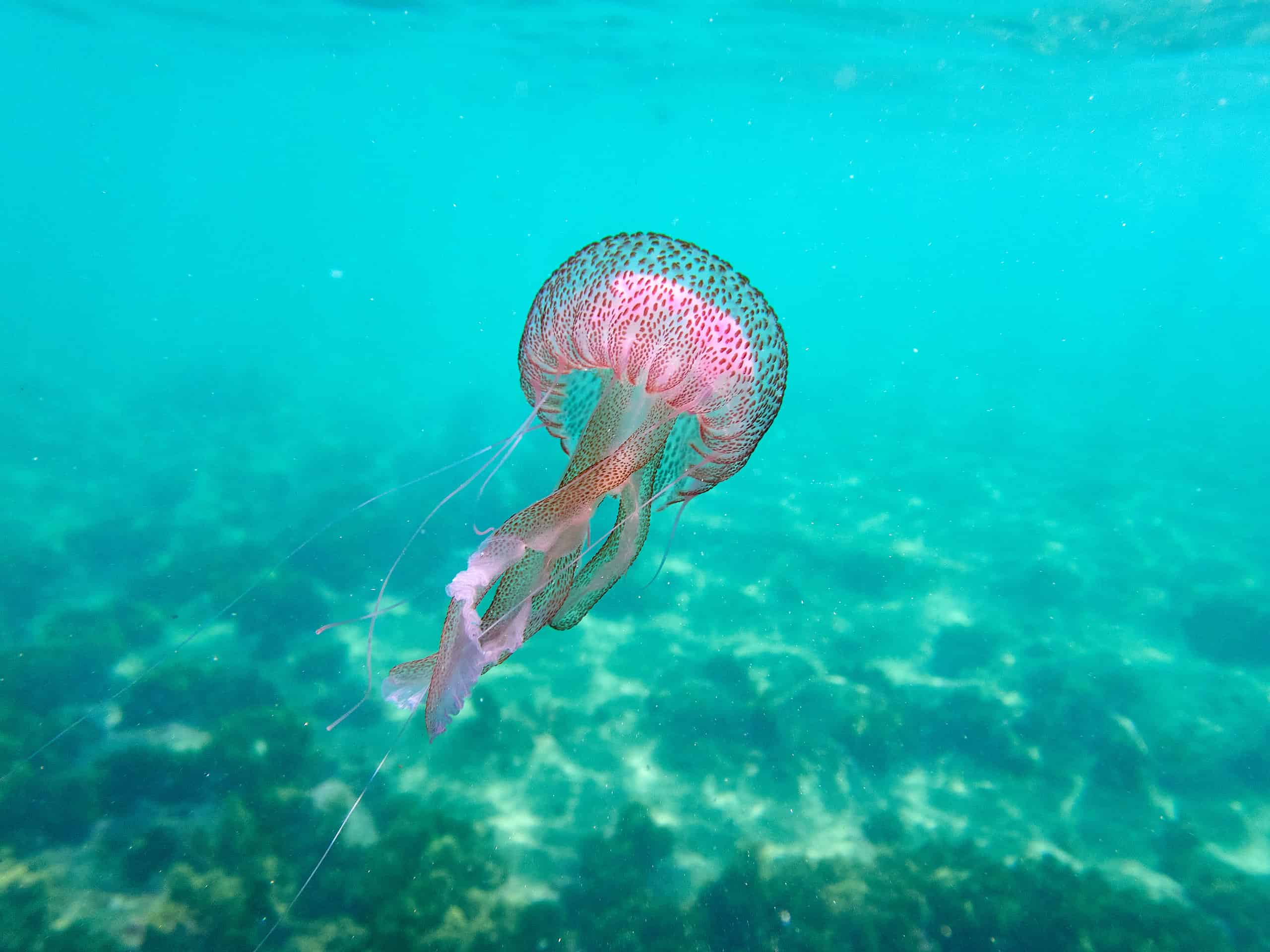

The jellyfish is one of the most fascinating creatures on the planet. With their beautiful luminescent glow and bell-shaped bodies, they hardly seem like animals at all. Instead, they appear to be some kind of alien life form. However, they share some qualities in common with other animals, including the ability to use oxygen and the need to hunt for food.
While all adult jellyfish have simple body plans, they exhibit enormous diversity in size and color. The number and shape of their tentacles also widely varies between species. They can be found in just about every marine environment in the world. They feed on a huge variety of animal and plant life in the oceans. The composition of the diet can even influence the color of the jellyfish, turning it pink, purple, or red with different pigments. Keep reading to learn more about what jellyfish eat and how they eat it.
Jellyfish Evolution
There are over 200 species of what are considered “true jellyfish.” They are part of the Scyphozoa group of animals that include the big, colorful jellyfish that often interact with humans. Scientists believe jellyfish evolved somewhere around 500 million years ago. The date is inexact because their soft parts do not fossilize well. However, they are thought to be representative of the earliest forms of multi-organ animal life on the Earth. Composed of more than 95% water, they have relatively simple bodies with no respiratory or circulatory system and only basic digestive and neurological functions.
Despite their simplicity, jellyfish are among the most efficient swimmers in the ocean. They are powered by the expanding and contracting motion of the bell, which squirts water in the opposite direction of the way they want to go. The way their simple digestive systems produce energy offers a fascinating study of how the digestive system could have evolved in early animals.
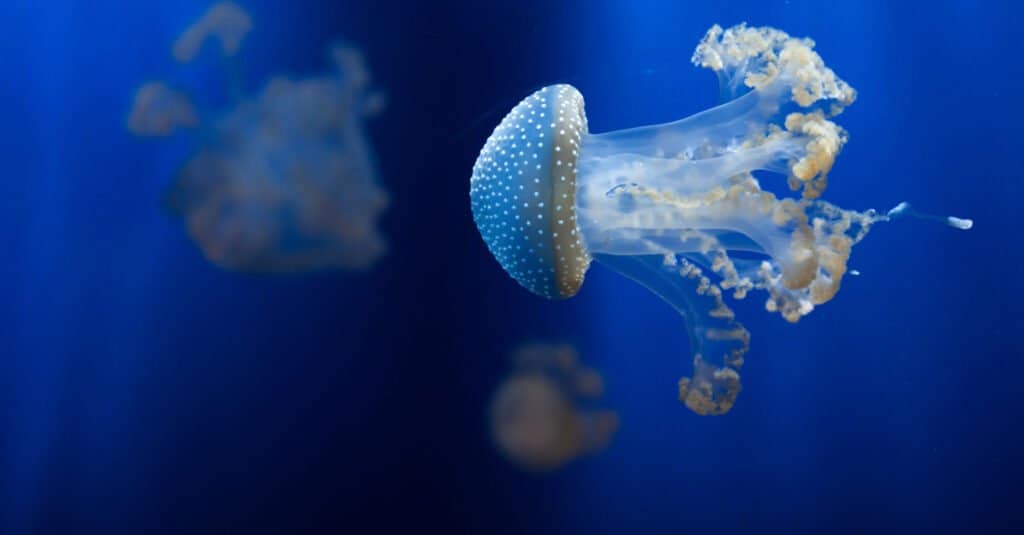
White-spotted jellyfish have venom but do not pose a threat to humans.
©iStock.com/wrangel
What Do Jellyfish Eat?
Jellyfish have a wide and eclectic diet, depending on the species. However, jellyfish are primarily carnivores, so they typically consume other animals. Jellyfish are voracious and opportunistic within their dietary limits, primarily consuming small marine organisms they can capture and digest. Their diet mostly consists of organisms like plankton, crustaceans, small fish, fish larvae, and even other jellyfish. They also eat small plants such as algae and phytoplankton.
Sometimes they can be seen congregating together in groups of millions, called blooms. These groups consume so much food that they have a negative impact on marine ecosystems. Unfortunately, it’s thought that climate change may increase the likelihood of blooms occurring throughout the world’s oceans. However, scientists are still debating the possibilities.
How Do Jellyfish Catch Their Food?
While floating placidly through the water, either by a current or their own power, they expend minimal effort to hunt down food. This is likely due to their limited neurological and muscular systems, which prevent them from out-swimming their prey. Instead, they spread out their long tentacles to help them collect food in the water as it passes by. Some species, like the lion’s mane jellyfish, have tentacles that can reach over 100 feet long.
Jellyfish tentacles contain painful stinging cells called nematocysts that paralyze or stun their prey. There are thousands of these small cells along the length of the tentacle. When the tentacles come into contact with prey, the cells’ harpoon-like barbs pierce the skin of its victims with a pressure of more than 2,000 pounds per square inch. In some species, the sting is powerful enough to cause immense pain and death, even in humans. However, this is usually the result of accidental contact or self-defense on the part of the jellyfish, rather than aggressive action.
There are some exceptions to this process. Some jellyfish, such as the moon jellyfish, are suspension feeders. This means they have a special filtering system to collect food particles, like zooplankton, that are floating in the water. Rather than searching for food, they let the food come to them as they move through the water. The spotted jellyfish also has a different feeding strategy. It raises algae inside its stomach and derives nutrients from the resulting photosynthesis.
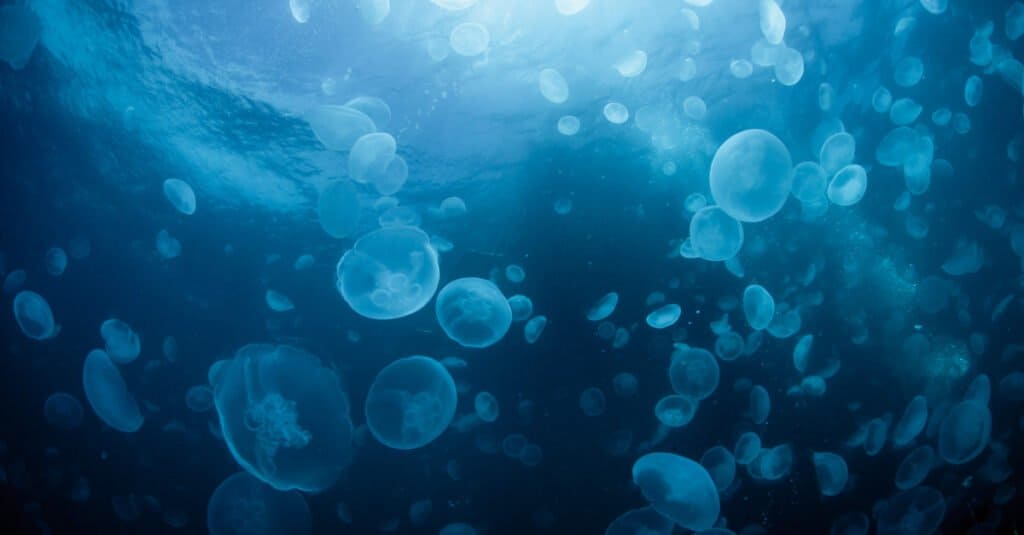
A group of jellyfish is called a swarm, a bloom, or a smack.
©iStock.com/inusuke
Jellyfish Digestion
Despite their simplistic anatomy, all jellyfish have a basic set of digestive organs like any other animal. After killing or paralyzing its quarry, some jellyfish will move the food toward its mouth with a set of oral arms, located on the underside of the bells. These arms basically resemble short tentacles and have a range of different movements. The mouth itself is nothing more than a small hole located on the underside of the bell. It simultaneously functions as a mouth, anus, and a general opening for water to enter and then leave the body.
The mouth opens right into the jellyfish’s gastrovascular cavity, which serves as a stomach. There is no throat or other organs in between. The digestive system of the jellyfish is so simple that it lacks a liver, pancreas, or intestines, which produce important chemicals and absorb nutrients in most other animals. Instead, the gastrovascular cavity produces the enzymes necessary to break down food. Then the cells that line the cavity absorb the nutrients.
When the jellyfish is done feeding, it will expel undigested waste out through the mouth. The process itself is relatively fast, with most having a digestion time between 1-3 hours. It cannot eat again until the previous food has left the body. While their incomplete digestive systems limit them to small, easily digestible foods, jellyfish are unhindered by the lack of complexity. After all, they are still thriving after 500 million years.