
Quick Take
- One of the box jellyfish's 24 eyes operates on a physical trick so clever it baffles engineers, and this trick is what keeps the jellyfish from getting lost. See the eye trick →
- The jellyfish navigates by looking at something it can't directly reach, and blocking that view instantly makes it helpless. How canopy vision guides it →
- Scientists have only ever seen this type of intelligence processing in animals with brains, which means the box jellyfish shouldn't be able to do it. Vision without a brain →
- For decades, researchers knew these eyes existed but had no idea why such a simple creature would need them. Then one habitat revealed the answer. What the habitat revealed →
Moving slowly through a dense mangrove forest, a box jellyfish seemingly knows exactly where to go. It effortlessly avoids the long, tentacle-like roots of the mangrove trees to find the shady spots it prefers.
But how is it navigating this complicated network of waterways? Turns out, the box jellyfish carries 24 eyes on its body, and some of them are sharp enough to make out real images – much like a human’s eye. Not bad for a species without a centralized brain.
Here’s how it works.
The Box Jellyfish’s Four Eye Clusters
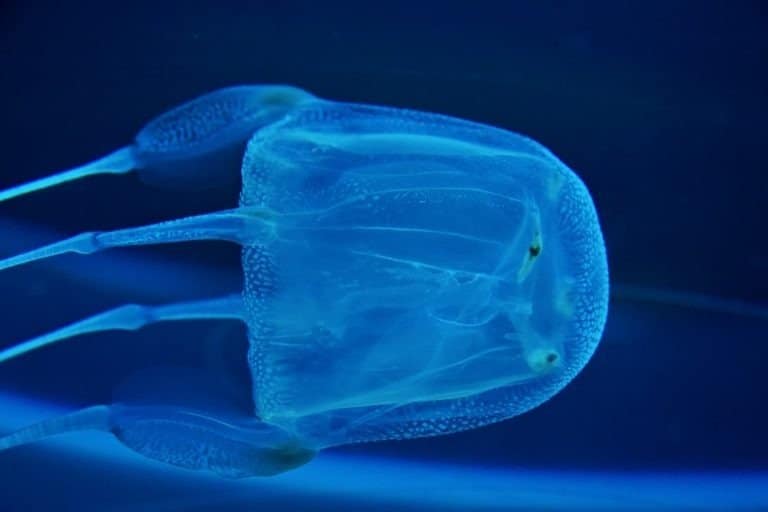
The box jellyfish, Tripedalia cystophora, has four different eye clusters called rhopalia. They are strategically located on each side of its box-shaped body. Each cluster contains six eyes.

Box jellyfish have four eye clusters spread around their bodies.
©IMC11/Shutterstock.com
Within each cluster, the six eyes consist of four eye types – an upper lens eye, a lower lens eye, two slit eyes, and two pit eyes. The slit eyes mostly just detect light and dark. It is the two lens eyes that do all the “seeing.”
Each of the lens eyes has a clear cornea, a lens, and a retina, mirroring the general structure found in human eyes.
The Eye That Never Changes Focus
Uniquely, the upper eye stays fixed in an upward position. It doesn’t matter how the jellyfish is oriented, either. Researchers discovered that the upper eye is like a miniature gyroscope. It hangs from a weighted stalk and automatically orients itself to an upward gaze.
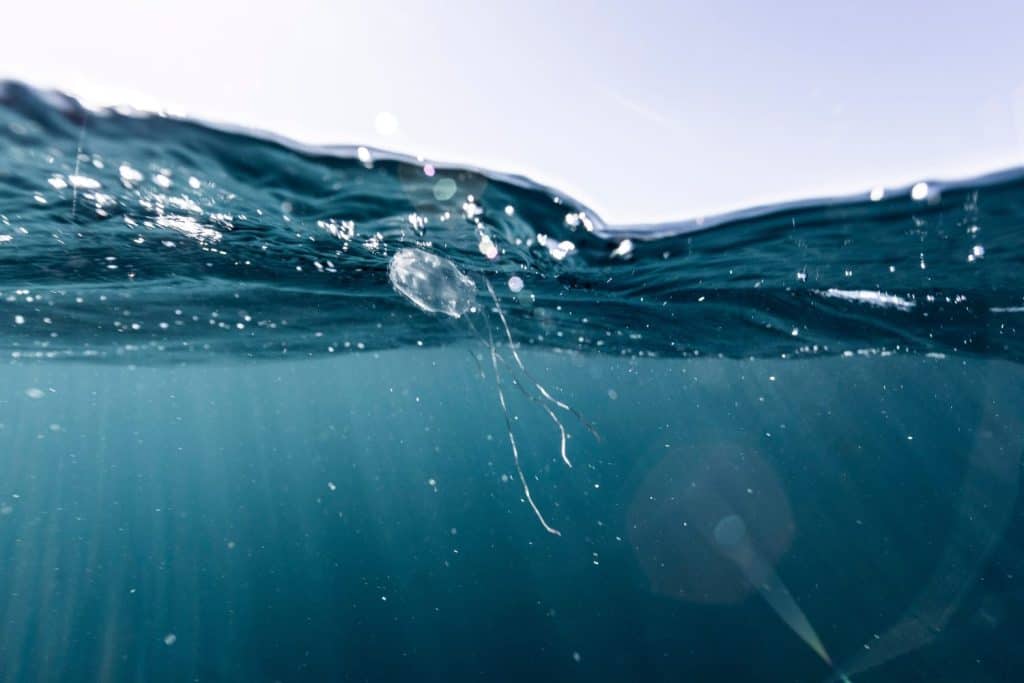
One of the box jellyfish’s eye clusters always points upward.
©Anna LoFi/Shutterstock.com
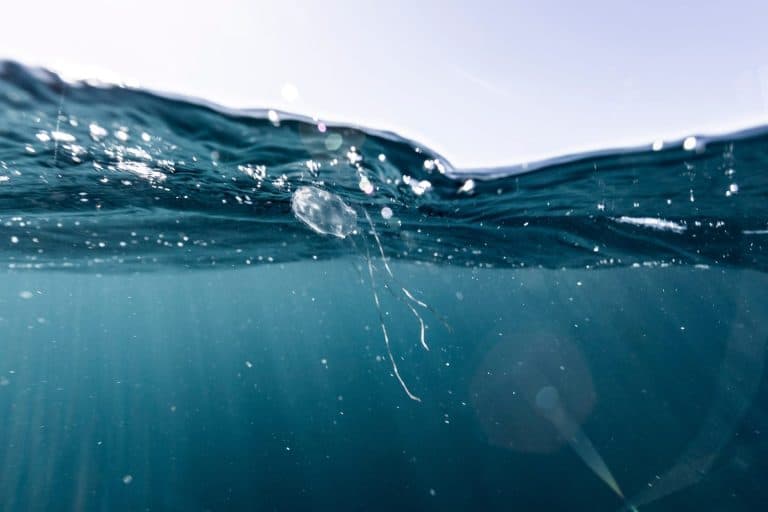
This sky-viewing eye is how the jellyfish navigates. It is structured to see through the water’s surface and make out the outline of mangrove trees above. This is how the jellyfish stays oriented when it can see the tree canopy.
When researchers blocked the jellyfish’s view of the tree canopy, it got lost. However, once it could see the treeline above the water, it could once again navigate successfully. It’s what keeps the jellyfish close to the nutrient-rich waters near the sheltered edges of the mangrove forest. If it cannot see, it might drift out into open water or get tangled in roots.
All This With No Brain
Box jellyfish don’t have a brain, at least not in the way we typically think of brains. Instead, each of the four eye clusters has a small nerve center. Those nerve centers are connected via nerve rings, so they can process information.
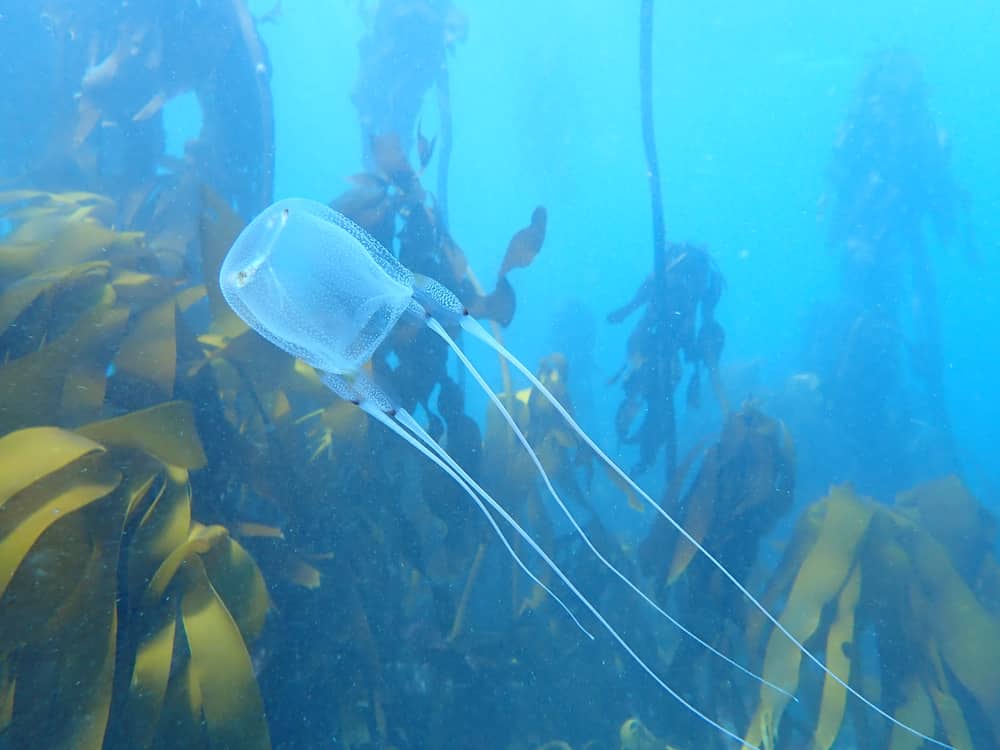
The box jellyfish uses its eye clusters to help it navigate.
©Katherine Wallis/Shutterstock.com
It combines the information from all four eye clusters to form a single image of its surroundings, which it then uses to maneuver through the water.
Scientists remain puzzled by how this process works, as such complex information processing has only been observed in animals with actual brains. In the box jellyfish’s case, it is mimicking that behavior using only its nervous system.
The Importance of These Findings
For scientists, understanding how the box jellyfish’s eyes work has been an ongoing quest. While they’ve known for decades about the eyes, they couldn’t be sure why they functioned the way they do or why a simple species like a jellyfish would even need them.
The mangrove navigation behavior gives scientists an answer – the eyes are what help the jellyfish navigate and survive. Even more interesting is the evidence that vision and decision-making don’t require a centralized brain—at least not in box jellyfish.