
Quick Take
- Irukandji jellyfish are some of the most dangerous creatures in the world—capable of delivering stings that can lead to brain hemorrhages.
- A mere 50 micrograms of Irukandji toxin triggers immediate cardiovascular collapse in healthy subjects.
- They send between 50 and 100 people to the hospital every year.
One minute, you’re swimming in the sparkling water off the Queensland coast. The next minute, you’re fighting for your life. That’s a plausible series of events for people unlucky enough to be stung by an Irukandji jellyfish. Practically invisible in the daylight and about the size of a sugar cube, Irukandji jellyfish are some of the most dangerous creatures in the world—capable of delivering stings that can lead to brain hemorrhages. They are so venomous that the effects of their stings have their own name: Irukandji syndrome.
Descriptions of this rare box jellyfish’s stings rival traumatic horror stories. They send between 50 and 100 people to the hospital every year. Writer Robert Drewe described their stings as “100 times as potent as that of a cobra and 1,000 times stronger than a tarantula.” However you describe it, Irukandji Syndrome is no joke. We sat down with a physician to learn more about Irukandji jellyfish, how their venom works its way through the human body, and what it feels like to endure such pain.
Irukandji Basics
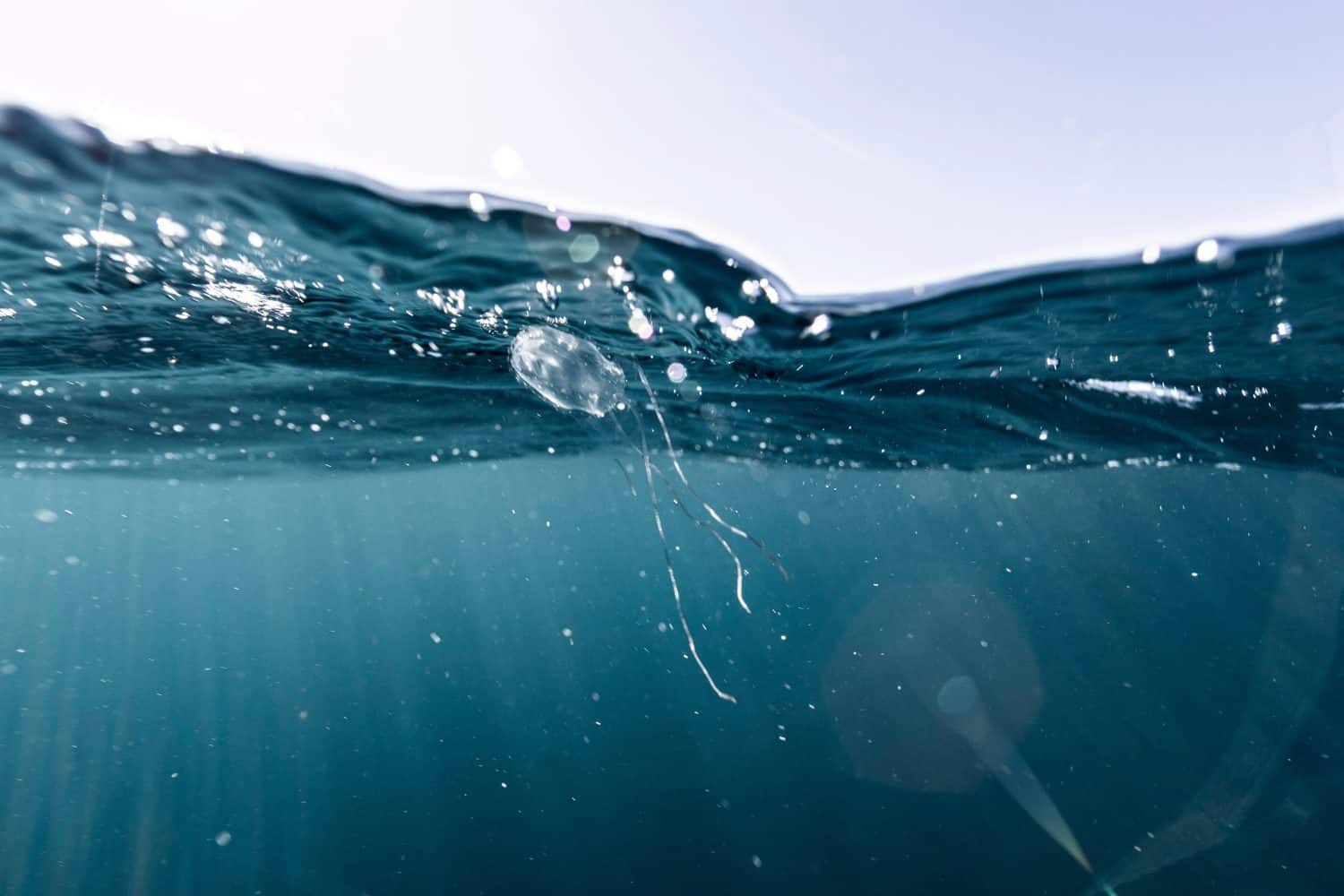
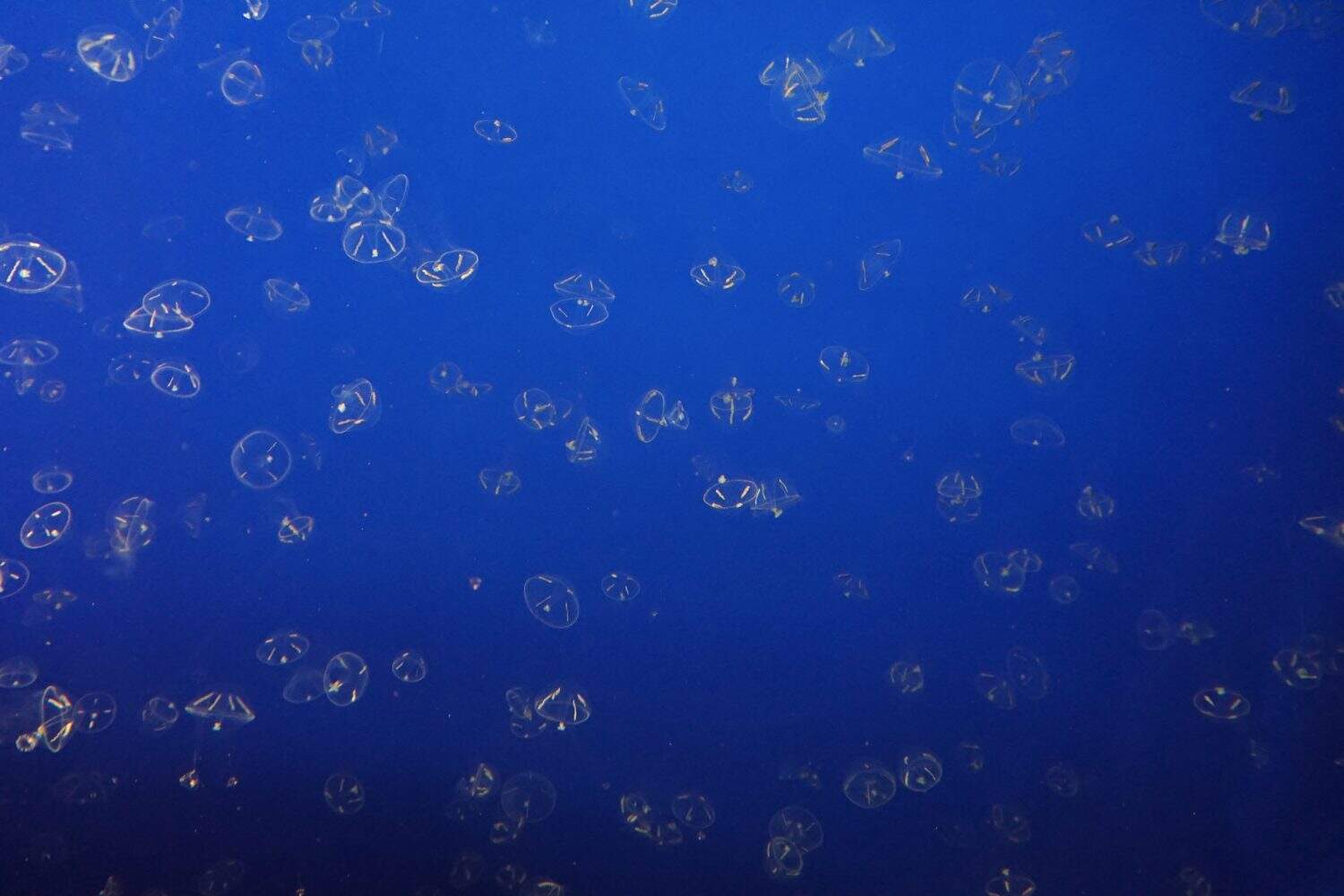
These jellyfish are about the size of a sugar cube and next to impossible to spot in open water.
©electra/Shutterstock.com
Irukandji jellyfish are pretty remarkable creatures, even without the death-inducing stings. They are small, with a bell under an inch wide and four extremely long tentacles, which range from only a few centimeters up to several feet in length. Mature irukandji have halo-esque rings of tissue around their four tentacles. These contain stingers in clumps, which look like rings of small red dots.
Whereas most jellyfish glide along and pick up food, some irukandji species are active hunters. In recent years, scientists have even seen them twitch their tentacles to mimic active zooplankton and lure in small fish. Seeing these jellyfish in action is challenging, however, as their small size and transparent frame make them next to impossible to see in open water. Their behaviors and life cycles are mysterious, and their stinging power is the stuff of legend.
In 1952, Hugo Flecker named them after the Irukandji people, whose region spans the strip of Queensland coast where these jellyfish are found. Fittingly, the first experiments with these jellyfish quickly proved their danger. In 1964, toxicologist Jack Barnes sought to prove that one of the aforementioned jellyfish was the cause of the dreaded Irukandji syndrome. He captured a tiny specimen and allowed it to sting him, his nine-year-old son, and a lifeguard. The stings resulted in a delayed but increasingly excruciating pain. Although reckless in his experiments, Barnes also discovered that synthetic materials like pantyhose could prevent Irukandji stings. As we will soon learn, however, a thin layer of fabric offers little defense against one of the most horrifying sensations known to humans.
Meet the Expert

Dr. Zumsteg learned about Irukandji jellyfish stings while living in Australia.
Daniel Zumsteg, MD, is an assistant professor at the Medical College of Wisconsin. Zumsteg studied at both the Ochsner Clinical School in New Orleans and the University of Queensland Medical School in Brisbane, Australia. While studying in Australia, Zumsteg was exposed to medical training regarding jellyfish stings, including that of the Irukandji. He also heard about them while getting his diving certification. “In the same way that [American-trained physicians] learn about scorpion bites and Lyme disease, they learn about Irukandji, because that’s what you could see if you’re a doctor moving around through Queensland and the Northern Territory,” he says.
Mechanisms of a Venom
It’s hard to undersell the potency of Irukandji venom. To illustrate this point, Dr. Zumsteg shared a paper detailing the effects of “Irukandji jellyfish (Carukia barnesi) nematocyst venom and a tentacle extract in rats.” Tests on rats produced devastating results, as even a low dose of venom caused one out of four rats to go into cardiovascular collapse. “At a higher dose, three-quarters of the rats went into cardiovascular collapse, from like 50 to 100 micrograms per kilogram, so like an exquisitely small amount,” Zumsteg explains, adding: “This incredibly small volume of toxin can still produce like a really incredible toxidrome.”
While the exact mechanism behind Irukandji venom is unknown, it likely stimulates the release of catecholamines—a class of molecules that act as neurotransmitters and hormones. The toxin activates sodium channels in cells, which are most concentrated on nerves in the sympathetic and parasympathetic systems.
Fight or Flight
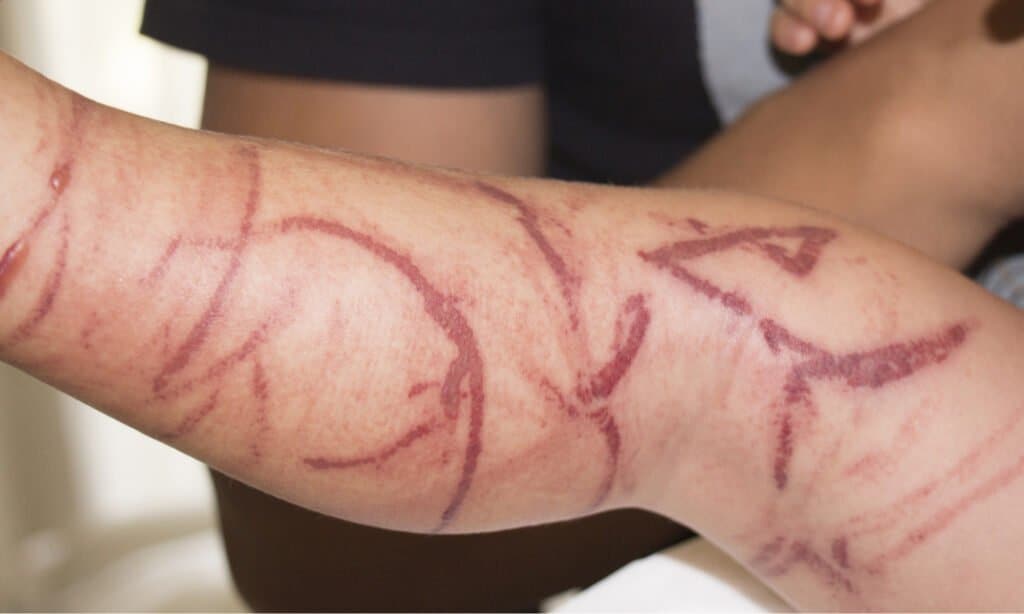
Jellyfish stings can leave serious welts on the skin. Pictured above are the marks left by another type of Australian box jellyfish.
©DonyaHHI/Shutterstock.com
The toxins trigger the release of norepinephrine and epinephrine. The fight-or-flight response activates and heart rate and blood pressure spike. Epinephrine will save someone in anaphylactic shock, but it will send a healthy body into overdrive. “With an increasing heart rate, your cardiac output goes up and up and up. And then, it turns a corner and falls off,” Zumsteg says.
With vitals overcharged and vessels compressed, blood struggles to flow out of the heart and through the body. The body’s vast capillary network experiences a severe traffic jam. Tissues are deprived of blood and begin to die. “The blood pressure itself is causing tissue damage because it’s bursting those capillary beds or it’s flooding them with fluid and basically making them dysfunctional,” Zumsteg says.
“It’s this wonderful sort of house of cards that falls because of the blood pressure jacked through the roof and the heart rate going through the roof, which is all due to the release of the norepinephrine and epinephrine from the Irukandji venom.”
What It Feels Like
Irukandji syndrome causes painful cramps, severe kidney and back pain, burning sensations, headaches, vomiting, and more.
©snacc641/Shutterstock.com
It’s this wonderful sort of house of cards that falls because of the blood pressure jacked through the roof and the heart rate going through the roof, which is all due to the release of the norepinephrine and epinephrine from the Irukandji venom.
Daniel Zumsteg, MD, assistant professor at the Medical College of Wisconsin
If the sting itself isn’t frightening enough, Irukandji syndrome certainly is. That’s because the release of catecholamines and the house-of-cards-like process the body undergoes causes excruciating pain, weakness, confusion, and abject fear. At first, an Irukandji sting causes mild irritation. However, about 30 minutes later, the full syndrome develops. The venom induces blisteringly painful muscle cramps, severe pain in the back and kidneys, and a burning sensation across the skin. Headaches, nausea, restlessness, and vomiting follow.
Throughout all of this, a sense of impending doom overwhelms the body. It feels like dying, and it induces an overwhelming panic and anxiety. This results from the surge of catecholamines, which spike blood pressure and heart rate. “Evolutionarily, the release of those chemicals in your body is associated with being on the brink of death,” Zumsteg says. “I don’t recommend trying this at all, but it’s somewhere along the lines of taking someone’s EpiPen that they take for anaphylaxis and injecting 3-5 milligrams of it into your veins.”
Age(less) Discrimination
Irukandji jellyfish do not discriminate among human victims. You may think that the young and elderly are most at risk—which they are—but statistically, young, active adult males are the most common victims. More specifically, people stung by Irukandji are usually swimming or scuba diving. Most incidents occur in water deeper than two meters and in good weather conditions.
Dr. Zumsteg shared a case study of a 24-year-old woman stung while swimming in the sea. Within four and a half hours of being stung, she showed signs of severe Irukandji syndrome “with significant cardiac dysfunction.” The woman lived, but she remained on ventilation for over a week.
Much Pain, Little Mortality
On the bright side, most people survive Irukandji stings. Up to a hundred people are hospitalized each year from stings, but there are only two confirmed deaths on record in Australia, both of which occurred in 2002. In comparison, the larger box jellyfish species has killed 79 people in Australia since records began. Even so, it’s difficult to determine how many deaths from Irukandji syndrome have been incorrectly attributed to heart attacks or drownings.
Dozens of people are hospitalized with Irukandji syndrome each year, but there are only two recorded fatalities.
©Adam Calaitzis/Shutterstock.com
Deaths from Irukandji syndrome may be rare, but the pain and fear it causes are among the worst sensations imaginable. “You’re awash in epinephrine. You already have this sense of dread, and then all of a sudden you can’t breathe, your heart’s pounding, your head’s pounding, you can’t see, and you’re vomiting,” Zumsteg says, “It’s like redlining an engine until it explodes.”