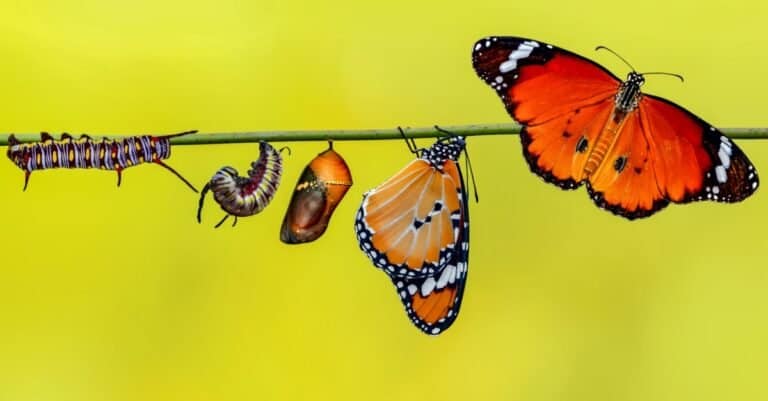

We are all used to seeing caterpillars hide themselves away and emerge as butterflies or moths, but the species featured in this YouTube clip emerges as another caterpillar. There is a very good reason for this: it is part of an impressive defense mechanism used by the spicebush swallowtail to avoid being eaten. Let’s dive deeper into its life story.
Challenges Faced by the Spicebush Swallowtail
Spicebush swallowtails (Papilio Troilus) are a type of swallowtail butterfly found in eastern North America. As larvae, they inhabit deciduous woodlands, wooded swamps, and pine barrens. The adults, however, are seen in woodlands and fields and you are likely to spot one in your yard or in your local park. As adult butterflies, they have a wingspan of around 4 inches. The upper surface of their forewings is mainly black, while the upper surface of their hindwings features an orange spot on the coastal margin (front edge).
Both adults and larvae suffer from extensive predation. They are eaten by spiders, dragonflies, robber flies, and, as you can see in this clip, by birds. To avoid ending up as a predator’s meal before they can even reach adulthood, spicebush swallowtail larvae get clever with their defense.
Hiding in Plain Sight
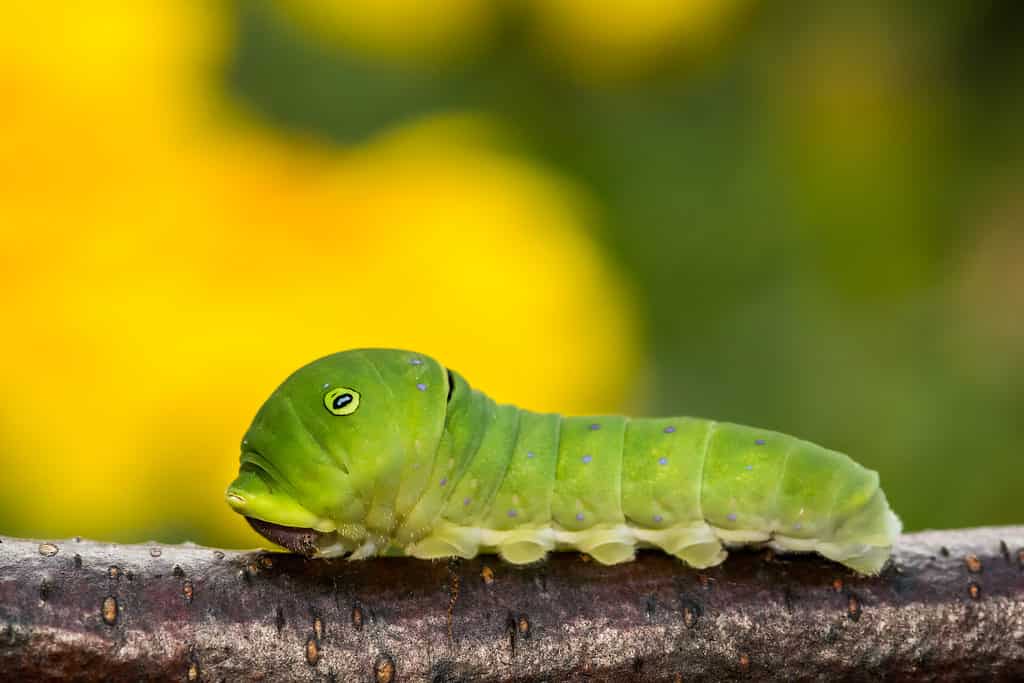
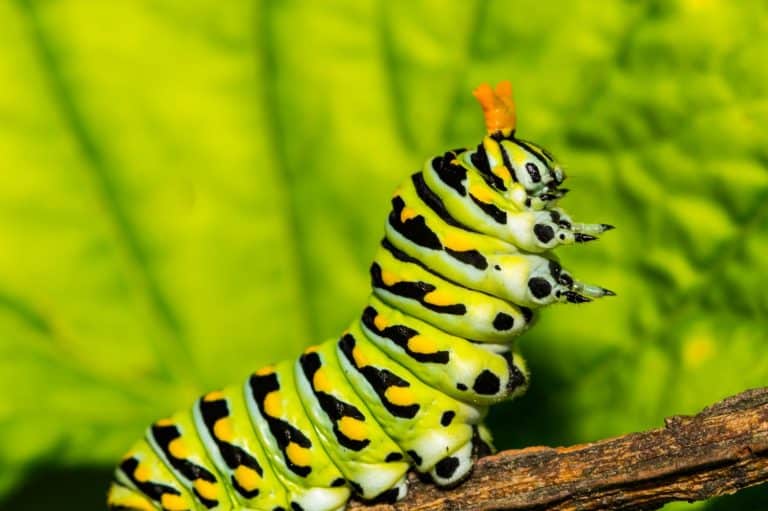
Swallowtail caterpillars mimic snakes.
©Jay Ondreicka/Shutterstock.com
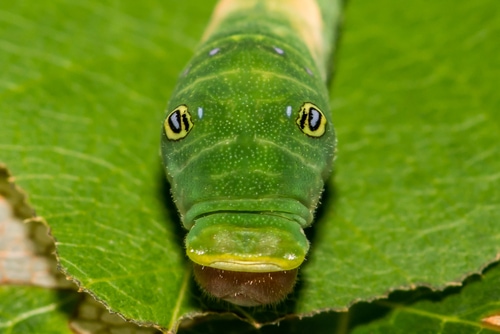
Eggs are laid on the underside of leaves and hatch into their initial form, which looks like bird droppings to evade predators. Then they build themselves a shelter by depositing silk threads across a leaf, which tighten and close the leaf around them. Inside the shelter, the caterpillar sheds its skin and emerges looking like a small green snake. They even have spots at the front of their head that look like eyes. If a predator approaches, they lift the front of their body, copying a snake when it is about to strike. This type of mimicry is enough to deter some predators, but not all.
Deploying the Osmeterium
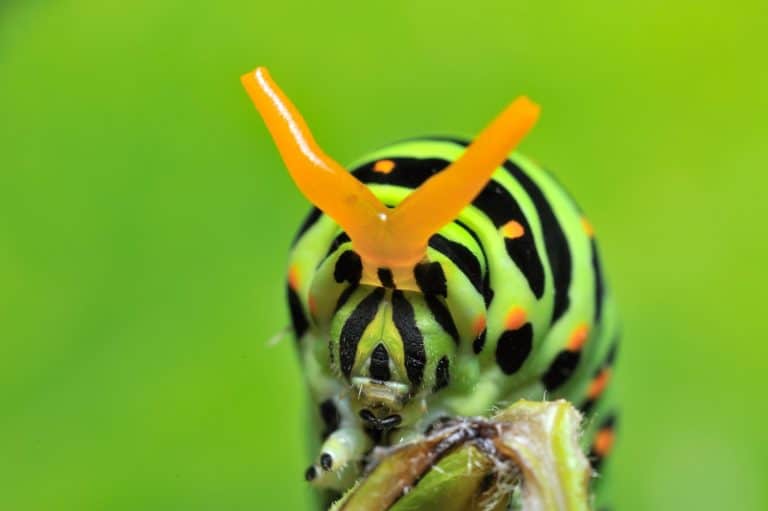
Towards the end of the clip, you see the caterpillar use its osmeterium as a further defense strategy. This is an organ located in the first body segment of swallowtail butterflies. When a potential predator approaches, the caterpillar pops out two bright red or yellow ‘horns’ that look a bit like a forked tongue. The osmeterium consists of tubular arms that are either everted or retracted by internal pressure generated by body fluids.
At the same time, a bitter, smelly, volatile fluid is ejected. The main component of this fluid is Germacrene A, which is a volatile organic hydrocarbon. Scientists have identified several other chemicals in the secretion, though research is ongoing to fully characterize its complex composition. Luckily, this is often enough to deter the predator from attacking!