Quick Take
- New vertebrate fossils reveal a more ancient mega-shark years before Megalodon
- This mega-shark was found in Australia
- The finding rewrites the historical timeline of shark evolution
Long before Jaws, long before Megalodon, and even long before Tyrannosaurus rex prowled the land, a colossal shark patrolled the ancient seas of what is now northern Australia. New research reveals that this formidable creature—stretching an estimated 18 to 24 feet (6 to 8 meters)—was not an early experiment in shark gigantism but one of the earliest modern megapredators to evolve.
And according to Dr. Benjamin Kear, Senior Curator at the Swedish Museum of Natural History and one of the study’s authors, it rewrites the timeline for when modern sharks began throwing their weight around.
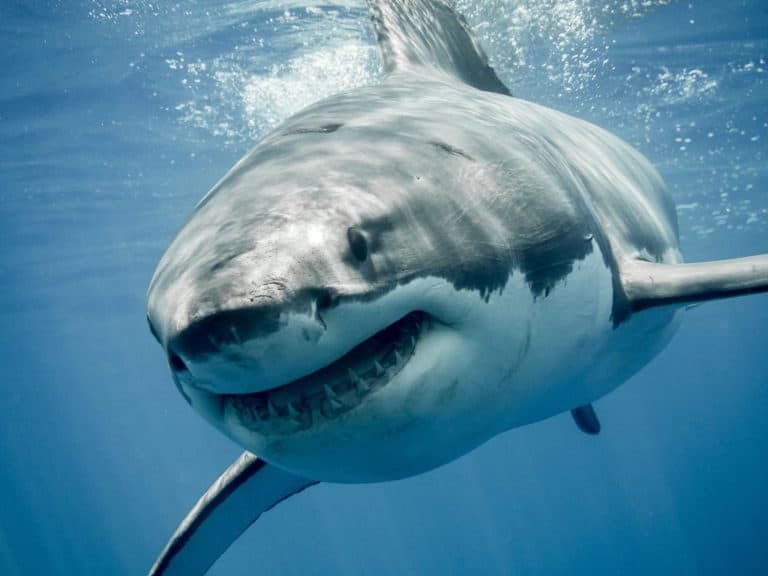
“Simply put, the new fossils reveal that modern sharks – meaning the shark lineages still living in the oceans today, and in this case, specifically lamniforms or Mackerel sharks, which include iconic Great white – can trace their ecological evolution as gigantic apex predators back 115 million years to the Age of Dinosaurs,” Kear tells A-Z Animals. “This pushes back previous records by more than 15 million years and uniquely associates the earliest modern shark mega-predators with higher-latitude, cooler water oceanic environments. Such settings are strikingly similar to living great white habitats.”
That revelation doesn’t just reposition a date on the evolutionary calendar. It suggests that modern shark gigantism—famously represented today by the great white—may have roots in habitat, climate, and a taste for big prey far earlier in Earth’s history than previously expected.
A giant hidden in a handful of bones
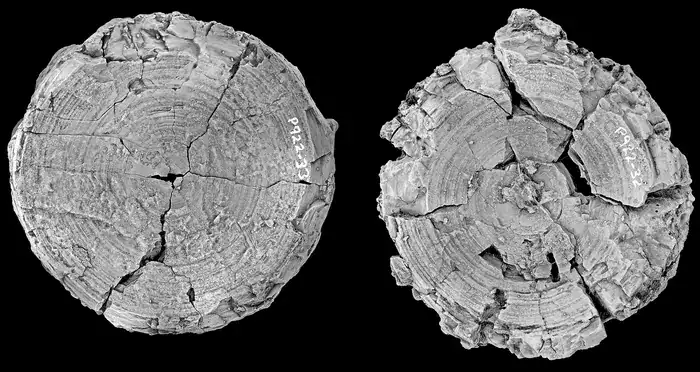
The 115-million-year-old gigantic shark vertebrae studied by Kear and colleagues.
The team’s evidence comes from a modest but remarkable set of fossils: five enormous shark vertebrae unearthed along the shorelines near Darwin, Australia. Each vertebra is over 4.5 inches (12 cm) across, huge compared to the eight-centimeter vertebrae of a fully grown great white.
From the outside, these bones already hinted at something massive. But the researchers wanted to go deeper.
“We used micro-CT scanning to visualize not only the external, but also internal anatomy of the vertebrae without damaging the precious fossils,” Kear explains. The scans “revealed a suite of features that unambiguously identified the Darwin Formation vertebrae as being a cardabiodontid,” referring to an extinct family of giant lamniform sharks known for their predatory teeth and far-ranging distribution.
This part of the story matters because cardabiodontids were apex predators wherever they swam. “Cardabiodontid remains have been found virtually worldwide and especially in Australia (where the group was first discovered), suggesting that the ancient southern oceans might have hosted their evolutionary origins,” Kear adds.
Once the identity was established, the team faced a second challenge: estimating the size of a shark based on only a handful of vertebrae.
Kear said that older studies often relied on tooth measurements or rough scaling. This time, however, the team took a different approach. “Previous approaches to estimating body size in extinct sharks such as this have typically proposed extrapolations based on tooth and/or vertebra measurements,” he notes. “We alternatively sourced a novel dataset of fisheries catch information that collated length, mass and vertebral dimensions for a range of living lamniform species and then used a rigorous statistical approach to comparatively estimate length and mass for a range of gigantic fossil sharks. This took into account the effects that different comparative shark body shapes might have on predicting body size in these extinct species.”
The result? A shark larger than most great whites alive today, already massive during the early Cretaceous, long before later giants like Cretoxyrhina or Megalodon.
Who was this predator?
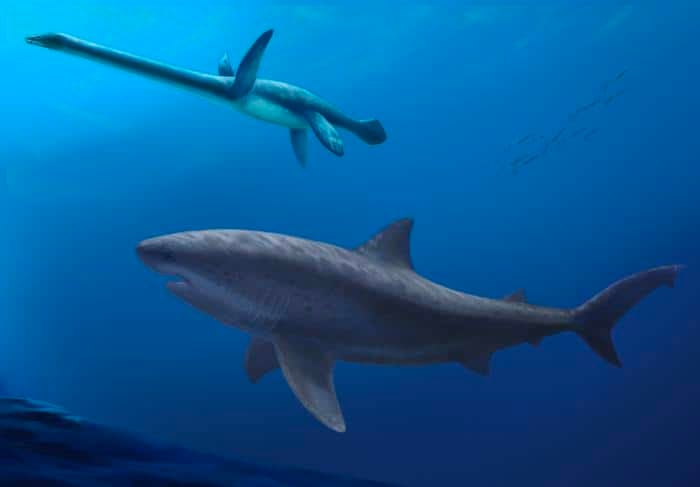
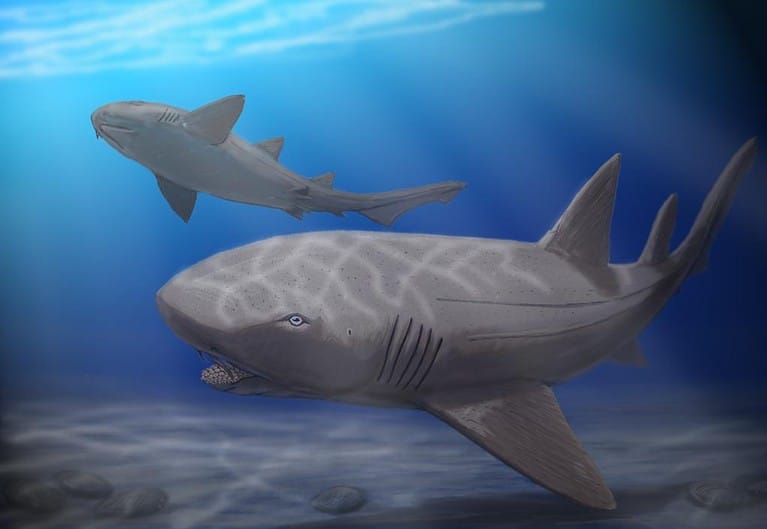
Who was this ancient mega-shark?
©Polyanna von Knorring, Swedish Museum of Natural History – Original / License
The ancient oceans surrounding Australia 115 million years ago were anything but quiet. They teemed with long-necked plesiosaurs, sleek ichthyosaurs, and huge bony fish, classic denizens of the dinosaur-era seas. But something crucial was missing from the fossil record of this particular region: other giant marine predators.
That opened a tantalizing possibility.
Kear says he envisions the newly identified shark as “an ancient ecological analogue of living Great whites and the extinct ‘Megalodon’ (which live some 110 million years later) in that it would have been a top predator in its marine community,” he elaborates. “Based on size and what we know about cardabiodontid teeth, they probably hunted large fish and marine reptiles, which incidentally, have also been found as fossils in the same Darwin Formation deposits.”
But the most intriguing twist comes from what isn’t found there.
Kear notes the “apparent absence of any equally gigantic marine reptile apex-predators, and especially the enormous 11 m long pliosaurid plesiosaur Kronosaurus,” despite living in the same time and region. Instead, Kronosaurus is known only from fossils in adjacent inland seas.
To Kear, that divide might not be accidental. “Perhaps since the fossils of Kronosaurus are only known from the adjacent inland sea environments that covered what it now the Australian landmass, gigantic cardabiodontid sharks might have already occupied this role and thus dominated more oceanic settings like those represented by the Darwin Formation,” he adds.
In other words, the earliest modern mega-sharks may have carved out a top-predator niche long before the Cretaceous seas became home to later giants.
Simply put, the new fossils reveal that modern sharks…can trace their ecological evolution as gigantic apex predators back 115 million years to the Age of Dinosaurs.
Dr. Benjamin Kear, Senior Curator at the Swedish Museum of Natural History
A new map for finding ancient sharks
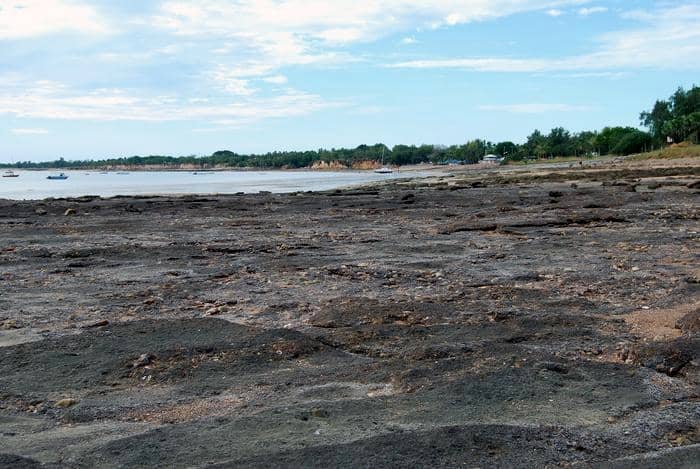
The 115-million-year-old sea floor deposits in Australia, where the shark fossils were found.
Discovering a mega-shark fifteen million years earlier than expected changes more than just timelines; it changes search patterns.
“We can now target older fossil-bearing deposits to track the adaptive ancestry of increasing body size in modern shark evolution,” Kear adds. “We can also concentrate on more offshore environmental settings because these seem to be where larger body-size was advantageous.”
But the next phase of research isn’t just about finding bigger sharks. It’s about understanding the evolutionary chessboard of ancient marine ecosystems.
Kear and his colleagues are now chasing larger questions. “Our research team is actively investigating how sharks, aquatic reptiles, and bony fishes all interacted and shaped marine communities from the Age of Dinosaurs, and what implications this might have for understanding large-scale biodiversity change both in deep time and today.”
A shark legacy older—and colder—than expected?
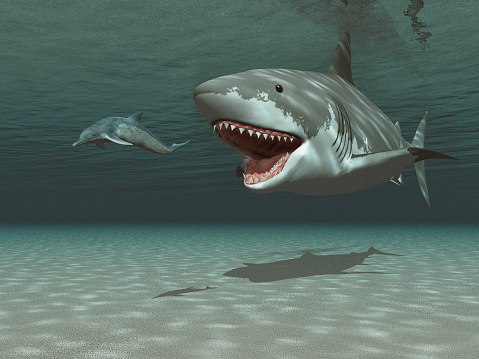
3d illustration of a megalodon chasing a kentriodon
©estt/ via Getty Images
The discovery of this Cretaceous super-shark paints a picture of modern shark evolution that is both older and more complex than previously believed. Rather than emerging in the mid-Cretaceous, the first gigantic lamniforms were already patrolling cooler, higher-latitude waters 115 million years ago, testing out strategies later perfected by great whites and echoed in the enormous Megalodon.
Far from being a modest early lineage, these sharks were powerful, specialized hunters living alongside giant marine reptiles, and sometimes dominating the same waters.
As Kear puts it succinctly: “The earliest modern shark mega-predator shared the oceans with a host of equally gigantic marine reptile mega-predators, suggesting that they effectively carved out a niche in ecosystems that were otherwise dominated by aquatic tetrapods.”
For a creature known only from five vertebrae, that’s an impressive legacy.