
Quick Take
- Secretary birds serve as a “living thermometer” for the African savanna because their nesting success directly reflects the health of the grassland ecosystem.
- The species is currently classified as Endangered by the IUCN.
- Recent GPS tracking reveals that female secretary birds require a hunting radius of up to 18.6 miles.
- By monitoring these birds as an early-warning system, researchers can gain real-time data on how climate change and land-use shifts are impacting the entire biome.
In the vast golden grasslands of sub-Saharan Africa, the secretary bird makes an unforgettable sight — long-legged, crested, and stalking the savanna with deliberate, high-stepping precision. Famous for stomping venomous snakes, this elegant raptor has long been admired as a specialist predator. But new research suggests it is something more: a living thermometer for the African grassland.
Because secretary birds are so finely tuned to rainfall, grass health, and open space, their nesting success functions as a real-time ecological report card. When the savanna suffers from erratic rainfall, shrub encroachment, or fragmentation, the secretary bird is among the first species to signal distress.
A Terrestrial Specialist
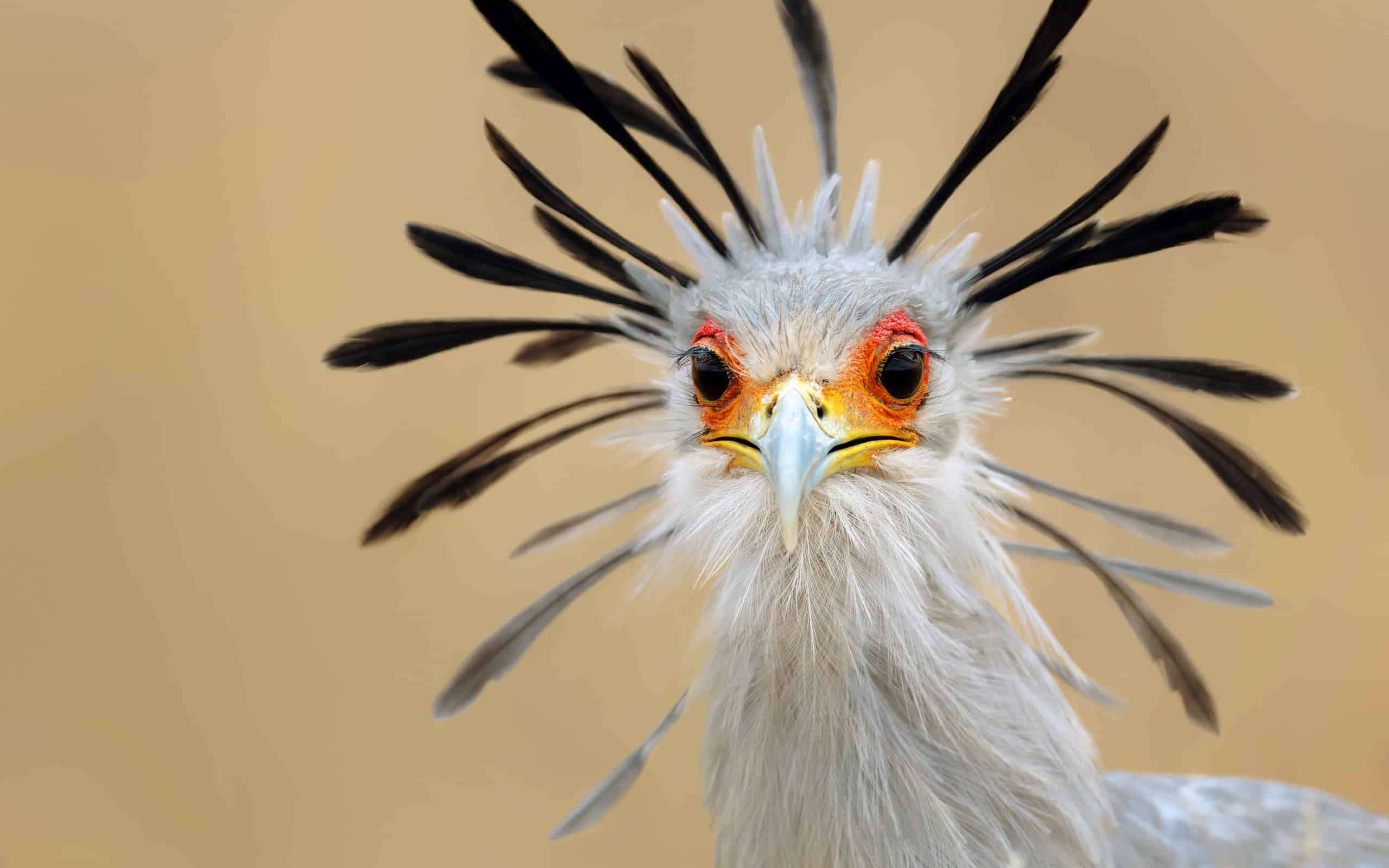
Although they can fly, secretary birds (Sagittarius serpentarius) spend most of their lives on foot. Standing over 4 feet tall, their powerful legs allow them to stride through tall grasses with grace, dispatching prey — including cobras — with stunning force and accuracy.
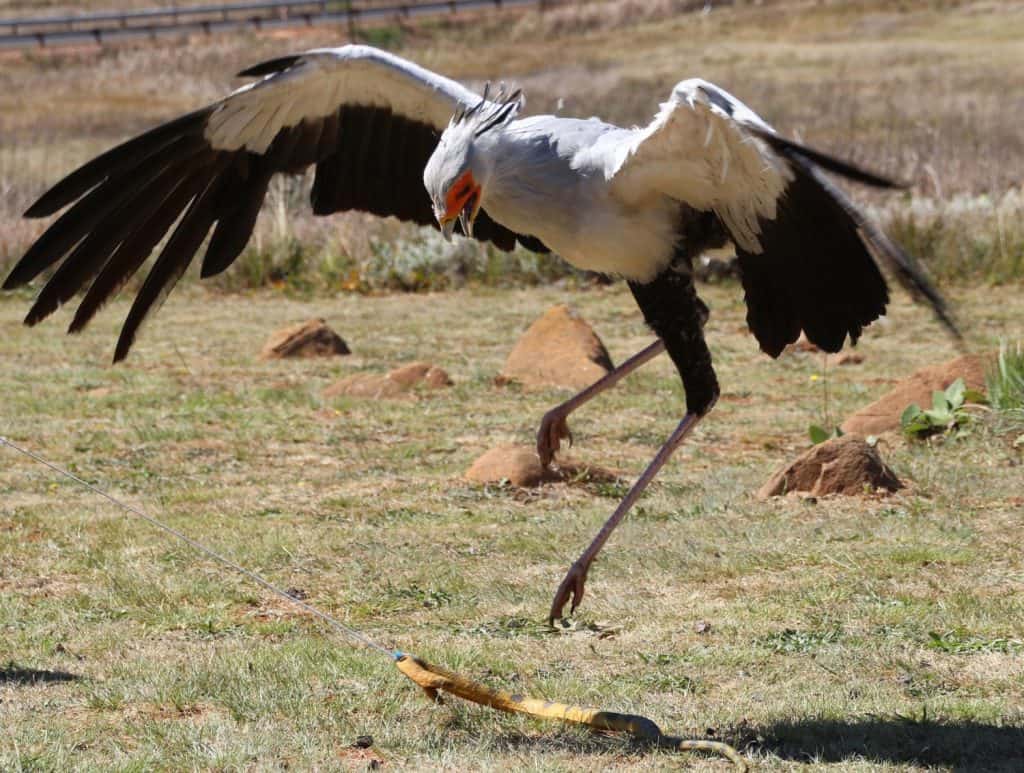
Secretary birds eat birds, small mammals, large insects, and reptiles.
©Mike van Kal/Shutterstock.com
Evolutionarily, secretary birds are outliers. In fact, they are so distinct that they hold a high EDGE score (Evolutionarily Distinct and Globally Endangered). Unlike hawks or eagles, secretary birds are specialized masters of open landscapes. This specialization, however, also makes the birds hostages to their environment. Any shift in the continuity of the grassland is immediately reflected in the birds’ biological success.
Survival for the secretary bird is essentially a struggle for open space. These terrestrial animals require wide, uninterrupted spaces to hunt effectively on foot. Unfortunately, they face two major threats to their open habitats. First, roads and farms are carving the savanna into isolated patches. This fragments the birds’ habitats, triggering steep declines in nesting success. Second, rising carbon dioxide and altered fire regimes are fueling woody plant encroachment. This process transforms open grasslands into dense shrublands, which conceal prey and obstruct the birds’ movement. Researchers found that secretary birds had a 71 percent success rate in wide-open, unfragmented grasslands, but only 18.9 percent in areas broken up by thick brush. For a bird adapted to walking and hunting across wide open horizons, even subtle landscape shifts have immediate biological consequences.
Watching Secretary Birds in Real Time
In 2025, a research team led by Dr. Megan Murgatroyd successfully fitted three adult secretary birds with GPS transmitters, providing new insights into their movement and habitat use. This allowed researchers to observe the daily survival strategies of a breeding family in real time. Combined with intensive nest monitoring, the results revealed both vulnerability and resilience.
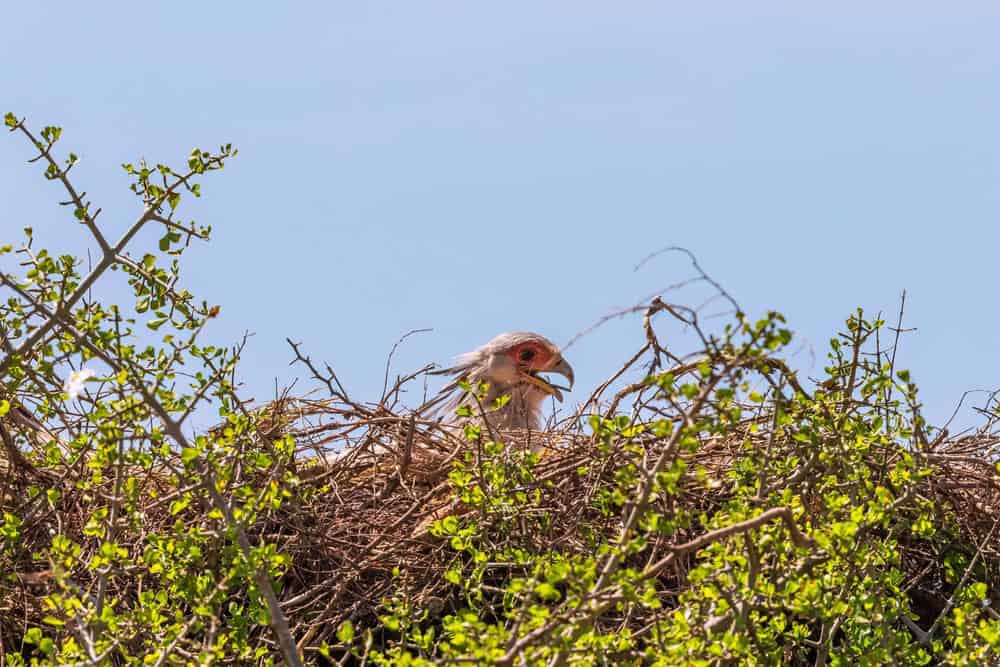
Secretary birds build their nests at the top of acacia trees.
©Lasse Johansson/Shutterstock.com
Of the ten monitored pairs, six successfully had chicks — a significant rebound from the previous season, when most nests failed due to environmental stressors.
Most striking was a nest at Papkuilsfontein Guest Farm, where three large, healthy chicks were raised — the maximum biological limit for the species. This success was not random. The farm’s conservation-minded management maintained connected grasslands and ecotonal transition zones, allowing the birds to fully capitalize on seasonal rainfall.
Rainfall, Range, and “Invisible Walls”
Rainfall is the primary engine of life in the savanna. Consistent rainfall triggers grass growth, which fuels explosions in insect, rodent, and reptile populations — the prey base that sustains secretary birds and their chicks. This abundance allows the birds to transition from mere survival to the high-energy demands of reproduction.
The GPS data shattered assumptions about how much of this rain-fed land secretary birds need. Researchers discovered a distinct division of labor between the sexes: while males tend to stay within 4.35 miles of the nest, females regularly travel up to 18.6 miles to find food during the breeding season.
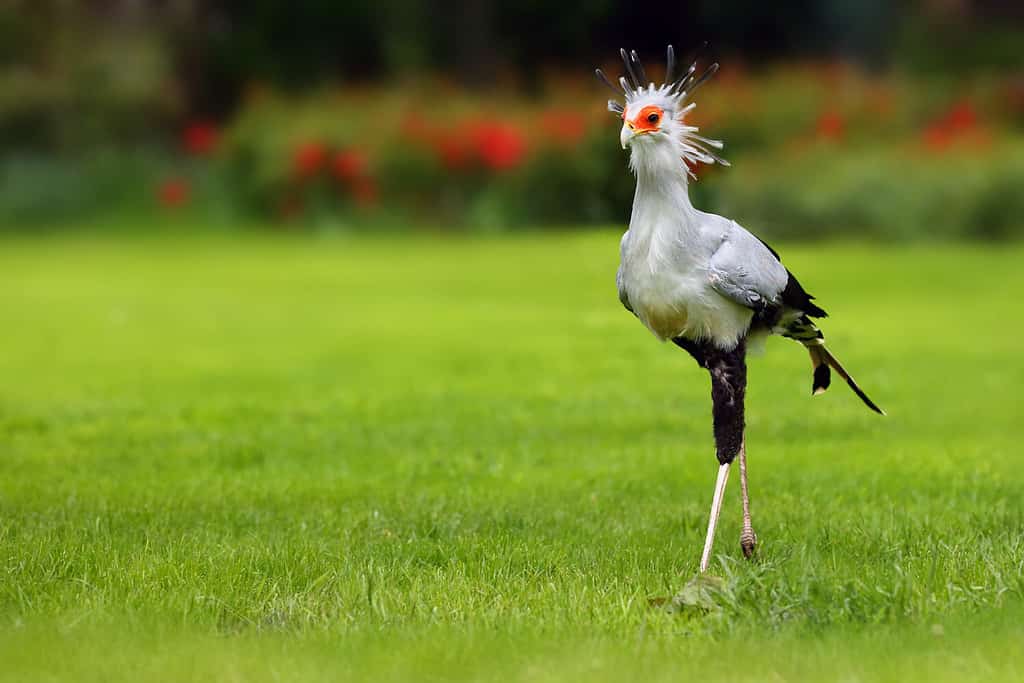
Secretary birds lay between one and three eggs.
©Karel Bartik/Shutterstock.com
This discovery proves that small nature reserves are insufficient for secretary birds. A 6.2-mile-wide reserve may appear sufficient on paper, but if a female requires an 18.6-mile hunting radius to sustain her chicks, that reserve effectively becomes a trap rather than a refuge.
Climate change and habitat fragmentation also amplify each other, drastically affecting the survival of the secretary bird. A drought that might be survivable in a vast, continuous savanna becomes a death sentence in a small, isolated patch, where resources are already depleted. These landscape boundaries become “invisible walls,” restricting movement in ways that gradually erode reproductive success.
A Real-Time Climate Report Card
By moving away from chance observations to high-frequency GPS tracking, researchers have transformed the secretary bird into a data-rich ecological sentinel. Its breeding outcomes now provide measurable insight into how rainfall variability, vegetation shifts, and land-use change interact.
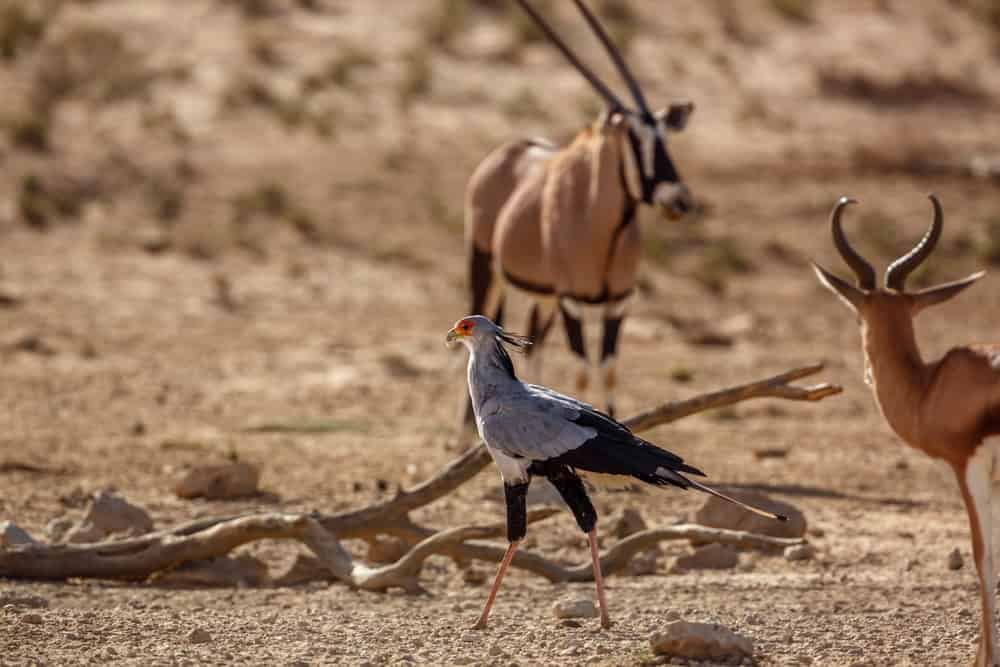
Secretary birds do not have a fixed breeding season.
©PACO COMO/Shutterstock.com
The 2025 season offers hope — but it is only a snapshot, containing a single year of data. Because secretary birds are tightly synchronized with environmental cycles, meaningful conservation requires multi-year monitoring and sustained investment in satellite tracking.
Protecting this species is not only about preventing the decline of a charismatic raptor. It is about preserving an early-warning system for the African savanna itself. The “Savannah’s Canary” is telling us when the grasslands are healthy — and when they are nearing ecological limits. Listening means funding long-term research, maintaining vast, connected horizons, and resisting the gradual fragmentation of open space. If we continue monitoring this high-stepping sentinel, we are not merely studying a bird; we are safeguarding the future stability of an entire biome in flux.