
Quick Take
- Everything scientists thought they knew about raptor territory just got overturned by one of the smallest birds of prey on Earth. See the territory findings →
- Pygmy falcons let another bird species build and maintain their homes, though the arrangement is far darker than it sounds. Explore the nest arrangement →
- A technology limitation kept these falcons scientifically invisible for decades, and what researchers found once that barrier lifted turned out to be unexpected. Discover what GPS uncovered →
- Conservationists may be applying the wrong playbook to protect pygmy falcons, and the consequences of that mismatch are quietly growing. Understand the conservation gap →
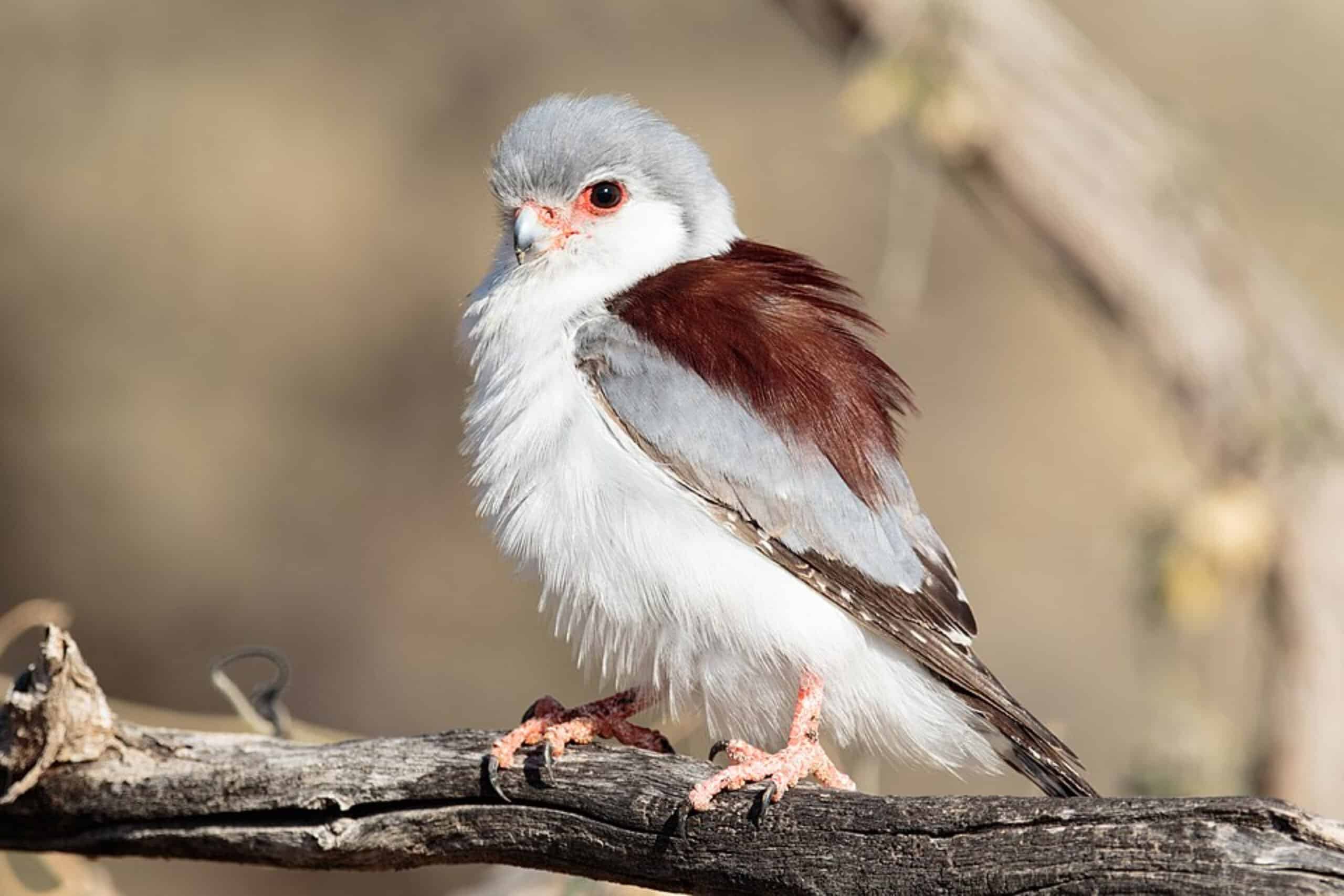
Raptors are often thought of as only being large birds of prey. However, some, such as the pygmy falcon, weigh less than three ounces. The spatial needs of these tiny falcons have only recently been studied, and the results are rewriting what scientists know about raptors.
Pygmy Falcons Demonstrate How Little Range Is Needed to Raise Young
It has long been believed that birds of prey need a great deal of territory, something that is especially true during nesting season. This belief arose from tracking large birds of prey, which, indeed, need space. However, this does not hold true for all raptors, as the pygmy falcon recently revealed to researchers.

Pygmy falcons need just 0.36 km² during the nesting season.
©EcoPrint/Shutterstock.com
According to a new study published on June 24, 2026, pygmy falcons have an incredibly small range when raising young. These raptors fly less than a square half mile from their nest, showing just how small a territory is needed when hatchlings are present.
To determine the falcons’ range, researchers from the University of Cape Town, Hartpury University, and the Forest Science and Technology Centre of Catalonia fitted 13 adult pygmy falcons with a GPS device. Over three years, the falcons were observed between October and December. During this time, the range did not change, overturning what researchers thought they knew about the spatial needs of birds of prey.
What GPS Tags Reveal About Pygmy Falcons
Pygmy falcons are small birds. With an average size of 7.9 inches and weighing no more than 2.9 ounces, the GPS tags used for other birds were far too heavy. It was not until recently, according to the study, that technology advanced enough to create small GPS tags capable of tracking the movements of small birds. The tags affixed to the pygmy falcons for short-term observation weighed approximately 4% of the falcons’ body weight.
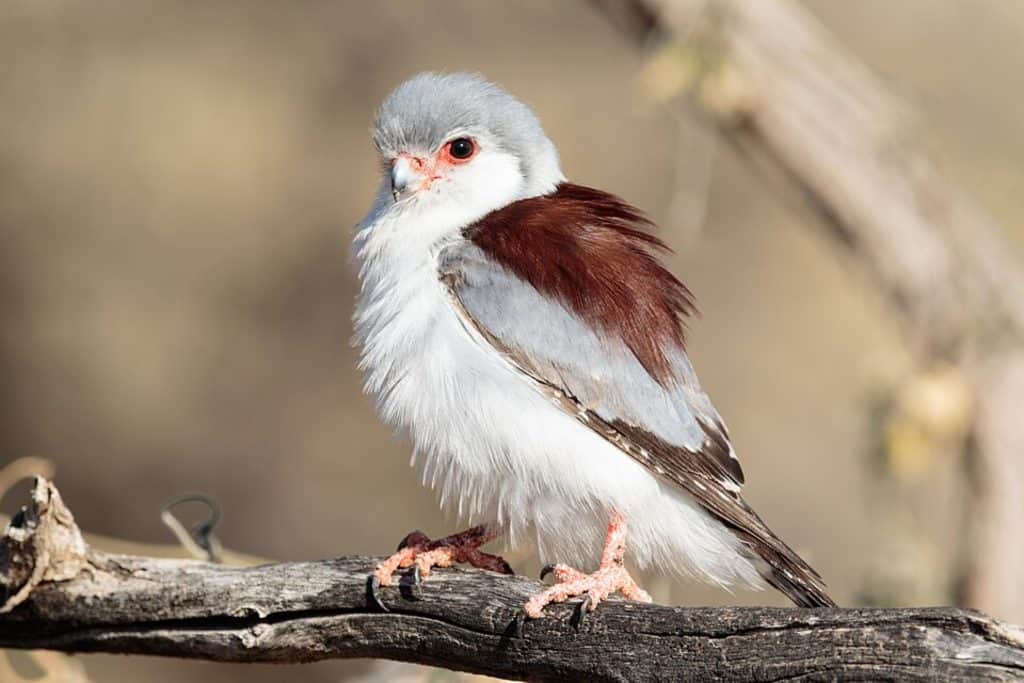
Pygmy falcons were not capable of being tracked in the past because GPS tracking technology was too heavy for the small birds.
©Stephen Temple from Cape Town, South Africa, CC BY-SA 2.0 , via Wikimedia Commons – Original / License
Researchers received 4,000 GPS locations over their three years of tracking the pygmy falcons. During the period when chicks were being raised, the pygmy falcons did not stray beyond an area of 0.36 square kilometers (km²). To put this in perspective, South Africa’s other small raptor, the lesser kestrel, which weighs up to six ounces, has a range 14 times larger than the pygmy falcon.
This small territory that pygmy falcons inhabit during nesting season is just the first of their territories to be explored. The same technology will be used in future studies to determine whether the range of pygmy falcons increases when there are no chicks to attend to.
Why Do Pygmy Falcons Rely on Sociable Weavers for Nest Building?
Unlike larger falcons, pygmy falcons do not build nests. Instead, they rely on sociable weavers and their nest-building skills for a place to live and raise their young.
Sociable weavers build communal nests. These nests have dozens of chambers in which the sociable weavers live year-round. Surprisingly, they do not mind pygmy falcons living with them. This likely has to do with the mutually beneficial relationship the two bird species have with one another.
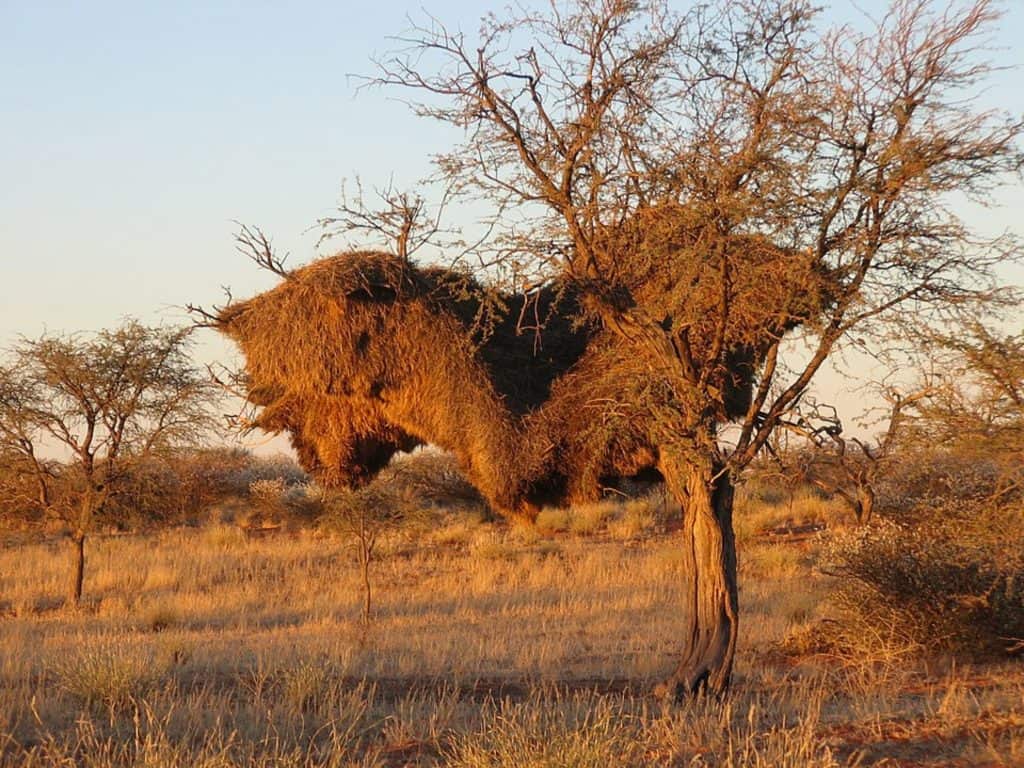
Sociable weavers create massive nests that are shared with pygmy falcons.
©Harald Süpfle, CC BY-SA 2.5 , via Wikimedia Commons – Original / License
Pygmy falcons live in communal nests to protect themselves from the wild swings in temperature between day and night during the breeding season and, for some, year-round. The sociable weaver nests maintain a consistent temperature that allows incubation of the falcons’ eggs. Consequently, the sociable weavers give up 12% to 25% of their nests to the pygmy falcons.
To assist the sociable weavers during nesting seasons, pygmy falcons aggressively defend the nest’s chambers. Most often, it is snakes that attempt to infiltrate the nest in search of eggs. Therefore, the more pygmy falcons that live in the sociable weavers’ nesting site, the better the weavers’ chances of successfully hatching their young.
The relationship between the weavers and the falcons benefits the falcons more than the weavers. This is because the pygmy falcons are opportunistic hunters. They might be protecting the nest from snakes, but if given the chance, the falcons will eat both the sociable weavers’ eggs and even the weavers themselves.
Threats to Pygmy Falcons
Currently, the pygmy falcon is not listed as a vulnerable species. However, the tiny raptors face several threats that, if not addressed soon, could cause the pygmy falcon to become endangered.
The threats that pygmy falcons face include:
- Habitat loss
- Habitat fragmentation
- Livestock grazing
- Construction
- Climate change
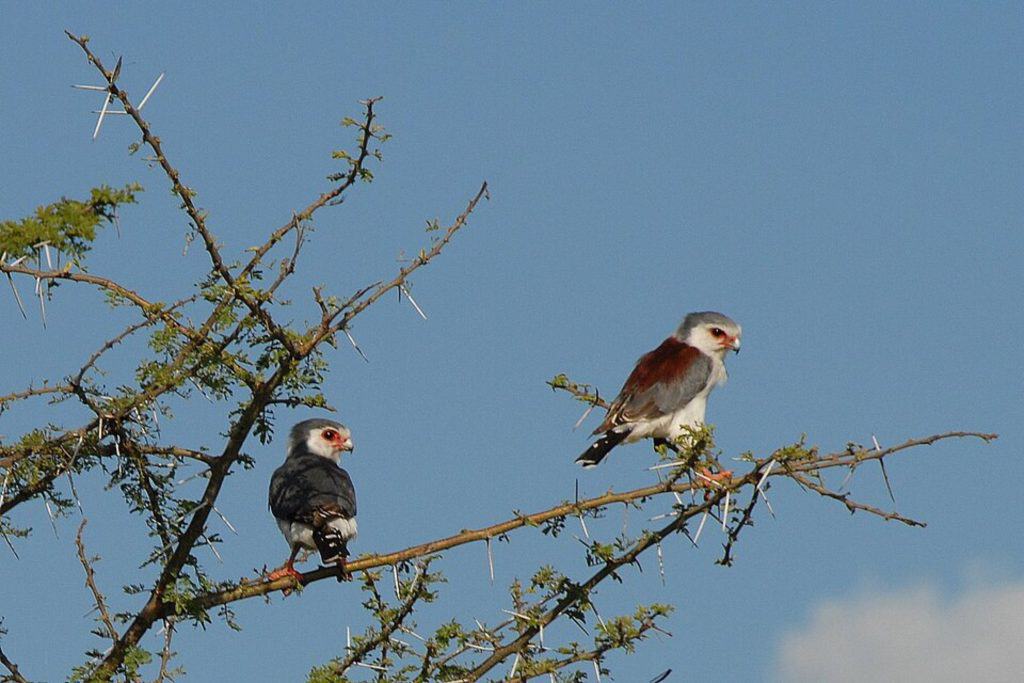
Learning more about the spatial needs of pygmy falcons can help to better conserve them.
©Bob, CC BY 3.0 , via Wikimedia Commons – Original / License
Additionally, pygmy falcons have to compete with other birds for sociable weaver nests to inhabit. If there are no weaver nests available, the falcons are prevented from laying their eggs and potentially surviving.
Because there have been very few studies on the small habitats where pygmy falcons live, some necessary conservation measures may be overlooked. Pygmy falcons have requirements that are similar to, yet distinct from, those of larger falcons in order to thrive in their environments. Understanding these differences will help conservation strategies better reflect the unique ecological needs of smaller raptors.