
Quick Take
- Carolina wolf spiders are the largest wolf spider species in North America
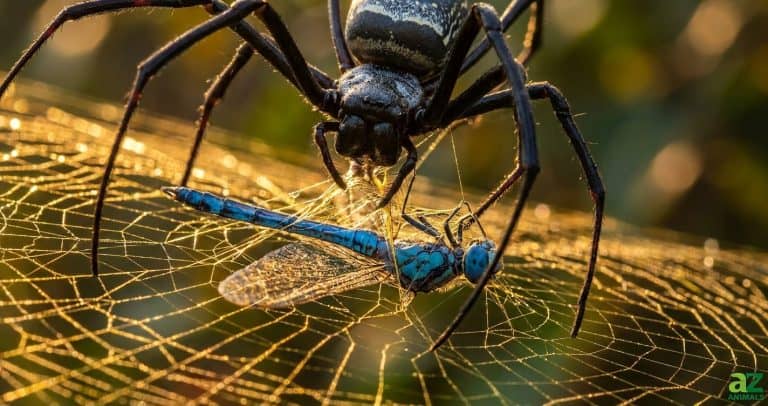
- Golden silk orb-weavers can spin webs that are five feet in diameter.
- Neil Young’s trapdoor spider is a species discovered in 2007 and named after Canadian musician Neil Young.
There are over 100,000 known species of arachnids, and spiders comprise over 50,000 of these species. Spiders are found on every continent except Antarctica, and Alabama is home to a diverse population of spiders, including some exceptionally large, intimidating species like the Carolina wolf spider and various orb weavers. Despite their often-frightening size and appearance, these large spiders are harmless to humans, possessing venom designed only for insects. The vast majority of spiders encountered in the state pose no threat, with only the black widow and brown recluse recognized as having venom that is medically significant. Continue reading to learn about five of the largest spiders in Alabama.
Giant House spider
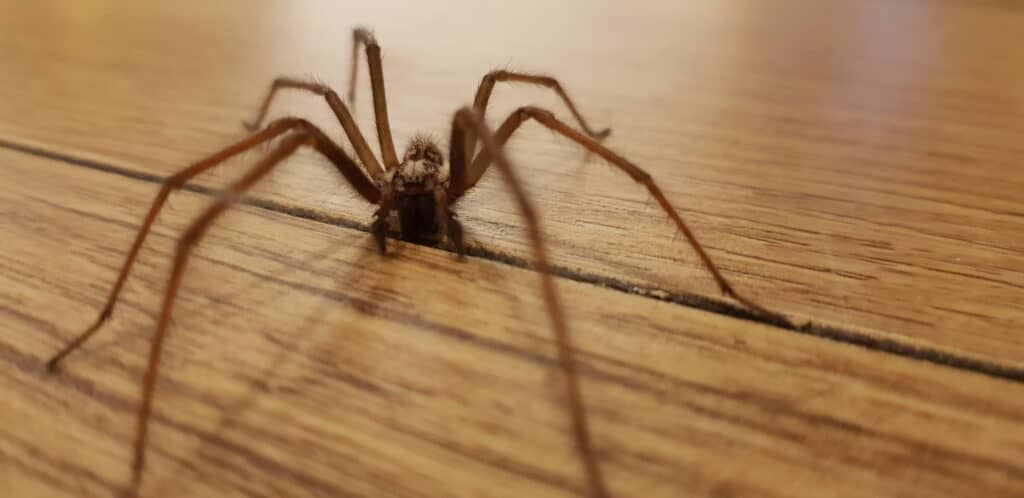
A close-up shot of a giant house spider on a wooden floor
©iStock.com/George Inguanez
The giant house spider (Eratigena atrica) is a large, brown, hairy spider with dark, patterned abdomens, known for creating sheet-like funnel webs.
Female giant house spiders have bodies up to 0.73 inches long and total legspans between 2 and 4 inches, while males have slightly smaller bodies but longer legs.
Giant house spiders prefer dark, damp, undisturbed habitats like basements, garages, and woodpiles, often found near human dwellings. Their bites cause a sharp, initial pain, followed by itching, redness, and swelling. While they are capable of biting, they are not aggressive and rarely do so unless cornered or handled. Their venom is considered medically insignificant to humans.
Neil Young’s Trapdoor Spider
Neil Young’s trapdoor spider (Myrmekiaphila neilyoungi) is considered the largest trapdoor spider in Alabama. Biologist Jason Bond named the new species of trapdoor spider he discovered in 2007 after the musician Neil Young because he appreciated the singer’s music and his activism for peace and justice. Like other trapdoor spiders, Neil Young’s trapdoor spider digs a hole to hide from predators and ambush prey. It uses a silk trapdoor to conceal its burrow, leaping out to catch prey that is moving past. The spider uses vibrations in the ground to sense prey.
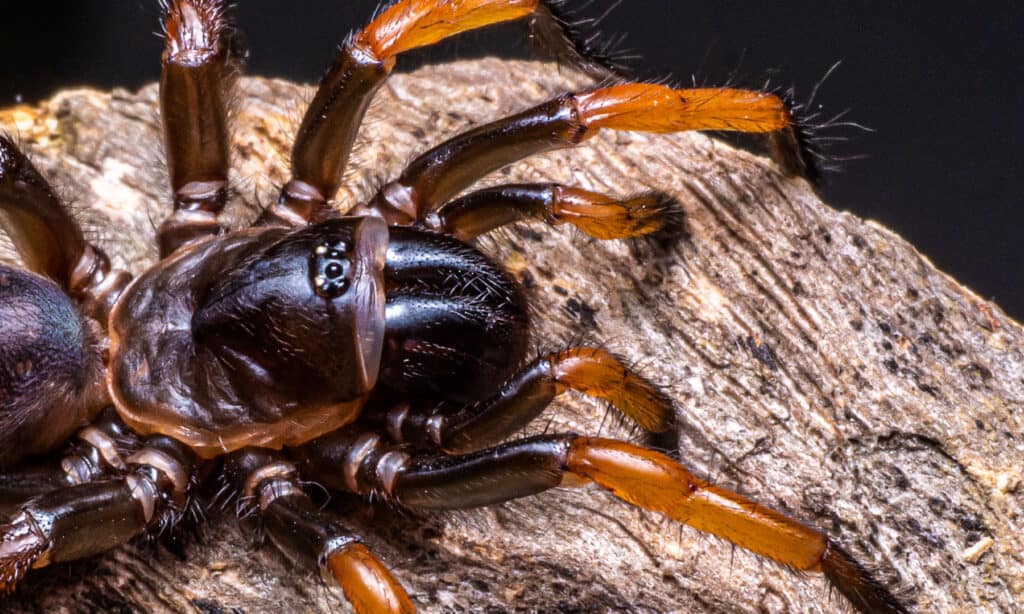
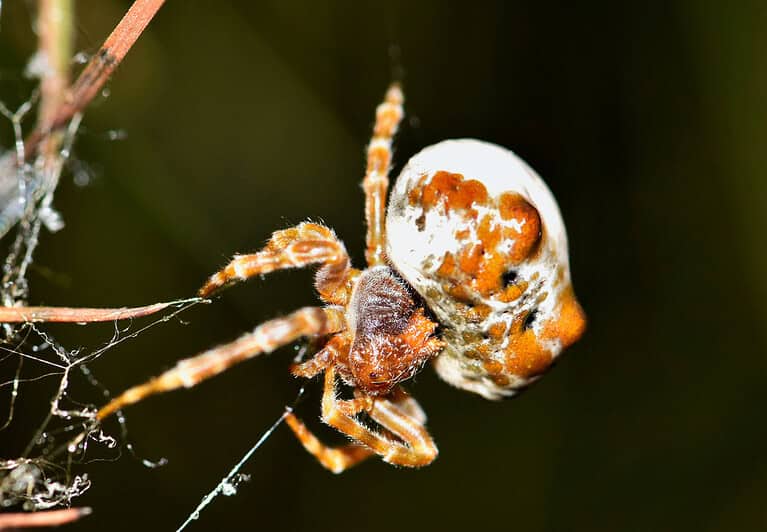
Neil Young’s trapdoor spider has legs that range in color from orangish-brown to pale to dark brown. It is an average-sized trapdoor spider, with a legspan ranging from 0.94 to 1.57 inches.
Neil Young’s trapdoor spider bites may cause mild pain and localized swelling, similar to a bee sting. Their venom is used to subdue insects, liquefying the prey’s insides for ease of consumption. These spiders are shy and sedentary, living in silk-lined underground burrows, making bites to humans rare.
Dark Fishing Spider
A large, non-web-building hunter found near water or wooded areas, the dark fishing spider (Dolomedes tenebrosus) features mottled brown/gray coloring with dark chevron markings. Females have bodies roughly 0.6 to 1.25 inches long, with a legspan of up to 4 inches. They are active predators, often ambushing prey by waiting on vertical surfaces or using their legs to detect vibrations on the water’s surface.
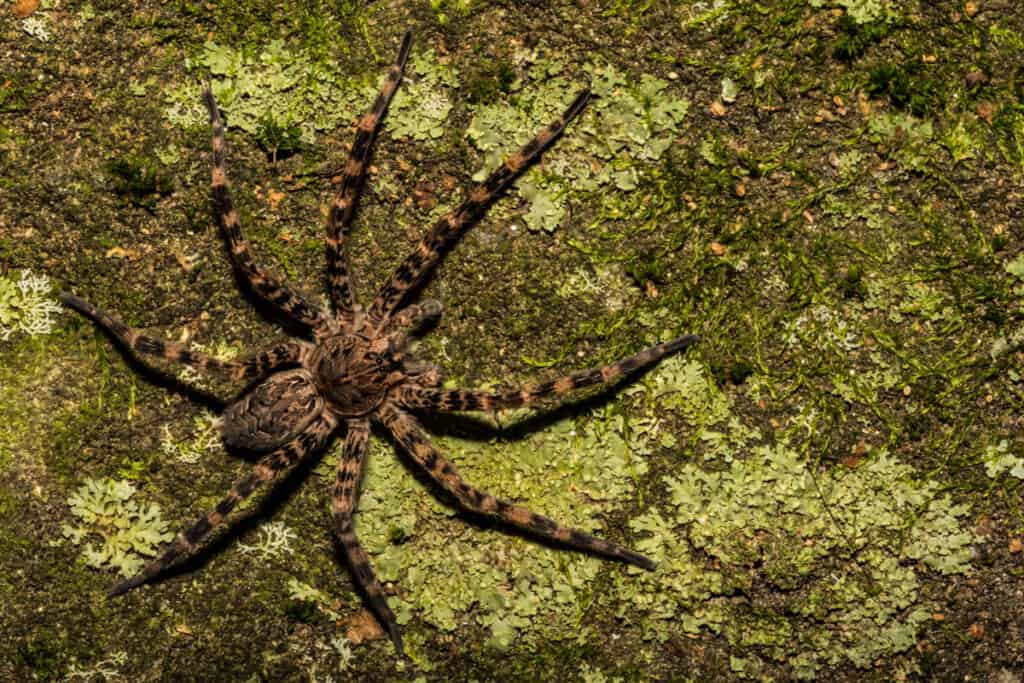
The dark fishing spider can run across the surface of water or dive into the water to catch prey.
©iStock.com/JasonOndreicka
Dark fishing spiders rarely bite humans, usually only doing so if handled or threatened, causing pain similar to a wasp sting.
Carolina Wolf Spider
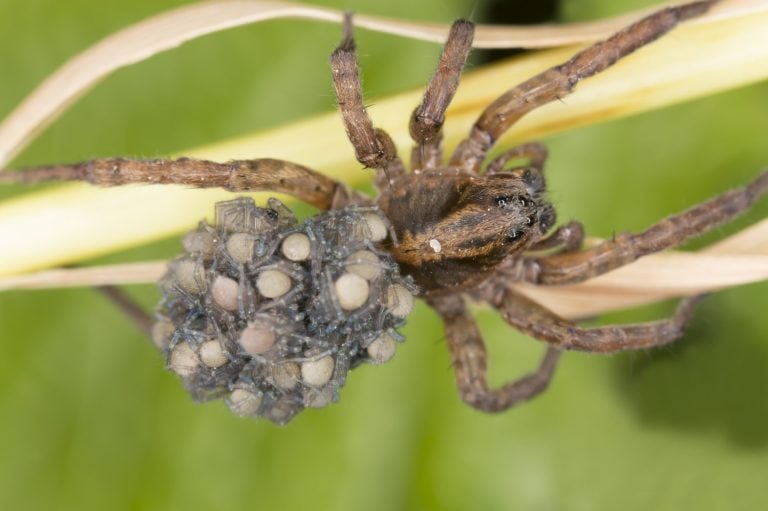
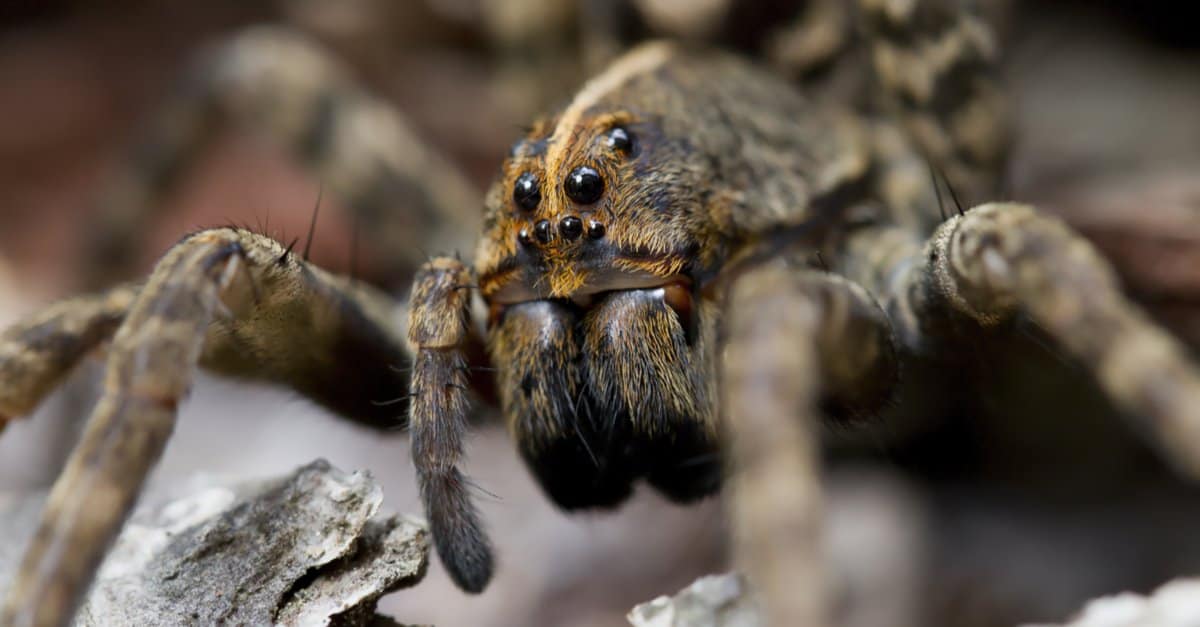
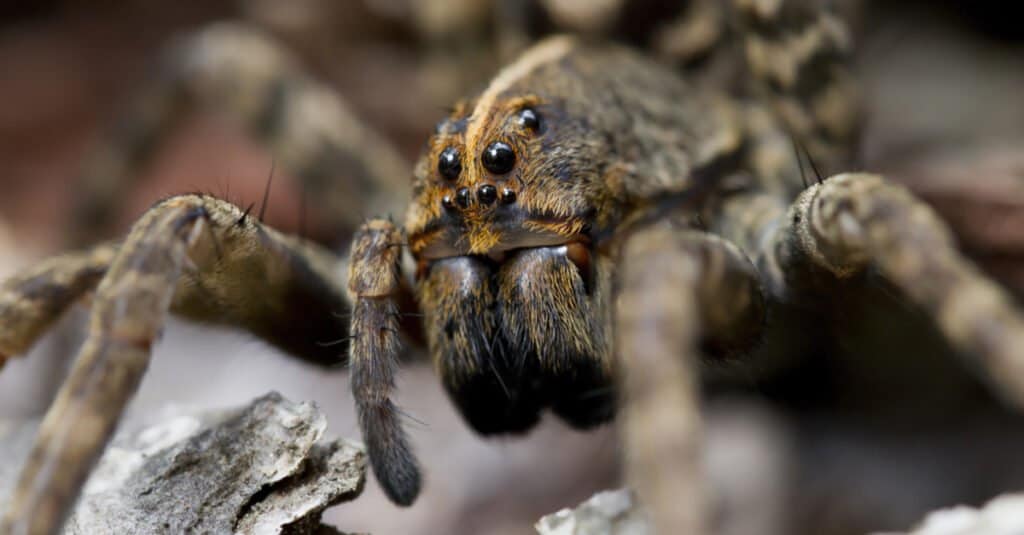
Among the largest spiders in Alabama is the Carolina wolf spider (Hogna carolinensis). Female Carolina wolf spiders can have a body length of up to 1.37 inches, with legspans approaching four inches. Males of the species are notably smaller, with a body length of 0.70 to 0.78 inches. Females carry their egg sacs on their spinnerets, which can make them appear much larger than they are. The Carolina wolf spider is North America’s largest wolf spider, with a total legspan reaching up to 4 inches.
Carolina wolf spiders have a mottled, cryptic coloration designed for camouflage, featuring shades of brown, gray, and black. They typically display a darker brown or blackish stripe along the abdomen and back. Their underside is often solid black, while the legs may have alternating dark and light bands.
©Will E. Davis/Shutterstock.com
The Carolina wolf spider is an expert hunter. It is an ambush predator that actively seeks its prey and attacks rather than waiting for it to become entangled in a complex web. Although it is possible to spot a Carolina wolf spider during the day, these spiders are primarily nocturnal. Despite their size, humans are generally not harmed by their bites.
Golden Silk Orb-weaver
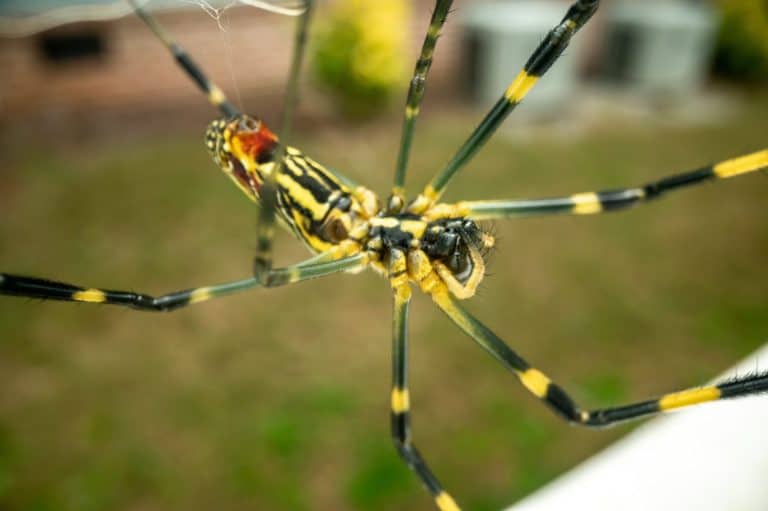
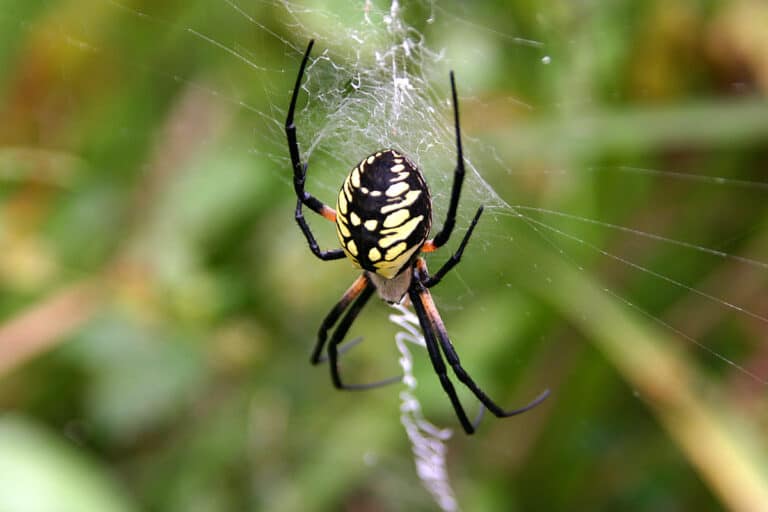
The golden silk orb-weaver (Trichonephila clavipes) is a large orb-weaving spider native to the Southeastern U.S. Females boast body lengths of up to 2 inches, with leg spans of over 4 inches. They are yellow-orange or silvery, with black-banded bodies and distinctive tufts of hair on their legs.
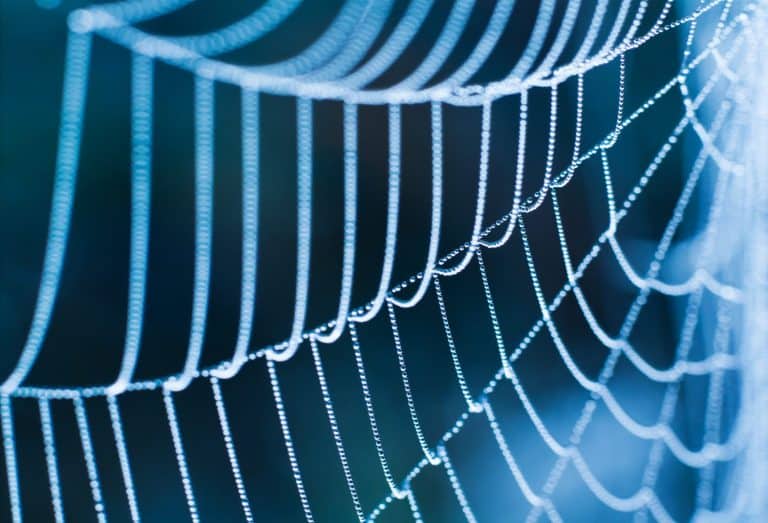
Golden silk orb-weavers inhabit forested areas, preferring the edges of woods, shrubbery, and tall trees for building their large, strong, golden-silk webs, which often measure between three and five feet in diameter.
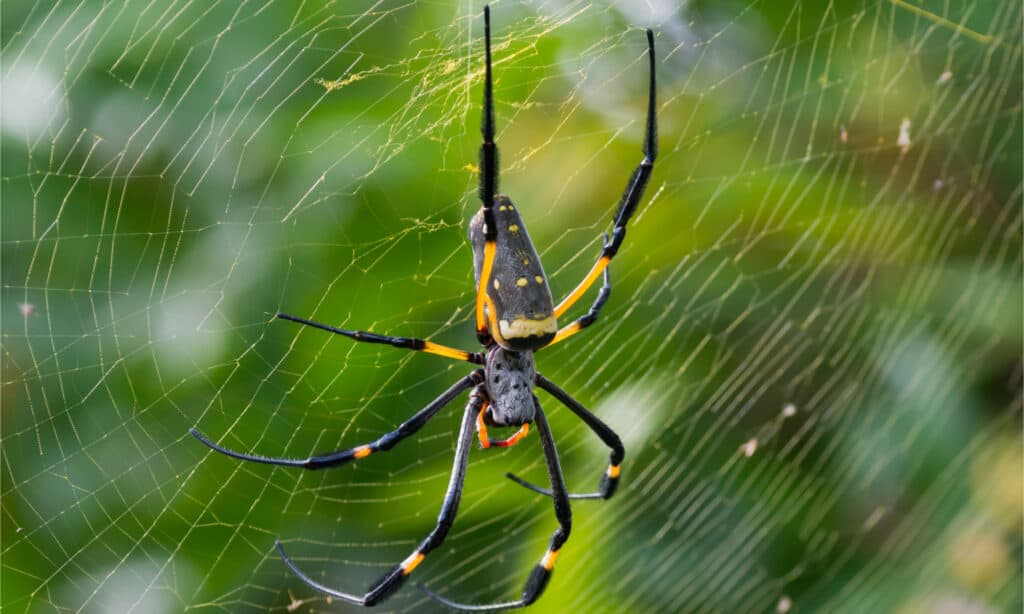
A female golden silk orb-weaver waits for prey to get caught in her web.
©Dave Montreuil/Shutterstock.com
Golden silk orb-weavers rarely bite humans and are not considered aggressive, typically only acting in self-defense. While they possess venom, it is not lethal to humans. Their bites cause localized pain, redness, swelling, and blisters.