Quick Take
- What looks like a brain floating inside the Pacific barreleye's transparent head is actually doing something far stranger. Inside the transparent head →
- Not all barreleyes see the same way. Some species have evolved up to three separate visual systems crammed into one head. Three visual systems compared →
- The way these fish see in total darkness may point engineers toward optical technologies that don't yet exist. Optical technology applications →
If there is anywhere on Earth that still retains true mystery, it’s the ocean. It’s vast and the deeper you go, the stranger the creatures that live there. To see what lives in the ocean’s greater depths is to experience an alien world. While many of the deep-ocean creatures are both fascinating and unsettling, the barreleye family of fish has some of the most incredible attributes of any marine organism. In an environment with little light, this family of fish has evolved surreal senses of vision to see in the dark.
Each member of the barreleye family, Opisthoproctidae, has visual systems that defy our conventional understanding of eyesight and perception. If you remember the aliens from the movie “Mars Attacks!” you might have a sense of just how strange barreleye fish look. They even use telescoping, with tubular eyes lodged in transparent head membranes. The species Macropinna microstoma may steal the spotlight, but each of the barreleye fish features ocular systems adapted to the constraints of the deep ocean. Let’s learn about this fascinating family of fish and how they use a host of visual tricks and techniques to see in almost pure darkness.
Barreleye Background
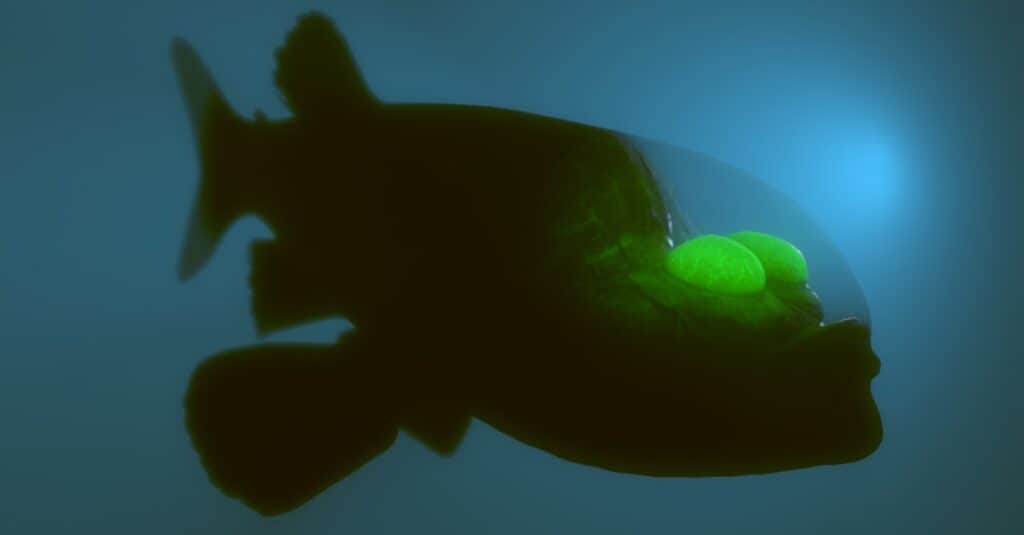
Barreleye fish have unique, tubular eyes situated in transparent, fluid-filled domes.
©iStock.com/3dsam79
Also known as spookfish, barreleyes are small, deep-sea-dwelling fish from the family Opisthoproctidae. Studying fish that inhabit the ocean’s depths is difficult, but scientists know of about 11 barreleye species in the family Opisthoproctidae. These fish have three basic forms: rotund and deep-framed like the genus Macropinna, long and slender like the genus Bathylychnops, and intermediate and dual-tapered, like the genus Rhynchohyalus.
Not much is known about the reproduction of these fish. However, scientists believe that they are pelagic spawners, meaning they typically release eggs and sperm into the water. Fertilized eggs drift towards the surface, and juveniles move through shallower ocean currents. Upon reaching maturity, barreleye fish swim back down to the deep.
Barreleye fish live at varying depths. While some species, such as the glasshead barreleye, are found in relatively shallow waters at depths of around 247 meters, others, like the Pacific barreleye, typically inhabit depths between 600 and 800 meters. Typically, they move through ranges just out of the sunlight’s reach. Therefore, finding food sources like zooplankton and pelagic crustaceans requires unique visual systems. Luckily, barreleyes have developed an incredible range of ocular attributes to help them spot prey, detect predators, and catch the faintest twinkling of natural light that makes it down to the deep.
Real Eyes, Realize
We think of ocular organs as either forward-facing, like humans, or side-facing, like rabbits. However, the barreleye family has eyes facing straight upwards. And while most eyes are round, barreleye eyes are tube-shaped.
These tubular eyes are situated in transparent, fluid-filled cavities. To capture the waning sunlight in the ocean’s depths, barreleye eyes look straight up; this helps them spot the silhouettes of prey moving through the ambient light.
Ways of Seeing
Barreleye fish species basically have three separate visual systems. Perhaps the most famous of these belongs to the Pacific barreleye (Macropinna microstoma), which features large cylindrical eyes equipped with green lenses. Videos of Pacific barreleyes regularly make the rounds on social media because of just how otherworldly the fish look. The way their tubular eyes sit inside a transparent dome on top of their heads gives them an almost brain-like appearance.
Brownsnouts have equally remarkable visual systems, despite not receiving the same acclaim as their Pacific relative. They have eyes with two parts: a main tubular eye facing upward, and a secondary side pouch that looks down. This produces a mirror-like effect; brownsnouts have organic mirrors made of guanine crystals that redirect light and focus it onto a secondary retina.
Glasshead barreleyes, Rhynchohyalus natalensis, have similar systems to brownsnouts. They rely on short but wide tubular eyes that look upwards. These pair with a smooth reflective plate and tunnel that helps them see faint flashes of bioluminescent creatures above.
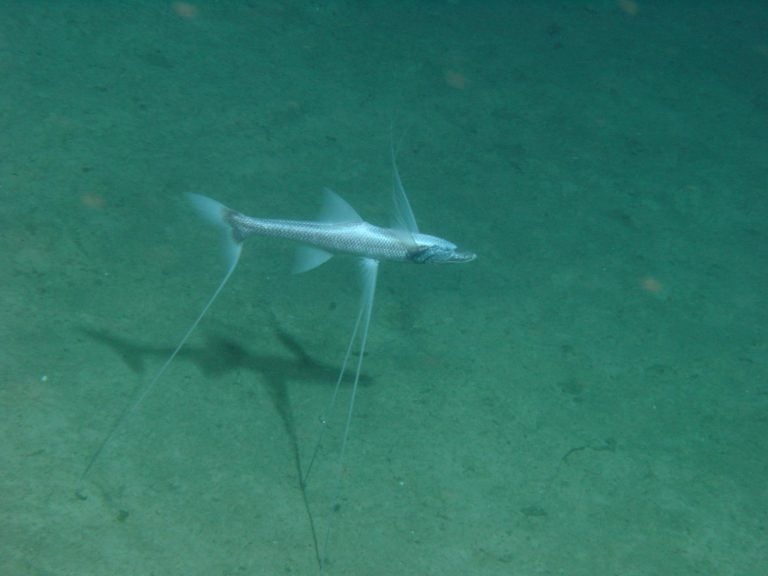
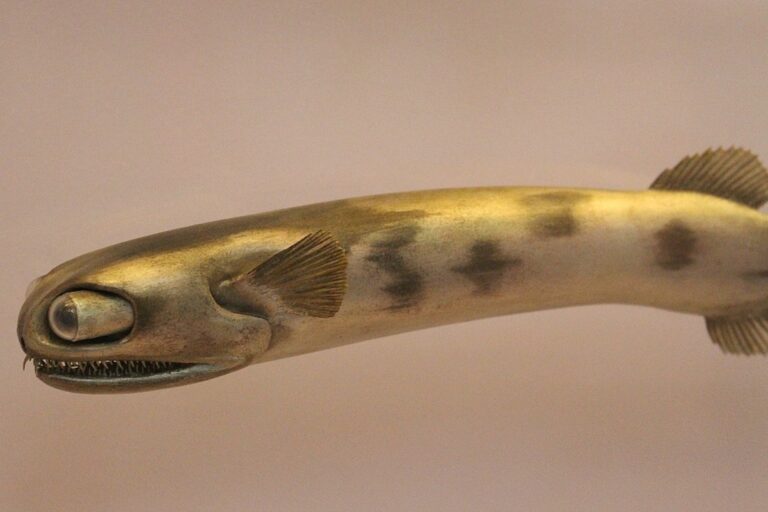
Lastly, we have the tripartite eye systems of javelin spookfish, Bathylychnops exilis. They have a large main eye that faces upward, supported by a secondary spherical bulb lens at the bottom corner. This gives javelin spookfish a multi-directional field of vision to see prey above and spot threats from below.
Top Contenders

The way barreleye fish see could inspire new optical inventions.
©YouTube/MBARIvideo – Original
Most vertebrates can bend light through an ocular lens, but barreleye fish species like brownsnouts have actual organic mirrors. While many biology textbooks suggest that backbone animals only use light refraction, barreleye fish break the paradigm and illustrate radically new ways of seeing.
Although little study has been done on these elusive fish, their visual systems likely have implications for science and technology. New innovations involving crystal mirror vision are likely waiting to be discovered by a clever researcher. Furthermore, space exploration might benefit from designs inspired by barreleye visual systems, which suggest that new ways of seeing the world are within reach.