
Quick Take
- The tripod fish doesn’t actively hunt. It stands on elongated fins and lets ocean currents bring food directly to it.
- Its extended fin rays function as both structural supports and sensory tools in total darkness.
- As a simultaneous hermaphrodite, the tripod fish increases its reproductive chances in the sparsely populated deep sea.
In the deep ocean, where sunlight never reaches, and food drifts down like confetti, survival is less about speed and more about strategy. Take, for example, the tripod fish, a creature that can swim if it has to, but hardly ever does. Instead, it stands. Balanced on three elongated fins like a living camera stand, this deep-sea oddity plants itself on the seafloor and waits.
The tripod fish lives thousands of feet beneath the ocean’s surface. Down there, in crushing darkness and cold that hovers just above freezing, movement is expensive, and meals are rare. So instead of burning energy cruising for prey, this fish has adopted a radically different approach. It builds itself a perch and lets the ocean do the work. In a place where every calorie matters, the tripod fish has mastered stillness.
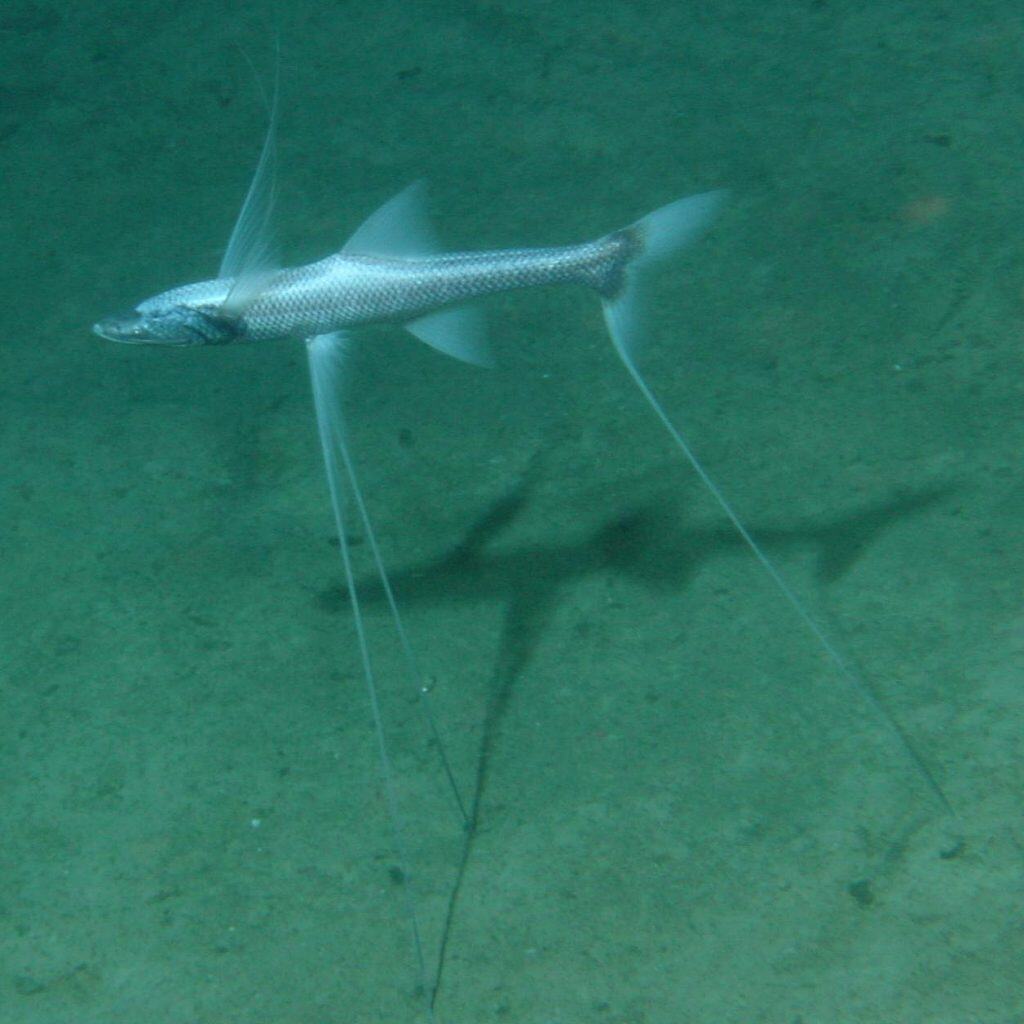
Tripod fish have been observed standing on fin rays at depths reaching 15,000 feet, elevating their bodies above soft seafloor sediment.
A Fish on Stilts
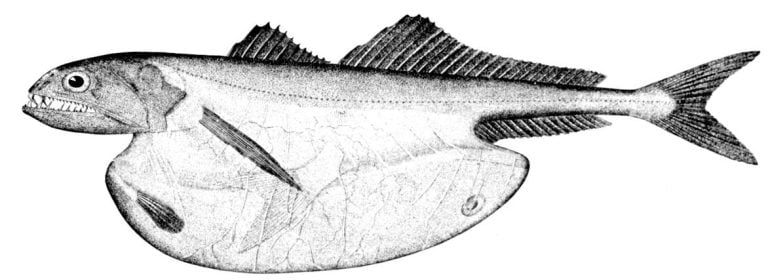
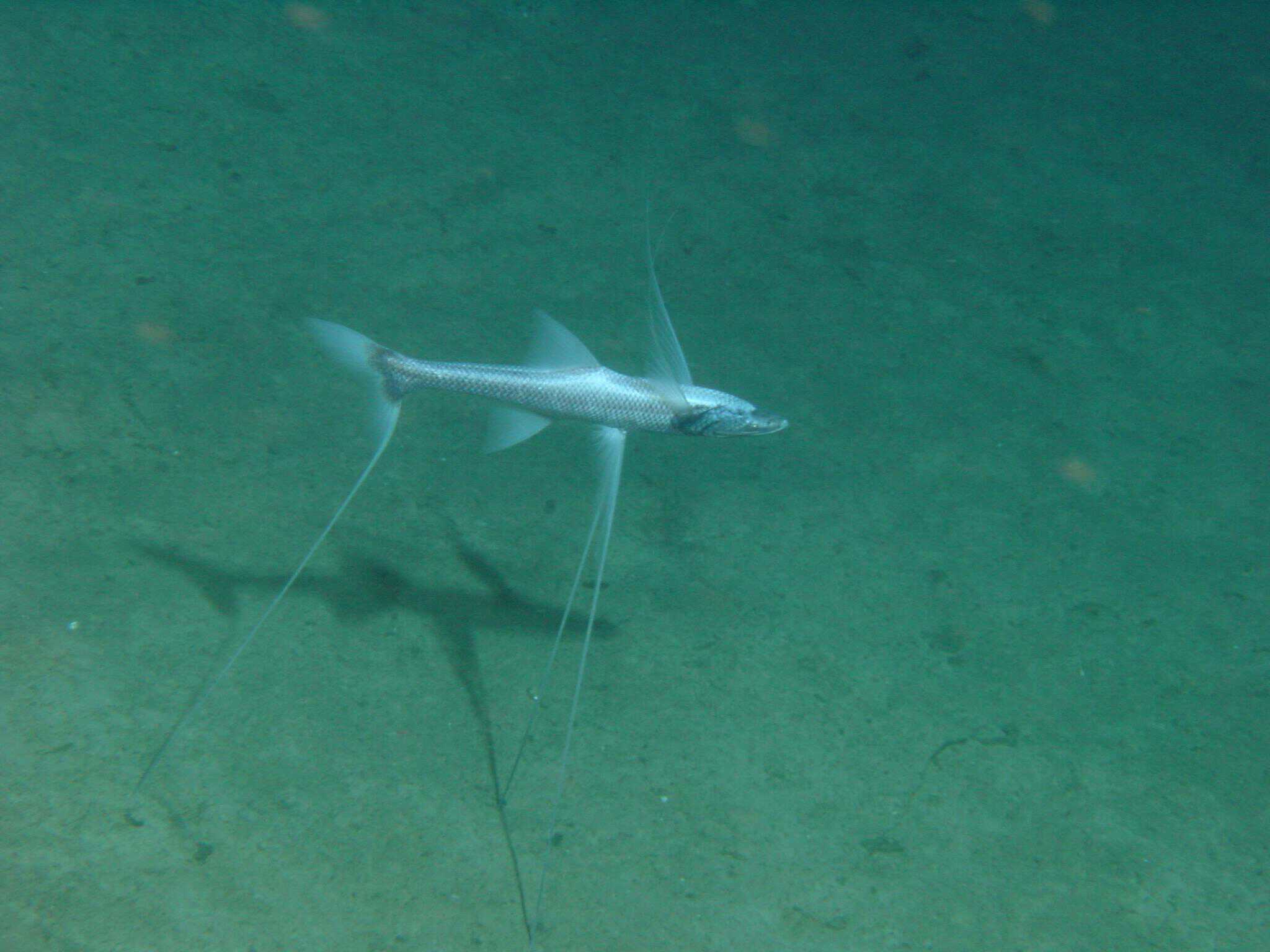
The tripod fish hang around the deep ocean, having been observed at depths of roughly 3,000 to 15,000 feet. They have a long, narrow body, typically reaching around a foot in length. But what really grabs your attention are their fins. Three of them are dramatically elongated—two rays extending from the pelvic fins and one from the lower tail fin. These three stiff, bony supports act like legs. When the fish reaches the seafloor, it spreads them out and props itself up above the sediment. Just like—as its name suggests—a tripod.
Standing offers a few major advantages. First, it keeps most of the fish’s body elevated above the soft, silty seafloor, reducing the chance that fine sediment will settle on its gills or mouth. Second, it allows the fish to hold a stable position in the current without constantly beating its fins. In the deep sea, where food is scarce and energy is precious, hovering or swimming continuously would burn calories that the fish might not be able to replace. By propping itself up, the tripod fish can remain nearly motionless while currents carry small crustaceans and organic debris directly to its mouth.
Facing the Current
The tripod fish consistently orients itself into the current—almost always facing upstream. Why? Because food comes to them. Rather than chasing prey, the tripod fish simply waits for small shrimp-like crustaceans or bits of marine snow to drift within reach. When something edible brushes against its sensory fins, it snaps it up.
This sit-and-wait strategy is common in shallow water ambush predators like frogfish, but in the deep ocean, it’s taken to a new level. Waiting for your food to be delivered to you may sound like a luxury, but it’s actually a smart strategy in the deep ocean. Prey density is low. Swimming continuously in search of food would burn more energy than the fish is likely to gain. By standing still and letting the current deliver meals, the tripod fish is conserving precious calories.
Sensory Fins
The deep sea is pitch black. At the depths where the tripod fish lives, sunlight is completely absent. Some deep-sea species evolve highly sensitive eyes to detect faint bioluminescence, but others, including the tripod fish, rely more heavily on touch than sight.
The elongated pelvic and tail fin rays aren’t just structural supports—the legs of the tripod, if you will—they’re also packed with sensory cells. Scientists believe these fin rays can detect vibrations and subtle water movements. When drifting prey bumps into or passes near the fins, the fish senses it instantly.
The elongated pectoral fins near the head are held forward into the current and likely serve as primary sensory tools, detecting subtle vibrations from drifting prey. The extended pelvic and tail fin rays provide stability and lift, raising the fish into faster-moving water just above the seafloor.
By spreading out its fins, the tripod fish increases the area it can monitor without moving. Expanding its sensory reach without having to move is just another way the tripod fish conserves energy in a world where motion is expensive.
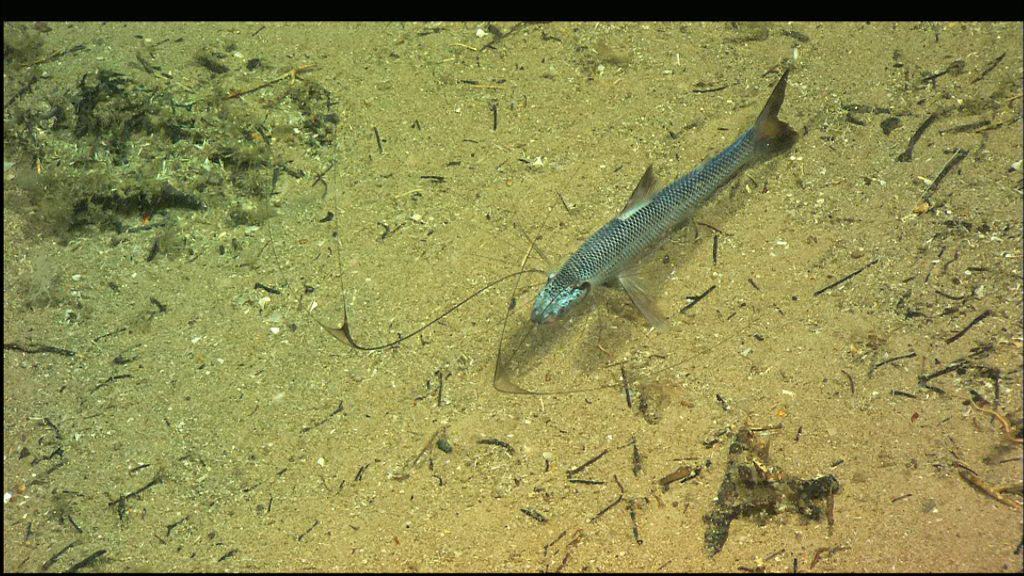
Deep-sea fishes like the tripod fish often have slower metabolisms, allowing them to conserve energy in cold water where food is limited.
©North Atlantic Stepping Stones Science Party, IFE, URI-IAO; NOAA/OAR/OER, Public domain, via Wikimedia Commons – Original / License
Extreme Patience in a World of Scarcity
Observations from deep-sea expeditions suggest that tripod fish can remain stationary for long periods. They may occasionally reposition themselves, especially if currents shift, but they don’t roam constantly.
Their metabolism reflects this lifestyle. Deep-sea fishes generally have slower metabolisms than their shallow-water counterparts. The cold temperatures and limited food supply select for energy efficiency. Every twitch matters.
The tripod fish’s entire body plan screams conservation. Long, lightweight fin rays provide support without heavy muscle mass. A narrow body reduces drag. Limited swimming reduces caloric burn.
A Hermaphrodite Strategy
The deep sea isn’t just food-poor, it’s also sparsely populated. Finding a mate can be a serious challenge when individuals are spread across vast stretches of ocean floor—especially for an animal trying to conserve energy.
The tripod fish has an unusual solution. Research indicates the tripod fish is a simultaneous hermaphrodite. That means each individual has both male and female reproductive organs at the same time. This greatly increases the odds of successful reproduction. When two individuals meet, either can function as male or female.
In an environment where encounters may be rare, this flexibility is a huge advantage. It essentially doubles their chances of finding a mate. Hermaphroditism is relatively common among deep-sea fishes for this very reason. It’s another example of how extreme environments push animals toward creative solutions.
Standing in Crushing Pressure
Not only does the tripod fish live in a world of almost complete darkness with a scarcity of food, but it’s also living under immense pressure. At depths of 10,000 feet, the pressure can exceed 4,000 pounds per square inch.
To survive this, deep-sea fish like the tripod fish have soft, flexible tissues and minimal air spaces. Unlike many shallow-water fishes, they don’t rely on large gas-filled swim bladders to control buoyancy. Gas compresses under pressure, so it’s not practical at extreme depths.
Instead, the tripod fish’s body is adapted to maintain near-neutral buoyancy without large gas pockets. Its tissues are slightly less dense than the surrounding water, helping it remain stable with minimal effort.
This buoyancy also makes it easier to stand. With much of its weight supported by water, the elongated fin rays don’t need to hold up a heavy mass. They simply anchor and balance.
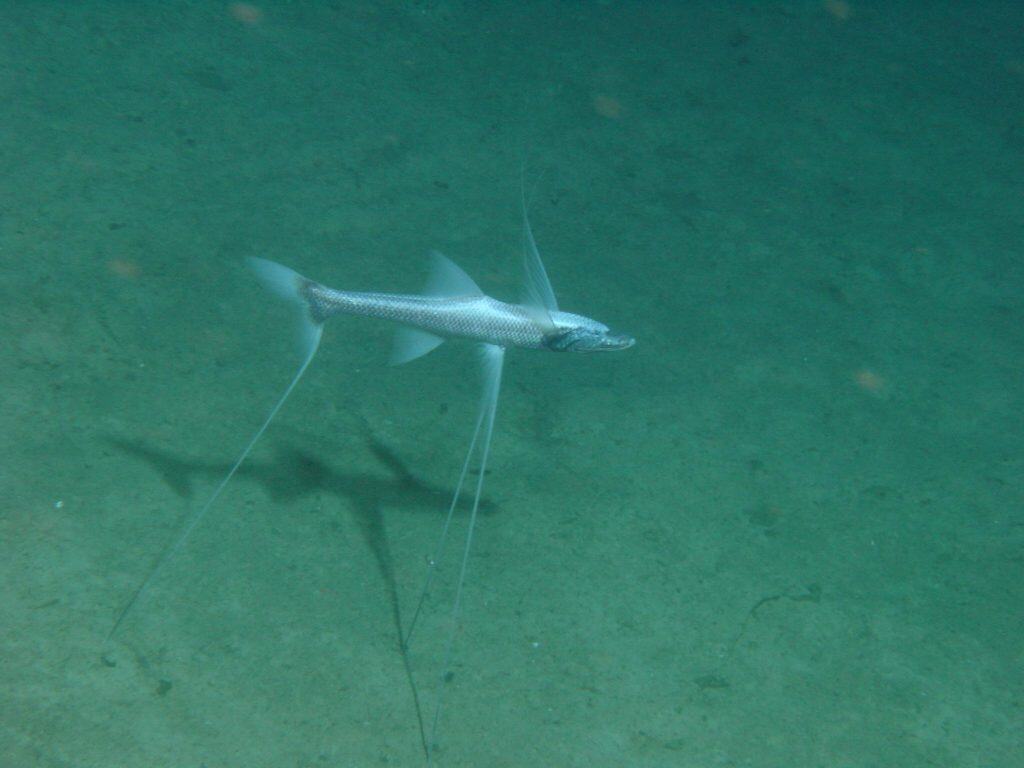
Instead of building large swimming muscles, the tripod fish invests in long fin rays and patience, conserving calories in a food-poor environment.
Why Not Swim?
You might be wondering why evolution didn’t simply give the tripod fish better swimming ability. Well, that’s a matter of trade-offs.
Building powerful swimming muscles requires energy and food. Maintaining those muscles requires more energy. In the deep sea, where both are in short supply, that investment doesn’t pay off.
Instead, natural selection favored individuals that could conserve energy and still capture enough food to survive and reproduce. Over time, elongated fins, sensory adaptations, and patient behavior won out over speed.
The Power of Standing Still
Survival doesn’t always require speed, strength, or constant motion. Sometimes it requires patience. In a place where movement is costly and meals are rare, standing still is a winning strategy. Thousands of feet below the waves, in a cold, black world few humans will ever see, the tripod fish continues to do exactly that. In nature, success doesn’t always look flashy. Sometimes it looks like doing almost nothing at all.