
Quick Take
- The viral 'cyborg locust' headlines six years ago described something that was never actually the plan, and the real goal was far more ambitious. See the original goal →
- A nanoparticle breakthrough quietly crossed a line researchers had been stuck behind for years, and in doing so it changed what the locust's brain could do. Explore the nanoparticle breakthrough →
- The latest research from the cyborg locust lab has nothing to do with bombs, and it might end up inside the human body. Discover the health applications →
- Years of research, a brand-new lab, and millions in federal funding have gone into bomb-sniffing robot locusts, but are they actually any closer to your airport? Check the current status →
Six years ago, headlines were ablaze with news of “cyborg locusts” – insects with the ability to detect and differentiate the smell of various explosives.
Not quite. At least not yet. In the six years following the breakthrough announcement from Washington University, we’re not on the verge of seeing locusts replacing the familiar vest-wearing dogs patrolling U.S. airports with their handlers.
So what’s been happening since the first study made a splash in scientific circles and went mainstream? Did the project end, or are bomb-sniffing locusts ready to make their debut?
The First Study
Contrary to popular headlines, it was never the intention to release living locusts into the world to sniff out bombs. The original goal, funded by a $750,000 grant from the Office of Naval Research, was to see whether replicating the locust’s sense of smell would be possible.
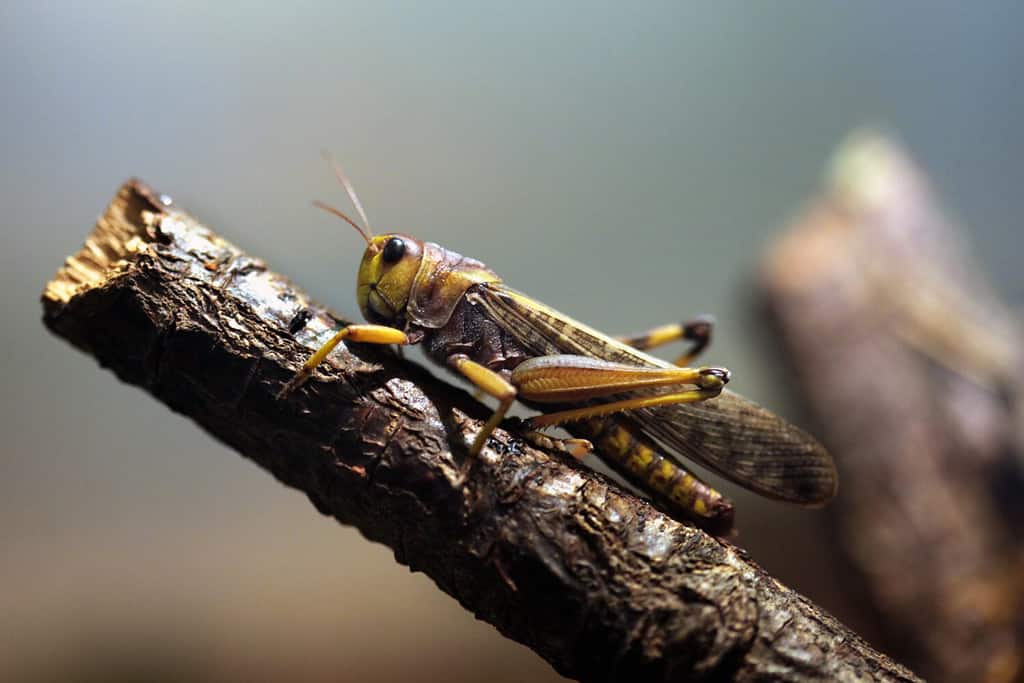
Researchers have been studying the olfactory system of locusts for six years.
©Vladimir Wrangel/Shutterstock.com
The real goal was to take that functionality and build it into robotic sensing systems. This would give security-focused government offices, like the Department of Homeland Security, a more scalable way to implement bomb-sniffing functions.
The first study proved that it could be done.
What’s Happened Since Then?
In October 2023, the same team secured a four-year, $4.3 million grant from the National Science Foundation. With it, researchers at Washington University’s McKelvey School of Engineering launched a one-of-a-kind Center for Cyborg and Biorobotics Research (CyBoR) lab. The goal was to develop a locust cyborg that could mimic the behavior of real locusts, including their ability to detect and differentiate explosives by smell.
The locust cyborg would be either a mobile robot or a drone.
In January 2024, CyBoR researchers revealed that they had developed custom nanoparticles that absorb light to create heat. Those nanoparticles, put in place with tiny electrodes, helped boost neural responses in the locust’s brain, which then helped the insects better identify different odors.
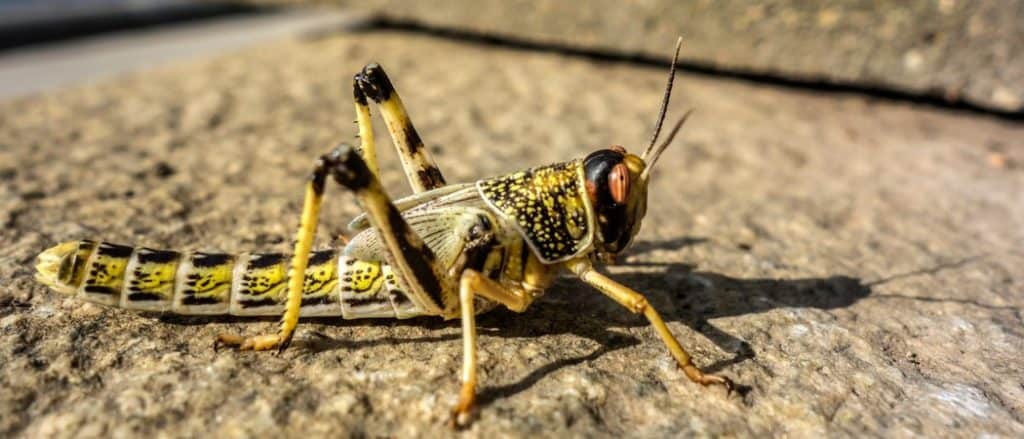
The goal is to build a replica of the locust’s sense of smell and implant it into robot locusts.
©iStock.com/ivanoel28
Until the nanoparticle development, researchers were limited to simply reading the insect’s brain signals. Now, they could turbocharge the locust’s sense of smell, which was akin to peak performance training.
In October 2025, more research news came from the CyBoR lab. Unlike previous studies, this time the locusts’ sense of smell was applied in a completely different way. Biomedical engineering researchers used the locust to test hydrogels – microparticles that could be injected into the human body to monitor and stimulate natural biological functions.
The study applied the microparticles to the locusts’ antennae, where the olfactory neurons are located. Then the researchers measured how the insect’s sense of smell changed with the microparticles applied.
What’s Next?
While the latest study does not directly relate to the original cyborg locust concept, it is the most recent update from the CyBoR lab and demonstrates that research into locust olfactory capabilities is ongoing.
Barani Raman, PhD, the founding director of the CyBoR lab, was also recently named the Dennis and Barbara Kessler Professor of Biomedical Engineering in the McKelvey School of Engineering. In the announcement, his advancements using locusts’ sense of smell were called out as having “significant implications for a wide range of societal problems ranging from security to health.”
With his research ongoing, it may only be a matter of time before locust cyborgs appear in airports across the country.