
Quick Take
- A fish walking backward sounds impossible, but that changes when you see what it's using instead of legs. See the fin-ray legs →
- The 'fish-prawn hybrid' label is catchy, but marine biologists have a very different name for what this creature actually is. Discover its real classification →
- Its awkward, slow movement is not a design flaw at all. It is a precision tool evolved for one very specific job. See the foraging purpose →
- Only one of three related species filmed in the same region moves this way, and researchers think they know why. Watch the species comparison →
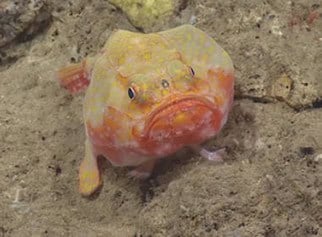
Deep on the floor of the northern South China Sea, a fish with a body like a shrimp and rake-like feelers on its snout was filmed doing something no fish had ever been documented doing before: walking backward. The deep sea is hard to study directly, so most of what scientists know about animals that live there comes from brief glimpses like this one, caught on camera during a handful of dives.
Researchers from Sun Yat-sen University and the Southern Marine Science and Engineering Guangdong Laboratory in Zhuhai used remotely operated and crewed submersibles to film the armored searobin, Scalicus engyceros, scuttling sideways and in reverse across the seafloor. The species has been known to science since 1872. This is the first time anyone recorded it moving this way, according to the study.
Legs Made From Fins
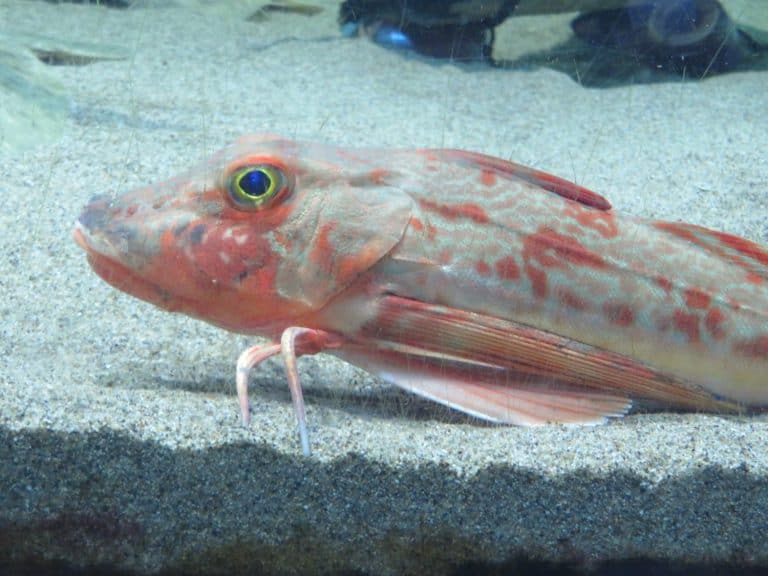
The nickname “fish-prawn hybrid” comes from American media coverage, not from marine biologists, and it isn’t quite accurate: the armored searobin is a true fish, not a cross between two animals. What gives it that shrimp-like look are specialized, free-moving rays that extend from its pectoral fins, operating almost independently of one another like a set of stiff little legs, researchers explain.
Han Tian, the study’s lead author and a doctoral researcher at Sun Yat-sen University, says those fin-rays let the fish walk much the way a crab or shrimp does, even though the underlying body plan is entirely fish. The pectoral fins themselves have flattened into rounded, fan-like plates that help the animal balance while it moves and forages along the bottom.
What the Footage Showed For the First Time
The team filmed three species of armored searobin in different parts of the northern South China Sea: Scalicus engyceros, Paraheminodus murrayi and Peristedion liorhynchus. Only Scalicus engyceros was seen walking sideways and backward, a type of movement the researchers say had never been recorded in any fish species before, according to Discover Wildlife.
Finding three related species occupying different spots in the same general region also hints that each may have adapted slightly differently to its own patch of seafloor, something the team wants to investigate further. Han Tian called the discovery a “paradigm-shifting revelation” for how scientists think about which fish are capable of true walking, not just hopping or skittering along the bottom.
Why the Structure Exists
The armored searobin’s snout carries paired, rake-shaped appendages that it uses to sense and probe the sediment for buried prey, and the walking fin-rays appear to serve a similar purpose. Han Tian describes the setup as awkward for getting around quickly, but useful for exactly the kind of slow, deliberate searching the fish needs to do to find food hidden in the seafloor, including digging directly into the sediment surface.
The findings were published July 30, 2026, in the journal Ocean-Land-Atmosphere Research. The researchers say the fish’s walking behavior, its evolution, and its deep-sea foraging strategy likely evolved together, and they hope the discovery opens up a new way of studying how bottom-dwelling fish adapt to life on the ocean floor more broadly.