
Quick Take
- This bird spent decades actively fleeing cities and human noise, which is why experts have no good explanation for why it suddenly decided to nest inside one of America's busiest urban zoos. See the urban colony story →
- The species has roughly three million individuals worldwide, yet Illinois treats it as endangered. The gap between those two facts reveals a fragility most people won't anticipate. Explore Illinois endangered status →
- The colony's recent record-breaking breeding seasons are actually the very reason conservationists are most worried right now, not least worried. Why success breeds concern →
- The office worker filming the bird had no idea what she was looking at. The answer turned out to be far rarer than anything that belongs outside a Chicago high-rise window. See the windowsill sighting →
Wildlife sightings in urban environments are becoming more common as habitats continue to disappear. Take, for example, a black-crowned night heron that made an appearance outside a Chicago high-rise recently.
Black-Crowned Night Heron Appeared at a Chicago-Based Meeting
On July 16, 2026, an interesting-looking bird stopped by an office windowsill in the River North region of Chicago. Mid-meeting, bird lover Alaina Neiburger managed to capture video of the brown-and-white bird, not knowing what species it was.
“Don’t know what this is. It’s outside the office window,” Nieburger said in the video. “Oh my gosh. What is it?”
Neiburger explained to Fox 32 Chicago that she had never seen anything like this bird.
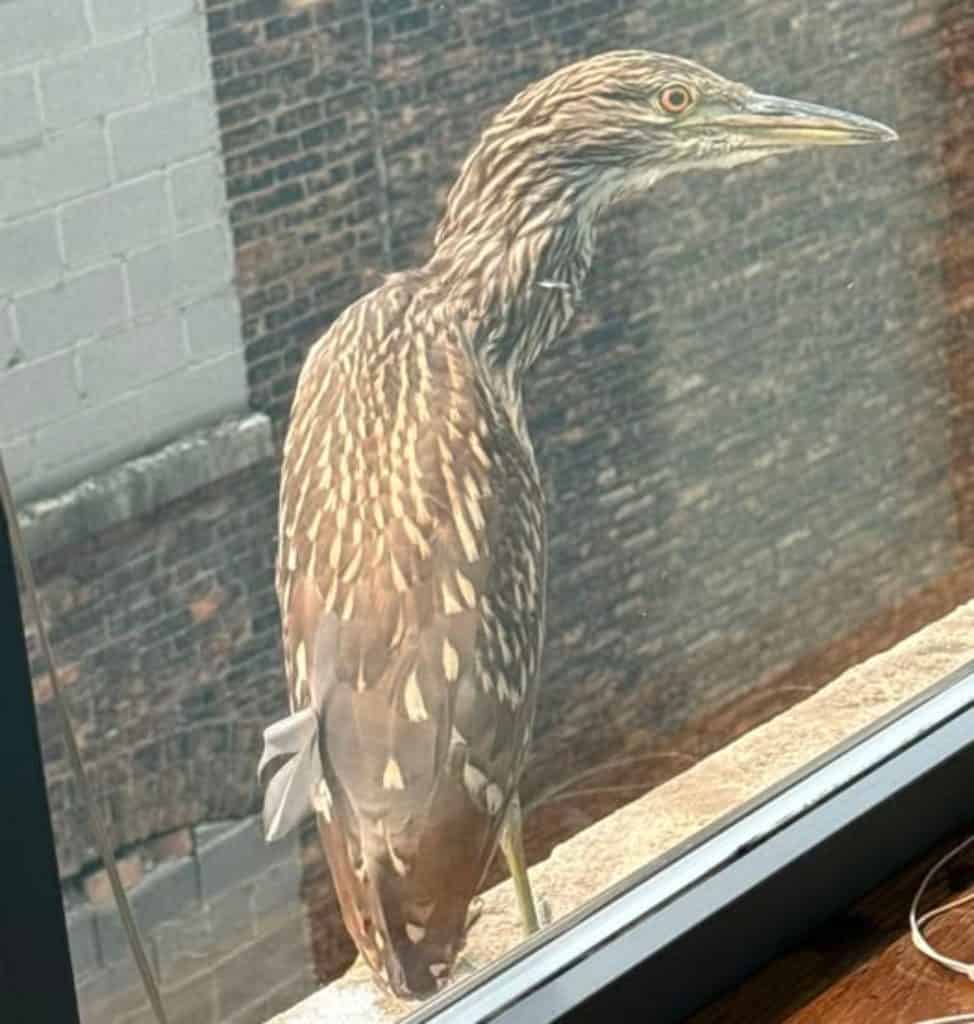
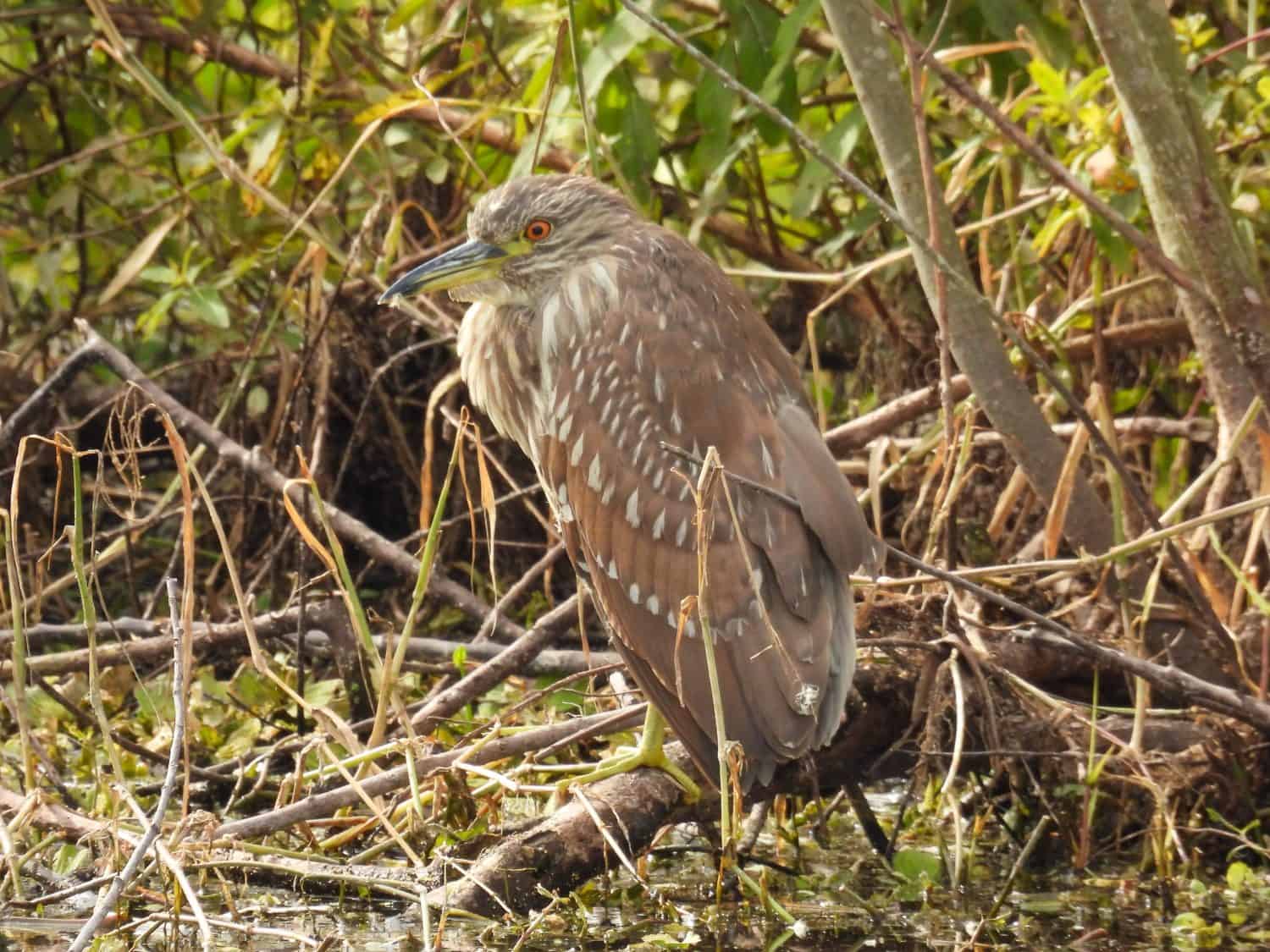
A juvenile black-crowned night heron stood outside a Chicago office windowsill.
©Alaina Neiburger / Illinois Bird Watchers / Facebook – Original
“It was big. It was huge,” Neiburger told the news outlet. “It was nearly two feet tall. The neck kept coming in and out.”
Not knowing what species it was, she posted a picture to Facebook, and shortly thereafter, bird enthusiasts started chiming in.
Experts from the Chicago Black-Crowned Night Heron Project shared that the bird was a juvenile black-crowned night heron. While endangered in the state, their presence in Chicago is not uncommon. Not only are the birds native, but they have established a nearly two-decade-long nesting ground location within the city that has allowed their population to grow.
Black-Crowned Night Herons Have an Established Population in Chicago
Despite being pushed out of their native wetland habitats over the last few centuries, the black-crowned night herons have managed to carve out a habitat for themselves in Chicago. Not only that, but over the past few years they are thriving due to successful breeding seasons.
Beginning in 2007, the first of what would become hundreds of black-crowned night herons began to show up at the Lincoln Park Zoo. In a matter of three years, 100 herons had participated in nesting at the zoo.
This is interesting to note, according to Sativa Volbrecht, of the University of Chicago’s Institute for Climate and Sustainable Growth program and former intern at the zoo, given that the birds do not like people or noise.
“It’s particularly interesting because before, this species was very human-shy and didn’t like noise. They would essentially avoid cities,” Volbrecht explained to UChicago Magazine. “Then, for no apparent reason, they decided to nest in the middle of the city.”

Black-crowned night herons have established a population at the Lincoln Park Zoo.
©Nycticorax nycticorax/Shutterstock.com
To date, the most successful breeding years were in 2022 and 2023. The former had 751 adult herons, while the latter had 686. During the 2023 breeding season, 486 chicks were successfully raised.
The heron’s preferred location is near the red wolf habitat at the Pritzker Family Children’s Zoo.
By observing the birds during breeding seasons and equipping them with tracking devices, more is being learned about the black-crowned night heron. This information will better assist with conservation efforts and help conservationists better understand how the species is navigating the urban environment.
Black-Crowned Night Herons are Endangered
With a global population of approximately three million birds, the IUCN lists black-crowned night herons as a “species of least concern.” However, in Illinois and surrounding states, this is not the case. The herons are considered an endangered species and were added to the Illinois Endangered Species List in 1977.
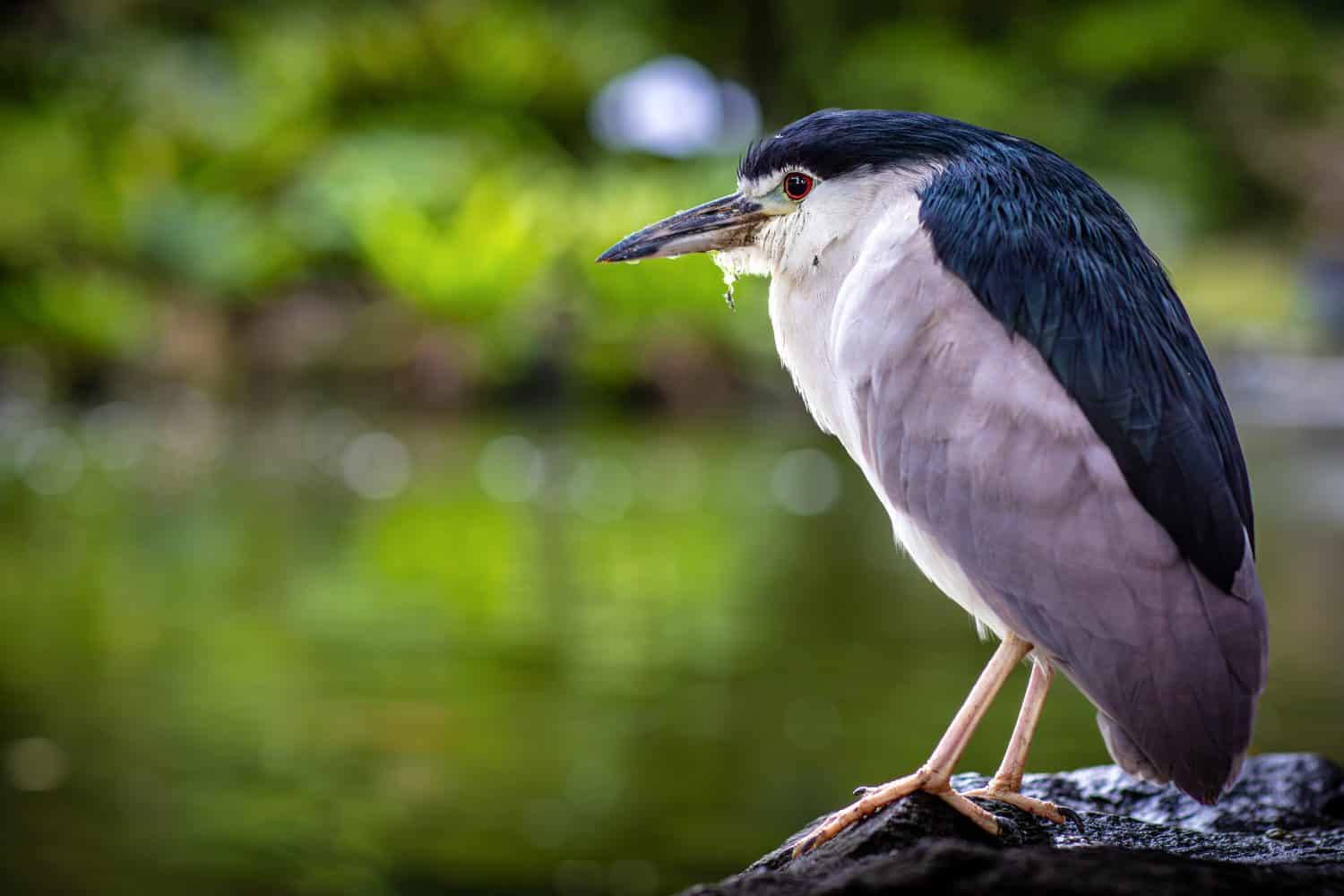
Black-crowned night herons are endangered in Illinois.
©CathyBrione001/Shutterstock.com
Throughout the 1800s, the black-crowned night heron could be found in large numbers throughout the Land of Lincoln. However, the 1900s brought a decline in the heron population. The main reasons the black-crowned night heron began to disappear include:
- Habitat loss
- Habitat degradation
- Human disturbance
- Poisoning
- Climate change
Today, a colony of approximately 600 black-crowned night herons live at the Lincoln Park Zoo. This is significantly fewer than the hundreds of nesting pairs that were once a common sight throughout the state, which is why conservationists are pushing for more protection for the birds.
What Can Be Done to Protect the Black-Crowned Night Herons?
The black-crowned herons in Illinois are concentrated in one area. This means that if there were a catastrophic event, such as an outbreak of Avian flu or severe weather, it could decimate the population. Because of this, positive breeding seasons should not be seen as a reason to slow conservation efforts, but instead as a time to strengthen them.
![Black-crowned Night Heron [Nycticorax nycticorax] with red eyes standing on a mossy log, side view.](https://a-z-animals.com/media/2026/07/shutterstock-2812788087-huge-licensed-scaled.jpg)
Black-crowned night herons need their wetlands restored, polluted water sources cleaned, and more to survive.
©Voodison328/Shutterstock.com
To better help the black-crowned night herons, conservationists and regular citizens can do the following:
- Restore native wetlands
- Clean up polluted water sources
- Avoid disturbing nesting colonies
- Participate in citizen science tracking programs
- Install platforms for nesting in areas where black-crowned herons once resided
As habitats continue to shrink, more bird species will likely be looking for new places to call home. Hopefully, environments like the Lincoln Park Zoo will be available to aid other species struggling to adapt to a changing planet.