
Quick Take
- Scientists can't agree on whether what the tuskfish does even counts as using a tool, and the debate hinges on a definition you wouldn't expect. Explore the tool debate →
- Researchers are not surprised by the tuskfish's jaw strength. What surprises them is something else entirely about how it hunts. See what surprises scientists →
- Divers keep finding the same strange clue scattered around certain rocks on coral reefs worldwide, though what it means is still up for debate. See the shell pile evidence →
- Not every wrasse pulls this off. Only a specific subset does, and the line between those that do and those that don't is sharper than you'd think. See which species qualify →
Somewhere in the world’s oceans right now, a fish is busy digging a clam out of the sand. Once it succeeds, the fish then swims to a favorite rock where the clam meets its demise. The fish slams the clam against the rock again and again until the clam’s shell finally cracks open.
It’s dinnertime for the tuskfish, and it isn’t a fluke limited to a single tuskfish species. Divers across the world’s oceans have filmed the phenomenon in several different kinds of tuskfish. For scientists, the fish’s action is notable because tool use is rarely recognized among fish and is more commonly documented in mammals and birds.
How Tuskfish Find Their Next Meal
Tuskfish are actually a group of large wrasses that live on coral reefs. Their preferred diet is hard-shelled animals like scallops and clams. To find dinner, the tuskfish cruises along the ocean floor, fanning out sand using quick blasts of water from its mouth. The goal? To reveal a buried shell.
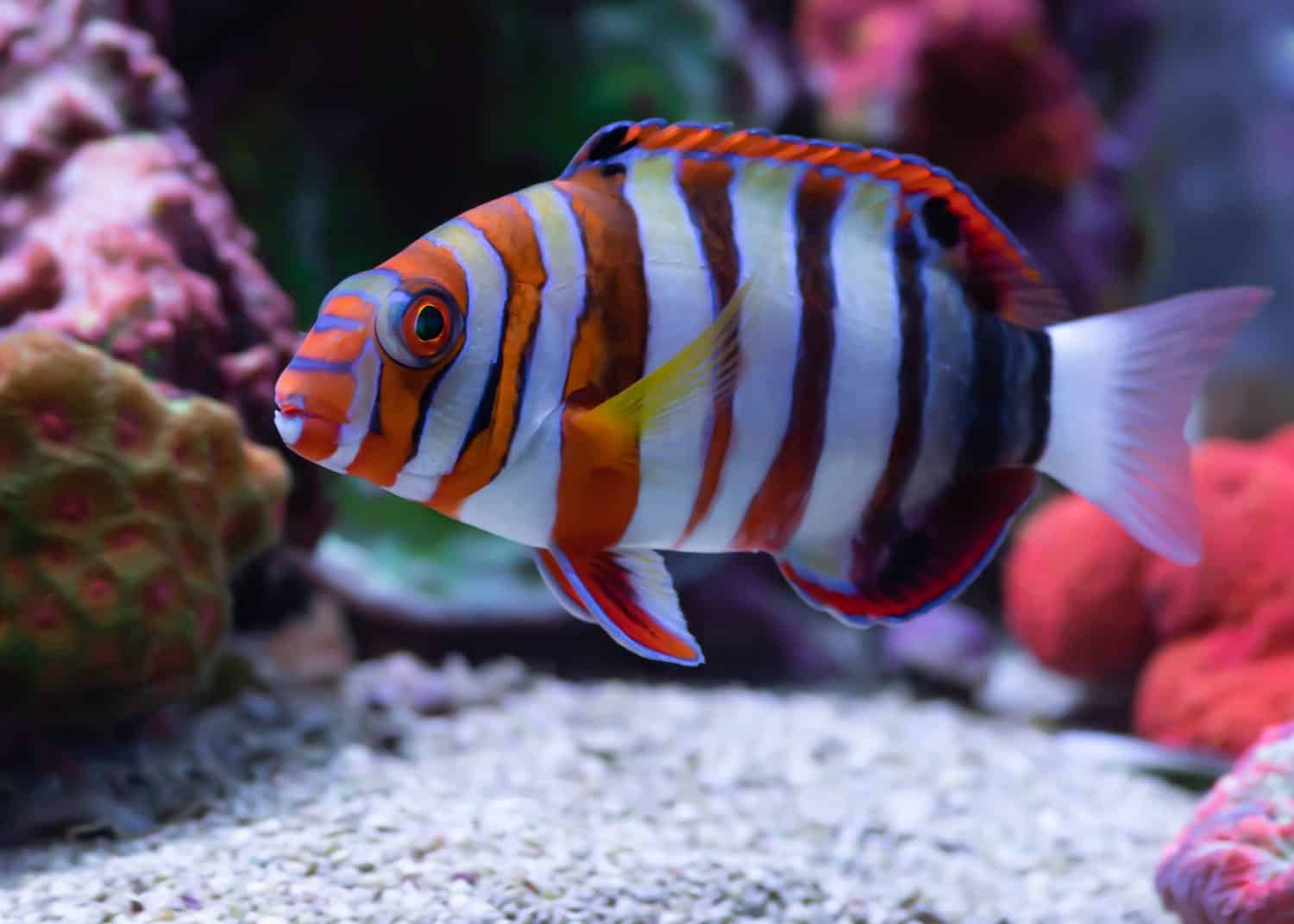
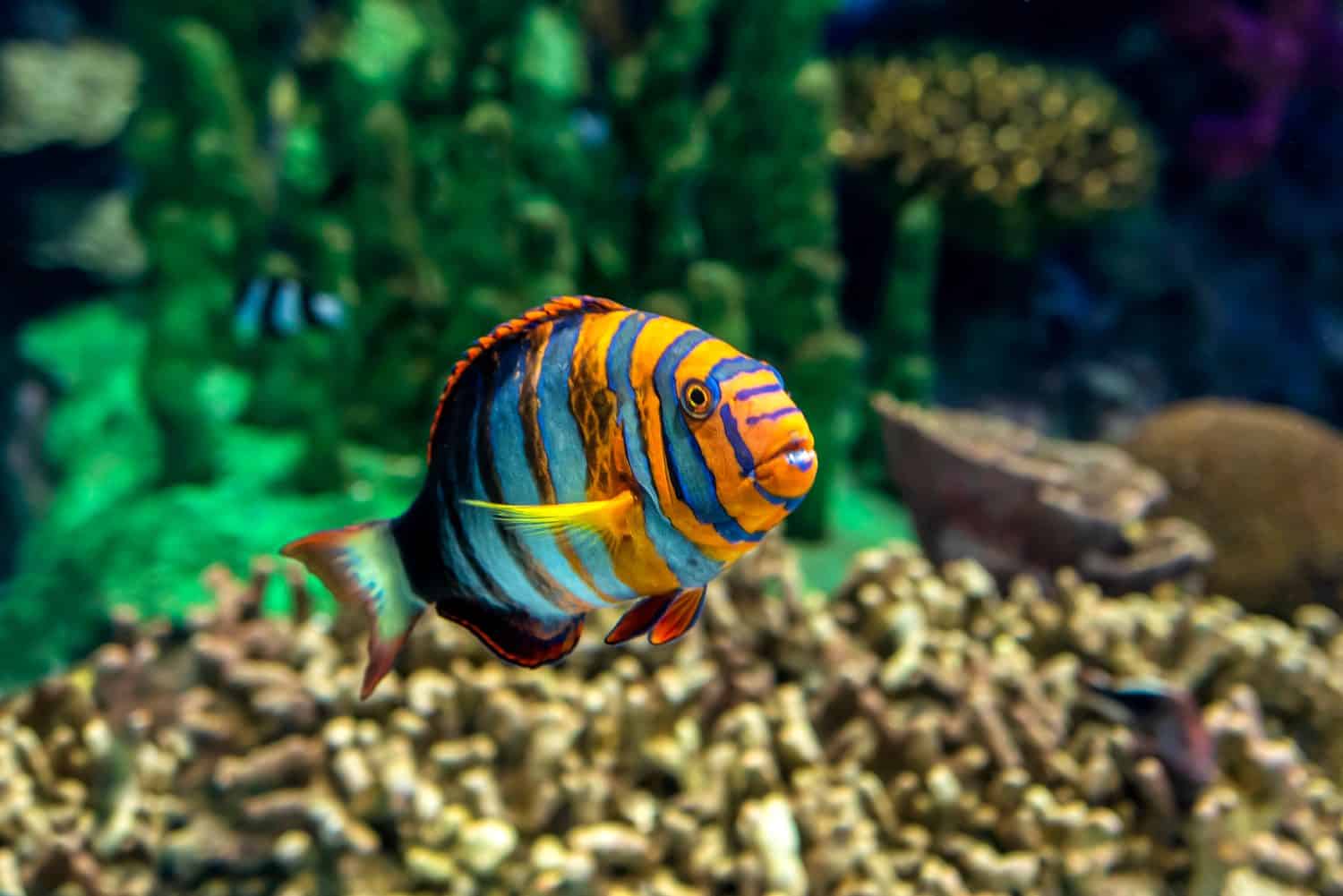
Tuskfish, like this harlequin, are members of the wrasse family.
©Jim Beers/Shutterstock.com
It’s important to note that not all members of the wrasse family do this; it is limited to tuskfish.
What Rocks Have to Do With It
Once the tuskfish has the clam in its mouth, it’s time to swim to a rock with a flat enough area to make the next step possible. Sometimes, the tuskfish must search for a while to find the ideal rock. One researcher observed a tuskfish swimming about 16 feet to find the ideal rock.
Once the perfect rock is found, it’s time to get to work. The tuskfish holds tightly to the shell with its mouth, then turns its body sideways and uses a swinging motion to hit the shell repeatedly on the rock. The fish tries different angles until the shell eventually cracks.
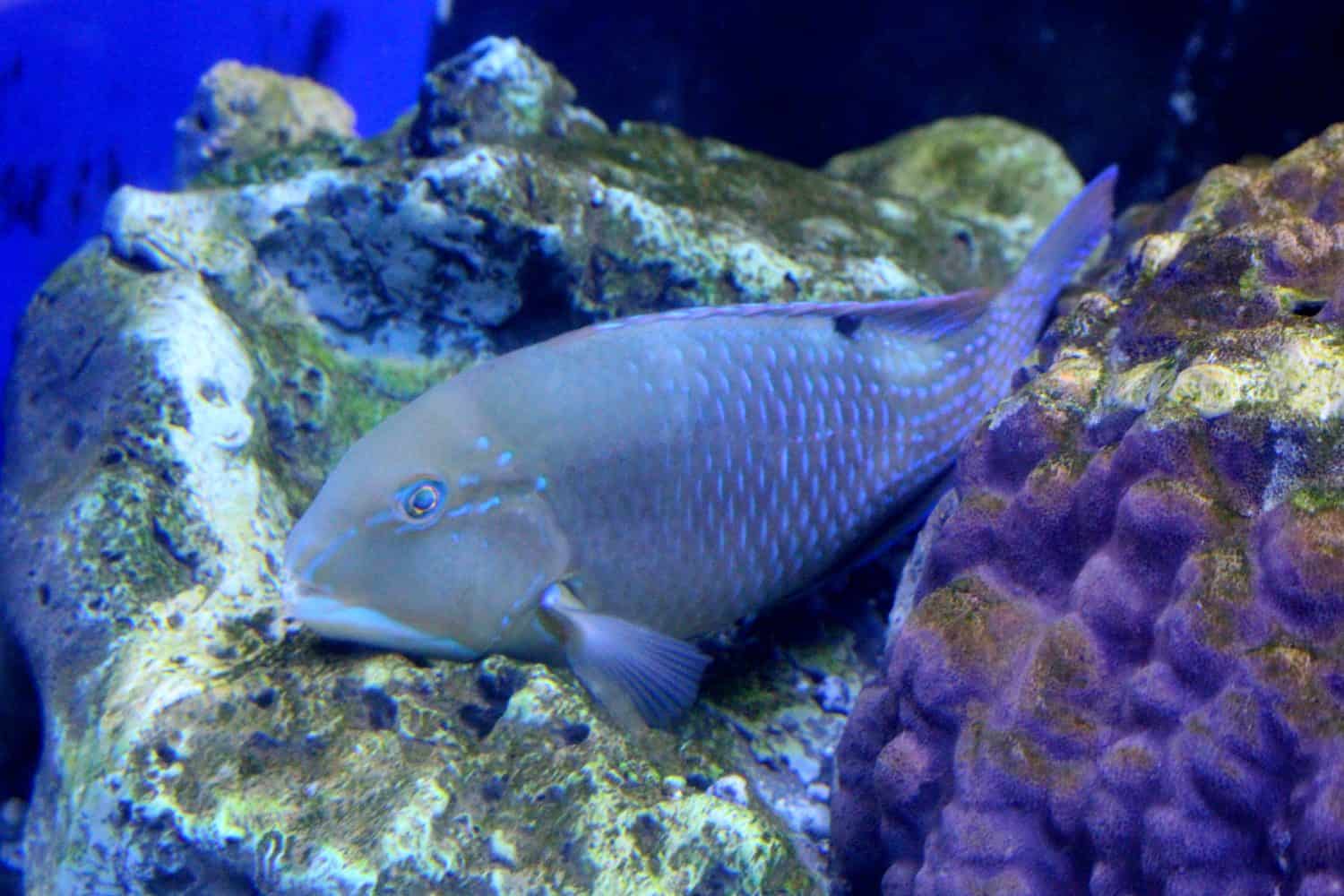
Blackspot tuskfish have been observed cracking shells on the Great Barrier Reef.
©THAIFINN/Shutterstock.com
One species, the blackspot tuskfish, was filmed by a diver on the Great Barrier Reef repeatedly striking a shell for over a minute until the shell cracked open. Another tuskfish species, the graphic tuskfish, made 28 strikes against two different rocks in a single six-minute feeding event, according to researchers who viewed footage of the incident.
All that effort is rewarded when the hard shell finally breaks open, allowing the fish to gobble up the soft body inside.
Is a Rock Really a Tool?
Most researchers classify tools as something an animal carries, then uses to accomplish a goal. Under that definition, a stationary rock sitting on the ocean floor doesn’t count.
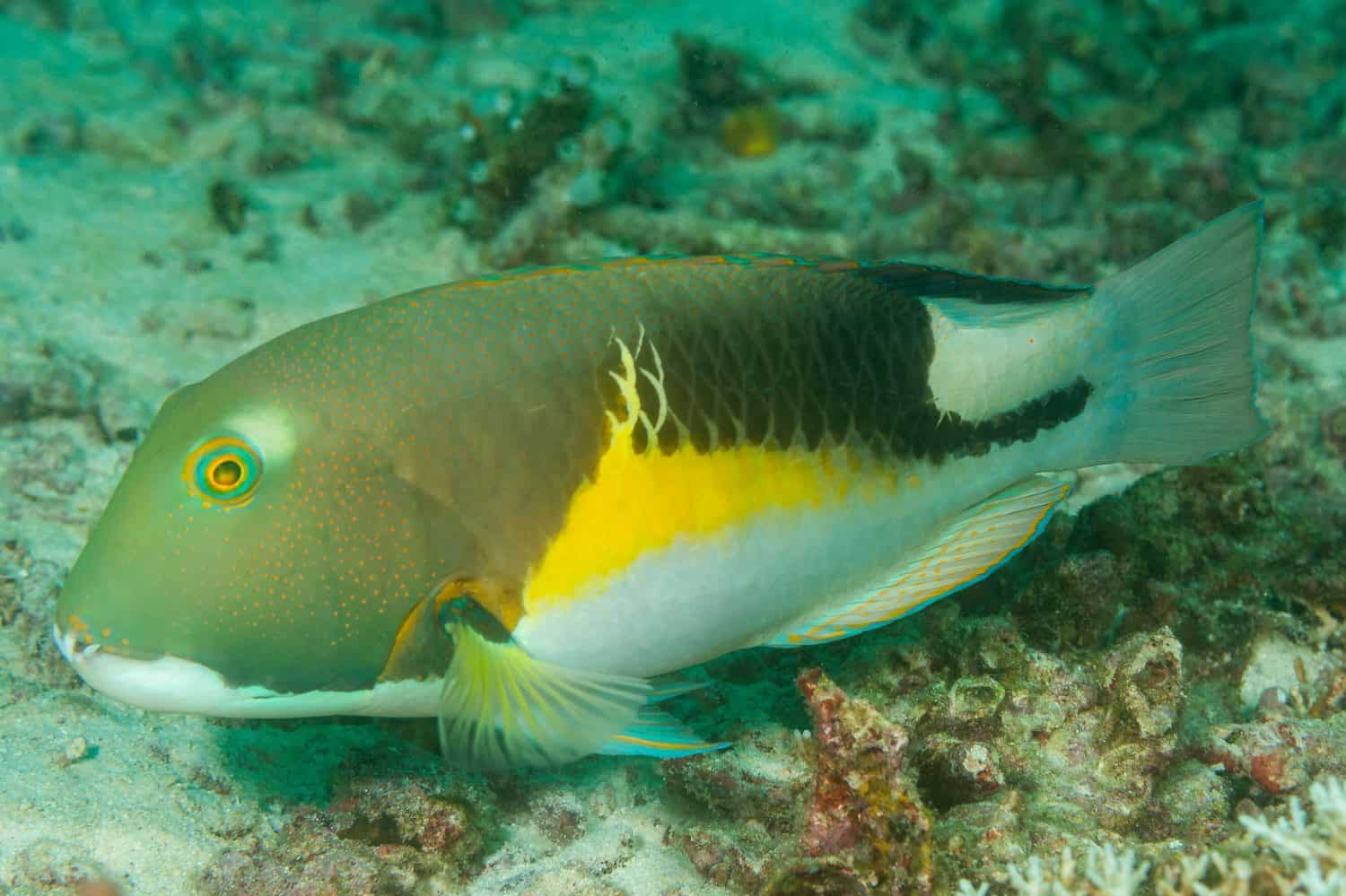
Orange-dotted tuskfish is another species observed doing this behavior.
©Jesus Cobaleda/Shutterstock.com
But researchers studying tuskfish point to findings made by primatologist Jane Goodall, who offered a broader definition. Goodall considered a tool to be any outside object used as an extension of the mouth or body to reach an immediate goal. That definition perfectly describes what the tuskfish is doing to break open the hard shells.
Of course, not all scientists agree. Some researchers think the rock is more of a “proto-tool.” Others say that using the rock should be considered tool use, given the fish’s overall circumstances. It doesn’t have hands to hold a tool. Trying to bring a rock to a buried shell would be ineffective. Instead, bringing the prey to a rock and using its own body momentum to open the shell is a more effective approach.
How Does a Tuskfish Manage All This?
Tuskfish have powerful jaws designed specifically to crush shelled prey. This is a trait shared across the entire group. That isn’t what surprises scientists.
Rather, it is the sequence in which the tuskfish hunts for food. First, it searches, then digs up its prey, carries it to the ideal rock, and strikes with precision over and over again until the mission is accomplished. This is a far different approach than simply finding a shell and cracking it open on the spot.
For some scientists, this is evidence of problem solving.
Do Tuskfish Have Favorite Rocks?
Based on evidence observed by scuba divers, the answer appears to be yes. Divers have often found piles of broken shells scattered around certain rocks. This suggests that the same rock is used repeatedly, either by a single fish or by groups of fish over time. Divers have spotted these shell piles on coral reefs around the world.
However, scientists are quick to note that seeing shell piles is not definitive proof that a tuskfish has a favorite rock. At most, it suggests that some rocks are more popular than others. Who exactly is using those popular rocks is still unknown.
Which Wrasse Species Are Doing This?
Researchers are also quick to clarify that not all wrasse species engage in this behavior. Photographic and video evidence confirms that blackspot tuskfish, orange-dotted tuskfish, and graphic tuskfish all do, as noted in one research paper.
While there is anecdotal evidence that other wrasse species besides tuskfish engage in this behavior, there is no documented proof to confirm this.