
Quick Take
- One chimp did something to teach an infant that scientists had never caught on camera before, and the behavior looks unsettlingly familiar. See the hand-guiding footage →
- Young chimps don't just watch and copy. Researchers now have footage proving the learning process is far more deliberate than that. See what the camera captured →
- The chimp doing the teaching wasn't who you'd expect, which changes what we thought we knew about how knowledge spreads in the wild. Find out who's teaching →
- Scientists disagree about whether what chimps do actually counts as 'teaching.' Here is the evidence that settled the debate. Explore the evidence →
Darwin was one of the first to theorize about chimpanzees using objects as tools. In 1871, he proposed in ‘The Descent of Man’ that chimpanzees use stones to crack nuts. Several decades later, Jane Goodall also watched as chimpanzee “David Greybeard” broke off a twig to dig for termites.
Now, new research has gone one step further in studying how chimps use the objects around them as tools. Scientists have now observed that not only do chimps use tools, but they also transfer their tool-using knowledge to the next generation. Those findings were recently published in the journal Frontiers in Psychology.
What the New Study Found
A research team from the Jane Goodall Institute Spain and the University of Barcelona studied wild western chimps, Pan troglodytes verus, at a savannah site in Dindefelo, Senegal. Scientists studied 14 hours and 58 minutes of footage, captured between 2017 and 2025, from camera traps at 14 known locations where chimps had been observed using tools.
They also collected 30 minutes of footage from cameras at 11 additional sites where chimps were known to carry baobab fruit, using stone “anvils” to pound the fruits open to extract the juicy insides.
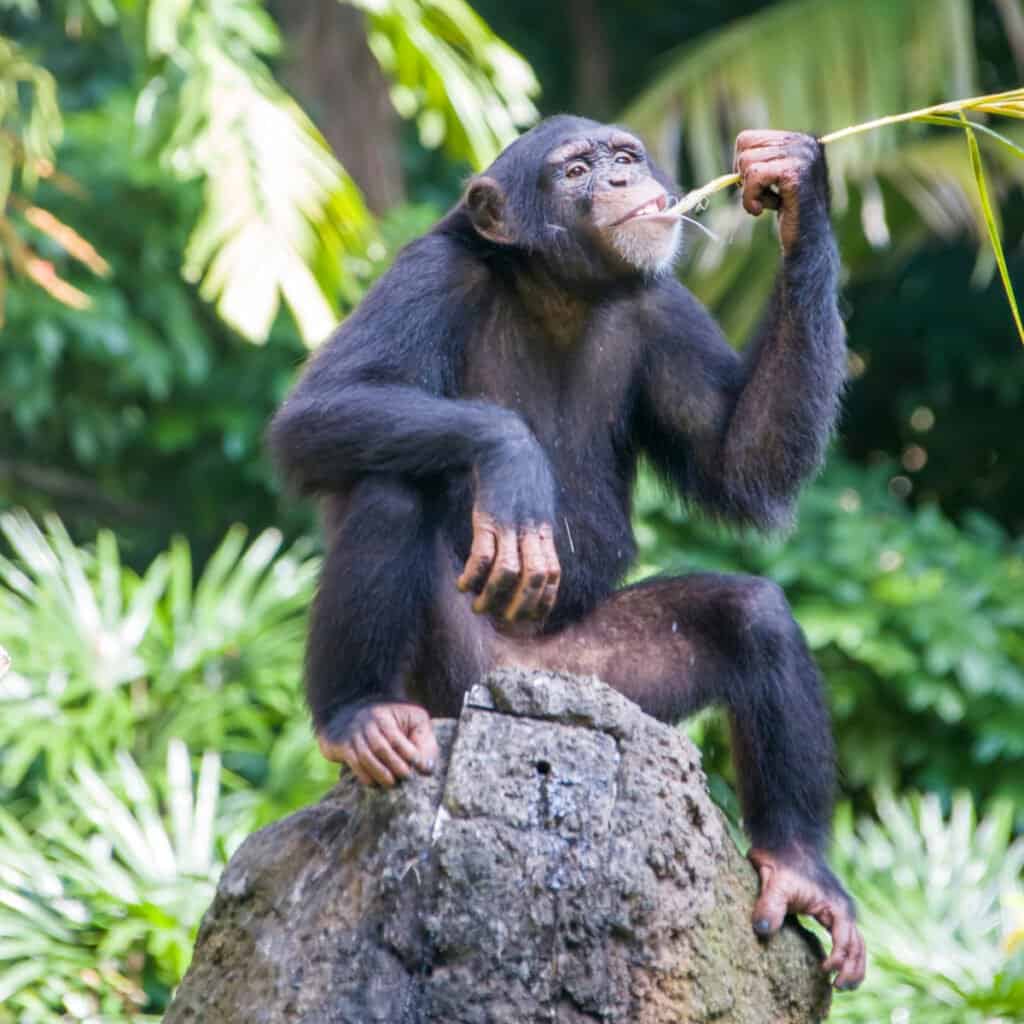
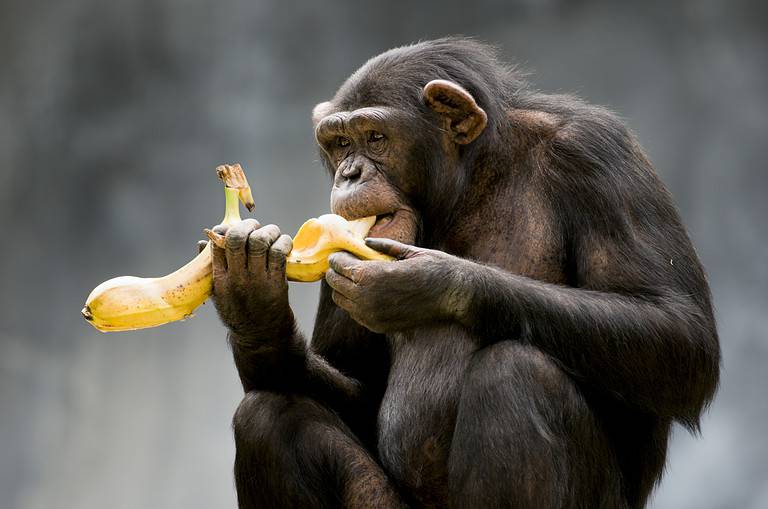
Chimpanzees will use tools to hunt for ants and termites.
©Danny Ye/Shutterstock.com
What they saw surprised them. On the tool transfer side, the footage revealed 33 instances of tool transfers from adult to younger chimps. Those interactions happened 19 times during ant dipping, 10 times during algae fishing, and four times during termite fishing. Fruit transfers occurred four times during the 30 minutes of footage.
For the first time, the footage studied by the research team was also made available to the general public, giving anyone the ability to witness the chimpanzees’ tool and fruit transfer skills.
Why Is Tool Transfer Important?
Favorite chimpanzee food like termites and ants aren’t always easy to get. Resourceful chimps discovered that using sticks to dip into termite mounds and ant nests brought the food to them more easily. As the stick is inserted into the insects’ homes, the bugs cling to the stick. When the chimp pulls the stick tool out, it’s like their favorite meal in popsicle form.
When it comes to baobab pounding, it’s the same story. The fruit the chimpanzees like is encased in a hard shell. Breaking it apart on the stone “anvil” makes extracting the fruit center easy.
But young chimps don’t innately know how to use tools to get to this food. They need adult chimps to teach them how to do it.
“Here we show that receiving food and tools from experienced individuals, which we call food or tool transfer, may help chimpanzees learn to use technology to extract foods that are difficult to access,” said Andreu Sánchez-Megías, a Ph.D. candidate at the University of Barcelona and the Jane Goodall Institute Spain in Senegal, in a news release announcing the findings.
Who Teaches the Young Chimps?
Most of the transfers occurred between mothers and younger chimps. Forty-two percent of the recipients were infants. The researchers also noted that in most cases, the objects were transferred between relatives, nearly 30 percent of the time between mother and offspring. In most cases, the interactions were prompted by the younger recipient rather than the adult. Sometimes, the recipient even got aggressive, stealing tools and fruit outright.
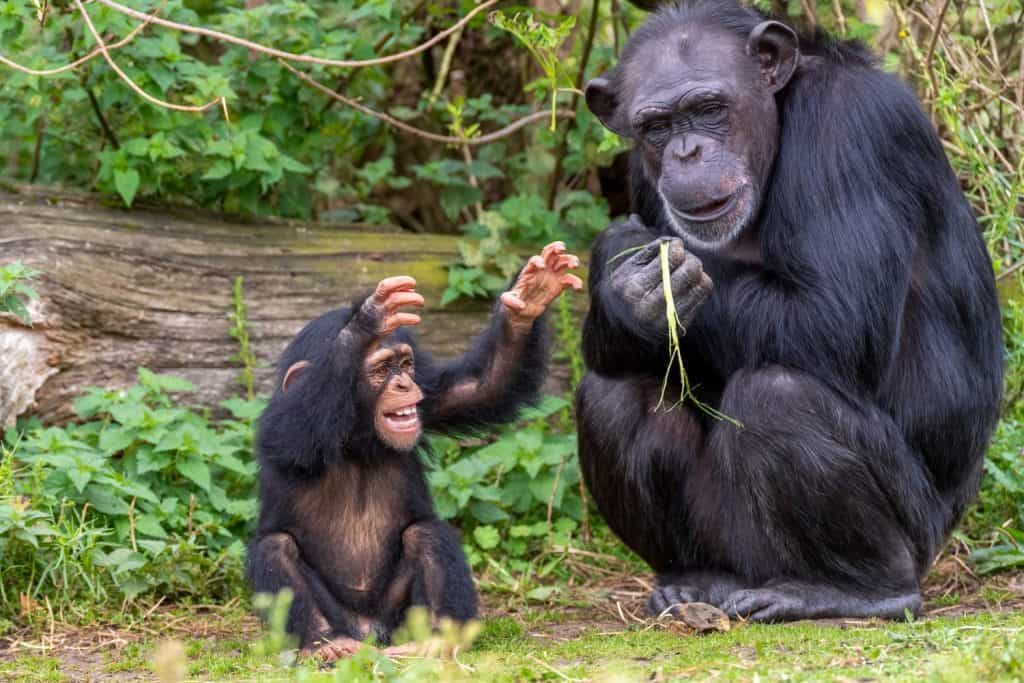
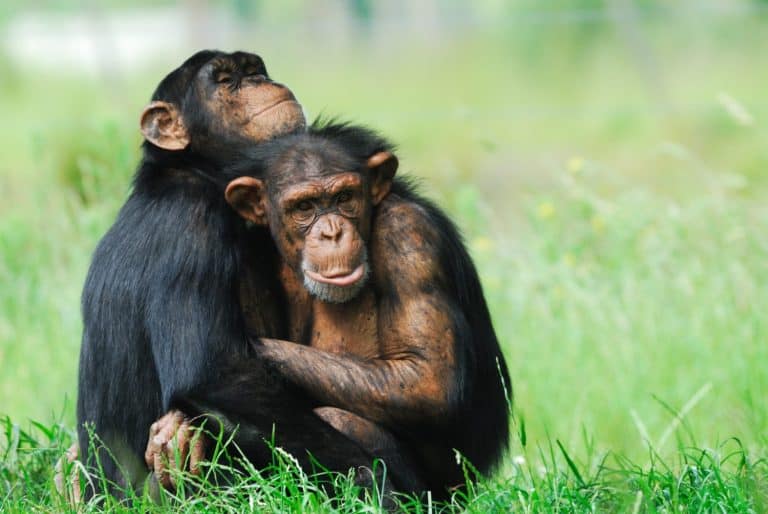
Nearly 30 percent of the transfers occurred between mother chimps and their young.
©Wirestock Creators/Shutterstock.com
“Tool transfers thus appear to be a form of teaching, together with observation and supervised practice. It appears that mothers are the main models and teachers for young chimpanzees in this manner.”
But it wasn’t always the mothers doing the teaching. In one instance, a young male chimp showed an infant named Totti how to pound the fruit. He even moved the infant’s hand with the fruit to demonstrate how it was done.
In all the observed interactions, the infants copied the actions they were shown.
Is It Really Teaching?
Researchers say yes.
“Teaching is one of the strategies that chimpanzees use to transfer information and skills between individuals. It requires an active role from the teacher, who must modify their behavior to facilitate the transmission of information to the learner, and this is why teaching is thought to have evolved to transfer information that is too complex to be acquired through simpler mechanisms, such as individual or observational learning,” Sánchez-Megías said in the news release.
But it isn’t just tool and fruit transfer. According to the researchers, teaching occurs through tool sharing, observation, and supervised practice. And this isn’t the first study to show this.
An earlier study in Congo’s Goualougo Triangle showed chimps giving termite fishing poles to learners. In that study, the giver lost out on the termite bounty in favor of the tool recipient. The recipients with the tools got to fish more.
What’s Next?
Now that researchers have seen the tool transfer teaching behavior in action, the next step is figuring out its importance in how great apes learn overall.
“One question that needs to be answered is the extent to which teaching contributes to the transmission of technological behaviors in great apes. Other questions are whether more complex behaviors require more teaching, and whether the individuals that receive more teaching ultimately become better teachers themselves,” Professor R. Adriana Hernandez-Aguilar, the study’s senior author and research co-director of the Jane Goodall Institute Spain, as well as Serra Hunter Professor at the University of Barcelona, said in the press release.
Further studies are planned.