
Quick Take
- Boas lack venom and fangs but use multiple rows of recurved teeth to securely grip prey.
- Their teeth act like hooks, making escape nearly impossible as they tighten their hold.
- Once anchored, boas rely on powerful constriction to subdue and kill their prey.
Not all snakes are created equal, and boas have one fundamental difference from vipers. Fangs are a prominent feature of many snakes, but this is one thing that boas don’t have. Instead, boas are aglyphous, meaning they lack specialized fangs. Their mouths are filled with rows of sharp, dense teeth. None of these are hollow or excrete venom, and that’s precisely why they work to a boa’s advantage.
These long, surgically sharp rows are the equivalent of a grappling hook. Once a boa has its prey in sight, its serrated grip allows it to do what it does best: constrict and kill. To accomplish this, boas rely on specialized teeth that vipers do not possess.
The Anatomy of a Boa’s Teeth
Just because a boa doesn’t have venom does not mean its bite isn’t fatal. Thanks to elongated teeth that curve inward, this snake can easily take a chunk out of any small mammal. Its teeth operate as hooks, driving down into the flesh of its prey. As this happens, the prey is unable to escape because the boa’s teeth grip in the opposite direction of the animal’s attempted movement. Several rows of these harpoon-like teeth immobilize prey, keeping them in place while the boa coils.
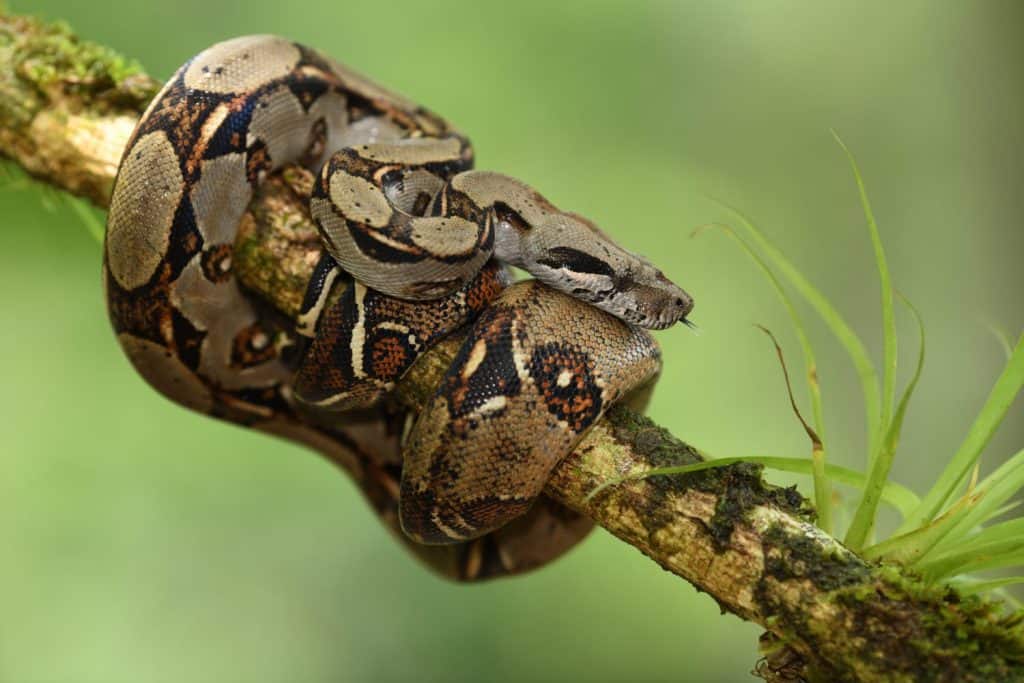
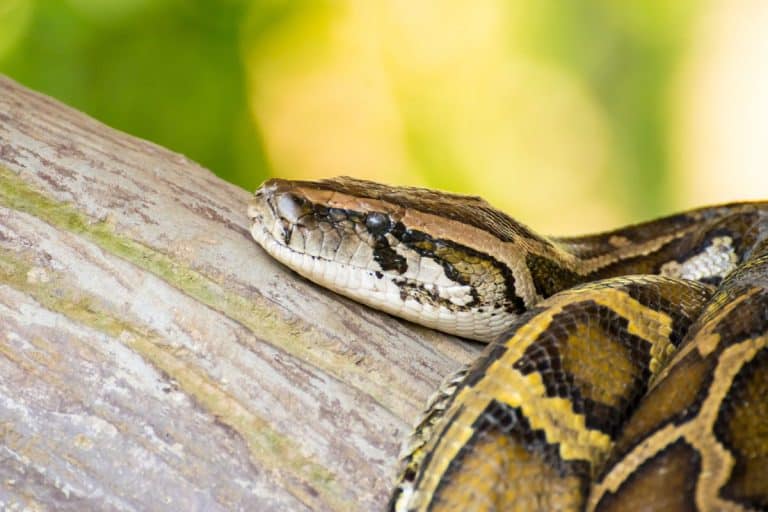
Boas sit in wait for the opportunity to strike prey, but not with venom.
©petrdd/Shutterstock.com
If its prey tries to pull away, the boa’s teeth only sink deeper. This not only creates an immovable trap but also causes significant pain for the animal caught in the boa’s grip. This is especially helpful when a boa attacks a slimy or slippery animal, such as a river fish or amphibian. For boas, size also matters. Smaller, younger boas primarily produce pinprick-sized lacerations, while full-grown, adult boa teeth cause significant puncture wounds. For the latter, there’s always a chance that a small animal may even bleed out before being constricted and turned into a meal.
Hook, Line, and Constrictor
As you may have guessed, the next thing a boa does after sinking its teeth into its prey is to constrict. Depending on the size of the snake, a boa can exert a pressure of 6 to 12 pounds per square inch (psi) when coiling around an animal. Part of that pressure is due to its muscular body, and the other part is thanks to the teeth that hold prey in place.
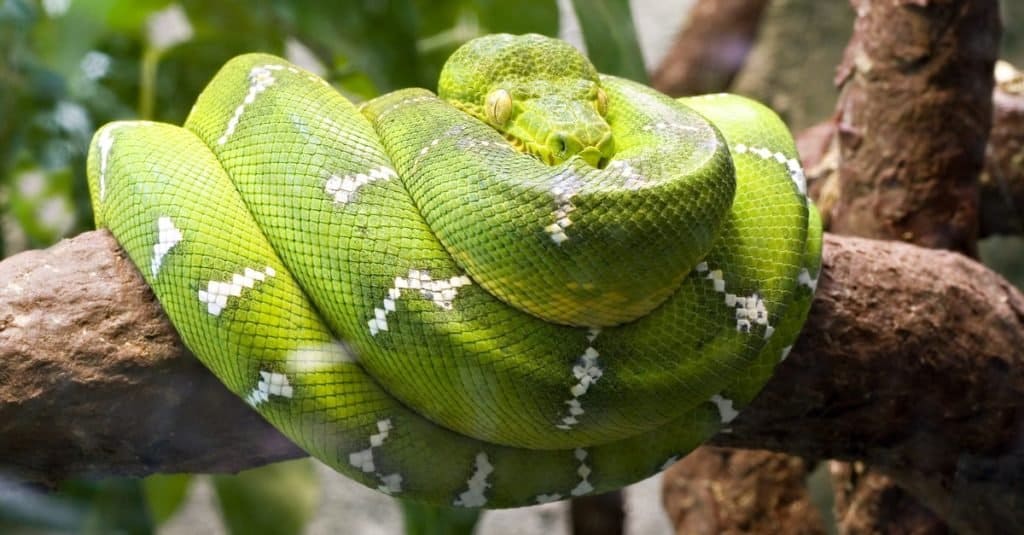
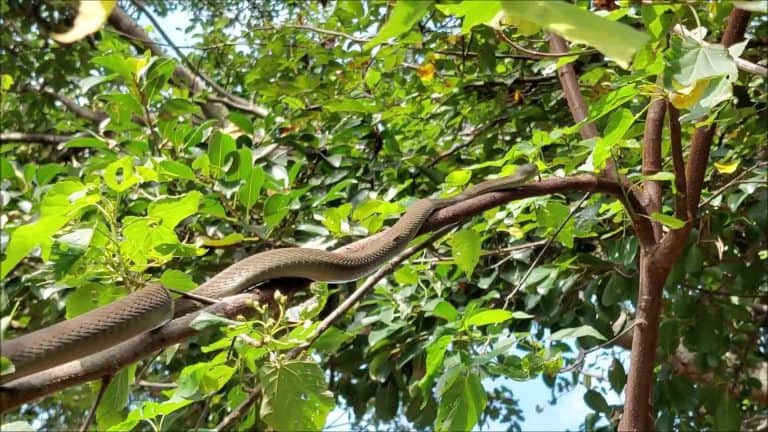
The Emerald boa constrictor catches most of its prey while hanging from a branch to snatch them off the ground.
©Hannamariah/Shutterstock.com
The boa keeps its teeth sunk into prey while it squeezes. Doing this makes for a slow, agonizing death, but an effective one. As the boa anchors prey with its longest teeth, it can also sense minute movements from the animal. Any resistance, and those teeth instinctively sink deeper into the animal’s flesh. As teeth and contracting muscles work in tandem, the boa does not require venom to subdue its target. Emerald tree boas are the best example of this. They have the longest non-venomous teeth of any snake, at just under one inch long. While they cannot inject venom, their bite is extremely painful.