
Quick Take
- Some gummivores gouge into living trees to trigger gum production, a behavior their teeth evolved specifically to support. See their specialized teeth →
- Plant gum can be toxic, yet some primates eat it as a dietary staple. Their trick for staying safe is stranger than you'd expect. Discover their digestive tricks →
- Gummivory may have shaped not just primate bodies but also primate minds, including the evolution of patience. Explore the cognitive links →
- For some species, gum isn't merely a snack but the dominant part of their entire diet, and the percentage will surprise you. See the diet breakdown →
There’s a lot more to diet classification than carnivores and herbivores. Have you heard of a gummivore? For example, you can see a cute gummivore in the Instagram post above. You’ve probably already guessed that gummivores eat gum! In this article, we’ll explain why some animals evolved to exploit this food source and introduce you to the fascinating world of gummivory.
What Exactly Is Gum?
Gum is an exudate produced by a plant. Its production is often a response to a pathological condition, such as insect or mechanical damage. Sometimes, gum is produced in just minutes, while in other cases, it can take more than 18 hours. Some plants produce gum as part of their seed dispersal process.
Which Animals Are Gummivores?
At least 69 primate species eat gum across three clades and several families. Some are specialist gummivores whose bodies have adapted specifically to obtain and digest gum. Examples include fork-marked lemurs (Phaner furcifer), southern needle-clawed galago (Euoticus elegantulus), thick-tailed galagos (Otolemur crassicaudatus), marmosets (e.g. Callithrix spp.), the pygmy marmoset (Callithrix pygmaea) and possibly the hairy-eared dwarf lemur (Allocebus trichotis).
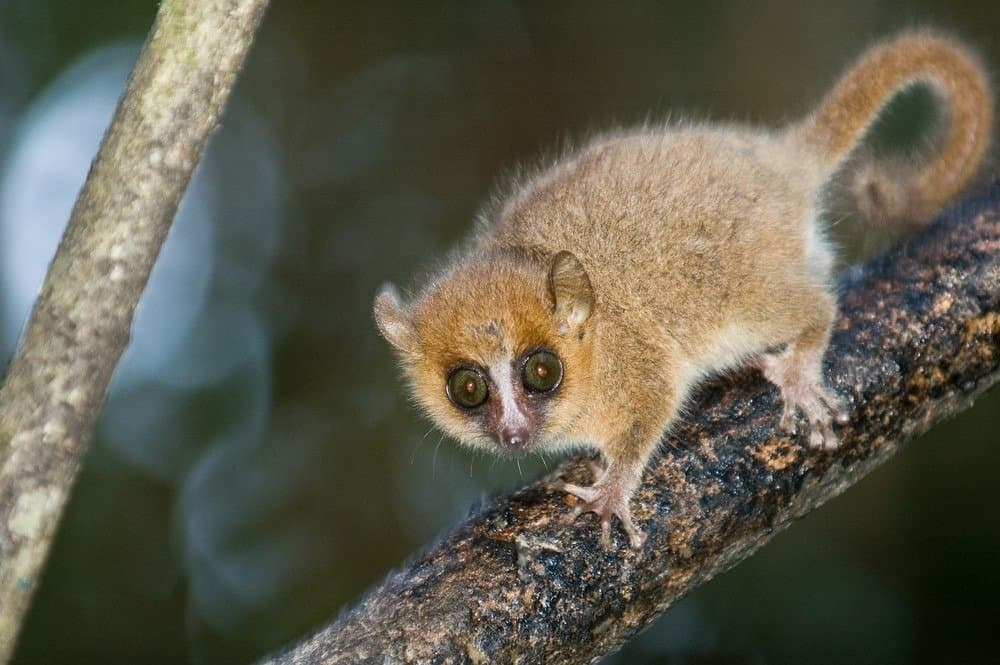
However, gum also makes up a significant part of the diet for other animals. For example, it constitutes around 15 percent of the diet of yellow baboons (Papio cynocephalus) and 75 percent of the diet of grey mouse lemurs (Microcebus murinus).
Some species consume gum only at certain times of the year, using it as a backup food source when other nutrition is unavailable. Also, some primates consume more gum at younger life stages.
What Types of Plant Gum Do Gummivores Eat?
So far, we know that gum from at least 250 plant species is consumed, but the true number may be higher. Some primates, such as Saddleback tamarins, consume gum from many different plants. Others are more selective, and most plant gums are only eaten by one or two species. The most frequently exploited plant gum genera are Parkia and Acacia.
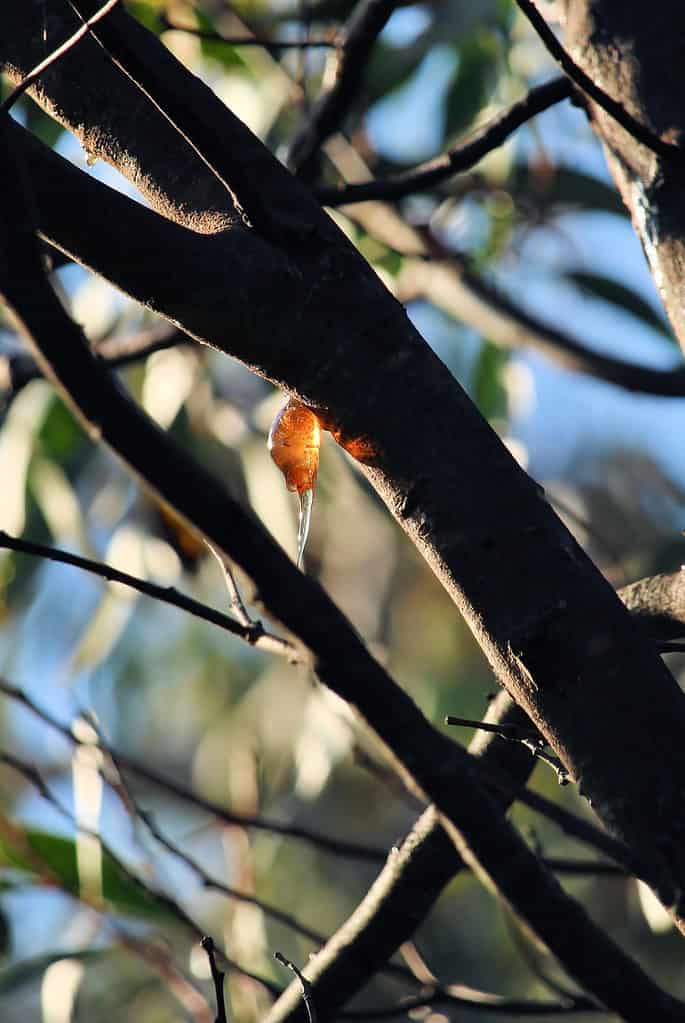
Plants under stress produce gum.
©Wattlebird/Shutterstock.com
How Are Gummivores Adapted to Eat Gum?
Gums are complex polysaccharides that, like vegetation, require fermentation for digestion. They are also high in minerals, particularly calcium. Some gums may trap bile acids. However, gums can also contain toxic secondary compounds. Some are high in phenols and tannins, and primates know how to select gums that are lower in these compounds. Other gums have distasteful compounds such as quinine, and some primates are less sensitive to this than others.
Primates adapted to eat gum generally have a small body size and sharp claws or nails, allowing them to cling to vertical trunks where gum is produced. They often have flattened canine teeth and incisors that protrude outward (procumbent), which they use to gouge tree bark and stimulate exudate production. Some also have an enlarged cecum and/or proximal colon (parts of the large intestine), providing more area for the microbial fermentation needed to digest gum.
More recently, gummivory has been linked to psychological differences between primate species, such as the evolution of patience. This dietary strategy may have major implications for the ecology and social organization of primates and deserves a closer look in future research.