
Quick Take
- Achieving one successful ice rescue required sub-zero immersion without the use of standard ice support.
- Using one standard rope failed because the dog could not overcome its natural limitations.
- The safest location during an ice rescue is the riverbank rather than the frozen surface.
- Initiating a manual ice-breaking stage was required to manage unseen currents during the extraction.
The poor dog in the above clip was in real danger. It had fallen through some ice and was waist-deep in a frozen river. Even though both of its front paws were on the ice, the lower part of its body was in the freezing water. It cannot get enough grip on the ice to haul its body out. In the above dramatic footage, a man saves the dog from a frozen river by cutting through the ice. However, please be aware that this is not the recommended course of action when a dog falls through ice as we explain here.
Man Saves Dog From Ice
The most important thing about this clip is that the man did not try to walk on the ice himself. This is the last thing that you should do when attempting a rescue, as it puts you in huge danger. Instead, he throws a rope towards the dog – this would work best with a human victim. Unfortunately, the dog did not understand that it could be pulled out of the ice if it grasped the rope with its mouth.
Next, the man worked his way across the river, breaking the ice with a stick as he moved forward. Luckily, this was not a very deep river – it reached the top of his legs. Nevertheless, this is a risky thing to do as it is so cold and there could have been fast-moving currents. Once all the ice was broken, the dog was able to swim to the riverbank by itself.
How To Rescue A Dog From Ice
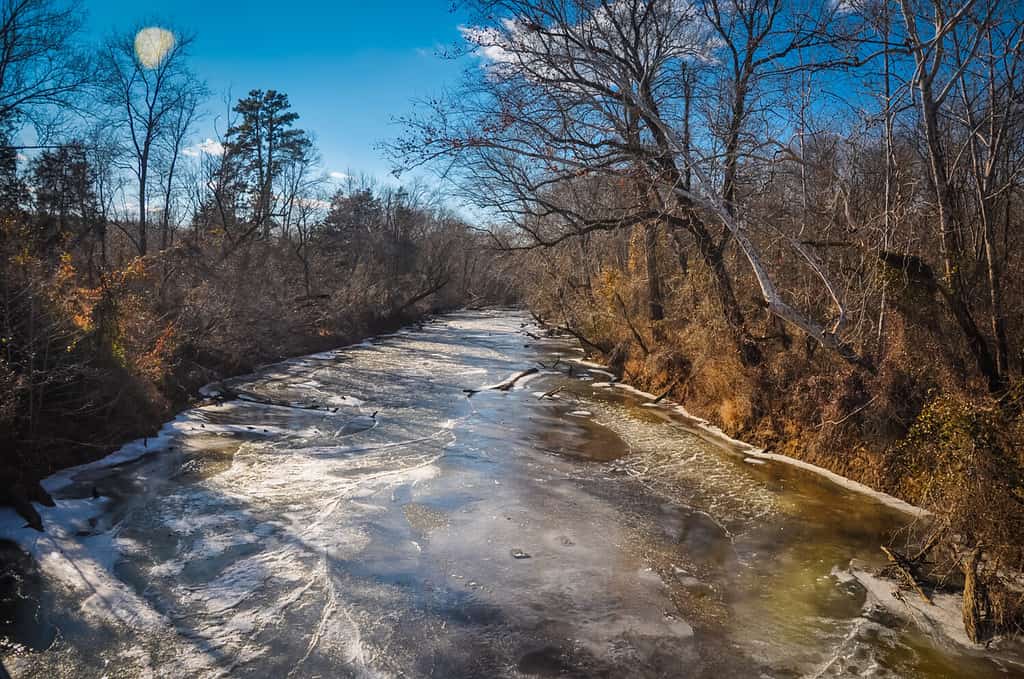
Frozen rivers are dangerous for dogs and people.
©Jon Marc Lyttle/Shutterstock.com
Sadly, every winter brings numerous reports of dogs falling through ice. It is not uncommon for their owners or passers-by to try to rescue them. Sometimes, as in the above clip, it is successful. However, at other times, it ends in tragedy and the rescuers themselves die.
The UK dog charity, the Dogs Trust, advises that you should always keep your dog on a leash if you are walking near a frozen lake, river, or pond. They explain that snow and ice can be very disorientating for dogs and they can end up on thin ice without realizing what they are doing. If your dog does fall through ice, you should encourage them to swim/walk back to you and never get onto the ice yourself. Call the emergency services who will have the expertise and equipment to deal with the situation safely.