
Quick Take
- Our evolutionary cohabitation with dogs has attuned them to our emotions.
- Exposure to human stress odors has been shown to induce more pessimistic behavior in dogs, suggesting our mood can affect theirs.
- Our facial expressions, vocal cues, body language, and other subtle shifts may express our moods to our dogs, even when we’re trying to hide them.
Have you ever had a miserable day and found that your dog was right there beside you? You might not have even been crying or emoting in any real way, but your pup still recognized your pain and wanted to help. Do dogs truly sense our feelings, or do humans just interpret behavior as emotional?
Reality and experts alike suggest that the science behind canine emotional sensitivity has expanded significantly in recent years, and what researchers are finding is both more sophisticated and more touching than many people realize.
Dr. Nathaniel Rakestraw, DVM, a veterinarian with TelaVets, explains it to us in an interview, stating, “Dogs have an amazing way of picking up on our emotions, even when we don’t say a word. They’re constantly watching us, so they notice the little things we don’t even realize we’re doing differently when we’re having a rough day.”
We explore how dogs are attuned to our emotions, drawing on expert advice. Through this interview, we learned some surprising things: dogs really do know when we’re having a bad day. We aren’t imagining it, and here’s why. Here’s the rest of Rakestraw’s insight, along with further research to support the idea that a dog truly is man’s best friend.
A Dog’s Love Is Rooted in Observation
The foundation of canine emotional sensitivity is actually observation—intense, constant, seemingly compulsive observation. Because dogs have co-evolved alongside humans for an estimated 15,000 to 30,000 years, much of that evolutionary journey involved learning how to read us. That’s why this ability is still embedded in dogs today.

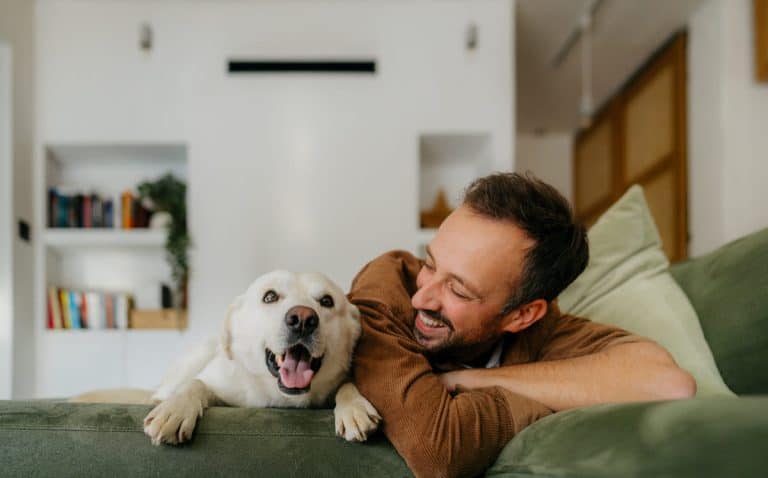
Our dogs are capable of deciphering our moods, studies suggest.
©Lindsay Helms/Shutterstock.com
Research published in the journal Animal Cognition found that dogs behaved differently in response to their owners’ genuine emotional states rather than simulated ones, both gazing less and jumping less when owners were sad. They also showed altered responsiveness to commands, picking up on their humans’ authentic emotional cues in real time.
Another study published in Evolutionary Human Sciences confirmed that dogs discriminate and show different responses to emotional cues expressed through body postures, facial expressions, vocalizations, and odors. They also appeared to integrate all of these channels to form an assessment of how a person is feeling, capable of taking in all sorts of underlying information at once.
Dr. Rakestraw describes how physical movement also tells a story to a dog. “It can be as simple as how you’re moving. When people are stressed or sad, they might walk slower, sit differently, avoid eye contact, or seem a little more tense. Dogs are tuned into those small changes because to them, we’re the most important thing in the room.”

Dogs have been observed paying extremely close attention to the facial expressions of humans in an effort to understand our moods.
©Prostock-studio/Shutterstock.com
Studies at the University of Lincoln echoed this, showing that dogs respond differently to positive, neutral, and negative human facial expressions, and that they spend a remarkable amount of time monitoring human faces specifically. Dogs seem to pay a great deal of attention to body language overall, giving them a better read of a person’s emotional state than we might’ve initially expected.
Dogs have an amazing way of picking up on our emotions, even when we don’t say a word. They’re constantly watching us, so they notice the little things we don’t even realize we’re doing differently when we’re having a rough day.
Dr. Nathaniel Rakestraw, DVM, a veterinarian with TelaVets
Our Vocal Cues and a Dog’s Insight
Most people, especially dog owners, recognize that dogs respond to tone of voice. However, there’s a depth in dogs and their ability to interpret vocal cues that we may not realize. Harsh or cheerful vocal qualities are one thing, but dogs are also attuned to subtler shifts that happen when something is emotionally off, even when a person is actively trying to sound normal.
“Your voice plays a role too,” says Dr. Rakestraw. “Even if you’re trying to sound normal, dogs can pick up on changes in tone or energy. A quieter voice, less enthusiasm, or even just longer pauses can signal that something’s off.”

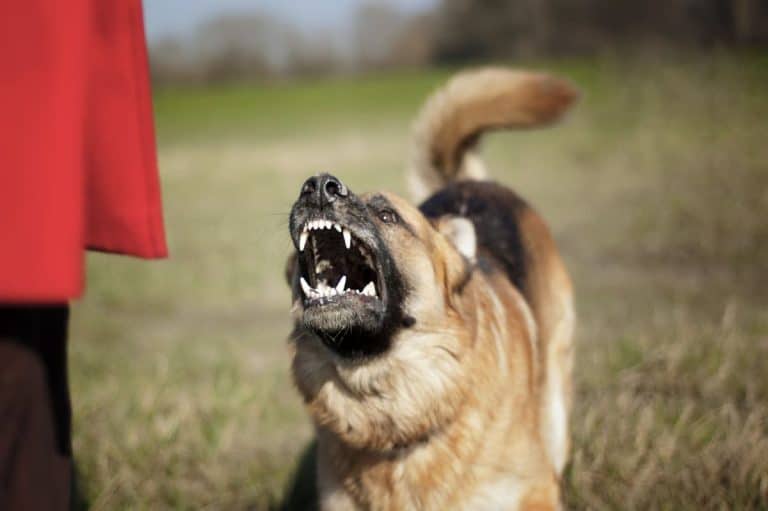
Our vocal cues are something dogs are obviously aware of, but they may even be able to ascertain the types of energies carried in our speech.
©VDB Photos/Shutterstock.com
Research cited by the American Kennel Club confirms that the sounds of happiness are likely to result in a positive reaction in dogs, while sadness and fear can result in a more cautious or concerned response. Dogs also pay attention to more than just words and volume; they seem to understand the energy or emotion carried in our speech, suggesting they know when we’re trying to hide our bad days.
A Dog’s Emotional Sense of Smell
Of all the ways dogs monitor our emotional states, their sense of smell may be the most astonishing, which isn’t a surprise given how powerful the dog nose can be. However, humans are not often consciously aware of all the things a dog can smell about us.
When we experience stress or anxiety, our bodies undergo multiple physiological changes: cortisol floods the bloodstream, adrenaline spikes, heart rate accelerates, and the composition of our sweat and breath shifts in ways that are typically undetectable to the human senses. Dogs, meanwhile, may be able to detect our physiological shifts.

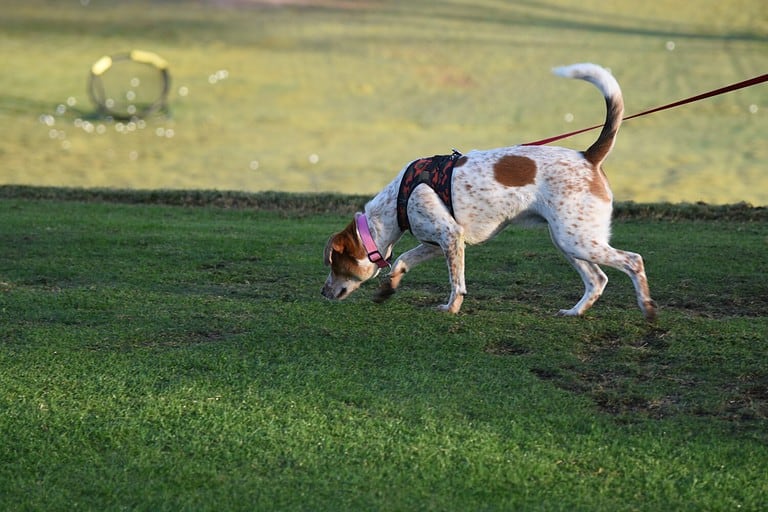
The sense of smell in dogs continues to surprise, as they are able to smell our stress hormones.
©Magui-rfajardo/iStock via Getty Images
Dr. Rakestraw actually points to this as one of the most underappreciated aspects of canine emotional awareness. “There’s growing evidence that they can detect changes in our body chemistry when we’re stressed or anxious. So in a way, they may ‘smell’ that you’re having a bad day before you even fully realize it yourself.”
The research backing this up exists: a landmark study published in PLOS ONE provided direct evidence that dogs can detect an odor associated with acute stress in humans, without any visual or vocal cues at all. The researchers collected breath and sweat samples from participants before and after a stress-inducing task, then trained dogs to identify the stress samples; they finished the task with impressive accuracy, demonstrating that a chemically distinct stress signature exists and that dogs can detect it.
An additional follow-up study published in Scientific Reports found that stress odor both informed the dogs of our emotional states and even affected their own moods. For example, dogs exposed to the scent of a stressed stranger became more pessimistic and more hesitant to approach uncertain situations compared to dogs exposed to a relaxed scent. Our scent of stress was contagious to these dogs in a measurable, behavioral way.
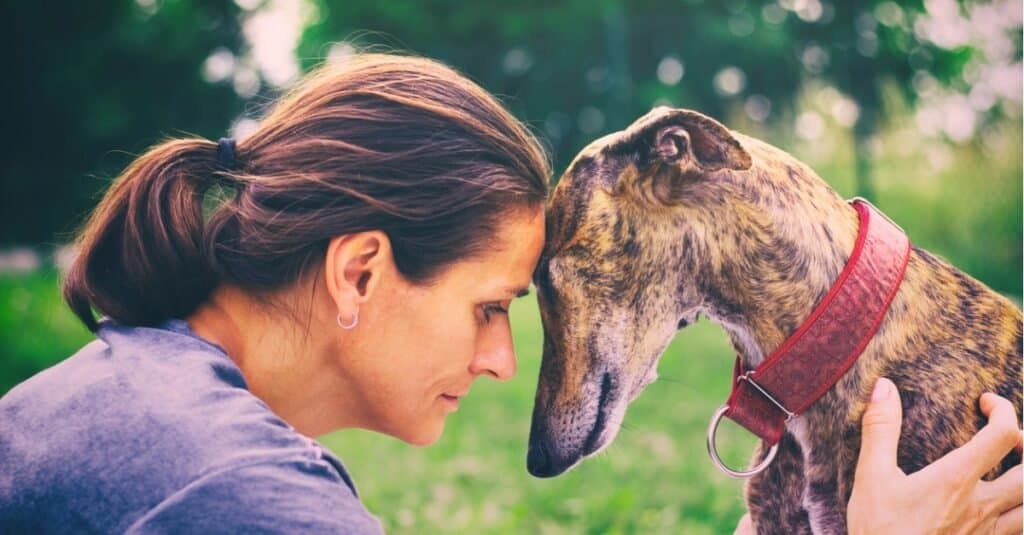
Dogs were capable of smelling stress hormones on strangers, indicating the potential for even stronger smelling abilities with humans they know.
©iStock.com/Zbynek Pospisil
What’s even more fascinating is that these stress odor experiments used samples from people the tested dogs had never met, suggesting this is a far broader skill beyond a dog smelling a familiar person’s chemistry. There seems to be a common stress smell across individuals that dogs can identify without prior training or even relationship history.
When we consider dogs that live with someone they know well, that sensitivity is almost certainly amplified further, especially with all the other factors dogs are aware of within humans.
Routine Is a Language Dogs Speak Best
If you have dogs in your home, you understand that they frequently pay attention to the rhythm of your days. They are creatures of extreme habit and are deeply attuned to the patterns and sequences of their entire household. If and when those patterns shift, dogs recognize it immediately, and this includes emotional deviations from routine.

If our routines change due to our emotions, dogs are painfully aware.
©Drazen Zigic/Shutterstock.com
“They also notice when your routine changes,” explains Dr. Rakestraw. “If you skip your usual walk, stay in bed longer, or just seem less engaged, that stands out to them right away. Dogs love predictability, so any shift can be a clue that something’s different.”
In other words, dogs are capable of noticing when you’re different from your usual self or from the baseline they’ve come to know, day in and day out. The more time a dog spends with you, the more attuned they become to your emotions, whether you realize it or not.
“What people often interpret as empathy is really a mix of strong bonding and observation,” Dr. Rakestraw explains. “Dogs that are close to their owners learn what ‘normal’ looks like, so when something changes, they respond. That’s why some dogs get extra cuddly, rest their head on you, or just quietly stay nearby when you’re not feeling your best.”
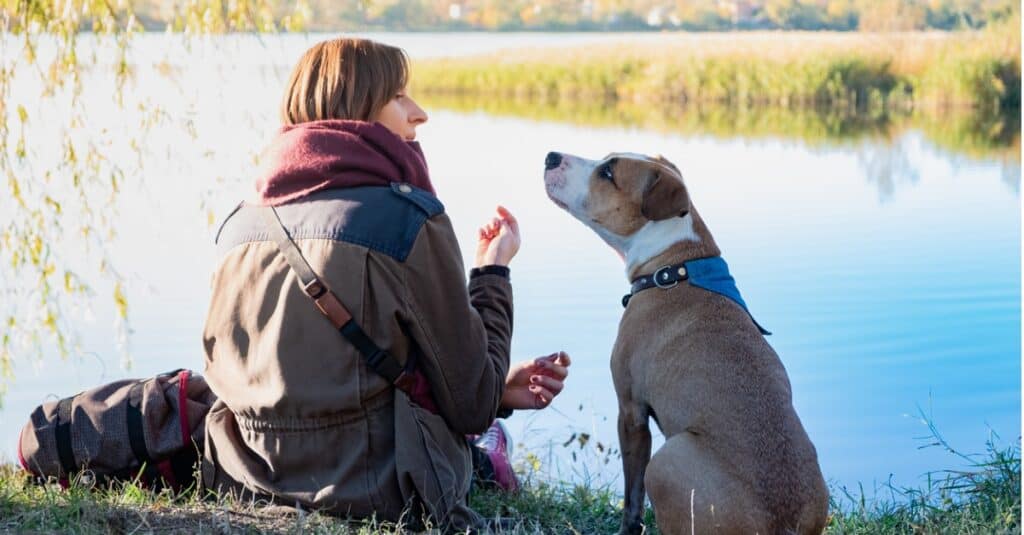
Dogs can sense when we’re stressed, but they may also understand that they have the potential to relieve our stress by reducing our cortisol levels.
©iStock.com/Photoboyko
Perhaps dogs recognize that their presence has the potential to help us feel better. Interactions with dogs have actually been associated with reductions in cortisol, the singular stress hormone that dogs can apparently detect in our sweat. Their awareness of our stress levels may allow them to act, to seek out closeness with us so that we may take advantage of their calming capabilities. It’s a beautiful thing to understand that dogs want us to cheer up when we’re having a no-good day.
Our Emotions Affect Our Dogs
The aforementioned stress odor research also noted that the effects of stress run in both directions. When dogs are around stressed individuals, their own mood shifts, suggesting our bonds with our dogs are genuinely shared. It is ultimately an aspect of the co-regulation that humans and dogs have been engaged in for millennia, in an effort to survive and find peace in one another.
“They may not understand why you’re having a bad day, but they definitely know that you are. And for a lot of people, that support is exactly what makes dogs so special,” Dr. Rakestraw says.

Our dogs know when we’re having a bad day, and all they want to do is make it better.
©Viorel Kurnosov/iStock via Getty Images
Thousands of years of shared history between our two species have created companions who want us to feel better and will stay by our side, even if we can’t turn the day around. Remember that, when your dog comes to you on a hard day and stays close without being asked, they are doing something ancient and profound, offering you comfort when they know you need it most.