
Quick Take
- Your dog's dominant paw might be silently revealing something unsettling about their emotional state. See what it reveals →
- Stress doesn't just affect a dog's mood. It can physically change something most owners never think to watch for. Explore the stress connection →
- Researchers need only a simple household object to decode your dog's personality, and you probably already own it. Try it at home →
- Dogs and humans share paw dominance, but the split between lefties and righties looks nothing like you'd expect. See the paw preference split →
Did you know that your dog can be a lefty or a righty, too? Just like humans, dogs prefer to use a dominant left or right hand — er, paw — in their daily lives, and this preference can actually tell us a lot about a dog’s inner life. (Science is so cool, isn’t it?)
Pawedness, or paw preference, refers to which side your dog prefers to use when completing basic tasks. Scientists assess laterality (a distinct, asymmetrical preference for one side or the other) using a variety of tests. However, determining this in dogs can be challenging because they may use different paws for different activities, depending on the task.
One 2017 study, which looked at which food bowl a dog would choose based on its location to the left or right of them, found that the majority of the dogs were ambilateral (using left and right sides equally) and the rest were split between right (5 dogs) and left (6 dogs). Their paw preferences were fairly even, despite differences in breed and sex. This is very different from humans, with studies showing that only about 10 percent of the population is left-handed.
Tests for Pawedness in Dogs
So how do you know which side your dog prefers? Researchers use different tests to determine your pet’s preference for one side over the other, such as the first-step test and the Kong ball method.
For example, the first-step test observes which paw a dog lifts first when walking or stepping over a hurdle, while the Kong ball test examines which paw a dog uses to hold a Kong ball. These studies show a dog’s natural preference for one side or the other; however, researchers do not agree on whether these tests are completely effective for determining pawedness. A 2022 study found that a dog’s preference for left or right may depend on the specific task, rather than indicating an overall left- or right-pawedness.
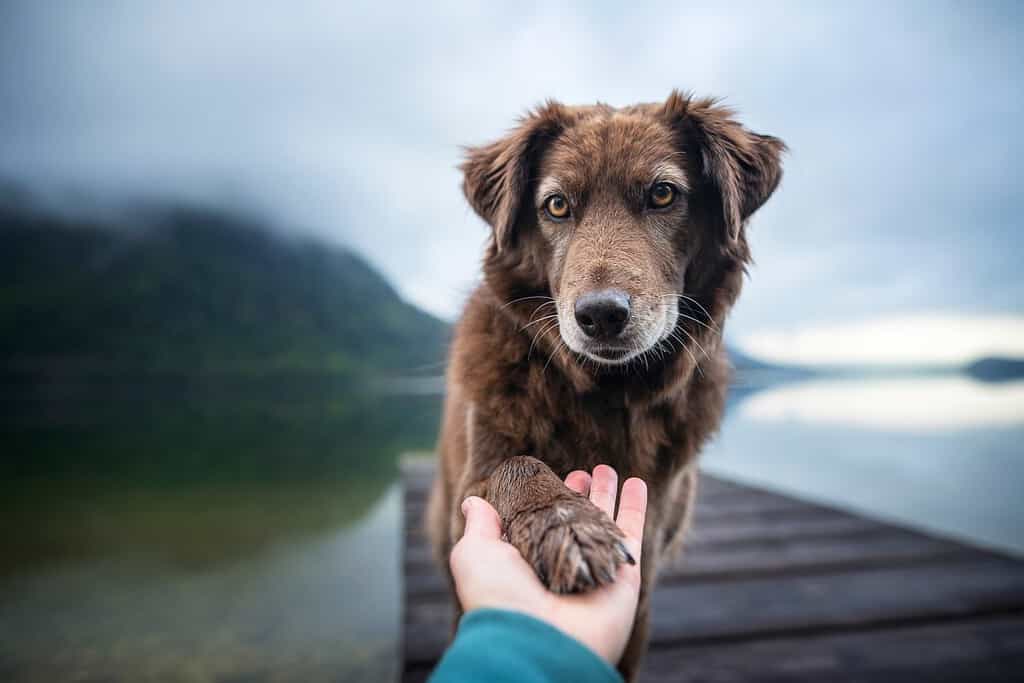
Just like humans, many dogs prefer to use one side or the other for basic tasks.
©Enna8982/Shutterstock.com
To create more consistent testing for paw preference, a group of researchers led by Sevim Isparta developed a new method called the “Doginburgh Inventory.” Inspired by the famous Edinburgh Handedness Inventory for humans, this tool helps determine which side a dog prefers overall. Their research was published in the Royal Society Open Science journal in June 2026, where they explained that their method for determining pawedness includes the Kong test, food reaching test, stationary first stepping on stairs test, and dynamic first stepping test.
“When we talk about laterality, we talk about two aspects,” Marcello Siniscalchi, veterinary physiologist at the University of Bari Aldo Moro and one of the study authors, told Science in June 2026. “The first is direction: You can be either left-handed, right-handed, or ambilateral. But there is also another important aspect, which is strength: How much are you right-handed, or how much are you left-handed? This aspect is very important because there is evidence that both direction and strength affect physiology, immune response, and behavior in dogs.”
The researchers then examined the results and placed dogs in one of five categories: strong left, weak left, ambilateral, weak right, and strong right. This expanded set of preference categories, combined with a more standardized testing method, could improve future dog laterality research by enabling researchers to use consistent criteria. This will help us learn more about dogs and how paw preference influences their personalities.
What Does Pawedness Say About Your Dog’s Personality?
Your dog’s preference for their left or right paw can give you clues into their personality and inner emotional life. Many studies have shown that left-pawed and right-pawed canines have different character traits and behaviors. For example, one study showed that left-pawed dogs have a more negative or pessimistic outlook than right-pawed or ambilateral dogs. Another study found that right-pawed dogs are more aggressive and less fearful than their left-pawed or ambilateral counterparts, specifically during sheepdog training.
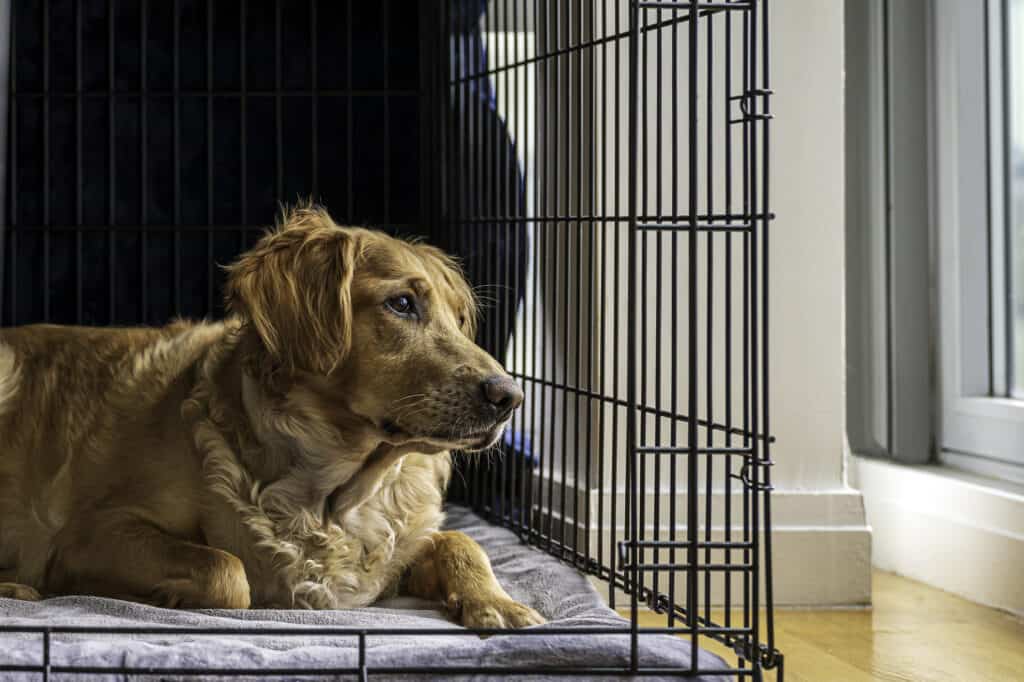
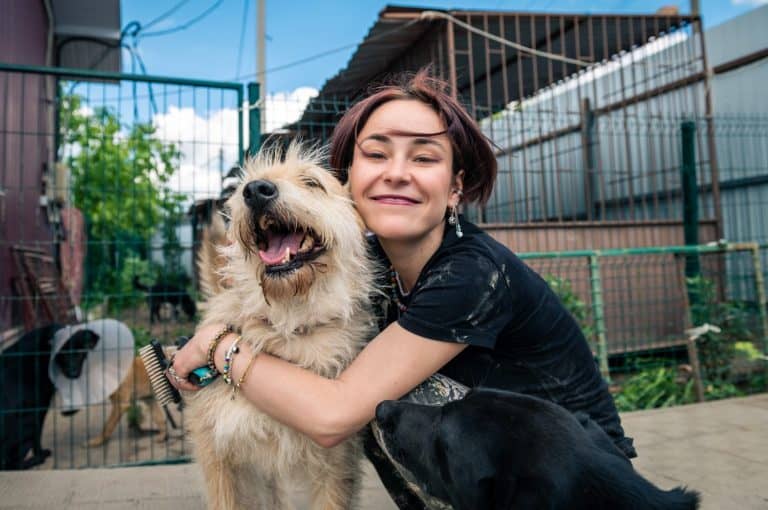
Dogs in shelters and other stressful situations may be more likely to have ambilaterality.
©iStock.com/Christine McCann
One study found that shelter dogs who experienced more chronic stress had higher levels of ambilaterality, and another showed that both temporary stress and long-term stress can change the paw preference in dogs. A different study found that ambilateral dogs showed less aggression to strangers than dogs with a paw preference. Other studies have shown that a dog’s pawedness gives clues into their immune response against vaccines.
Understanding dogs’ paw preferences and how these relate to their behaviors and personalities provides valuable insights into animal welfare. Hopefully, research in this area will continue to expand, allowing us to better help our dogs and give them their best lives.
How to Figure Out Your Dog’s Paw Preference
While it might not be entirely scientifically accurate, as researchers will go through paw tests dozens of times with the same dogs, there are a few ways you can try to determine which paw your dog likes best at home. You can conduct the experiments researchers did in the “Doginburgh Inventory” by filling a Kong toy with peanut butter and seeing which paw your dog uses to hold it or have them walk on steps to see which paw they put forward first. You could also simply observe your dog to see which paw they tend to use when interacting with toys or when you ask for a paw. Keep in mind that these unofficial tests are just done for fun at home to learn more about your pup!