
Quick Take
- Honey badgers aren’t fearless; they survive by carefully assessing risk and retreating when the odds turn against them.
- Their loose skin, durability, and pain tolerance give them time and options, not guaranteed victories.
- Intelligence and adaptability, not brute force, are the honey badger’s greatest survival tools.
Anyone who’s ever spent any time online has probably seen the honey badger described as the world’s most fearless animal. Maybe you’ve seen videos of it squaring up to lions, stealing food from hyenas, and charging headlong into danger like it has nothing to lose. That reputation is entertaining, but it’s also misleading. Honey badgers aren’t reckless thrill-seekers. They’re calculated survivors. What looks like fearlessness is actually something far more useful in the wild: adaptability.
The honey badger, also known as the ratel (Mellivora capensis), has survived across Africa, the Middle East, and parts of India for hundreds of thousands of years. It hasn’t lasted this long by winning every fight, but rather by knowing which fights are worth starting, which ones are worth bluffing through, and which ones require a fast retreat. Its toughness is real, but it isn’t ruled by pure brazenness—its intelligence and problem-solving skills are actually what keep it alive.
The Fearlessness Myth
Honey badgers don’t lack fear, as their reputation suggests. They respond to threats, show stress behaviors, and avoid danger. What sets them apart is that they don’t panic easily. In the wild, panic can lead to poor decisions, which can get an animal killed. A honey badger confronted by a predator doesn’t freeze or bolt blindly. Instead, it evaluates what’s happening in real time.
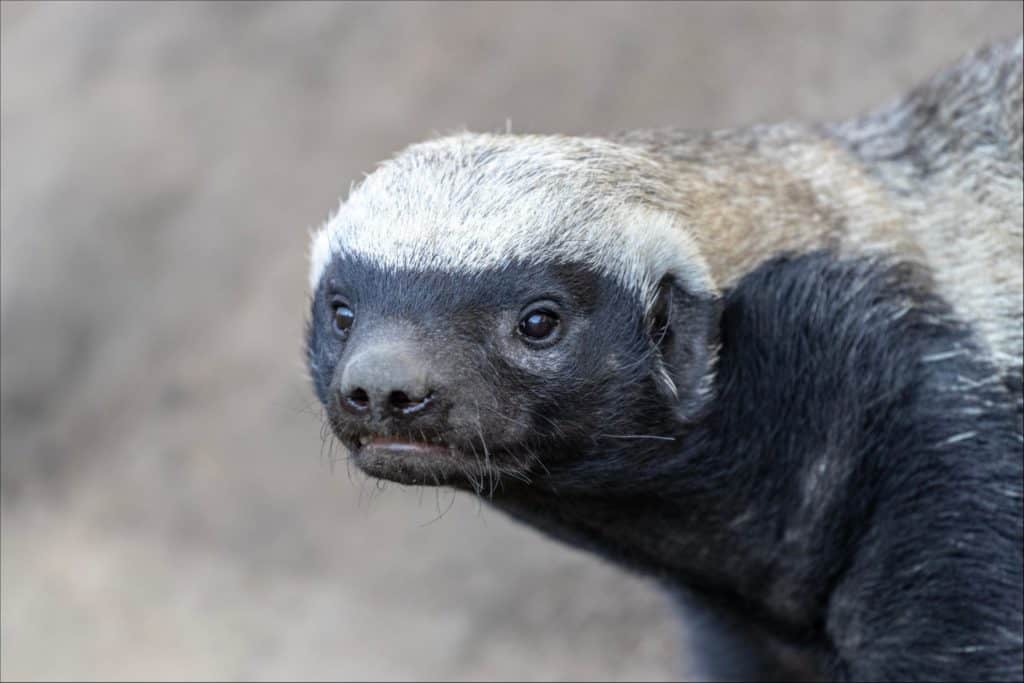
Honey badgers often pause, stand upright, and sniff the air before engaging, showing that threat assessment, not blind aggression, guides their behavior.
©LM Gray/Shutterstock.com
Honey badgers often approach potential threats slowly, stopping to sniff, stand upright, and visually assess the situation. If a lion, leopard, or hyena is resting or distracted, the honey badger may posture aggressively to discourage pursuit. Sometimes this works, and the predators back down. Those are the interactions that find their way to YouTube. But if the predator shows sustained interest, the honey badger frequently retreats into cover, a burrow, or thick vegetation—and that rarely makes it into the reels.
This is a crucial point. Honey badgers back down all the time. They abandon kills, drop stolen food, and disappear underground when the odds turn against them. That behavior doesn’t make for dramatic video, but it’s why they live long enough to reproduce.
A Body Built for Conflict
Honey badgers weigh risk differently because their bodies give them more margin for error than most mammals of their size. Adults typically weigh between 20 and 30 pounds, but they’re built like compact tanks. Their low center of gravity makes them exceedingly difficult to flip or pin.
They also have loose skin, which is a curious survival tool. Predators often rely on holding prey still long enough to deliver a killing bite. When a honey badger is grabbed by the neck or shoulders, it can rotate within its own skin and bite back. This doesn’t necessarily mean it wins those fights, but it can create enough chaos and discomfort to break the predator’s focus.
From a risk perspective, this gives honey badgers options. They can afford to test boundaries because they’re hard to kill quickly. That doesn’t make them invincible, but it does tilt the survival math a little in their favor.
Why Lions, Leopards, and Hyenas Often Give Up
Large predators hunt for efficiency. A lion or leopard wants prey that can be subdued quickly with minimal risk of injury. Even a minor wound can become infected or limit hunting ability, which can be fatal in the long run.
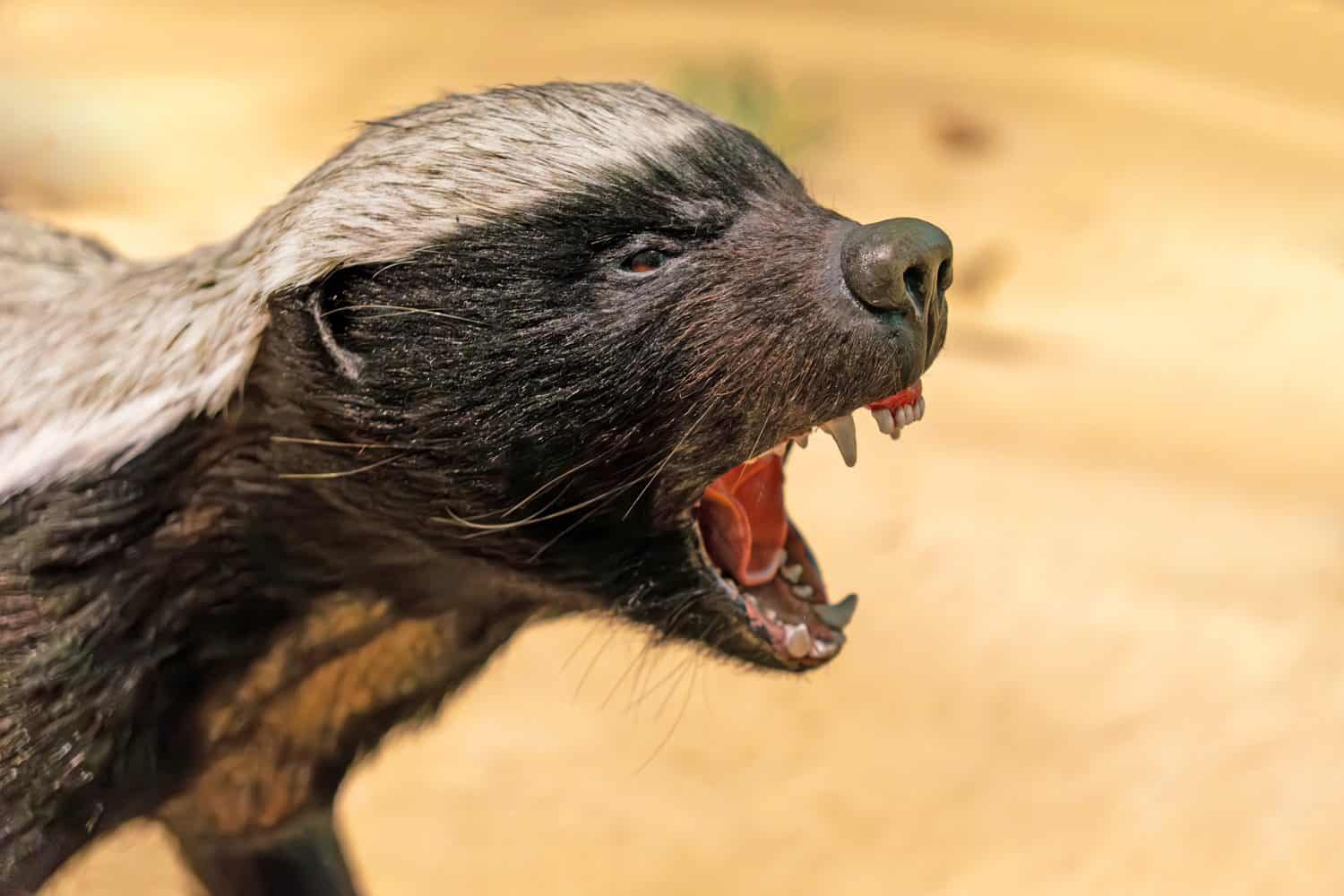
Honey badgers advertise themselves as bad investments. They hiss, growl, bare their teeth, and release a strong-smelling secretion from their anal glands. This display is loud, persistent, and unpleasant. It tells the predator that this small animal is going to fight back and fight dirty.
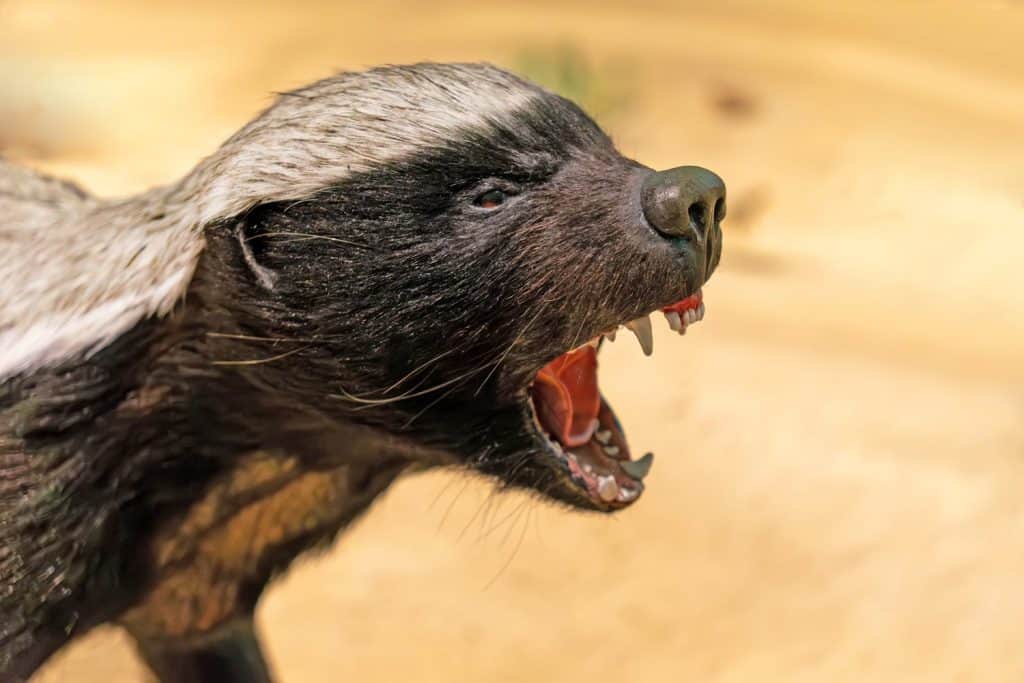
Large predators frequently disengage from honey badgers because the risk of injury outweighs the reward of such a small meal.
©Melnikov Dmitriy/Shutterstock.com
In many documented encounters, predators investigate briefly and then disengage. Not because the honey badger is going to win, but because the cost-benefit analysis doesn’t add up. Why expend energy on a creature that’s going to put up a fight when there is far more docile prey out there? A honey badger doesn’t need to defeat a lion; it only needs to convince the lion that it’s not worth the trouble.
The Strategy of Retreat
One of the biggest misconceptions about honey badgers is that they never back down. This is patently false. Retreat is central to how they survive. Honey badgers are excellent diggers, capable of excavating escape burrows in minutes. They also reuse abandoned dens made by other animals. When confronted by persistent threats, honey badgers frequently retreat underground, where larger predators can’t follow, then wait until the danger passes before resurfacing. This isn’t cowardice, it’s survival.

Honey badgers can dig escape burrows in minutes, disappearing underground to wait out danger rather than forcing a losing fight.
©LouisLotterPhotography/Shutterstock.com
They’ve also been observed abandoning food sources when pressure from predators becomes too intense. They don’t fixate on a reward. If something becomes too risky, they make a sacrifice and move on. That flexibility—the ability to reasonably assess risk versus reward—is one of their greatest advantages.
Surviving Bee Stings
Bees defend their hives aggressively. A human attacked by a large swarm can be literally killed by the accumulated venom. Yet the honey badger—a fraction of the size of a human—is well-known to raid beehives, receive hundreds—perhaps thousands—of stings, and live to tell the tale. How?
The answer is a combination of anatomy, physiology, and behavior. Honey badgers have thick skin that reduces the penetration depth of stingers. More importantly, they have a high tolerance for venom. Studies of related mustelids suggest that their nervous systems are less sensitive to certain neurotoxins, allowing them to remain functional despite heavy envenomation.
Behavior also plays a role. Honey badgers don’t linger in hives longer than necessary. They break into the structure, consume larvae and honey rapidly, and retreat to digest and recover. After a raid, they may appear lethargic or disoriented, but they usually recover fully within hours.
Pain doesn’t stop them, but it does slow them down. That’s an important distinction. Honey badgers aren’t immune to pain; they’re just capable of functioning through it long enough to escape. It’s yet another example of them assessing risk—a few irritating bee stings—against reward—a big old container full of honey.
Taking a Beating and Walking Away
There are documented cases of honey badgers surviving absolutely brutal attacks: bites to the head, crushing blows, prolonged grappling. Their survival isn’t some magic trick—it simply comes down to durability and recovery.
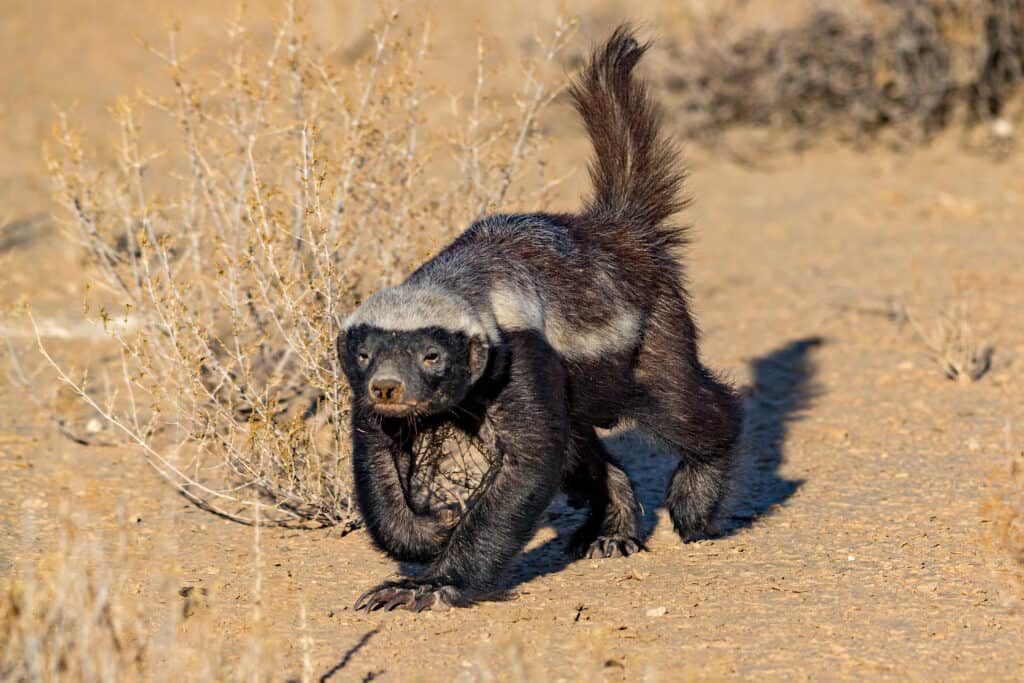
A thick skull, strong neck muscles, and flexible spine help honey badgers survive encounters that would be fatal to many animals.
©Braam Collins/Shutterstock.com
Their skulls are thick, their neck muscles are strong, and their spinal flexibility reduces the chance of fatal injury. Combined with their loose skin, this means that injuries often remain surface level, failing to reach vital organs.
Then, patience. After an encounter, honey badgers may retreat for days while wounds heal. This recovery session is aided by their metabolism, which allows them to go long periods without food, giving them plenty of time to heal before resuming normal activity.
Strategists, Not Superheroes
Honey badgers are notably intelligent, especially for their size. In captivity and in the wild, they’ve been observed solving complex problems, such as opening secured containers, navigating obstacles, and using tools like logs or rocks to climb. When stealing food from larger predators, honey badgers often approach from angles that limit pursuit, grabbing quickly and retreating immediately.
This intelligence translates directly to survival. They don’t overpower enemies; they outthink them. They exploit weaknesses, create distractions, and use the environment to their advantage. They can shift between aggression and retreat, between persistence and abandonment, depending on what the situation demands.
That adaptability allows honey badgers to thrive in deserts, savannas, forests, and scrublands. It allows them to eat everything from rodents and reptiles to fruit and honey. It allows them to survive injuries that would end the lives of more specialized animals.
They’re not fearless, they’re realistic. They’re more strategist than superheroes. They understand risk, manage pain, and make smart decisions under pressure. Sometimes it means running. Sometimes it means digging straight down and waiting it out. And sometimes, under the right circumstances, that means standing their ground against a much larger predator.