
Quick Take
- The bearded vulture achieves peak survival by consuming a diet of up to 90% solid bone.
- It’s surprising that calcified remains offer greater caloric density than fresh meat.
- The acidic dissolution stage is required to extract nutrients from solid minerals.
High above the tree line, where steep cliffs meet a clear blue sky, a unique bird circles patiently with a specific purpose. Below, wolves, lions, and eagles eat their kills, but this bird does not hurry. It does not compete for meat or blood. Instead, it waits for the leftovers others leave behind.
The bearded vulture, or lammergeier, is one of nature’s most unusual specialists. While most scavengers fight for meat, this bird has found its own unique role…it lives mostly on bones. Yes, you read that correctly. The bearded vulture eats bones. Not cartilage or scraps, but bone itself. About 70 to 90 percent of its diet is made up of bones. No other vertebrate lives like this.
This is not just a strange habit; it is the result of millions of years of evolution, shaping the bearded vulture into a specialist perfectly adapted to consume what other animals leave behind.
The bearded vulture’s approach begins with restraint. In the high mountains of Europe, Africa, and Asia, large animals often die. Ibex fall from cliffs, sheep die in storms, and other animals are hunted by predators. The first to arrive are the usual carnivores and scavengers, who quickly eat the soft parts. The lammergeier, another name for the bearded vulture, arrives later to clean up.

Lammergeier, which comes from German and roughly translates to “lamb vulture.”
©Wirestock Creators/Shutterstock.com
By waiting until the meat is gone, the bearded vulture avoids competition almost entirely. What remains is a resource most animals cannot use efficiently: dense, mineral-rich bone. To nearly every other species, bones are a problem, too hard to chew, too difficult to digest, too risky to swallow. To the bearded vulture, they are dinner.
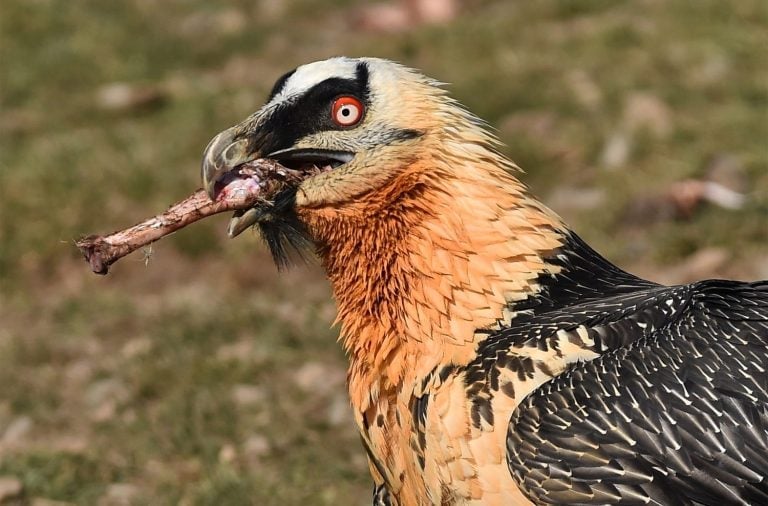
Unlike many birds of prey that tear food into strips, the bearded vulture often swallows bones whole. Its throat and esophagus are wide and flexible, able to handle bones as big as a human forearm in young birds and even larger pieces in adults.

Up to 90% of its diet is made up of bone, which reflects the bird’s unique ecological niche.
©alberto clemares exposito/Shutterstock.com
But swallowing the bone is only the beginning. Inside the bird’s stomach is one of the most powerful digestive systems known among vertebrates. Its gastric acid has an extremely low pH (less than 1 pH), strong enough to dissolve compact bone matter in a matter of hours. Hooves, dense limb bones, and vertebrae, materials that might take years to break down in nature, are reduced to nutrients overnight.
This acid does more than remove calcium; it also breaks down the collagen that gives bones their strength, allowing minerals and fats to be absorbed directly into the bird’s bloodstream. Bone marrow, full of fats and calories, is especially important in cold, high mountain areas where energy is hard to find. However, not all bones can be swallowed whole. This is when the bearded vulture’s most famous behavior comes into play.
The bearded vulture’s stomach acid is extremely powerful, allowing it to digest bone completely.
©Aitor Lamadrid Lopez/Shutterstock.com
They carry large bones high into the air, often 100 to 150 meters, and drop them onto steep, rocky cliffs chosen specifically for their ability to shatter bone on impact. If the bone doesn’t break the first time, the vulture simply tries again, sometimes repeating the process until the fragments are small enough to swallow safely.
This behavior is not purely instinctive. Young bearded vultures must practice and refine their aim, learning through trial and error which surfaces work best. Early attempts are often clumsy, with missed drops and unbroken bones, but over time, the birds develop impressive accuracy. The result is a simple yet elegant form of tool use: no sticks or crafted objects, just physics, timing, and careful effort.
By specializing in bones, bearded vultures avoid competition with other scavengers and gain access to a food source that lasts long after flesh has disappeared. Bones can remain available for weeks or even months after an animal dies, making them a reliable resource. In harsh mountain winters, when prey is scarce and the landscape is frozen, this adaptation can mean the difference between survival and starvation. Through this singular strategy, bearded vultures fill an ecological role that no other animal does, recycling what would otherwise be left behind.
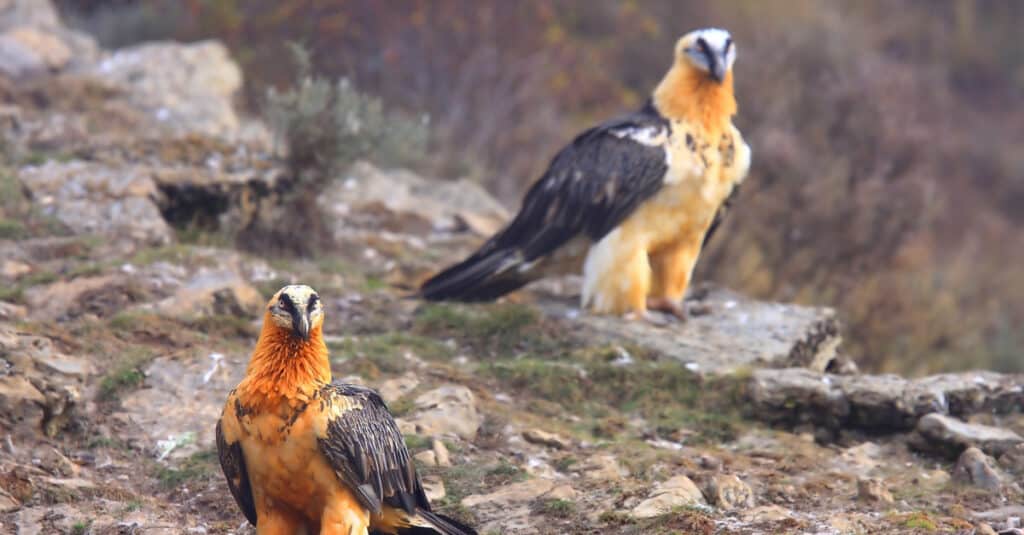
They’re surprisingly quiet. Unlike many birds, bearded vultures are mostly silent, especially when flying.
©ESCOCIA/Shutterstock.com
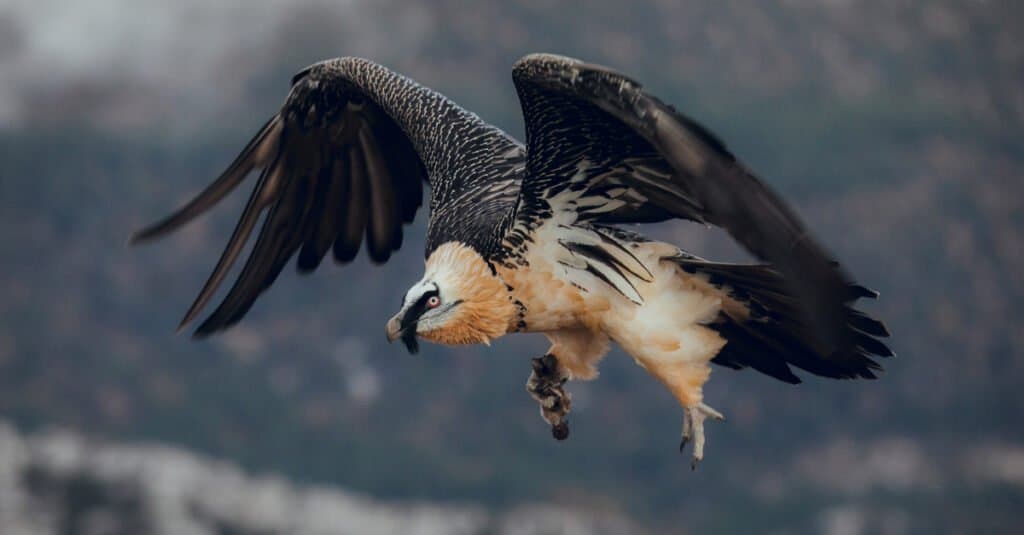
Bones are also surprisingly easy to find in healthy ecosystems. Wherever large plant-eating animals live and die, bones accumulate over time. The lammergeier’s massive wings, nearly 9 feet across, allow it to cover vast areas efficiently, scanning cliffs and mountain slopes for the telltale white glint of bone fragments below.
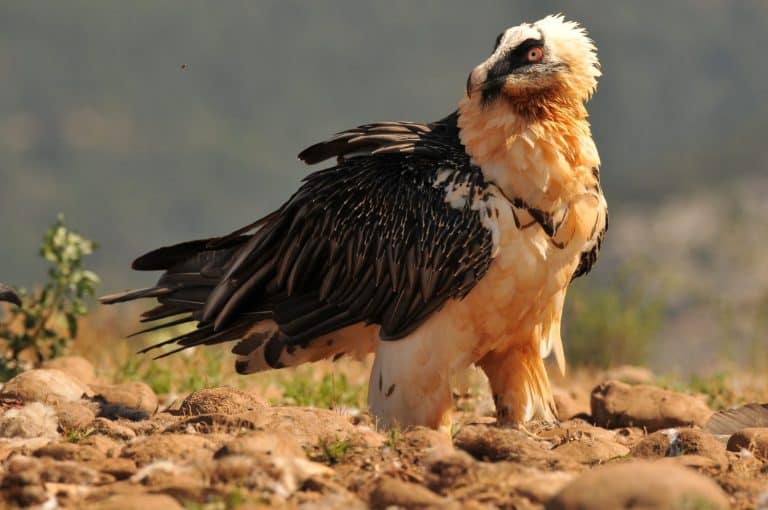
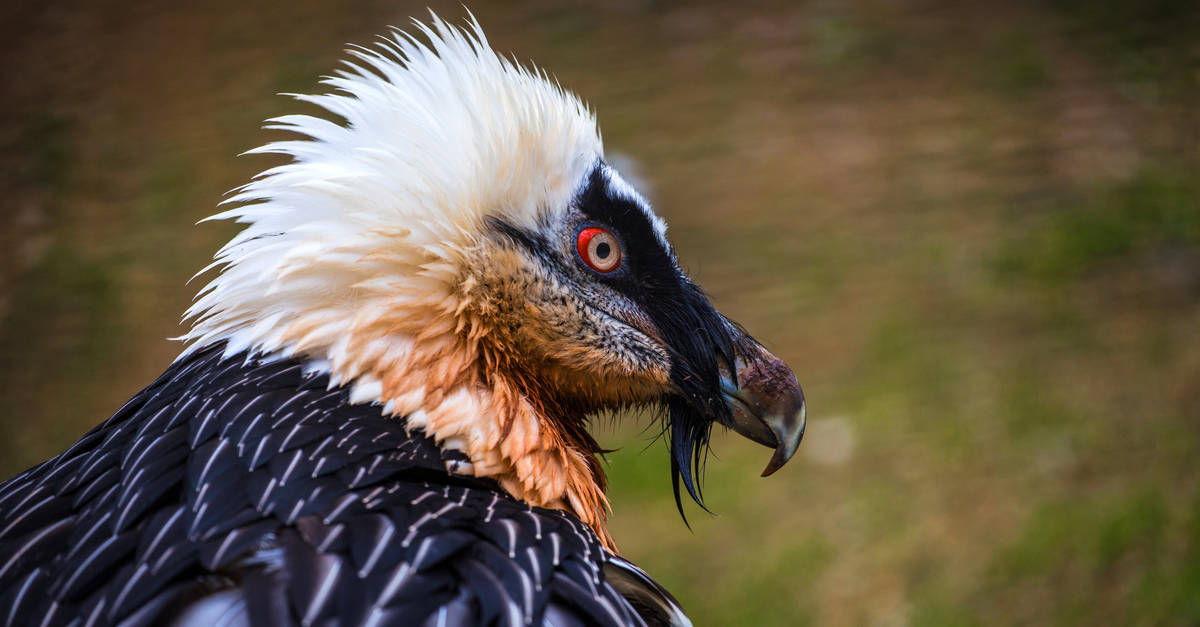
Even its head and feathers reveal how specialized this bird is. Unlike other vultures, which have bald heads to stay clean while tearing into rotting carcasses, the bearded vulture is fully feathered. It doesn’t need bare skin because it rarely eats decaying flesh. Its namesake “beard,” a tuft of dark bristles beneath the beak, may signal maturity or social status, though its exact purpose is still debated.
The bearded vulture’s appearance tells yet another evolutionary story. Naturally, it has dark gray-blue to nearly black wings and tail feathers, contrasted with creamy white feathers on the head, neck, and chest. But the species is famous for something no other bird does in quite the same way: deliberate feather dyeing.
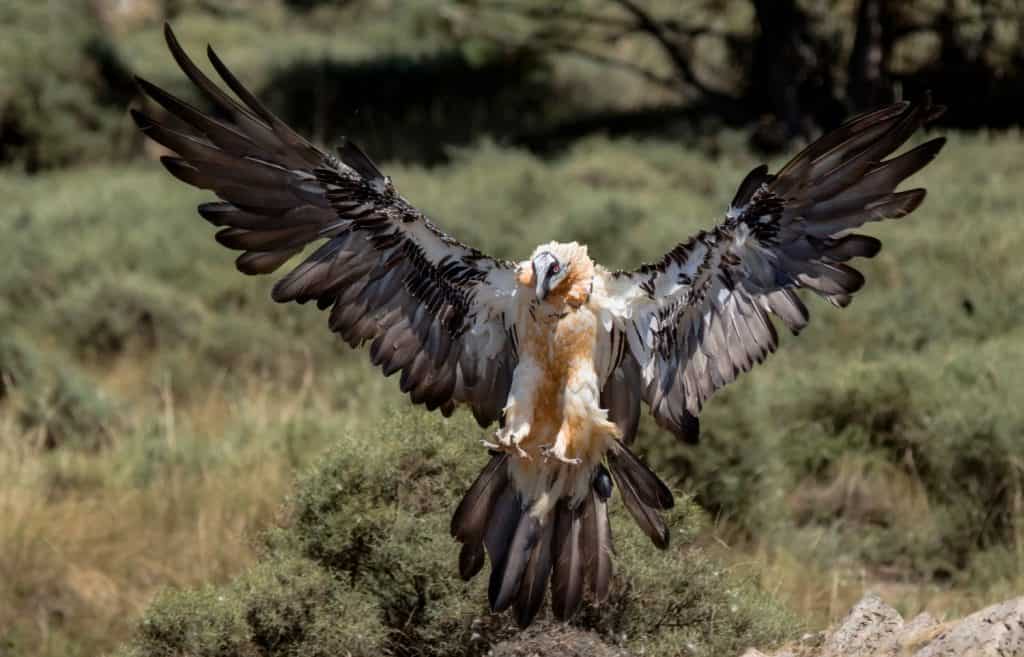
The bearded vulture has a wingspan of up to 9 feet; it is one of the largest flying birds in the world.
©Andrea Vergani/Shutterstock.com
Bearded vultures intentionally stain their white feathers by bathing in iron-rich mud or mineral springs. Using their beaks and talons, they rub red ochre (iron oxide) into their plumage, transforming their chests, necks, and legs into shades of rusty orange or deep red-brown. This “cosmetic bathing” is a learned and purposeful behavior, not a byproduct of their environment.
The intensity of this coloration often reflects age, health, or social status. Older birds tend to be redder, while younger birds start out dark brown and gradually lighten as they mature, reaching full adult coloration over four to five years. Along with their dyed feathers, adults display black eye patches, a bold facial stripe, and the distinctive black beard beneath the chin.
Why they do this is still being studied. The coloration may signal dominance or seniority, serve as a form of visual communication, or even help inhibit bacterial growth on the feathers. Whatever the reason, the result is unmistakable: a bird shaped by time, scarcity, and ingenuity, one that turned bones, minerals, and mountains into a niche no other animal could fill.
The result is a species so well adapted to its role that it is almost hard to believe.
However, this unique bone specialization can also make the bearded vulture vulnerable. As of 2026, France has adopted a new National Action Plan for the bearded vulture, and recent conservation efforts have led to a more optimistic outlook for the species in some regions, though its survival still depends on healthy mountain ecosystems.
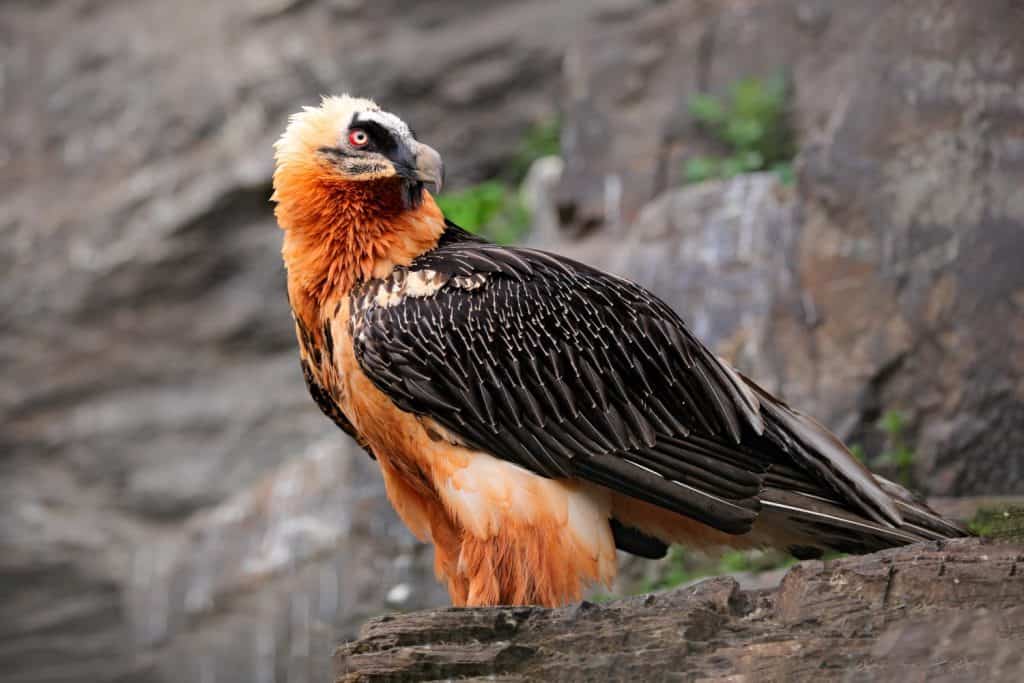
The bearded vulture was nearly wiped out in Europe due to myths about killing livestock and children.
©Ondrej Prosicky/Shutterstock.com
While many animals focus on flesh and blood, the bearded vulture chooses calcium and marrow. It turned leftovers into a way to survive and uses gravity as a tool. Where others see waste, it finds food.
There is something almost poetic about this bird. It does not live off the moment of death, but on what remains after. In the quiet after the feast, when the mountains are silent, and only skeletons are left, the bearded vulture finally eats. By doing this, the bearded vulture shows us that evolution rewards not only strength or speed, but also the ability to use what others ignore and make it work.