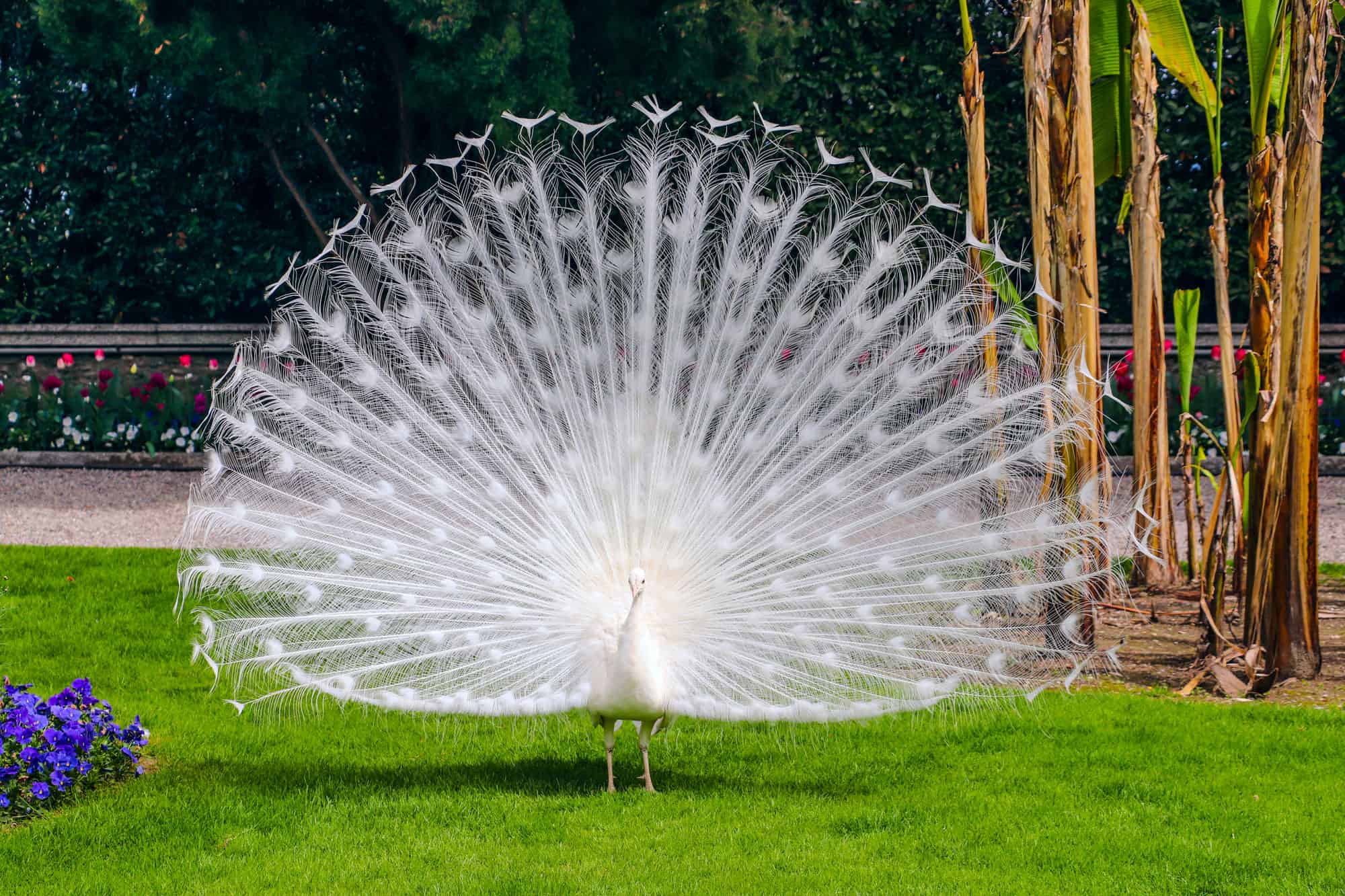

Peacocks are famous for their beautiful and intricate feathers. Fanning out in an amazing display, peacocks exhibit this behavior for a few main purposes. This display involves both visual and auditory elements and is used for courtship, communication, and rivalry with other males. This YouTube Short by @KRIBST shows a beautiful white peacock displaying its feathers, which are drastically different from those of its blue and green counterparts. Read on to learn more about the peacock courtship display.
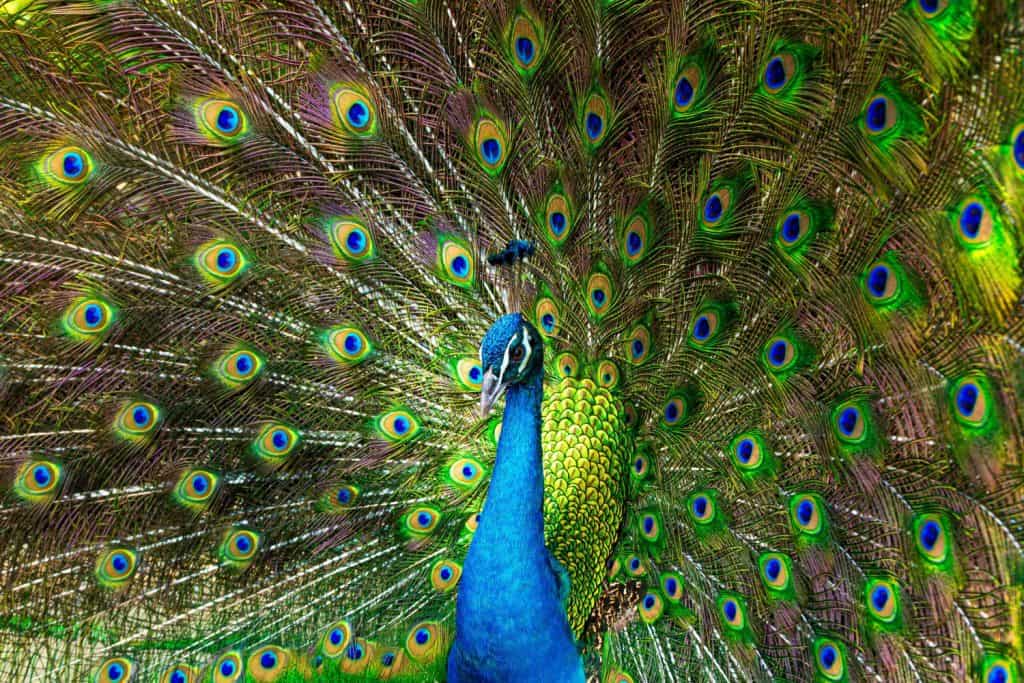
A full fan of peacock feathers consists of 150 to 200 feathers.
©banjongseal324SS/Shutterstock.com
Why Do Peacocks Shake Their Feathers Out?
Peacocks shake out their feathers mainly for courtship and communication reasons. You can mostly see these beautiful displays during the breeding season, which occurs in the spring and summer months. As in other bird species where the male needs to impress the females, male peacocks have the same goal in mind. Using their feathers, they position themselves in front of females, vibrating their shimmery feathers to draw their attention. A large and healthy train of feathers is important for attracting and maintaining the female’s attention, as it indicates good health and strong genetics. Male peacocks also compete with each other, often displaying their feathers in close proximity as a form of competition.
A full fan consists of anywhere between 150 and 200 feathers, with the majority featuring eyespots, or shimmery dots. Although the feathers fan out like a tail, they are actually upper tail coverts—special long feathers that extend outward, not part of the true tail. After extending its feathers to around five feet, the peacock shakes them to draw attention to itself. While it is mainly for attracting mates, this display also has the potential of attracting predators. This concept is called the handicap principle, where a behavior may attract predators, but survival despite this risk indicates strength and genetic quality to other members of the species. So, how do white peacocks differ from other peacocks?
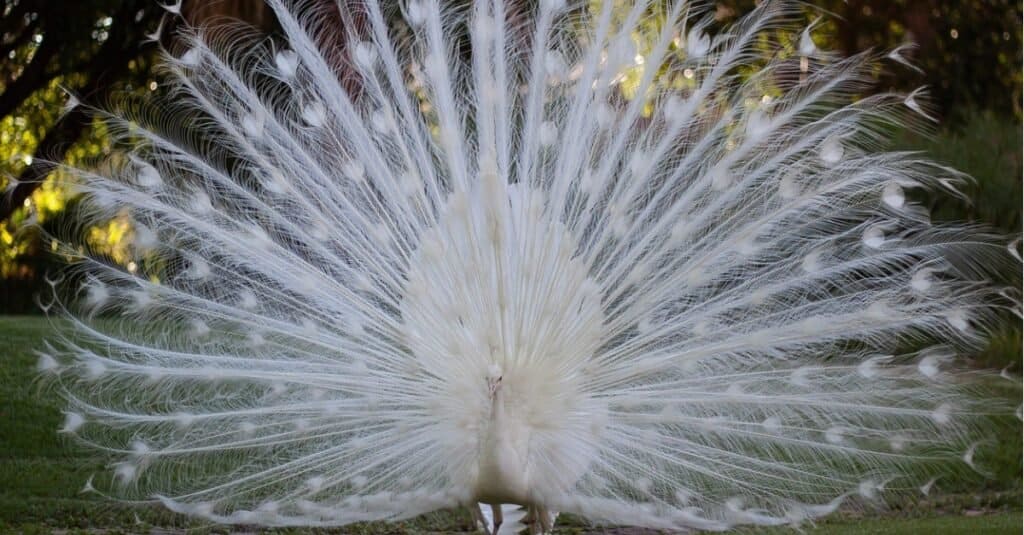
Some peacocks are white as a result of a rare genetic mutation called leucism.
©iStock.com/D-Art Photography
Why Are Some Peacocks White?
As with other species, having a completely white peacock is rare, and for good reason. The peacock in the video likely exhibits leucism. Leucism is a genetic mutation that, in birds, prevents pigment from being deposited in the feathers. This is what gives white peacocks such a bright appearance. While many may believe it is albinism, leucism does not affect the eyes, so the peacock will have standard blue eyes. So, while they may seem like a completely different species, white peacocks are the same as any other, differing only in appearance.
White peacocks are extremely rare, making it difficult to estimate how many there are in nature. To be born with leucism, both parents must carry the gene. This makes the mutation a recessive trait. Some peacock breeders selectively breed white peacocks, so they are more commonly seen in zoos than in the wild. The exact number of white peacocks in the world is unknown, but they are considered very rare and are mostly found in captivity rather than in the wild. So, while it is somewhat easier to find them in captivity, they remain a one-of-a-kind beauty that is extremely special.