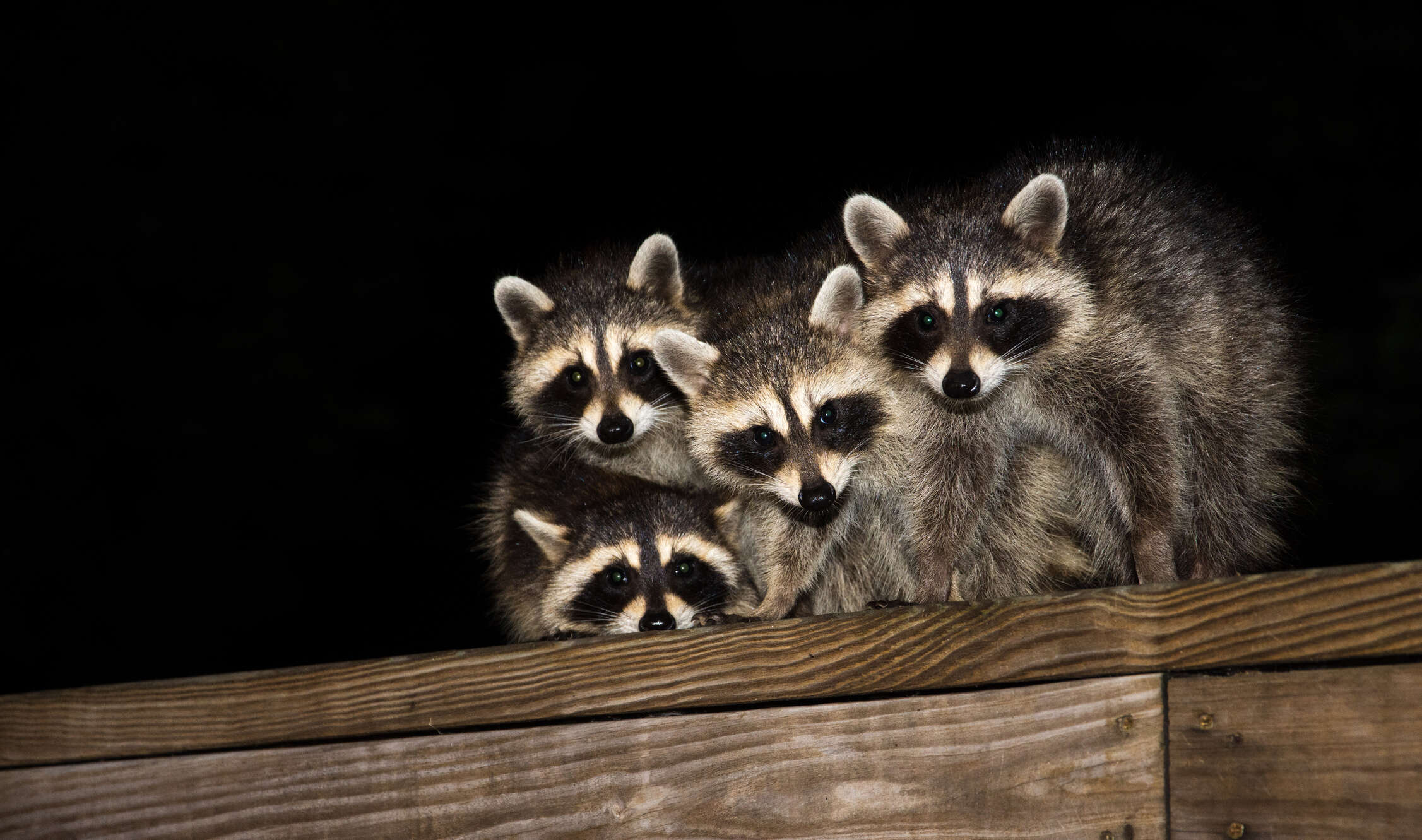

Quick Take
- Raccoons are highly adaptable omnivores that thrive in urban areas and increasingly coexist with humans.
- Raccoons are one of the primary wildlife species that can carry rabies in the United States; bite wounds require prompt washing with soap and water, plus post-exposure treatment, and pets should be vaccinated.
- A nationwide program uses oral rabies vaccine baits to curb wildlife rabies, with 2025 cases like Suffolk County, New York’s 17th rabid raccoon.
Raccoons are kind of cute, with their black face markings and striped tails, right? These masked bandits thrive in urban settings, where they either annoy or delight people with their antics. The recent press about a raccoon breaking into a liquor store and drinking itself into a stupor on rum, moonshine, and peanut butter whiskey certainly got some smiles. But when raccoons break into trash cans and strew garbage around, it’s not typically a happy event.
Within their mammalian family, raccoons are the most adaptable, exhibiting behaviors that have dramatically extended their range and allowed them to coexist with humans. In some places, raccoons increasingly behave like domesticated animals, with instances of people feeding and even taming them as pets. The biological characteristics of raccoons may predispose them to come into close contact with humans.
Raccoon Habits
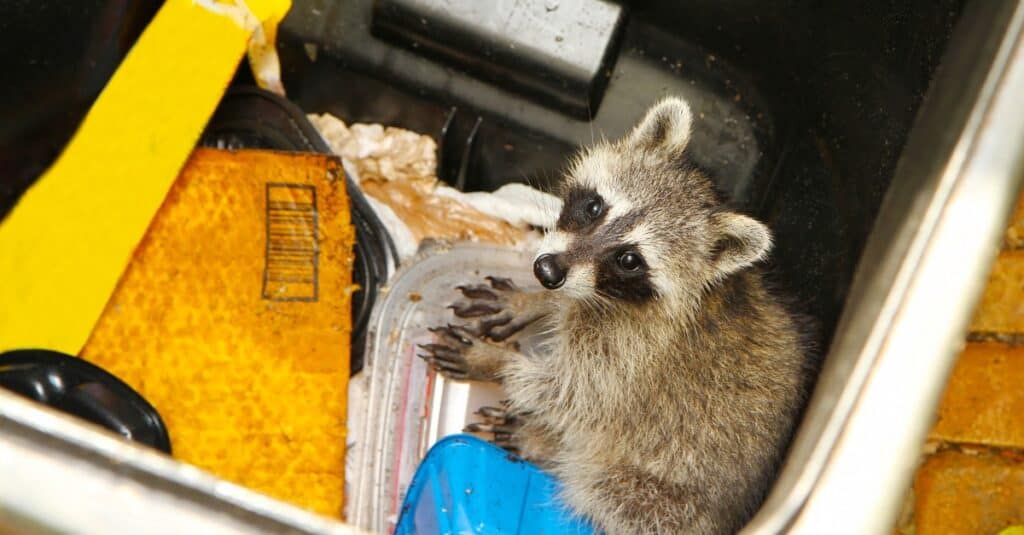
This raccoon was caught in the act of raiding a trash can for food.
©Jillian Cain Photography/Shutterstock.com
Raccoons (Procyon lotor) are the largest members of their scientific family—the Procyonidae—that otherwise includes animals further south, like the coatis, ringtails, and olingos of Central America. While those raccoon cousins are carnivorous, raccoons have evolved to be flexible omnivores, eating plants, animals, or just about whatever is available. This explains why they frequently raid trash cans. A raccoon can subsist on farm crops like corn, peaches, and figs; wild offerings such as insects, rodents, and bird eggs; or urban diets of discarded hot dogs, pizza, or Chinese takeout.
Farmers consider them pests because of the damage raccoons do to orchards, cornfields, and even chicken yards where feed is available. Raccoons’ eclectic diets put them into closer contact with humans than many other mammal species. A recent study published in Frontiers in Zoology found that urban raccoons have snouts that are about 3.5% shorter than those of rural raccoons, a morphological change that may be an early sign of domestication due to exposure to human environments. Says study author Raffaela Lesch, “It would be fitting and funny if our next domesticated species was raccoons.”
Raccoons in Proximity to People
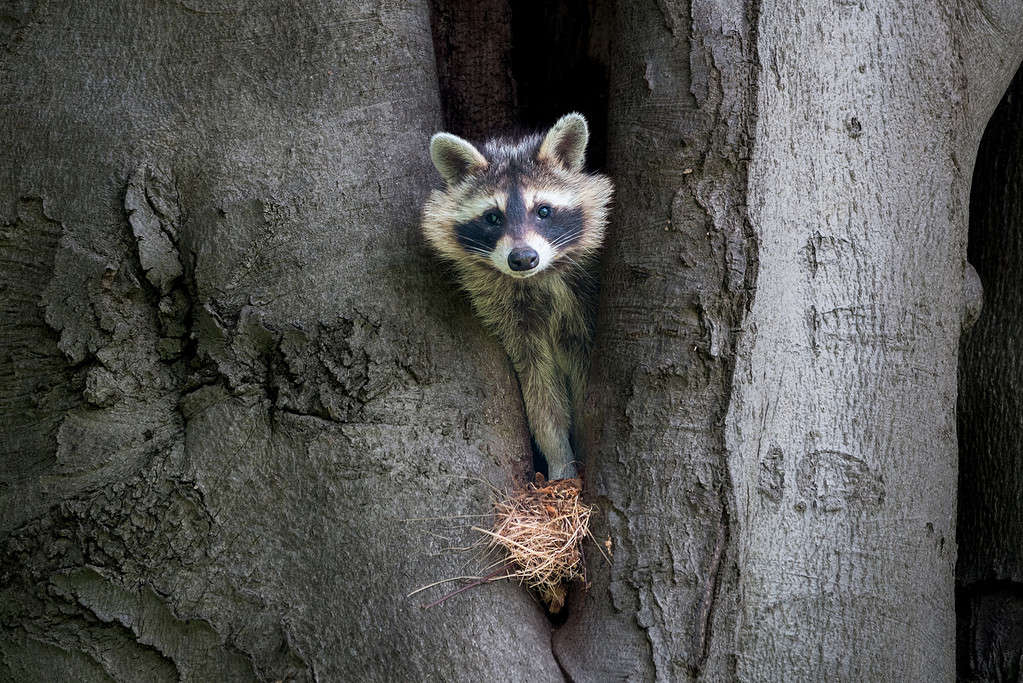
High up in a tree crevice, a mother raccoon looks out of her tree den before heading out to hunt.
©Brams-Photography/iStock via Getty Images
Because of their exceptional adaptability, raccoons range all the way into Canada, sometimes occupying manmade structures like barns, houses, sewers, and garages. As they become conditioned to finding and eating human foods, they tend to lose their fear of people. Still, raccoons are mostly nocturnal, or you would see them substantially more often. At night, they take refuge in trees, hollow logs, or urban places like attics and abandoned cars. Raccoons are about the size of small dogs and are remarkably agile, giving them plenty of shelter options.
It’s typical to catch glimpses of raccoons at dawn or dusk, starting their foraging journeys. They’ll occasionally raid trash cans or farms in the daytime, if it’s a particularly good food reward. But a raccoon behaving normally should walk or run away from you. If you keep your distance and provide an escape route, the raccoon will take it. If, instead, a raccoon approaches you, it may be infected with rabies—a dangerous situation. You should run away. Even a rabid raccoon is unlikely to continue chasing you, and if it does, humans can generally outrun raccoons, whose top speed is 9 to 15 miles per hour compared to a human’s 28 miles per hour.
Raccoons and Rabies – Run!
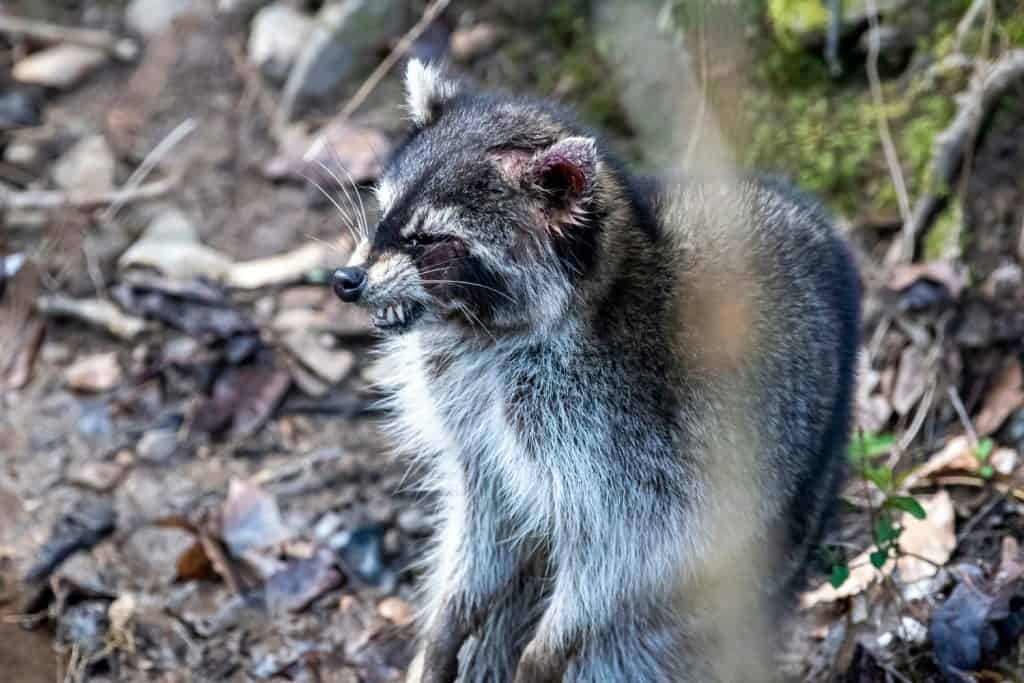
This sick raccoon is having a seizure, either from rabies or some other illness.
©Christopher J Barger/Shutterstock.com
Rabies is a virus transmitted to humans through the bite or scratch of a rabid animal. It can be fatal because it affects the central nervous system, ultimately causing brain disease.
Raccoons are among the wild animals most likely to have rabies. Recent CDC statistics from the Centers for Disease Control deem raccoons to be “one of the highest rabies risks in the United States.” Three out of four Americans live in communities where raccoons or other small mammals are carrying rabies. However, the cases of raccoon-transmitted rabies are mostly confined to the eastern U.S.
The first symptoms of rabies are similar to those of the flu, such as fever, headache, and weakness. The bite site itself may feel itchy or prickly as the disease develops. At this early stage, rabies is treatable, so it is crucial to seek medical attention immediately. If rabies progresses to the brain, it is likely to be fatal. In advanced stages, people may experience confusion, agitation, hallucinations, and even aggressive behaviors such as thrashing or biting.
What Is the Prognosis for Rabies?
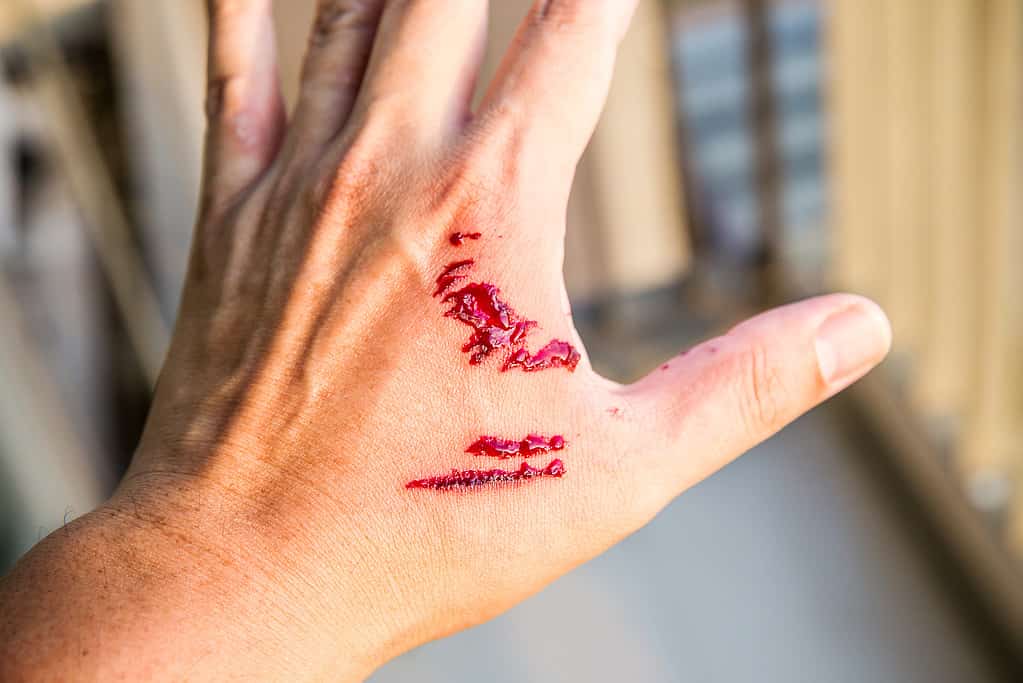
A bite from an animal infected with rabies engenders serious health concerns.
©kckate16/iStock via Getty Images
Historically, before about 1960, several hundred people died annually in the U.S. from rabies. Since the inception of animal control programs, the number of people dying from rabies has gone down to less than 10 per year. Each year, about 1.4 million Americans receive healthcare for possible rabies exposure, and approximately 100,000 receive post-exposure prophylaxis (PEP), with the vast majority surviving due to timely treatment.
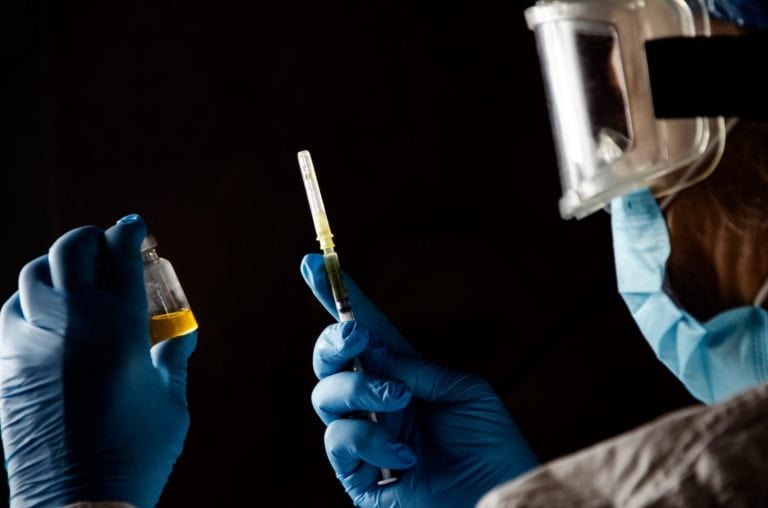
If you are bitten by an animal that may be rabid, immediately rinse the wound with soap and water for at least 15 minutes. Medical treatment involves post-exposure prophylaxis, which includes treating the wound and boosting your immunity with a series of rabies vaccines. If you have never received the rabies vaccine before, you may also be given injections of human rabies immune globulin (HRIG), which provides immediate antibodies to fight the virus until your body can produce its own in response to the vaccine.
If your dog, cat, or other mammal pet is bitten by a rabid raccoon, it may also contract the disease. Rabies vaccinations for pets are administered as part of regular veterinary care. Because cats and dogs often spend time outdoors and may encounter wildlife, they are routinely vaccinated against rabies, not just after exposure. In some countries with large populations of feral dogs and cats, however, such as in parts of Africa, Asia, and Central and South America, rabies is prevalent. Since 1990, reports the CDC, more than 80 people from the U.S. have died from rabies infections acquired during travel.
Other Raccoon Diseases
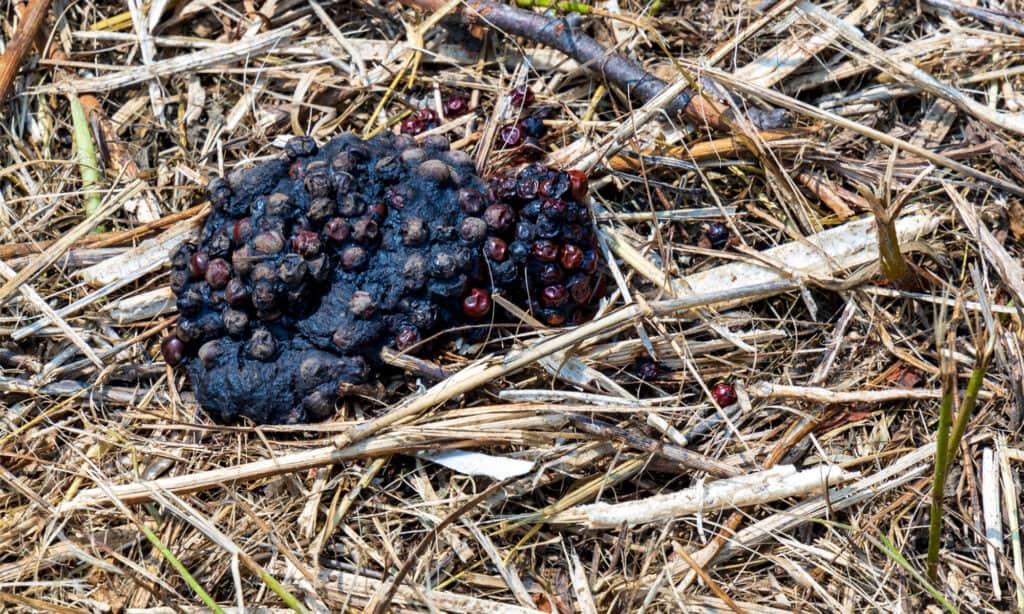
Raccoon droppings tend to be dark and contain berries.
©iStock.com/Chimperil59
Raccoons may also carry bacterial or parasitic diseases that can be transmitted to humans, including the following:
- Roundworms (Baylisascaris procyonis) – These parasites live in raccoon intestines, laying microscopic eggs that are hidden in raccoon droppings. If you accidentally ingest an egg, you could suffer a serious disease of your central nervous system.
- Giardia (Giardia spp.) – These parasites are microscopic protozoans that are likewise found in raccoon droppings. They adopt a resistant cyst-like form that becomes active when it encounters a suitable environment, such as your digestive tract.
- Leptospirosis (Leptospira spp.) – These pathogenic bacteria are shed in urine or other secretions of infected raccoons. When contracted by humans, they may be fatal, causing kidney damage, liver failure, and inflammation around the brain.
The bottom line for safety is to avoid handling raccoons or touching their droppings. Raccoons tend to create “latrines,” or designated areas where they repeatedly defecate. These may be natural sites, such as the base of trees, or around manmade structures, including porches, rooftops, and attics. Be alert for piles of small, dark, smelly droppings, often with fresh feces layered over older, dried ones. When cleaning up raccoon latrines around your home, use gloves and tools that can be thoroughly washed afterward.
Eradicating Rabies
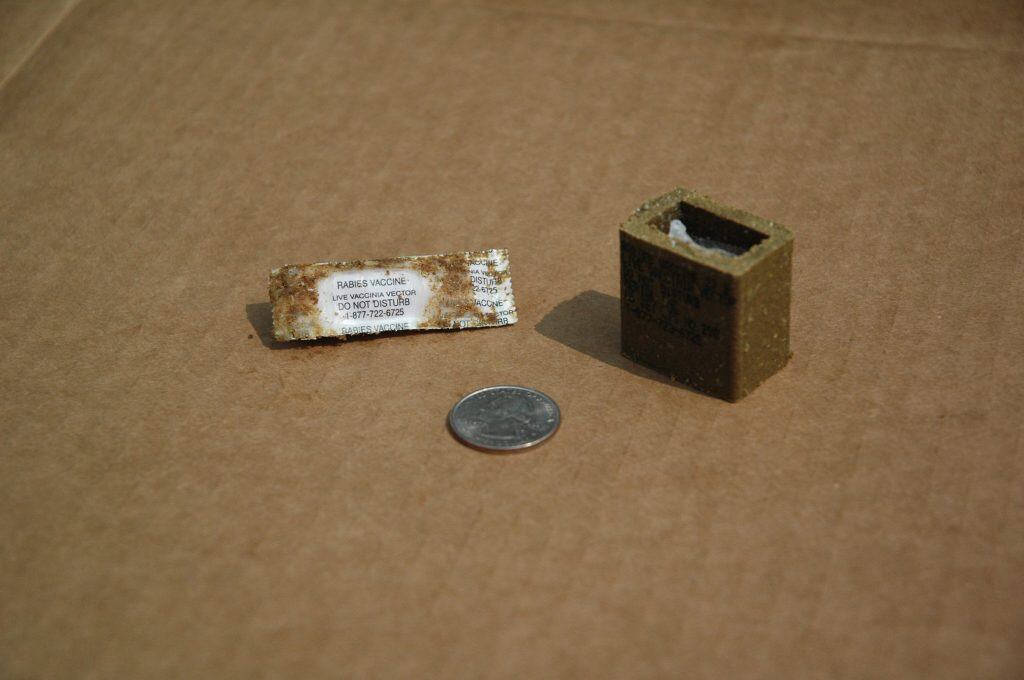
These RABORAL-VRG fishmeal-coated sachet (left) and fishmeal-polymer baits (right) are for rabies vaccination, with a quarter for perspective.
Individual counties keep tabs on rabies infections in wild animals in an effort coordinated by the U.S. Department of Agriculture. The National Rabies Management Program was established in 1995 to “prevent further spread of wildlife rabies and eventually eliminate terrestrial rabies in the United States.” The program works with Federal, State, and local governments and partners to deploy bait that contains an oral rabies vaccine. The bait consists of a packet of RABORAL V-RG® rabies vaccine coated with fishmeal to attract wildlife.
In November 2025, Suffolk County, New York, reported its 17th rabid raccoon of the year, notable because no rabid raccoons had been reported in the county since 2009. The dead raccoon was sent to the New York Department of Health for rabies testing. The Suffolk County Health Commissioner stated, “Our expectation is that our Raccoon Rabies Control Program, which we conducted in cooperation with the U.S. Department of Agriculture, has contained and hopefully eliminated terrestrial rabies in wild animal populations in Suffolk County.”
This and other rabies incidents during 2025 have inspired a spate of serious recommendations regarding rabies eradication:
- Vaccinate all mammal pets against rabies.
- Keep pets on leashes when outside.
- Keep pets and their food indoors at night.
- Never feed wildlife or stray animals.
- Never touch dead or dying animals;
- Never approach an unknown wild or domestic animal;
- Keep garbage cans covered and/or latched;
- Encourage children to tell an adult if they get scratched or bitten.
- Report any wildlife that is acting strangely or appears to be sick.