
Quick Take
- The bigger a Burmese python gets, its feeding ability doesn't just grow. It explodes in a way that caught biologists completely off guard. Explore the prey capacity findings →
- Florida has deployed hunters, K9s, water testing, and radio trackers against the python invasion, but experts say it still isn't enough. See Florida's control efforts →
- Scientists keep revising which Florida animals are at risk from pythons, and that list has only ever grown in one direction. See the growing list of victims →
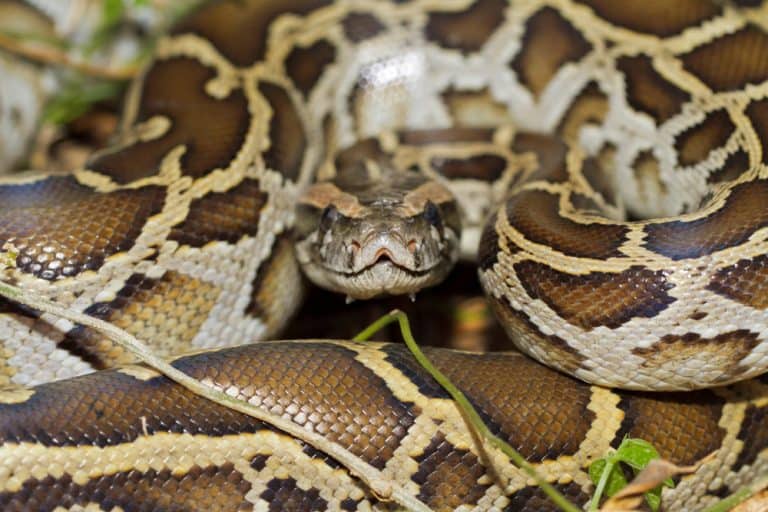
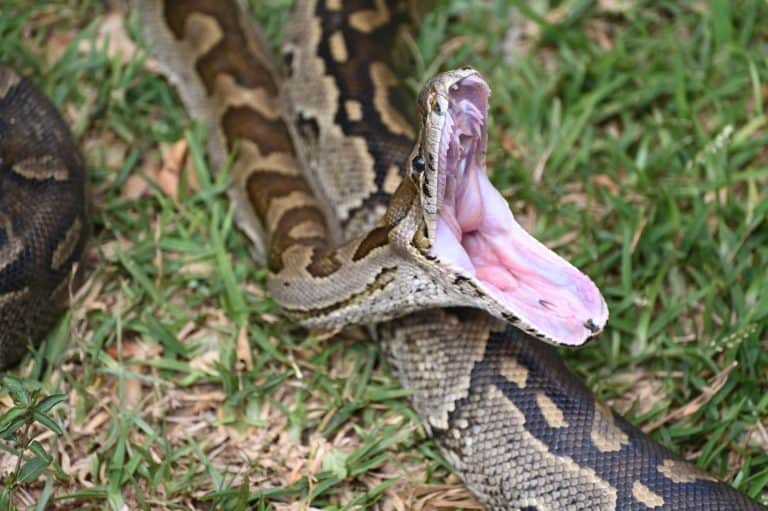
Florida biologists have confirmed something truly jaw-dropping: invasive Burmese pythons can open their mouths much wider than we ever thought. This means they can swallow massive prey — like full-grown white-tailed deer and American alligators — completely whole.
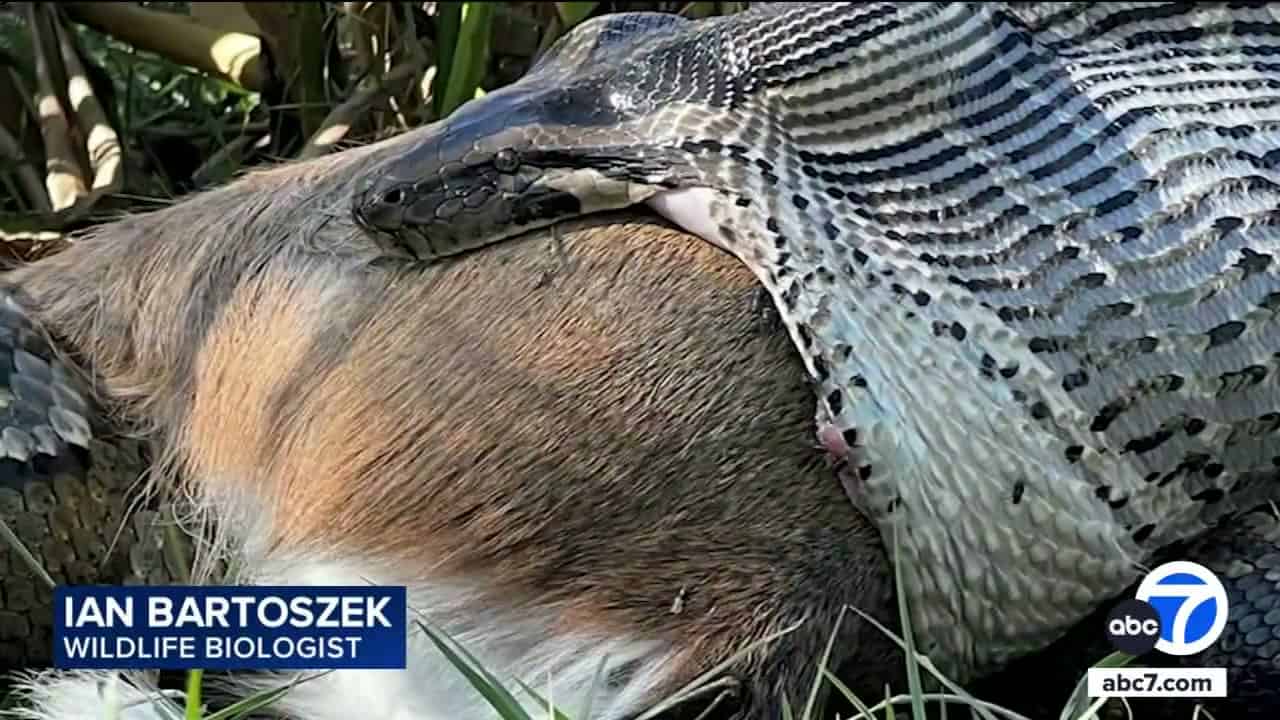
In fact, a remarkable video captured in South Florida (and featured on ABC News) shows a 115-pound python successfully swallowing a 77-pound deer.
How is This Even Possible?
In the snake world, eating something that weighs nearly 70% of your own body mass is extreme.
To figure out how they pull this off, researcher Bruce Jayne and his team at the University of Cincinnati published a study in 2022 on the scaling of maximal gape in pythons. They measured the maximum mouth stretch (or “gape”) of pythons in the Everglades. They discovered that as these snakes grow longer, their mouth capacity doesn’t just increase steadily, it skyrockets. The biggest pythons have a massive feeding advantage that grows much faster than their body length alone would suggest.
So, how do the mechanics of it actually work?
- Snakes do not actually dislocate their jaws. That is a popular myth.
- Their lower jawbones aren’t fused together at the chin like ours are. Instead, they are connected by a highly stretchy ligament, allowing the left and right sides to move completely independently.
- A flexible bone (the quadrate bone) at the back of the skull acts like a hinge, letting the whole jaw apparatus swing outward.
- Combined with incredibly stretchy skin, the python slowly “walks” its top and bottom jaws alternately over the prey, gradually forcing it down its throat.
A Major Threat to Florida’s Wildlife
While the python’s anatomy is fascinating, the real issue is the ecological disaster it’s causing.
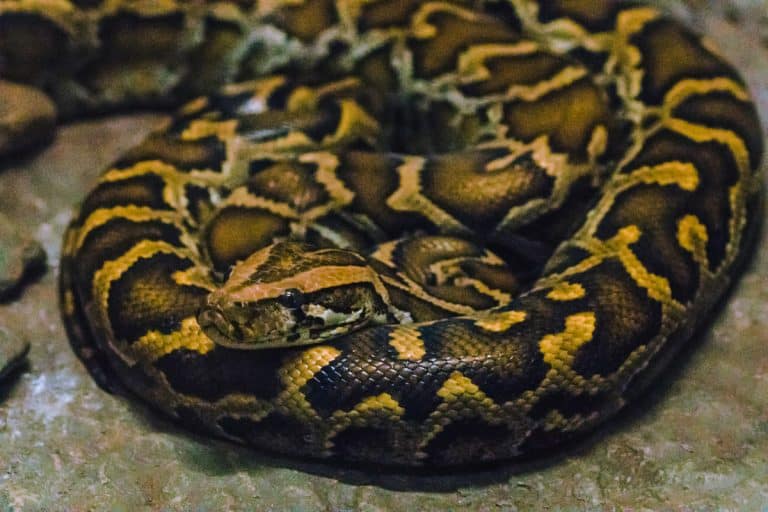
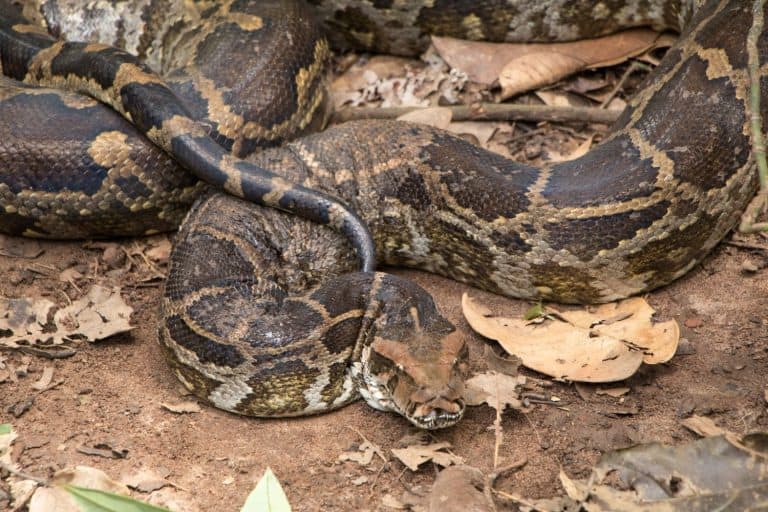
Burmese pythons are native to Southeast Asia. They established a reproducing population in the Florida Everglades by the early 2000s, mostly due to escaped or intentionally released exotic pets. Because they didn’t evolve alongside Florida’s native wildlife, they have no natural predators here. To make matters worse, native mammals have no evolutionary instinct to fear or avoid a massive constrictor snake.
The video of the python swallowing the deer isn’t a one-off fluke; it’s a pattern biologists have been tracking for over a decade. When scientists perform autopsies on captured pythons, they routinely find:
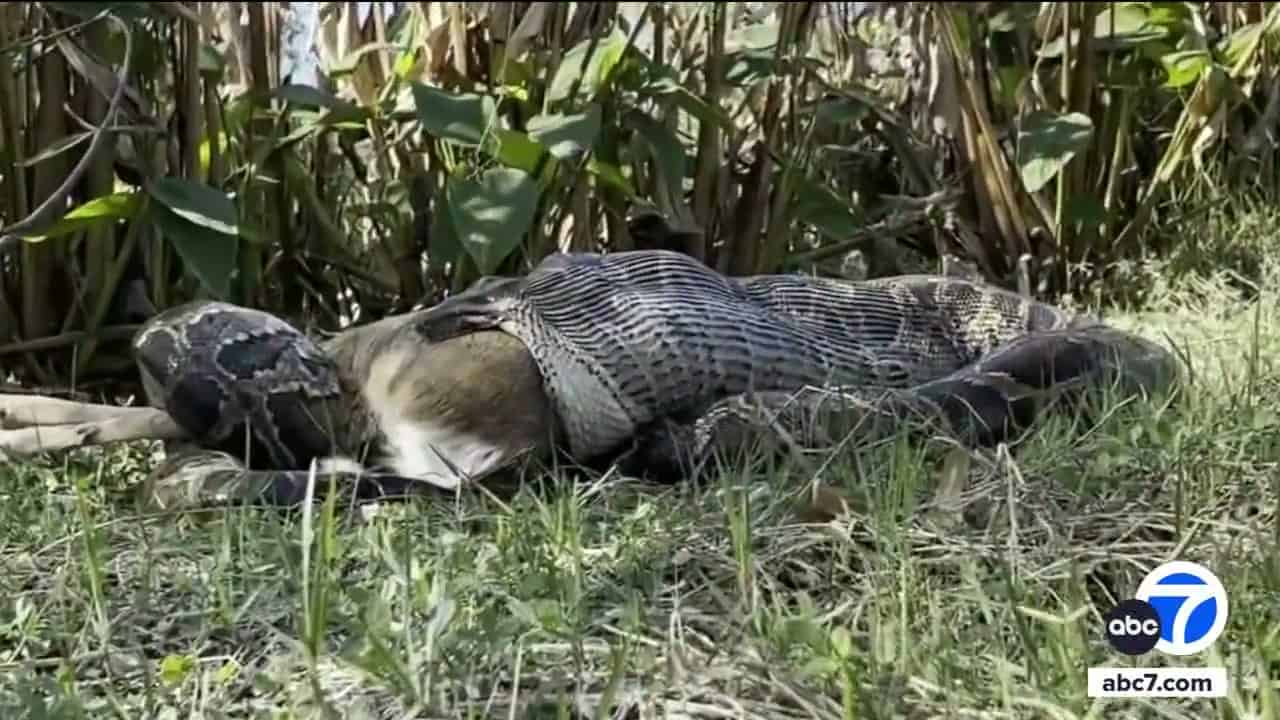
Pythons “gape” allows them to consume animals equal to or sometimes even bigger in size than the snake itself.
©ABC7 via YouTube — used under fair use – Original / License
- White-tailed deer (both fawns and adults)
- Full-grown alligators
- Wading birds
- Endangered Key Largo woodrats
A 2018 study even documented a python that managed to swallow a deer that weighed more than the snake itself.
The Massive Challenge of Managing the Invasion
Stopping these snakes is an uphill battle for several reasons. First, their camouflage patterns make them nearly invisible in dense sawgrass and underwater. Additionally, a single female can lay a clutch of more than 50 eggs at a time.
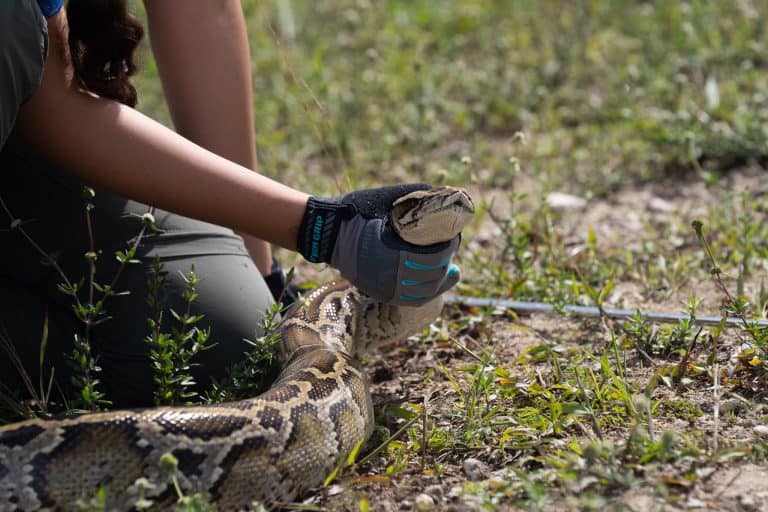
Florida is fighting back in a few ways. The Florida Fish and Wildlife Conservation Commission (FWC) hosts the annual Florida Python Challenge, a public hunting event that has removed over 1,400 snakes since 2013. Additionally, professional contracted hunters work year-round to remove thousands more.
Unfortunately, population models show that all these efforts combined are only scratching the surface of the tens or even hundreds of thousands of pythons hiding in South Florida.
Biologists are now testing high-tech detection tools, including:
- Sampling water to detect snake environmental DNA (eDNA).
- Training K9s to sniff out the snakes.
- Fitting wild pythons with radio trackers to lead researchers straight to breeding groups.
While these tools help, scientists agree that total eradication is no longer realistic. Instead, the goal has shifted to “suppression,” or keeping python numbers down in high-priority areas.
The Key Takeaway
The biggest lesson from recent studies and footage is that we have constantly underestimated what these snakes can eat. Every time scientists realize the snakes can open their mouths wider, the list of native Florida animals at risk grows longer.
This is exactly why state and federal wildlife agencies are fiercely focused on containment. The main goal now is preventing these giant predators from spreading further north and into coastal regions.