
Quick Take
- The way a Goliath grouper eats has nothing to do with biting, which is exactly why prey seems to vanish on camera. See the suction mechanism →
- Sharks aren't automatically the apex predator in any encounter, and the ocean's actual rule of dominance is more unsettling than most people expect. Understand the size rule →
- There's a specific reason these grouper videos keep appearing, and it traces back to a crisis most people have already forgotten about. Read the recovery story →
- Goliath groupers have learned something specific about fishing boats, and this knowledge is costing anglers their catch right at the surface. See how boats attract groupers →
This short clip of a Goliath grouper engulfing a shark right near the water’s surface is absolutely wild. The footage is fast, a bit blurry, and punctuated by the fisherman’s shocked shouts. But while it looks unbelievable, this behavior is actually well-documented across Florida’s reefs and shipwrecks, where Goliath groupers routinely ambush prey most people think would be impossible to catch.
Meeting the Titans of the Reef
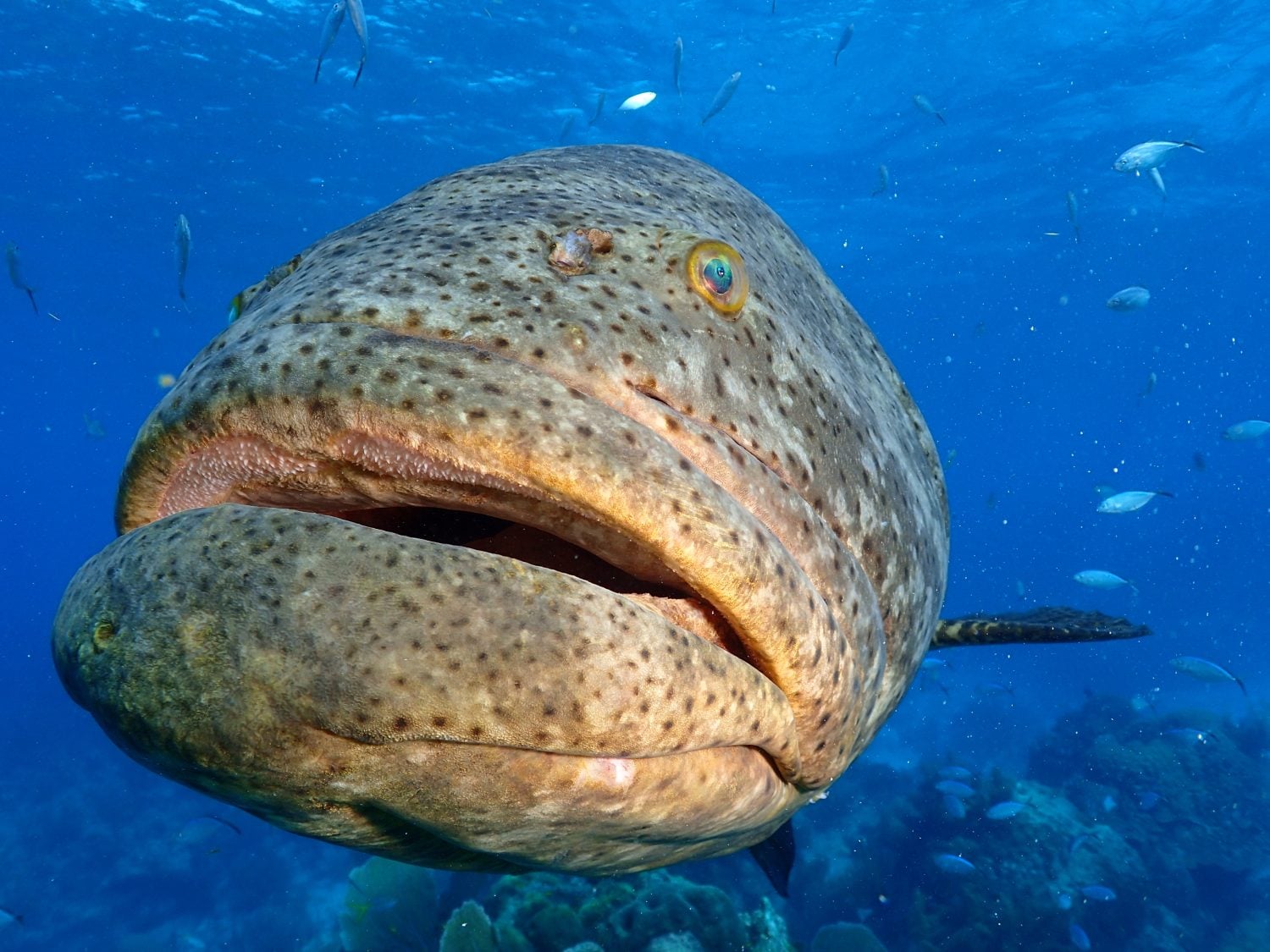
Goliath groupers (Epinephelus itajara) are the undisputed heavyweights of the Atlantic reef. They can grow up to 8 feet long and weigh more than 800 pounds. These slow-growing, long-lived giants are frequently found around reefs, wrecks, and mangrove forests throughout the tropical and subtropical Atlantic. Once they reach adulthood, they have almost no natural predators to worry about except for humans and very large sharks.
The most shocking part of the video is watching the grouper swallow the shark completely whole. To understand how that’s possible, you have to look at how they eat:
- Goliath groupers don’t chew their food. Instead, they rapidly expand their massive mouths and throats.
- This sudden expansion creates a powerful vacuum that pulls water and the prey into their mouths in a fraction of a second.
- Research into how fish suction feeding works shows that jaws can close on prey within about 50 milliseconds of the strike beginning. That lightning speed is exactly why the prey seems to simply vanish on camera. The target is drawn in and swallowed completely intact.
Sharks on the Menu
Sharks, including blacktips, bonnetheads, and smaller nurse sharks, are a normal part of a Goliath’s diet. A widely cited study by NOAA and researchers at Florida State University analyzed Goliath grouper stomach contents and found that sharks make up a measurable portion of their meals, right alongside crabs, lobsters, stingrays, and regular fish.
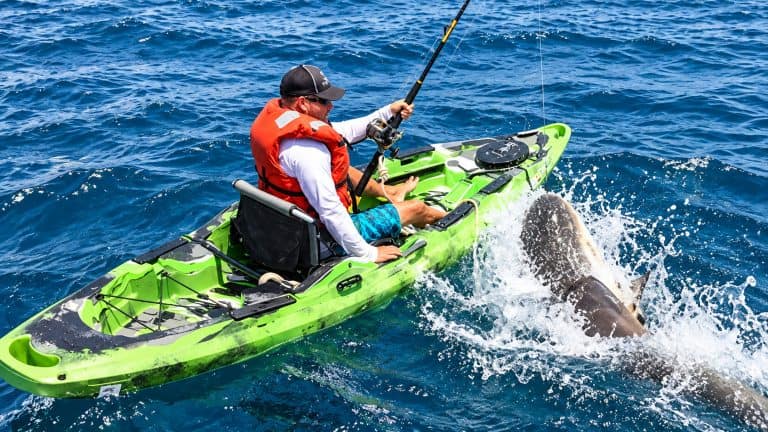
Anglers fishing for sharks near reefs and wrecks frequently report groupers stealing their catch right at the boat, which is almost certainly what is happening in this clip. A struggling fish on a line broadcasts low-frequency vibrations through the water, acting like a dinner bell for an ambush predator.
This opportunistic behavior has been reinforced by catch-and-release fishing. Goliath groupers are highly intelligent; research published in Fisheries Research shows they have learned to associate boats and fighting fish with a free, easy meal.
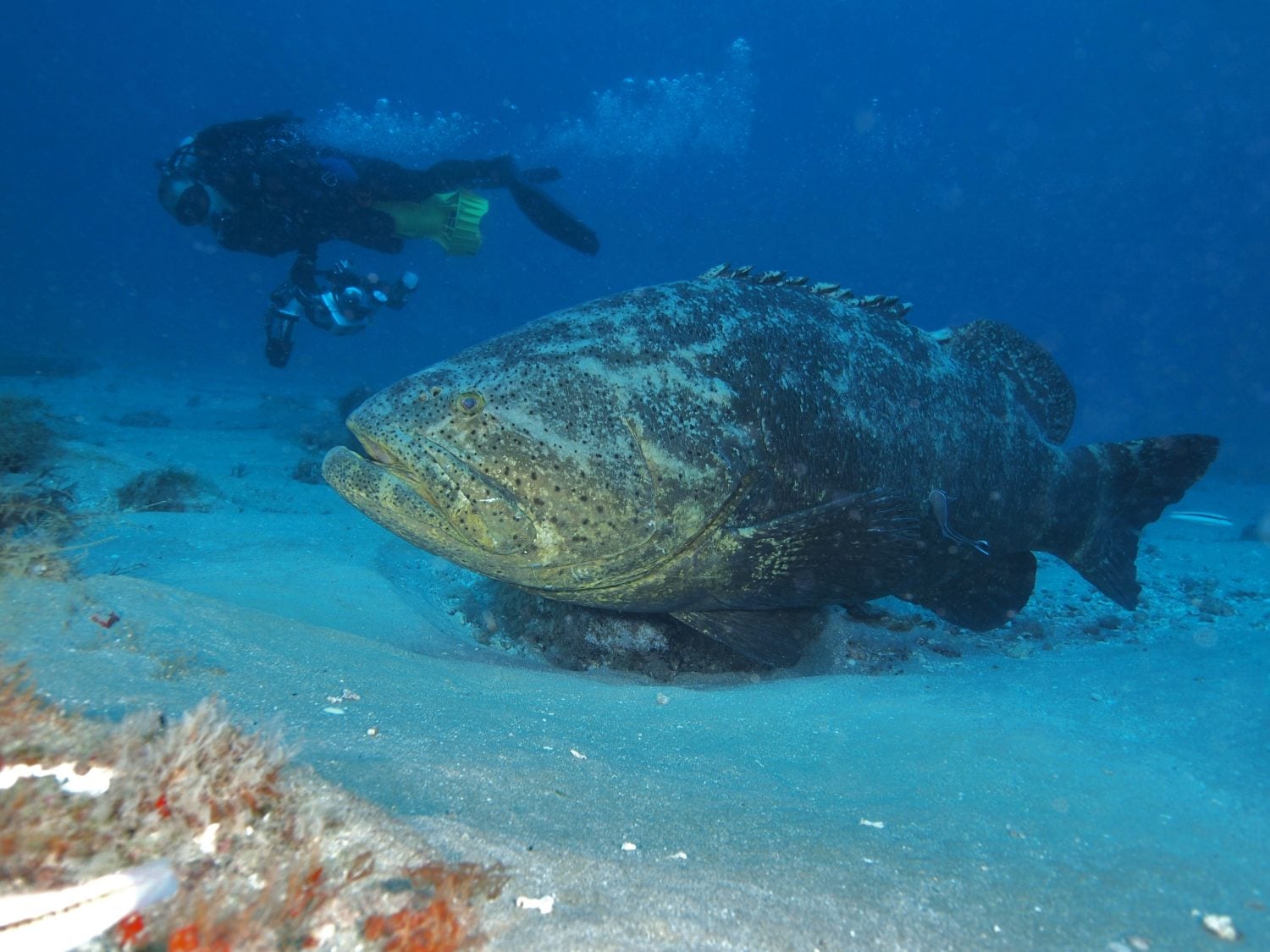
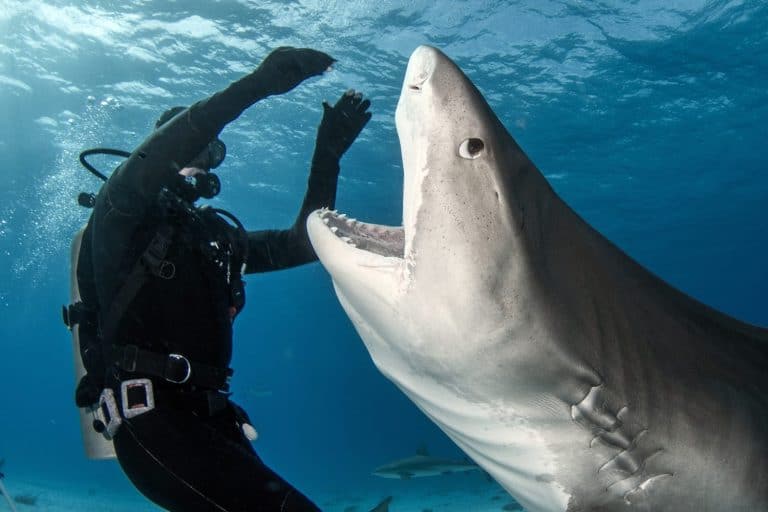
Goliath grouper are remarkably tolerant of scuba divers.
©Jonathan Churchill/Shutterstock.com
The Story Behind the Comeback
The reason we are seeing so many of these videos lately is because the species is recovering. By the late 20th century, decades of intense spearfishing and commercial harvesting had devastated the Goliath grouper population. In 1990, the United States banned all harvesting, allowing the population to slowly bounce back around Florida. By 1994, the IUCN had formally listed the species as critically endangered.
With more large adults returning to the reefs, interactions like this are bound to happen more often. In 2023, Florida reopened a highly limited, lottery-based harvest—a controversial move that marine scientists are still divided on, given how slowly these fish reproduce and how much they rely on specific group gatherings to spawn.
Size Matters, Not Species
A common misconception in clips like this is that the grouper somehow “defeated” the shark, as if the natural order of the ocean has been turned upside down. But in the ocean, body size, not the type of animal, dictates who eats whom.
A 400-pound Goliath grouper facing off against a 4-foot blacktip shark is simply a massive size mismatch. The grouper’s vacuum-like mouth is perfectly built to swallow anything that fits. When the sizes are reversed, the roles flip: large tiger sharks and bull sharks are among the few predators that successfully hunt and eat adult Goliath groupers.
The Ultimate Ambush Predator
This behavior also highlights how these fish live. Goliaths spend most of their adult lives hugging structures, hovering near shipwrecks and underwater ledges where they can hide and rush out at unsuspecting prey.
This ambush behavior, combined with their tendency to stay in the same home territory and their surprising tolerance of scuba divers, is why they have become a favorite subject for underwater photographers. It also makes them easier to study, especially during the late summer when they gather in large groups off Jupiter, Florida, for their annual spawning season.
If you watched the clip and thought you saw a freak one-in-a-million anomaly, the truth is even cooler. You just watched a recovering apex predator doing exactly what its body evolved to do, in a spot where human fishing happened to hand-deliver an easy target.