
Quick Take
- The strangest part of the encounter is the rhino's behavior right before the charge, which has nothing to do with the jeep. See the moment unfold →
- Black rhinos can charge at a speed most people would never guess from looking at them. Check the actual speed →
- Poor eyesight plays a bigger role in rhino charges than most safari-goers realize, a fact that changes how you should respond. Understand why rhinos charge →
- If a rhino starts closing the distance at full speed, one common instinct could make everything worse. Know the right response →
Imagine sitting in a safari vehicle, watching a massive black rhinoceros peacefully eating in the distance. Everything seems perfectly normal until the animal suddenly stops what it’s doing, turns toward your vehicle, and starts coming straight at you. That’s exactly what happens in this remarkable encounter from South Africa, where a black rhino goes from quietly feeding to charging a safari jeep in a matter of moments. But there’s something else unusual about this encounter, and it starts with what the rhino was eating before the confrontation. Watch the footage below and see how quickly the situation changes.
Watch a Black Rhino Suddenly Charge a Safari Jeep
Black Rhino Encounter in South Africa
The footage was shared by Tekweni, a YouTube channel specializing in wildlife encounters, African landscapes, and stories from across Africa. According to the filmmakers, the encounter took place in South Africa’s Eastern Cape, where a safari group came across a large male black rhinoceros feeding in an open area.
As the video begins, a group of zebras moves across the landscape while the rhino feeds nearby. The animal initially seems more interested in its meal than the people watching from the vehicle. The surrounding zebras aren’t much of a concern either, since both species are herbivores and there’s no reason for the rhino to pursue them for food.
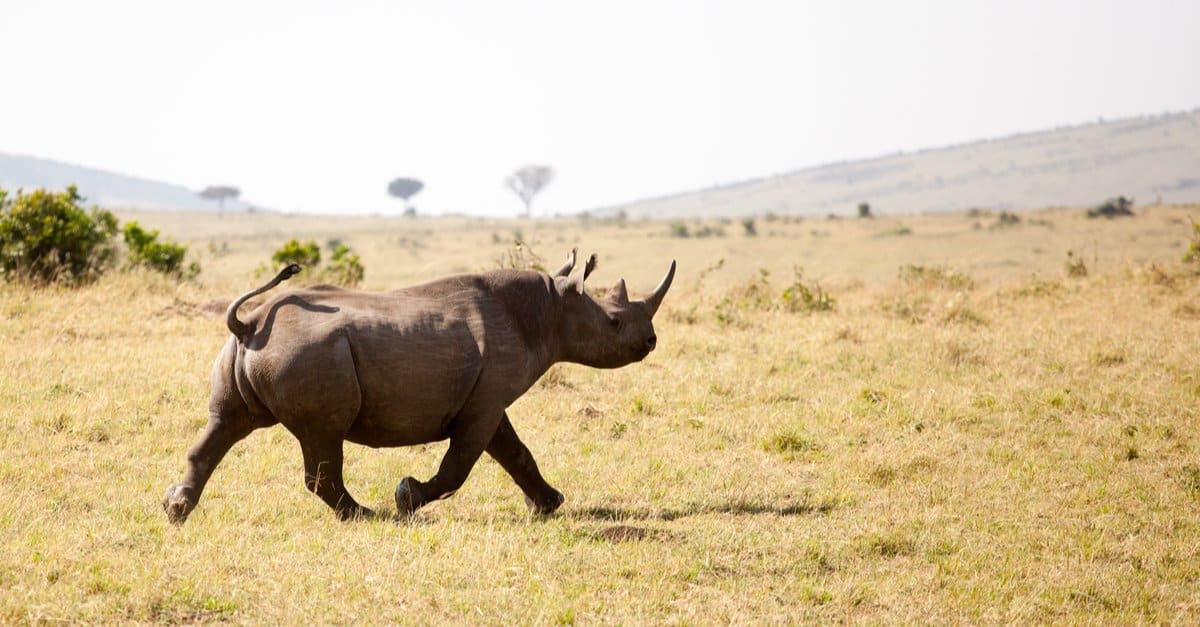
But around the 1:15 mark, the encounter takes a dramatic turn. The rhino shifts its attention toward the safari vehicle, begins approaching, and suddenly charges. The people inside react quickly as the enormous animal closes the distance, turning an ordinary wildlife sighting into a potentially dangerous situation.
What’s particularly interesting is that the rhino appears to be grazing shortly before the charge. For a black rhino, that’s not its usual feeding behavior.
Why Is This Black Rhino Eating Grass?
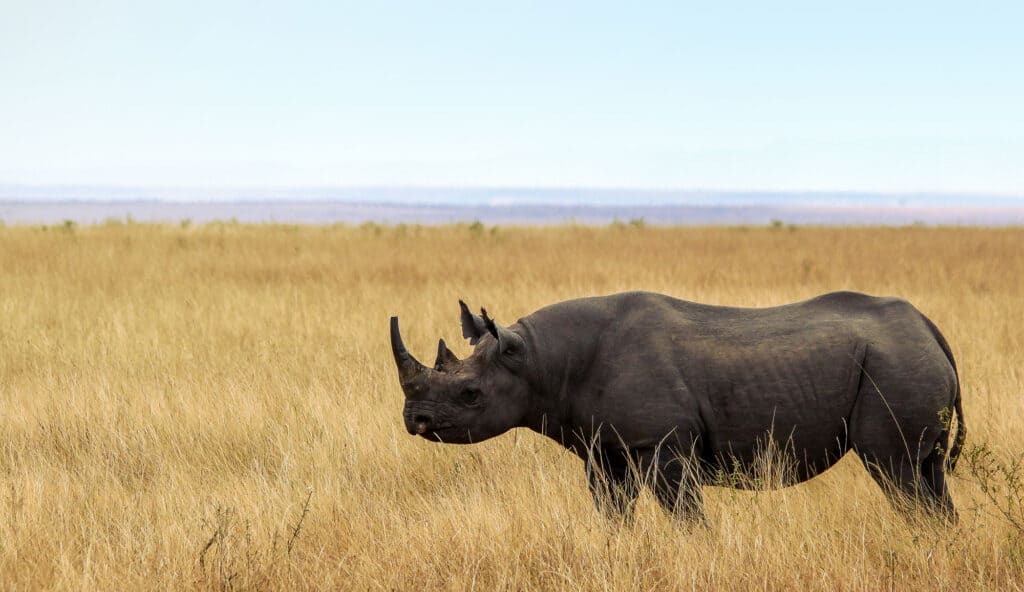
Black rhinos are primarily browsers, using their hooked upper lips to grasp leaves, twigs, and shrubs.
©iStock.com/Black Rhinoceros, Rhinoceros, Savannah, Tanzania, Animal
Although black and white rhinos are both native to Africa, their eating habits are quite different. White rhinos are primarily grazers, using their wide, square-shaped mouths to crop grass close to the ground. Black rhinos, on the other hand, are browsers. They have a pointed, prehensile upper lip that works almost like a small gripping finger, allowing them to pull leaves, shoots, and twigs from bushes and trees.
That doesn’t mean a black rhino will never eat grass. Research has documented grass consumption among wild black rhinos, although it generally makes up a relatively small portion of their diet. The amount can vary depending on the habitat, season, and available vegetation. In some environments, grass becomes a more important food source than it would ordinarily be.
So, while watching a black rhino graze is unusual, it isn’t necessarily a sign that something is wrong. The feeding behavior is interesting enough on its own. The sudden charge that follows is another matter entirely.
Why Do Black Rhinos Charge Safari Vehicles?
Black rhinos have a reputation for being more reactive and unpredictable than their larger white rhino relatives. They are often solitary animals, and adult males can be territorial, marking their surroundings with urine, dung, and other scent signals. An approaching vehicle may be perceived as an intrusion or potential threat, particularly if the animal is startled or feels that its space is being challenged.
Another factor is the rhino’s eyesight. While black rhinos aren’t blind, their vision is considerably less useful for identifying distant objects than their excellent hearing and sense of smell. An unfamiliar shape, movement, or sound may cause an animal to investigate or react defensively before it has fully identified what it’s dealing with.
The filmmakers describe this particular encounter as a territorial display, although it’s impossible to determine the animal’s exact motivation from the footage alone. The rhino may have perceived the safari vehicle as a threat or simply reacted to its presence at an uncomfortable distance.
Either way, there’s little doubt about the danger. An adult black rhino has the size, strength, and speed to cause serious damage to a vehicle. And unlike an animal simply bluffing from a distance, a rhino that begins closing the gap at full speed leaves very little room for error.
How Fast Can a Black Rhino Run?
Black rhinos may not look particularly athletic, but their bulky bodies are surprisingly capable of moving at high speeds. Adults typically weigh between 1,800 and 3,100 pounds and can measure roughly 10 to 12 feet long. Despite carrying more than a ton of body weight, these animals can accelerate quickly and change direction with remarkable agility.
According to Save the Rhino International, black rhinos have been recorded running at speeds of approximately 34 miles per hour. Some zoological sources place their maximum speed as high as 40 miles per hour. Either way, that’s faster than most humans could ever hope to run, particularly over rough terrain.
That speed becomes even more impressive when you consider the animal’s size. A charging black rhino isn’t just moving quickly. It’s carrying an enormous amount of momentum, which makes a collision with a person or vehicle potentially devastating.
What Should You Do if a Rhino Charges?
The safest way to avoid a dangerous rhino encounter is to prevent one from developing in the first place. When traveling through a wildlife reserve, visitors should maintain a respectful distance, avoid blocking an animal’s path, and follow the instructions of their safari guide. South African National Parks also requires visitors to remain inside their vehicles except in designated areas.
If a rhino begins behaving aggressively, the appropriate response depends on the circumstances, including the animal’s distance, the surrounding terrain, and whether the vehicle can retreat safely. Visitors should never leave their vehicle or attempt to approach the animal for a better photograph. Experienced safari guides are trained to assess these situations, and their instructions should take priority over any general advice.
Black rhinos are also critically endangered, with poaching and habitat loss continuing to threaten their survival. Respecting their space isn’t just about protecting people. It also reduces unnecessary stress and potentially dangerous encounters for the animals themselves.
The encounter captured by Tekweni is a striking reminder of just how quickly wildlife behavior can change. One moment, a massive black rhino is quietly feeding alongside a group of zebras. The next, it’s charging toward a safari vehicle. It’s the kind of unforgettable experience that makes an African safari so remarkable, although the people inside that jeep probably would have preferred a slightly less personal introduction.