
Quick Take
- 20 lions outnumber one elephant, yet the pride makes a choice that defies every instinct you'd expect from Africa's apex predators. See the encounter →
- A healthy adult elephant has a physical advantage so extreme that even a massive pride of lions weighs the odds and reconsiders. The math behind that decision, however, is surprisingly counterintuitive. See the size comparison →
- The elephant isn't protecting a herd or defending calves, yet a lone bull deliberately walks toward 20 lions. What could explain that behavior? Understand the solo bull →
- Lions are documented hunters of elephants under specific conditions, yet this pride never even tries. The reason reveals something important about how predators survive. See why lions held back →
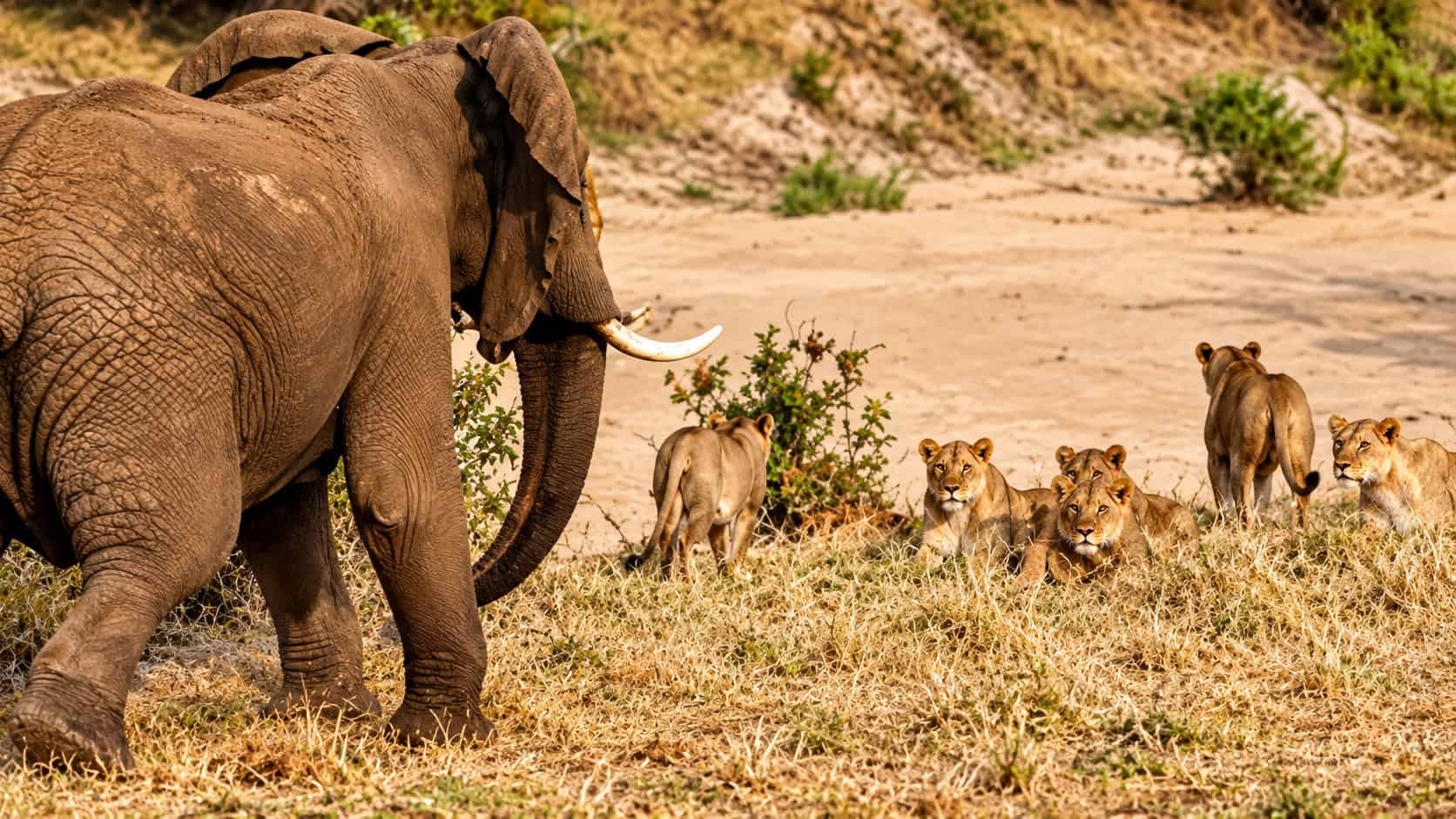
Twenty lions might seem like more than enough to intimidate almost any animal on the African savanna. But one young elephant apparently didn’t get that message. In extraordinary footage from South Africa’s Kruger National Park, a lone bull elephant approaches an entire pride of lions resting near a dry riverbed. Instead of turning around or keeping his distance, the elephant walks directly toward them. Some of the big cats begin moving away, while others seem reluctant to give up their resting spot. Then, the elephant makes a move that sends the entire pride scrambling for safety.
Watch One Elephant Take On an Entire Pride of Lions
The incredible encounter was filmed by Deon Kelbrick near the H1-3 road, north of Tshokwane Picnic Site in South Africa’s Kruger National Park. The footage was shared by the popular wildlife channel Latest Sightings in April 2025.
At the beginning of the encounter, approximately 20 lions are resting along the bank of a dry riverbed. The pride includes a mature male, several lionesses, and cubs of different ages. For the most part, the animals appear perfectly comfortable until several members of the pride become alert to something approaching.
Moments later, a young bull elephant appears, walking directly toward the lions. His ears are spread, and he approaches with his head raised. Three of the lions move away as he advances, but the rest of the pride seems less concerned about the approaching giant.
When the elephant gets within approximately 20 meters, or 65 feet, he stops and appears to assess the situation. Several more lions finally get up and move away, but others remain in place. That’s when the encounter takes a dramatic turn.
The elephant suddenly accelerates toward the pride, trumpeting loudly as he charges. Within seconds, the lions scatter in different directions, including the adult male and younger cubs. The elephant stops short of making contact, and no injuries are apparent in the footage.
Afterward, the elephant briefly watches a lioness that separated from the group before pulling up some grass and eventually wandering away. According to Latest Sightings, the lions later returned to the area once the elephant had left.
Why Would One Elephant Challenge 20 Lions?
At first glance, deliberately approaching a group of 20 powerful predators might seem like an unnecessary risk. After all, lions are among Africa’s most formidable hunters. But an elephant has some extraordinary physical advantages, especially when confronting animals much smaller than itself.
Elephants rely on their enormous size, strength, and intimidating displays to discourage potential threats. Spreading their ears, raising their heads, trumpeting, and making sudden forward movements can all serve as warnings. Depending on the situation, an elephant may perform a short bluff charge or continue into a more serious attack.
In this encounter, the elephant’s behavior is consistent with an assertive threat display. Rather than attacking the lions individually, he advances toward the group and eventually charges, apparently encouraging the pride to move away.
That doesn’t mean the elephant was deliberately trying to establish himself as the ruler of the savanna. While the video makes that interpretation entertaining, we can’t determine the animal’s exact motivation from the footage alone. He may have been responding defensively to the lions’ presence, clearing a path, or simply reacting to animals he considered potential threats.
Could 20 Lions Actually Defeat a Bull Elephant?

African elephants are the largest living land animals, giving them an enormous size advantage over lions.
©iStock.com/MOIZ HUSEIN
There’s a reason even an entire pride of lions might think twice about confronting a healthy adult elephant. The difference in size is enormous.
An adult male African savanna elephant can weigh more than 13,000 pounds, while adult male lions generally weigh between 330 and 570 pounds. Female lions are usually smaller, typically weighing between 270 and 400 pounds.
Besides their size, elephants possess tremendous strength. Their heavy legs, powerful trunks, and potentially dangerous tusks make close contact risky for predators. A single kick, charge, or forceful movement from an elephant could seriously injure a lion.
However, lions are capable of hunting elephants under certain circumstances. Large prides have been documented attacking calves, juveniles, and vulnerable elephants, particularly in parts of Botswana where unusually large groups of lions have developed specialized hunting strategies.
Those encounters are exceptional. Lions generally target prey that offers a more manageable balance between the energy required to make a kill and the risk of injury. Taking on a healthy elephant can be extraordinarily dangerous, even when the lions have a significant numerical advantage.
The lions in this particular video appear to choose the safer option. Rather than confronting the approaching elephant, they retreat when he charges.
Why Is This Young Male Elephant Traveling Alone?
One particularly interesting detail is that the elephant isn’t accompanied by a family herd. Unlike the closely bonded groups of females and calves commonly associated with elephants, mature males often spend time alone or in loose associations with other bulls.
Young male elephants typically leave their maternal family groups as they approach adolescence or sexual maturity. They may join bachelor groups, associate with older males, or spend periods traveling independently.
This behavior is a normal part of elephant social development. While females generally remain with their family groups throughout their lives, males establish different social relationships as they mature. Older bulls can also play important roles in the behavioral and social development of younger males.
The elephant in the footage was identified by Latest Sightings as a young bull, making his solitary appearance unsurprising. What is unusual is his decision to approach such a large gathering of lions without immediately retreating.
What Does This Encounter Reveal About Lions and Elephants?
One of the most fascinating aspects of this encounter is how quickly the balance of power changes. At first, the lions appear to have little reason to be concerned. They’re surrounded by members of their own pride, including an adult male, and vastly outnumber the approaching elephant.
But numbers aren’t everything in the wild. The elephant’s enormous size, powerful movements, and sudden charge present a serious potential threat. For the lions, standing their ground offers little obvious benefit when they can simply move elsewhere.
The encounter also demonstrates that predators don’t necessarily seek confrontation simply because they are capable hunters. Avoiding unnecessary injuries can be essential to survival. A lion with a serious leg injury, for example, may struggle to hunt successfully or defend itself against other predators.
Ultimately, the young elephant manages to scatter approximately 20 lions without making physical contact. The big cats eventually return once he leaves, suggesting the entire confrontation was temporary rather than a lasting dispute over territory.
It’s an extraordinary example of how size, confidence, and defensive behavior can influence interactions between two of Africa’s most recognizable animals. Lions may have earned their reputation as powerful predators, but this encounter shows why even a large pride can have good reason to give a determined elephant plenty of room.