
Quick Take
- Jellyfish have no brain, heart, or blood, yet they've outlasted almost every creature on Earth. The reason why is stranger than you'd expect.
- A war forced two jellyfish experts to abandon everything they built, and then they did something remarkable with the wreckage. Meet the Yanovskys →
- One jellyfish on display looks like it would hurt to touch, but would it really? See the harmless-looking species →
- One species at the museum doesn't eat in an expected way, and its food source will make you rethink the food chain. Discover its unusual diet →
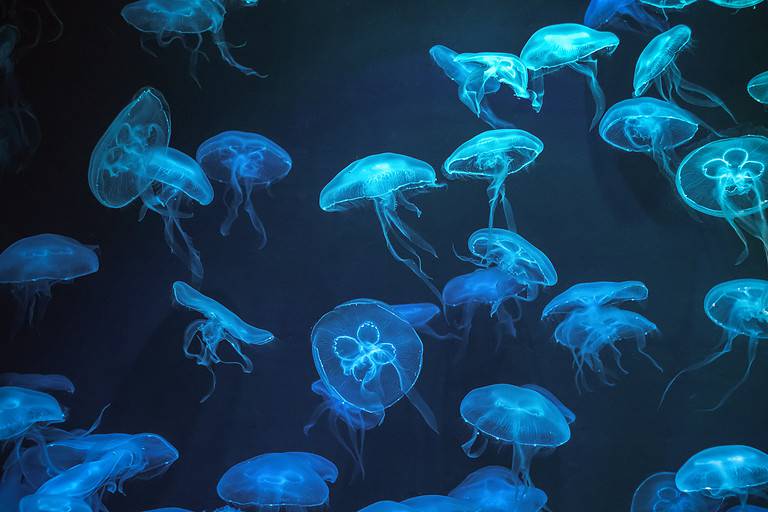
Have you ever looked at a jellyfish and wondered how it survives? Jellyfish lack most of what we assume a living organism needs to survive: namely, a heart, brain, blood, and lungs. Instead, jellyfish use a nerve net, as well as sensory organs called rhopalia, to help them navigate and find food. Although many people consider jellyfish to be relatively simple creatures, they have survived on Earth longer than most other animals. It’s estimated that true jellyfish, or jellyfish that are part of the class Scyphozoa, have been around for somewhere between 500 million and 700 million years. For context, they predate dinosaurs (which appeared around 230 million years ago), trees (400 million years ago), horseshoe crabs (445 million years ago), jawed fish (419-420 million years ago), and even sharks (450 million years ago).
While many of us shy away from jellyfish due to their potentially painful sting, we also love watching jellyfish as they drift through the sea. Research has even shown that observing aquarium animals can improve mood and lower stress. There has even been an uptick in people keeping jellyfish as pets! If staring at a tank full of jellyfish sounds like fun, there’s an ideal spot for you: the Jellyfish Museum in Pompano Beach, Florida.
Spreading a Love of Jellyfish
If you’re like me, you find yourself gravitating to the jellyfish tanks whenever you visit the aquarium. I enjoy how the lights illuminate them and how gracefully they move through the water.
Alex and Yana Yanovsky, who started the Jellyfish Museum, seem equally drawn to these animals. The Yanovskys were successful aquarists in Ukraine for 20 years. They even launched the Museum of Jellyfish in Kyiv. Unfortunately, the Russian invasion of Ukraine in 2022 forced the Yanovskys to flee their home.
After settling in Florida, the couple decided to restart the museum and share their love of jellyfish with the surrounding community. The museum has been open for less than a year but is already drawing quite the crowd. Tickets to the museum start at $23 for single admission, with discounted pricing available for Florida residents, and children under 3 are admitted free.
What’s in the Museum?
There’s a lot to do when visiting the Jellyfish Museum. Several immersive 3D projections allow viewers to feel like they’re surrounded by the ocean; think pulsing lights and projections of jellyfish floating all around. You can also head to the mini laboratory, which gives insight into jellyfish reproduction and feeding. Along the way, you’ll also find educational displays with fascinating information about these incredible creatures.
But the stars of the show, of course, are the 20-25 species of both cold-water and warm-water jellyfish. The museum procures the jellyfish from licensed aquaculture partners. Let’s take a look at the various species.
Fried Egg Jellyfish

Also known as the egg yolk jellyfish, fried egg jellyfish get their name from their appearance, which looks like a sunny-side-up egg.
©RaDoll/Shutterstock.com
The fried egg jellyfish (Cotylorhiza tuberculata) lives in the warm waters of the Mediterranean, Aegean, or Adriatic Seas. This species gets its name in part from its bright yellow color. While a vibrant, stunning appearance in nature often signals significant danger, the egg yolk jellyfish is fairly harmless to humans. Its sting is weak, though it might cause minor irritation to sensitive individuals. The fried egg jellyfish typically measures around 6.7–7.9 inches wide, though its bell can reach up to 13.8 inches. Its diet largely consists of zooplankton and phytoplankton.
Pacific Sea Nettle
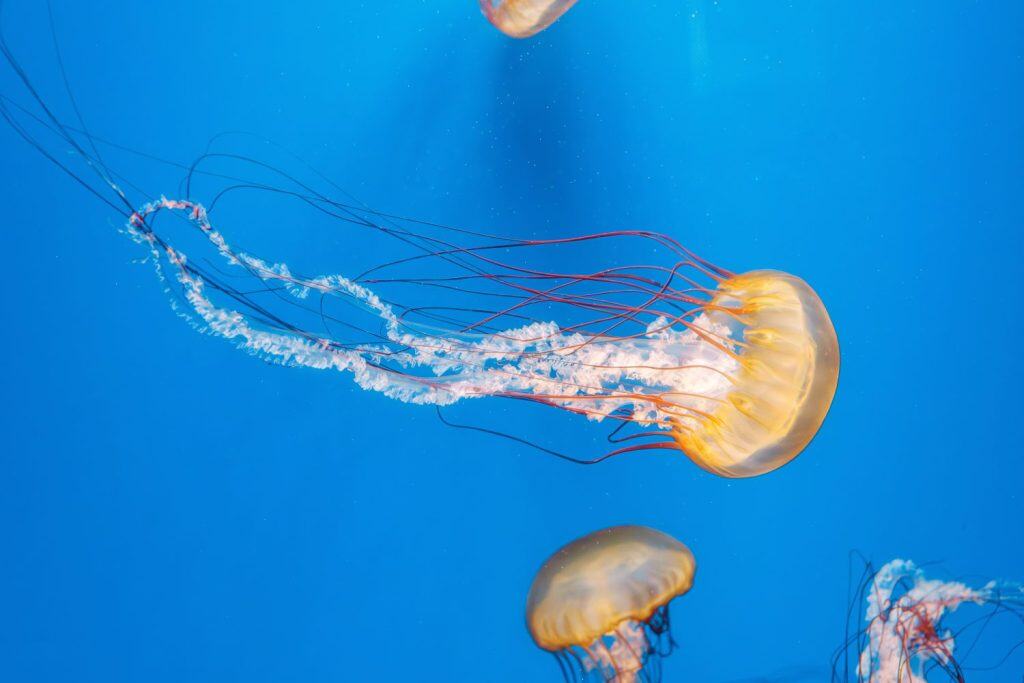
A Pacific sea nettle’s tentacles can stretch up to 15 feet long!
©Minakryn Ruslan/Shutterstock.com
Pacific sea nettles (Chrysaora fuscescens) are mostly found on the west coast of the United States, stretching from Alaska down to Mexico. Their reddish-brown or yellow bells can be up to 12 inches wide, though some individuals may grow considerably larger. Unlike the fried egg jellyfish, the Pacific sea nettle has a painful sting. Some people compare it to a stinging nettle plant or a bee sting. Pacific sea nettles are carnivorous. They feed on zooplankton, including other jellyfish!
Blue Blubber Jellyfish
Also known as jelly blubber, the blue blubber jellyfish (Catostylus mosaicus) is found in the waters of eastern Australia and the Indo-Pacific. Despite having “blue” in the name, the color of these jellyfish can vary. Some individuals are light to dark blue, while others can be purple, brown, or even white. Blue blubber jellyfish have eight oral arms rather than tentacles. They mostly eat zooplankton; however, they’ve also been known to consume small fish or crustaceans. Fun fact: the blue blubber jellyfish is edible. It’s even considered a delicacy in some parts of the world!
Upside-Down Jellyfish

Although normally found resting on the sediment, upside-down jellyfish are capable of swimming.
©Jesus Cobaleda/Shutterstock.com
Perhaps one of the most unique jellyfish you might see at the Jellyfish Museum is the upside-down jellyfish (Cassiopea xamachana). Most true jellyfish have a curved bell, but the upside-down jellyfish’s bell is flat, which helps them settle into their environment. These jellyfish are typically found in shallow marine waters, including coastal lagoons and estuaries associated with mangroves. Zooxanthellae, a type of photosynthetic algae, live in the upside-down jellyfish’s oral arm tissue. By facing upward, the upside-down jellyfish allows the zooxanthellae to get enough light, which enables them to produce nutrients for the jellyfish. However, the zooxanthellae cannot provide all the necessary nutrients, so these jellyfish sometimes feed on zooplankton.