
Jellyfish, of which thousands of species exist, are found in pretty much every area of the ocean you can think of. Some jellyfish are harmless to humans or have stings that cause only mild irritation. But stings from the world’s most dangerous jellyfish may lead to potentially lethal reactions, including loss of muscle control, respiratory distress, red blood cell destruction, coma, or death. Since jellyfish can be hard to spot, and we tend to think of these brainless creatures as unpredictable, it’s no surprise that jellyfish spark more fear in beachgoers than sharks.
With factors like climate change, pollution, and overfishing leading to higher rates of jellyfish blooms, it’s no surprise that certain coastal areas are seeing higher rates of jellyfish stings than ever before. In 2025 alone, Delaware’s Lewes Beach reported a fourfold increase in stings compared to the year before, with up to 92 happening in a single day. Luckily, not every sting is devastating. Still, you should be informed on what to do if you’re stung and where to be most careful. Read on to learn more about the world’s six most dangerous jellyfish.
1. Australian Box Jellyfish (Chironex Fleckeri)
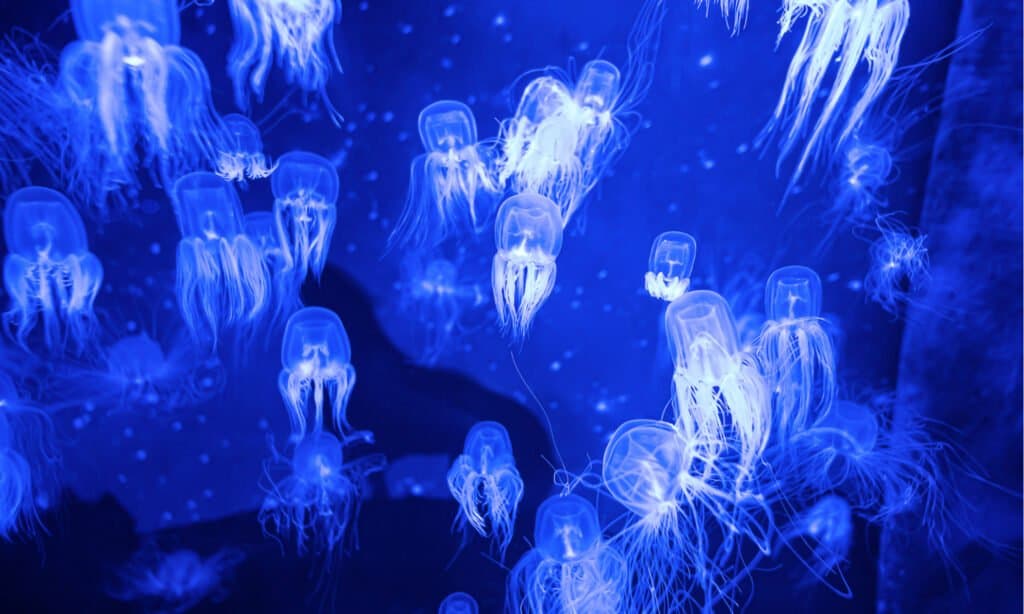
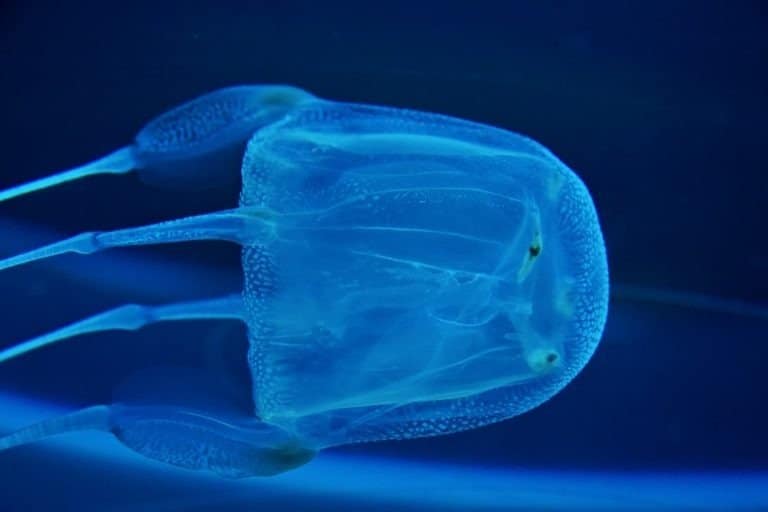
There are over 50 different species of box jellyfish, but the Australian box jellyfish is not one you want to come across when swimming.
©Nuttawut Uttamaharad/Shutterstock.com
At first, you might not think the Australian box jellyfish, named for its characteristic boxy shape, could do too much damage. These largely translucent jellyfish can be beautiful. But they are also one of the deadliest creatures you could encounter in the ocean.
Where are Australian box jellyfish found?
Nicknamed “Sea Wasp,” Australian box jellyfish are found in tropical waters around northern Australia. During warm summer months, the jellyfish may travel to coastal rivers and mangroves in search of food. Their pale bodies can make them difficult to spot, leading to an excess of stings.
What do Australian box jellyfish look like?
The bell of Australian box jellyfish can grow as large as one foot long, with tentacles reaching up to ten feet in length. Interestingly, unlike other species, box jellyfish have eyes: 24 of them, in fact! Australian box jellyfish have up to sixty tentacles attached around their bell, with each tentacle covered in specialized stinging cells called nematocysts. The nematocysts discharge venom when touched. If you find a jellyfish washed up on the beach, or see tentacles disconnected from a jellyfish, be careful: the nematocysts can still sting.
Why are Australian box jellyfish so dangerous?
Australian box jellyfish have a potent venom that causes incredibly painful stings, leading to this creature being known as the most venomous creature in the ocean. Stings can cause skin welts and scarring, excruciating pain, a sense of impending doom, cardiovascular stress and failure, tissue necrosis, and even death within minutes. Although antivenom is available, not everyone agrees on how effective this treatment is. CPR may have to be performed on someone stung by this jellyfish. Survivors are often treated with opioids to help manage the pain.
2. Irukandji Jellyfish (Carukia barnesi)
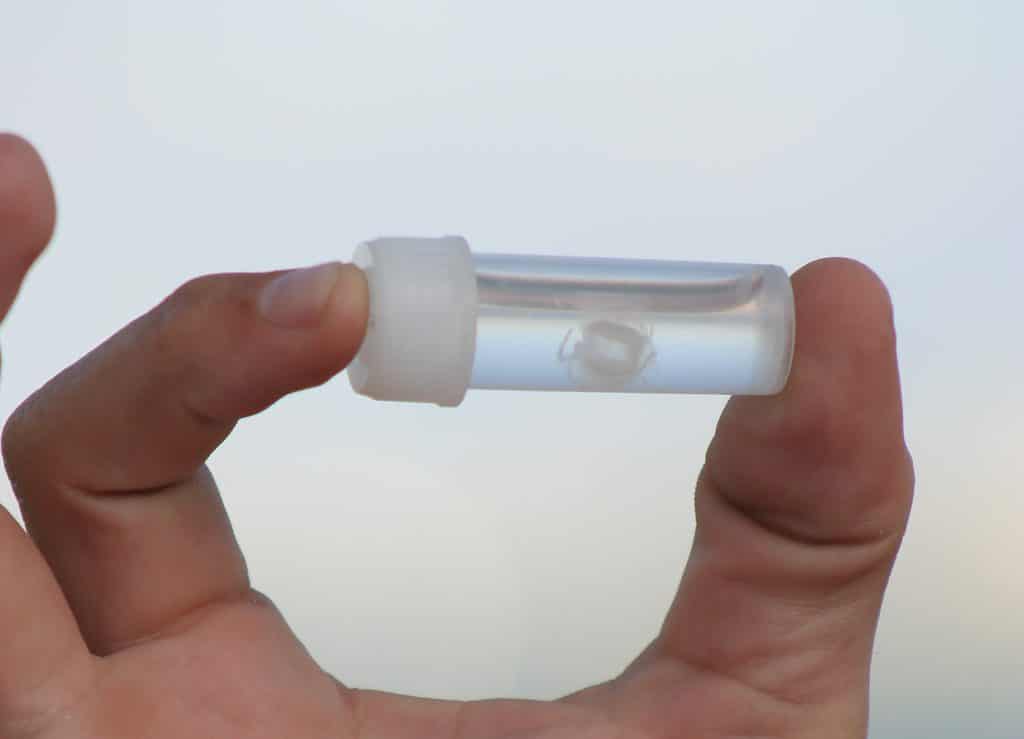
Stings from Irukandji jellyfish can lead to Irukandji syndrome, a painful and sometimes deadly condition, within an hour.
©2,221 × 1,606 pixels, file size: 596 KB, MIME type: image/jpeg – Original / License
Starting as early as 1922, swimmers around Queensland, Australia, began dealing with an agonizing illness. Named Irukandji Syndrome in 1952 by toxicologist Hugo Flecker, the condition caused horrific pain and muscle cramping. Physician Jack Barnes later set out to identify the cause of Irukandji syndrome. In 1961, Barnes collected minuscule jellyfish specimens and proceeded to use them to sting himself, his son, and another volunteer. His pioneering, yet painful, experience was the catalyst needed to identify the Irukandji jellyfish.
Where are Irukandji jellyfish found?
Like many of the world’s most venomous creatures, Irukandji jellyfish are largely found in Australia, especially in more northernmost tropical waters. In rarer cases, these jellyfish have been spotted in Africa, Hawaii, or areas around the Caribbean.
What do Irukandji jellyfish look like?
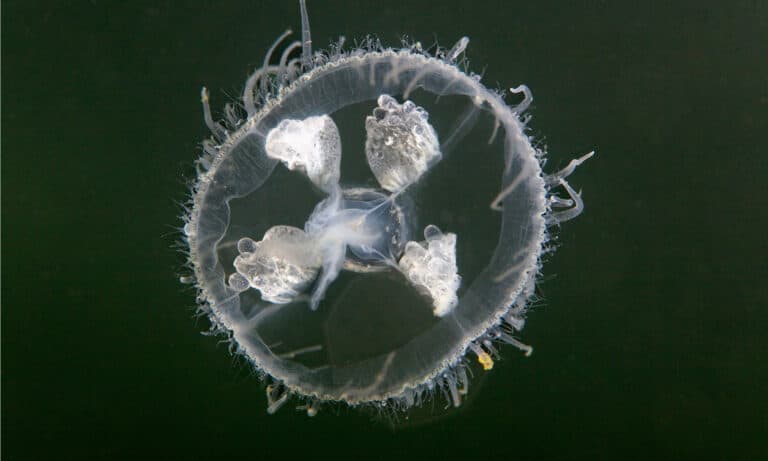
Unlike some of the jellyfish you’ll see later on this list, you probably can’t spot the Irukandji jellyfish with just your eyes. These transparent creatures top out at about one inch in diameter. However, their tentacles can extend up to 3.3 feet long. Many people envenomated by Irukandji jellyfish will not actually see the jellyfish that stung them.
Why are Irukandji jellyfish so dangerous?
Because of their minuscule size, it can be almost impossible to avoid Irukandji jellyfish while swimming. In most cases, Irukandji jellyfish stings are not fatal, though there have been several cases where the stings have caused fatal cardiac symptoms. Some scientists posit that Irukandji jellyfish stings may be more serious in older individuals or those with pre-existing health issues.
Although stings may not kill you, Irukandji syndrome is deeply uncomfortable. Those stung can expect a range of symptoms which may include:
- Extreme muscle and joint pain
- Muscle spasms
- High blood pressure
- Overwhelming feeling of doom
- Agitation
- Difficulty breathing
- Rapid heart rate
- Nausea and vomiting
- Fluid accumulation in the lungs
- Heavy sweating all over the body
Right now, no antivenom exists to treat Irukandji syndrome. If you’re stung, you’ll likely receive IV magnesium and opioid treatment ot help control the severe pain.
3. Nomura’s Jellyfish (Nemopilema nomurai)
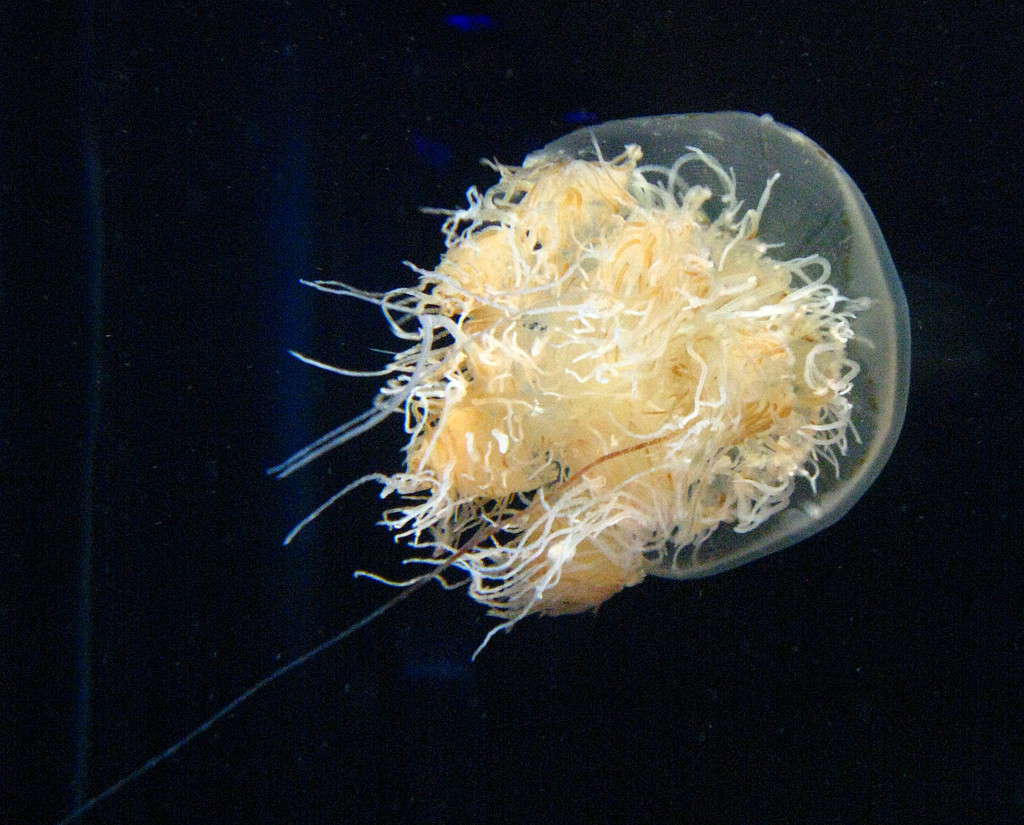
This jellyfish starts as the size of a grain of rice and grows rapidly, reaching its size in under a year.
©I, KENPEI, CC BY-SA 3.0, via Wikimedia Commons – Original / License
The Nomura’s jellyfish is a formidable force in the ocean. Although the Nomura’s jellyfish isn’t the largest jellyfish of all (that title goes to the Lion’s Mane jellyfish), this enormous creature still spans up to six and a half feet in diameter and can weigh up to 440 pounds. In recent decades, the population of these jellyfish has exploded thanks to factors like climate change and overfishing of the jellyfish’s predators. Yes, these creatures are huge. But that doesn’t stop sunfish, swordfish, tuna, or turtles from snacking!
Where are Nomura’s jellyfish found?
Nomura’s jellyfish are commonly found in Asia, particularly in the East China Sea, Bohai Sea, Sea of Japan, and Yellow Sea. Because these jellyfish are slow and easily moved by currents, they may be pushed into areas where people are swimming, scuba diving, or fishing.
What do Nomura’s jellyfish look like?
As you can imagine, their size makes Nomura’s jellyfish hard to miss! These jellyfish can range in color from pink to brown, yellow, or gray. Tentacles may reach 20 feet in length.
Why are Nomura’s jellyfish so dangerous?
Intense pain and blistering may occur at the sting site. Skin redness and swelling are also common. In rarer cases, those stung may go into shock or even die. Some research has proposed that these jellyfish may have certain toxins in their venom that are similar to poisonous snakes, bees, or spiders. People with those allergies would, understandably, respond much worse to a sting. Nomura’s jellyfish are also “dangerous” in the sense that they can cause economic damage and damage to local biodiversity.
4. Lion’s Mane Jellyfish (Cyanea capillata)
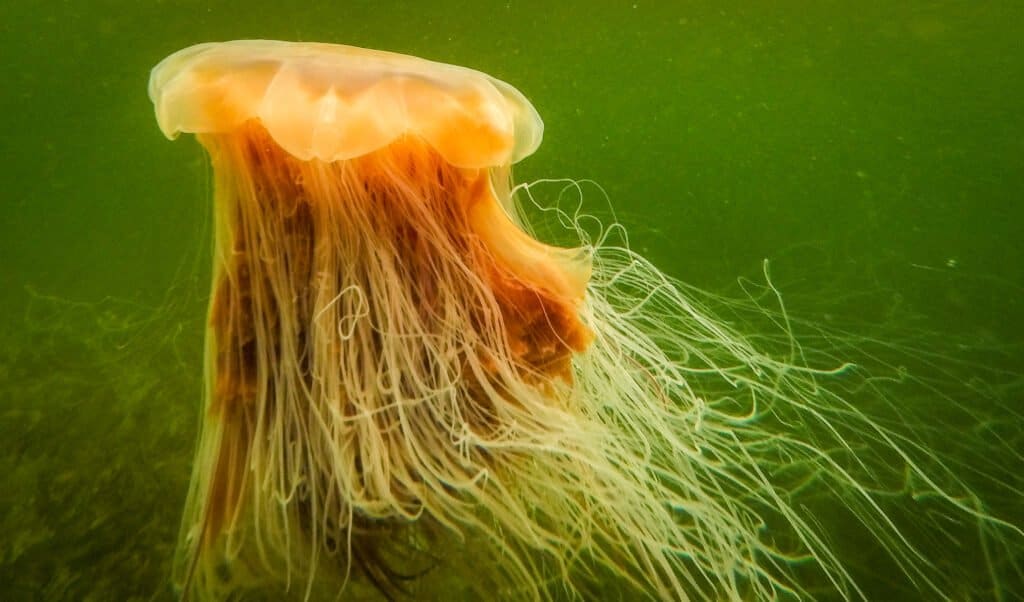
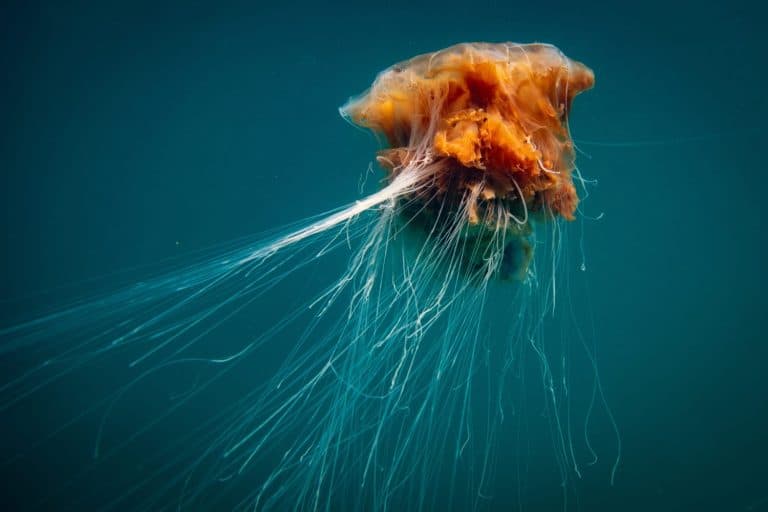
Lion’s mane jellyfish can have anywhere from a few hundred to up to 1,200 tentacles.
©Sunart Media/Shutterstock.com
Not a fan of cold water? Then you’re unlikely to come into contact with the Lion’s mane jellyfish. Frequently called one of the largest jellyfish species worldwide, the Lion’s mane jellyfish prefers colder northern waters. But climate changes mean these jellyfish populations may be found elsewhere. These jellyfish have also been known to wash up on beaches. If you see one, stay away! They can still sting after death.
Where are lion’s mane jellyfish found?
Historically, these creatures have been heavily found around the United Kingdom’s coastline. Lion’s mane jellyfish are also found in areas around Toronto and Vancouver, Alaska, or other cool ocean areas. The Virginia Institute of Marine Science even says Lion’s mane jellyfish may appear in the Chesapeake Bay during colder months, but not at the same size as you’d find in the deep ocean.
What do lion’s mane jellyfish look like?
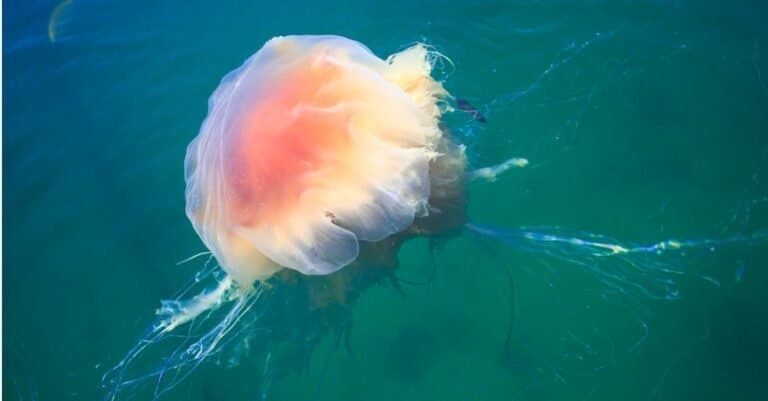
Weighing up to 200 pounds and stretching up to eight feet in diameter, the Lion’s mane jellyfish are extremely huge and hard to miss. Tentacles, of which there can be thousands, collect under this jellyfish’s bell. According to Britannica, the longest Lion’s mane jellyfish have tentacles up to 120 feet in length.
The color of this jellyfish can vary. But usually Lion’s mane jellyfish range from dark brown and yellow to deeper crimson red or orange. People are usually warned not to touch any red creatures (especially jellyfish!) that wash up on the beach.
Why are lion’s mane jellyfish so dangerous?
Because Lion’s mane jellyfish have so many tentacles, it’s possible for those stung to get wrapped in the tentacles, or at least stung by several at once. Lion’s mane jellyfish stings are rarely fatal. But you can expect nasty pain and swelling at sting sites. Other symptoms can include a rash, nausea, sweating, muscle pain, headaches, or trouble breathing. If you’re stung and experiencing any difficulty breathing, seek medical attention as soon as possible.
5. Four-Handed Box Jellyfish (Chiropsalmus quadrumanus)
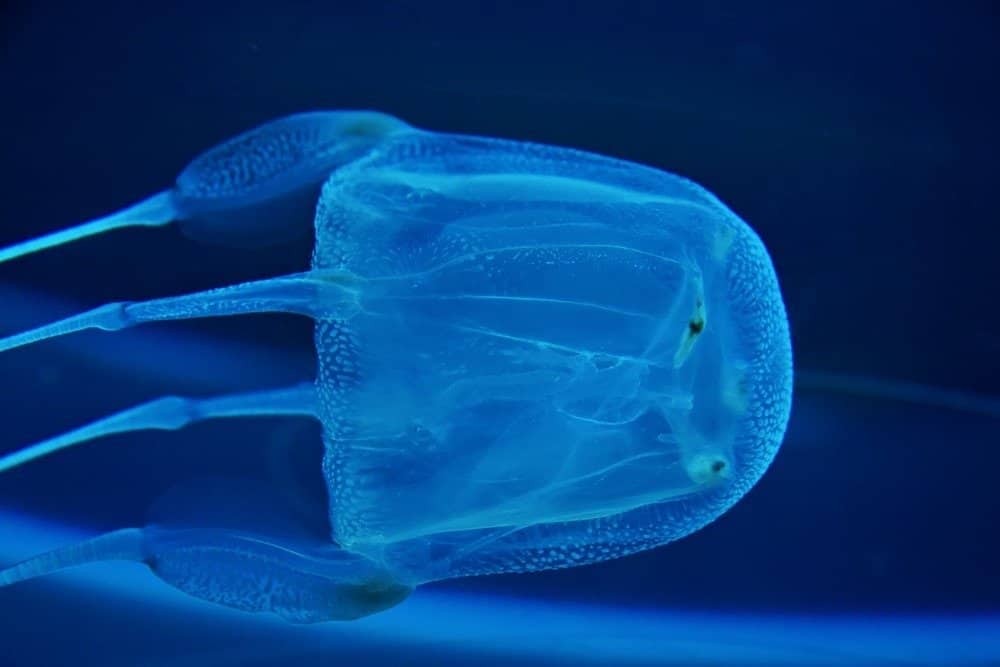
Sea turtles don’t have the same reaction to four-handed box jellyfish as humans, which makes sea turtles a natural predator for these jellyfish.
©Daleen Loest/Shutterstock.com
While the Australian box jellyfish holds the record for the most dangerous jellyfish, the four-handed box jellyfish follows shortly behind. The four-handed box jellyfish gets its name from four pedalia, fleshy areas that look similar to hands or fingers.
Where are four-handed box jellyfish found?
Unlike its Australian counterpart, the four-handed box jellyfish can be found in significantly more ocean environments worldwide. These creatures have been spotted in Brazil, areas of the Pacific Ocean, Hawaii, Australia, and Gulf states bordered by the Atlantic Ocean, including:
- North and South Carolina
- Texas
- Georgia
- Alabama
- Florida
- Mississippi
Some studies suggest four-handed box jellyfish are likely to be closer to the coasts whenever the ocean’s salt concentration (salinity) is especially high.
What do four-handed box jellyfish look like?
Four-handed box jellyfish are transparent in color. These jellyfish usually have a bell of around five and a half inches at max. However, the tentacles emerging from their pedalia can stretch up to 13 feet in length.
Why are four-handed box jellyfish so dangerous?
The challenge around the four-handed box jellyfish is that they have been studied less than other species. But existing research and anecdotal evidence suggest the sting of these creatures is immediate, searing, and burning. This jellyfish is not often fatal, though it has killed children before. But those who are stung may develop a painful, itchy rash that lasts for months. More serious cases may also see respiratory distress and cardiac issues.
6. Atlantic Sea Nettle (Chrysaora quinquecirrha)
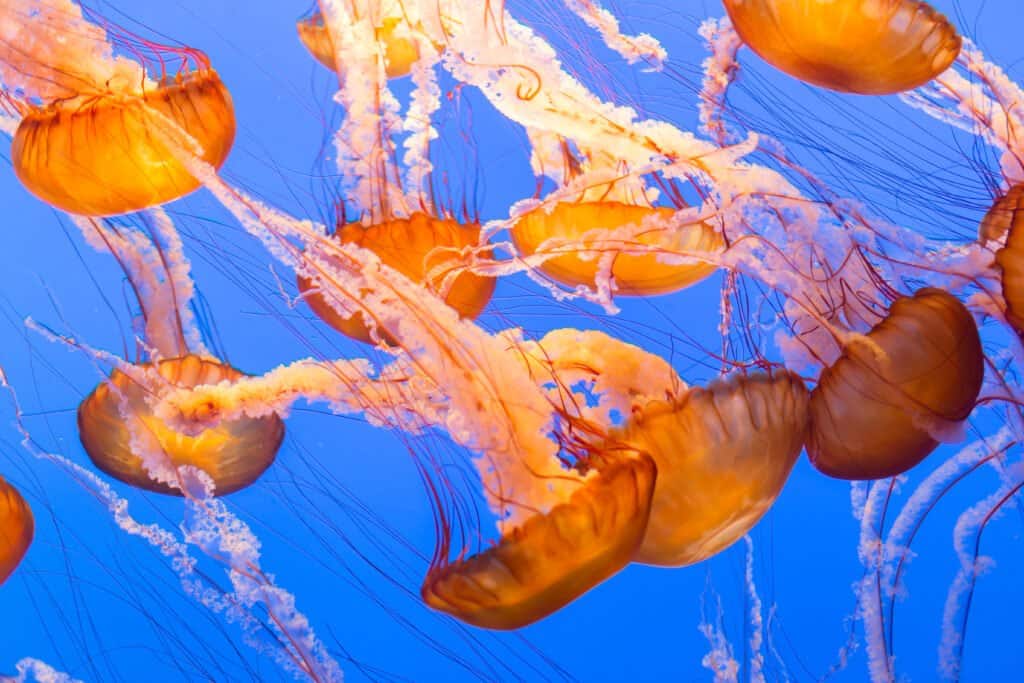
Although both Atlantic and Pacific sea nettles exist, these two jellyfish actually have different scientific names!
©Ken Wolter/Shutterstock.com
In recent years, researchers have discovered that the Atlantic sea nettles swimming in the Chesapeake Bay actually comprise two separate species. A 2017 study on Atlantic sea nettles found that Chrysaora quinquecirrha was larger and found in the open ocean, while Chrysaora chesapeakei is the bay-based version of this species. The two fascinating species differ in appearance, but can both sting painfully.
Where are Atlantic sea nettles found?
Atlantic sea nettles are found, as the name suggests, in the Atlantic Ocean along the U.S. coastline. Sea nettles may also be found in other parts of the world, but are usually separate species. Pacific sea nettles (Chrysaora fuscescens) are found more around California, Oregon, and the Gulf of Alaska. Japanese sea nettles (Chrysaora pacifica) range as far as Japan.
What do Atlantic sea nettles look like?
Chrysaora quinquecirrha and Chrysaora chesapeakei both share similar appearances. These jellyfish are typically milky white in color. Some may have brown or purple splotches. The bay-based sea nettles have prominent bells up to eight inches in diameter, though the sea-based versions have bells up to twice as large. Tentacle length also differs slightly. The oral tentacles are longer in bay sea nettles, but Atlantic sea nettles have more overall stinging tentacles.
Why are Atlantic sea nettles so dangerous?
Unless you’re allergic to Atlantic sea nettle stings, your chance of death is extremely low. However, you probably won’t escape the pain or uncomfortable rash, which lasts anywhere from 20 minutes to hours. Some people also experience chest tightness.
A Brief Guide to Handling Jellyfish Stings
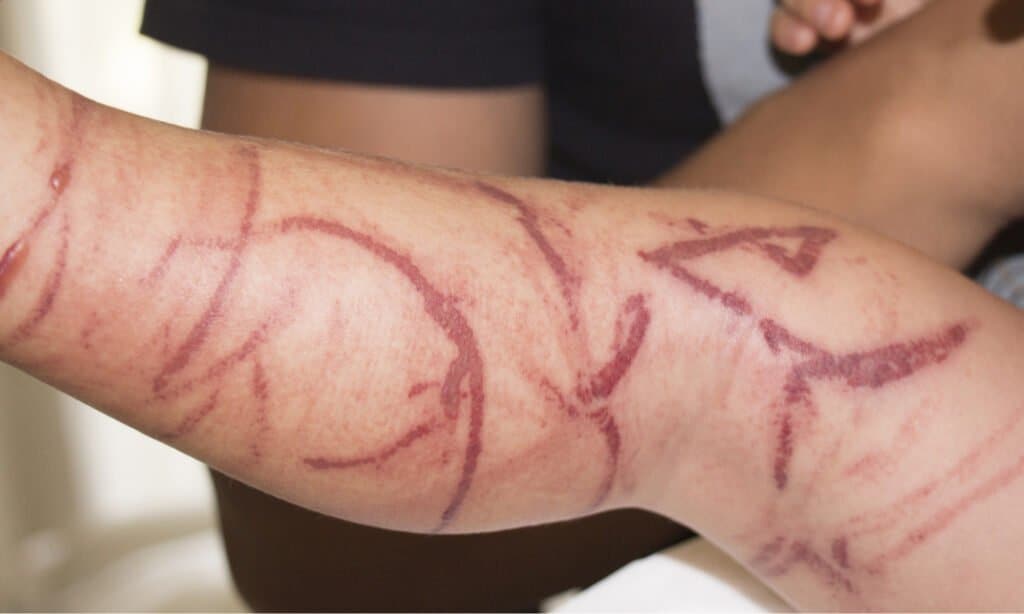
Severe jellyfish stings, or stings from some of the world’s most dangerous jellyfish, can cause permanent skin scarring.
©DonyaHHI/Shutterstock.com
Getting stung by a jellyfish can be scary. But taking proper precautions and knowing what to do if you’re stung can save you some trouble. Here are some do’s and don’ts that’ll keep you safe:
Do…
- Remove any visible tentacles or material stuck to your skin.
- Rinse using vinegar, which neutralizes stings.
- Soak the skin in hot water to help reduce the pain.
- Use hydrocortisone cream or pain relievers to manage symptoms.
Don’t…
- Remove any tentacles using your hands, or you’ll risk additional stings.
- Rinse with fresh water, since that may cause more stingers to activate.
- Wash with urine or meat tenderizer (as these have not been proven helpful).
- Wrap a bandage around the stings, which can worsen the spread of venom.
Is hospitalization needed?
In most cases, you won’t need to go to the hospital for a jellyfish sting. However, if you’re in a tropical area where the world’s most dangerous jellyfish are common, or you’re experiencing side effects like nausea and vomiting, severe headaches, muscle spasms, or difficulty breathing or swallowing, pursue emergency care immediately.