
Quick Take
- Scientists can now detect fish in the ocean without ever seeing them, and what they found off Japan's coast surprised even the researchers. See how eDNA works →
- Some fish quietly crossed boundaries that scientists thought were fixed, and the clue they left behind was invisible to the naked eye. Species found out of range →
- Herbivorous fish creeping northward could be silently dismantling entire underwater ecosystems, and most people have no idea it's happening. Herbivores threatening seaweed beds →
- Japan's fishing culture faces a crisis it didn't see coming, and ocean warming is only part of the story. Ecological and cultural consequences →
One of the many unwelcome effects of climate change is the redistribution of species. Animals gravitate toward the environmental conditions they’ve spent millennia adapting to, and this is just as true in our oceans as it is on land. Increasingly, fish are moving towards the poles but tracking exactly how far they’ve traveled can be challenging. A new study conducted by researchers at Japan’s Okinawa Institute of Science and Technology (OIST) has used eDNA sampling to track fish further north than was previously expected.
What Is eDNA?
DNA analysis is not just for forensics; it is increasingly used in wildlife survey work because it can identify the diversity of creatures that live in an area without the need for a physical survey. When a creature moves through the environment, it constantly sheds parts of its body. So, when a fish swims through the sea, it leaves some of its DNA in the water. Scientists call this eDNA.

DNA is unique to each species.
©Billion Photos/Shutterstock.com
By sampling seawater, scientists can determine whether fish have recently been in the area. They can test for many species at the same time instead of having to focus on just a few. DNA sampling is a rapidly advancing field of science, but there are still challenges to overcome. It is important to bear in mind that environmental conditions can affect eDNA deposition and decay. The same is true for biomass and behavior.
How Was Fish eDNA Collected?
The scientists analyzed 19,054 eDNA occurrence records for 504 fish species from 2094 marine eDNA samples taken across Japan between 2017 and 2024. A total of 983 samples and controls were collected across 12 locations along the eastern Pacific coastline of Japan and the Seto Inland Sea. Most were taken from the seawater surface with buckets. Back at the laboratory, the scientists used eDNA extraction and metabarcoding to identify the fish species.
They compared their findings to a baseline reference of range edges for each species. This was constructed using the Global Biodiversity Information Facility (GBIF) and the Ocean Biodiversity Information System (OBIS), core habitats as modelled by Aquamaps habitat suitability maps, and IUCN extent-of-occurrence maps.
Fish Recorded Out of Range
In all, there was eDNA evidence that 126 species from 92 genera and 53 families were living outside their ranges. They were also outside of historical occurrence records, modelled core habitats and/or expert-delineated extent-of-occurrence. There was not always agreement between the various baseline reference sources. For example, Enneapterygius philippinus was found beyond the IUCN expert map northern limits but below the Aquamaps core habitat northern limit.

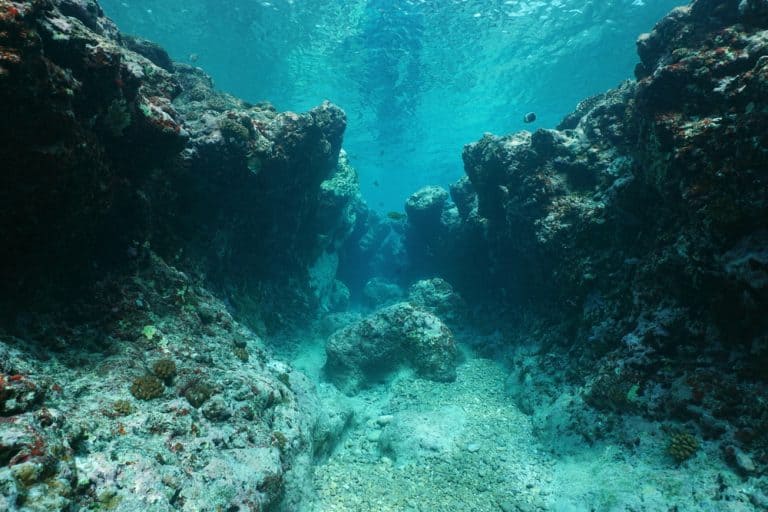
Seaweed bed may be under threat.
©inusuke/iStock via Getty Images
That said, eDNA for 12 species was found outside the ranges of all three reference limits and historical occurrence records. Amongst these were Blenniidae (nearshore cryptics), Sparidae, Lethrinidae, Epinephelidae, Carangidae (popular angling fish), and Atherionidae and Labridae (reef-associated fish).
Implications for Temperate Seaweed Beds
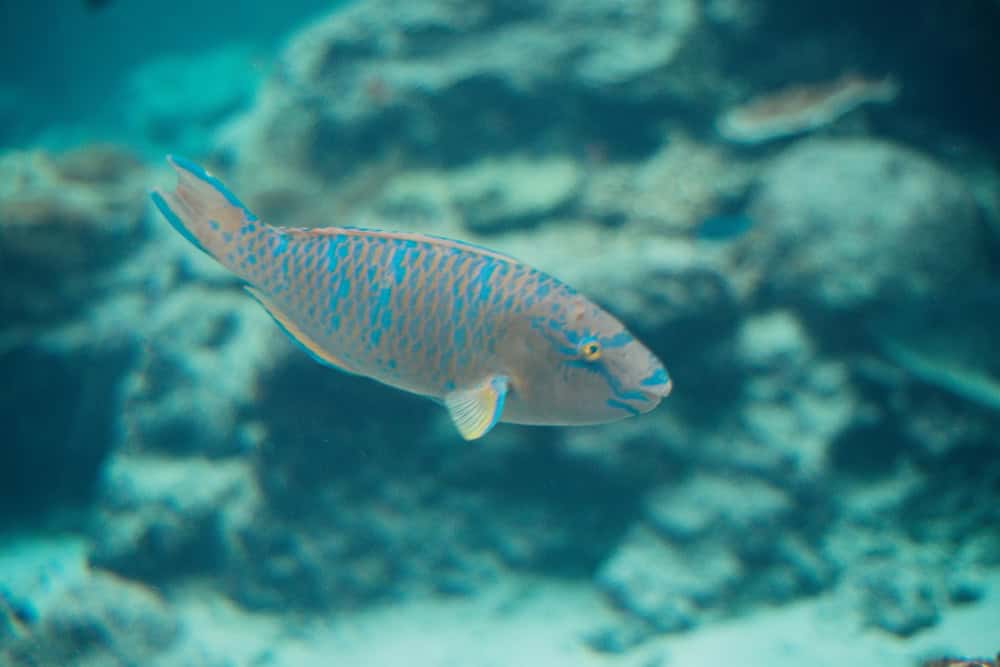
Three species covered by this study are herbivorous fish that are suspected to be one of the causes of the decline of temperate seaweed beds. The mottled spinefoot (Siganus fuscescens), the Japanese parrotfish (Calotomus japonicus), and the Japanese sawtail (Prionurus scalprum) have been reported in greater numbers beyond their traditional northern limits. They have also reportedly overwintered in new locations since 2000. This study found eDNA for all three species significantly above the GBIF-OBIS limits but below modelled core habitat limits.
What Are the Ecological and Conservation Implications?
One of the major challenges in ecology and conservation biology is the ‘Wallacean shortfall’. This is the lack of scientific knowledge regarding the geographic distribution and spatial limits of known plant and animal species. So, even though there are numerous reports that fish species in Japan are extending their ranges, we need continuous monitoring along gradients to confirm that it’s actually happening. This is where studies of eDNA can help.
The out-of-range occurrences recorded in this study were likely down to larval dispersal and ocean warming via the Kuroshio and Tsushima currents in the Pacific and Sea of Japan. The sampling period of the study coincided with rapid ocean warming along the Pacific coasts of central Japan and record-breaking marine heatwaves. Marine heat waves can displace ocean creatures in a fraction of the time that climate change can.
Japan’s economy and culture are deeply connected with the sea and fish, so the implications for significant changes in distribution are severe. Fishermen will likely be forced to catch different species unfamiliar to them, and they may not have the skills to do so. The local population is not used to preparing and eating these new fish. They may not be able to make culturally important dishes that require a particular species of fish. Also, the arrival of new species in ecosystems that are not used to hosting them has severe implications for the animals and plants that already live there.