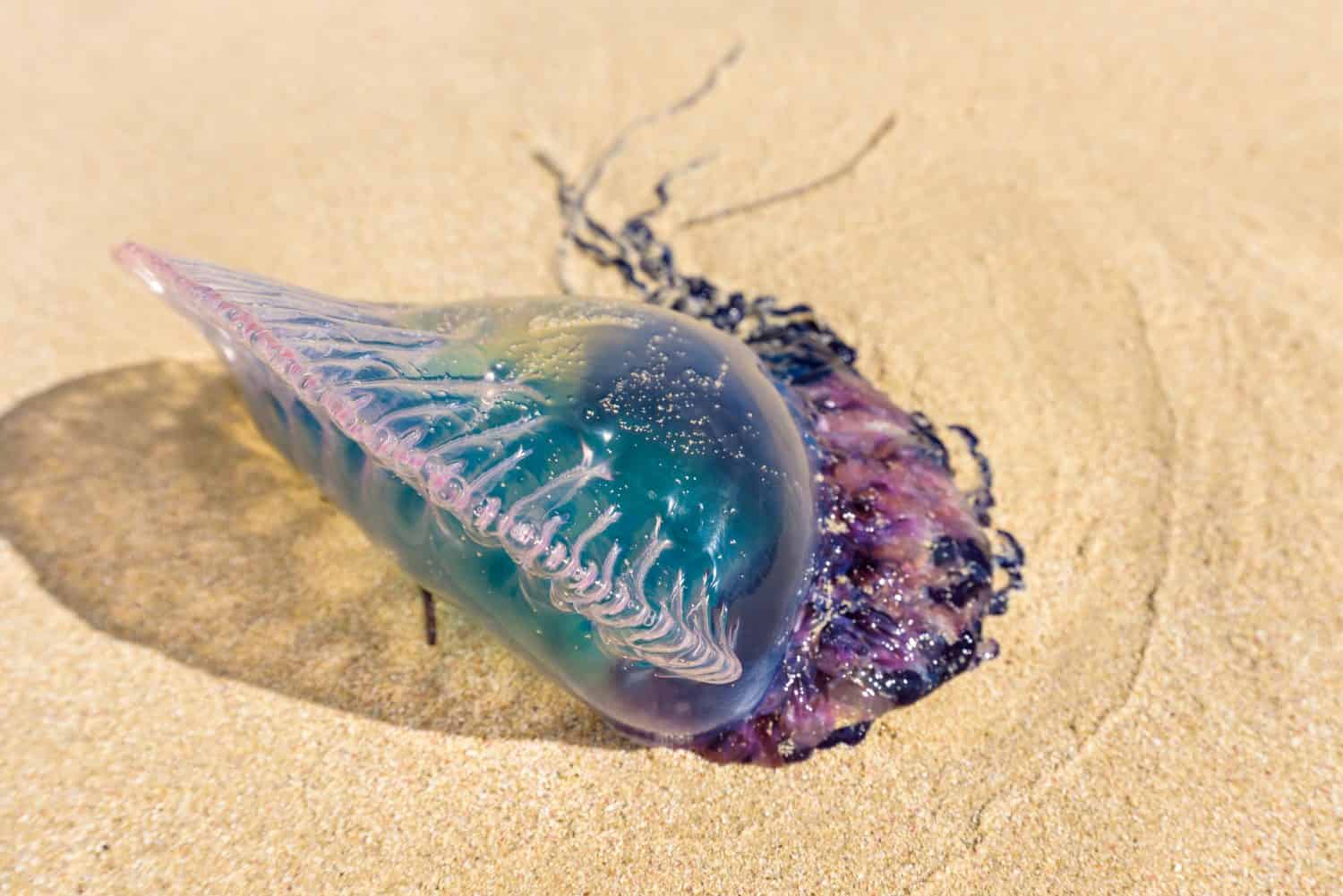

One look at a Portuguese man-of-war in the open water, and you would think it was some kind of singular, extravagant jellyfish. So named for its appearance, which is uncannily similar to a Portuguese man-of-war ship at full sail, these creatures sail the ocean blue, particularly in subtropical and tropical waters.
However, these creatures are neither jellyfish nor single organisms. Instead, these gelatinous ships are composed of colonies of organisms. The Portuguese man-of-war is a type of siphonophore, and the only member of the family Physaliidae. Previous genetic evidence suggested that there were likely more members of this family, but there wasn’t enough evidence to prove those assumptions true. These inklings proved correct, as Japanese scientists recently discovered a previously unknown species of Portuguese man-of-war in the waters northeast of Japan.
The first discovered species of man-of-war is classified as a neuston, meaning it is one of many organisms that live on the surface of the water. Unable to propel themselves, man-of-wars use floats filled with carbon dioxide and air to catch the wind and sail, often for thousands of miles at a clip. While statuesque on the water’s surface, man-of-wars have long, trailing tentacles that release deadly venom to sting and kill fish.
Despite their quantifiable sailing habits (Lagrangian particle tracking can calculate their oceanic circulation), much of their movement remains a mystery. The discovery of a new species of man-of-war in the Japanese coastal waters, colloquially called the “samurai jellyfish,” offers new clues about the ocean’s changing ecosystems. Let’s learn more about this new species.
Changing Classifications
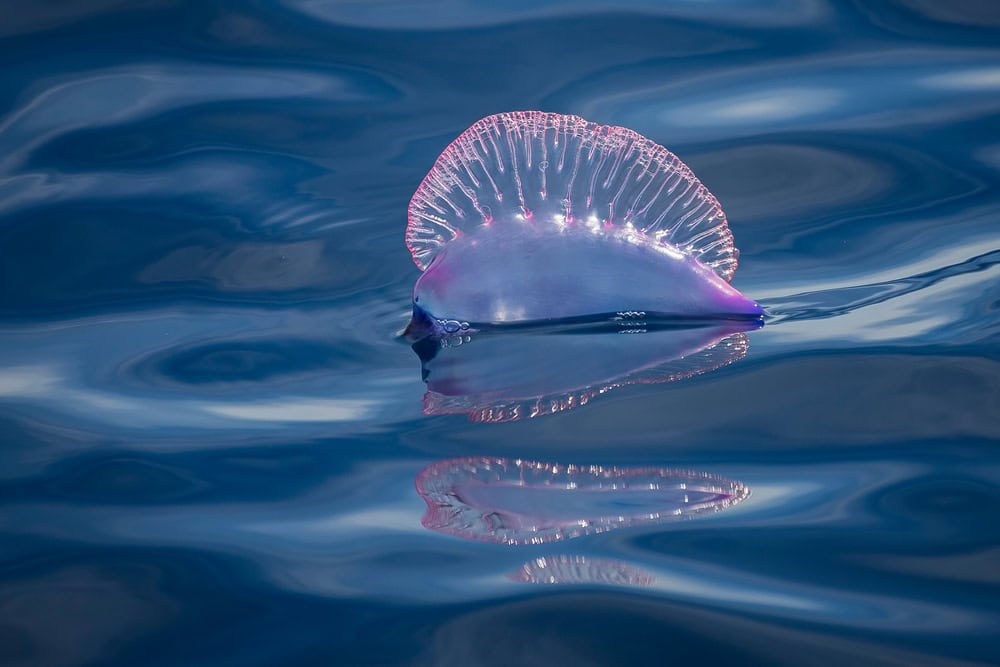
Though these creatures were first described in the mid-18th century, later revisions placed them in their own genus and family.
©Gonzalo Jara/Shutterstock.com
The Portuguese man-of-war was first described in the mid-18th century by the “father of modern taxonomy,” Carl Linnaeus, in the tenth edition of his seminal work Systema Naturae. A century of scientific progress saw the creature moved to its own distinct family and genus. Even then, the existence of other related species was plausible but controversial.
For example, the species P. utriculus features a smaller float and a single tentacle, the same appearance as a juvenile man-of-war. Despite morphological evidence of distinct but related species of man-of-war, the findings proved inconclusive. A 2012 study using New Zealand Specimens suggested that there were three distinct lineages and up to ten species of man-of-war. This scientific guesswork remained unproven until Japanese scientists made a startling discovery off the coast of northeastern Japan.
A Long-Awaited Discovery
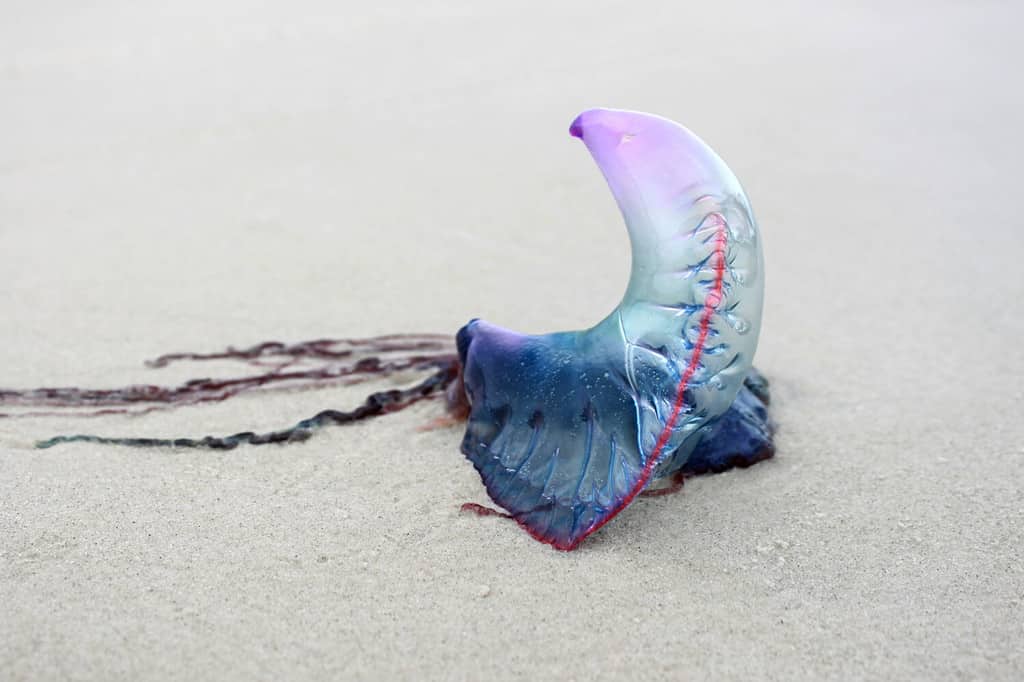
Scientist Yoshiki Ochiai found the new species while working on a different research project around Japan’s Sendai Bay.
©Pedro Sales Prado/Shutterstock.com
According to an article recently published by Science Daily, this discovery of a new species happened completely by accident. Scientist Yoshiki Ochiai was working on a different research project around Sendai Bay in Japan’s Tohoku region when he happened upon a curious-looking jellyfish. Sensing an opportunity, he collected a sample. He said, “So I scooped it up, put it in a ziplock bag, hopped on my scooter, and brought it back to the lab!”
While man-of-wars have long drifted into the waters between Okinawa and Sagami Bay, scientists previously assumed them to be the only members of their genus. Ochiai’s chance collection, however, led to the naming and classification of a new species. Large and colored in a stunning cobalt-blue, scientists named the species Physalia mikazuki, or the crescent helmet man-of-war. They named it in honor of Sendai’s feudal lord, Date Masamune, a samurai warrior with a crescent moon on his helmet.
The Process of Classification
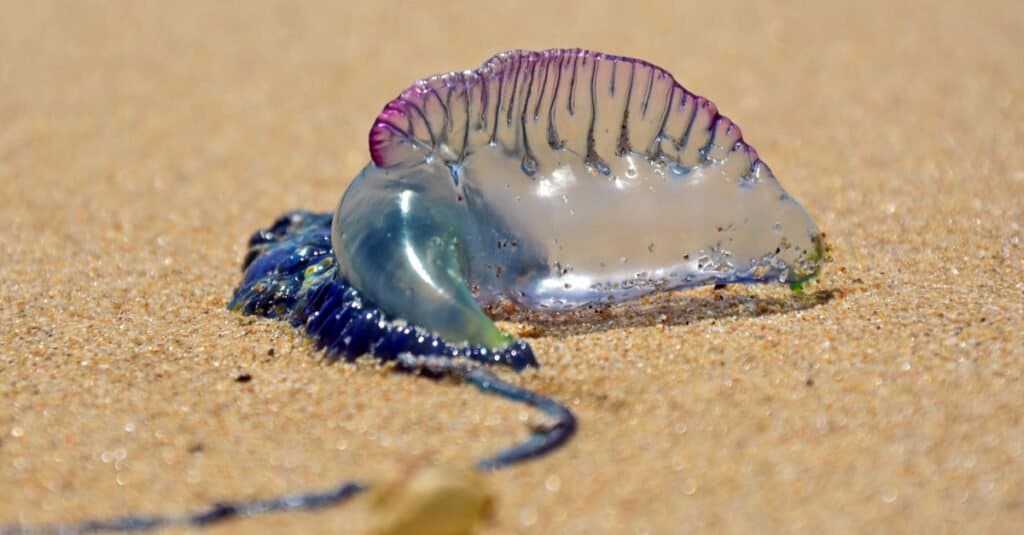
Morphological and DNA analysis confirmed it to be a new species of man-of-war.
©KarenHBlack/Shutterstock.com
To record and confirm the subtle variations in body structure between the crescent moon man-of-war and its Portuguese-named relative, scientists had to look closely. As the first author of the study, Chanikarn Yongstar, explained, “I looked at each individual part, comparing its appearance to old tomes where scholars drew out the jellyfish anatomy by hand. A real challenge when you look at just how many tangled parts it has.”
Her observations suggested that this specimen was different enough to stand apart. While it resembled the more commonly known Portuguese man-of-war in terms of dimensions, it featured a vibrant cobalt blue color that was distinct from other known man-of-war species. Morphological and DNA analysis confirmed that it was indeed a new species.
While this undoubtedly excited the researchers, it raised questions about how this siphonophore reached the northeastern part of Japan. As Kei Chloe Tan explained, “Our morphological and DNA analyses confirmed that these specimens represent a new species, distinct from its tropical relatives. Which is an exciting finding in and of itself, but we still had questions about how it got here.”
Migration Simulation
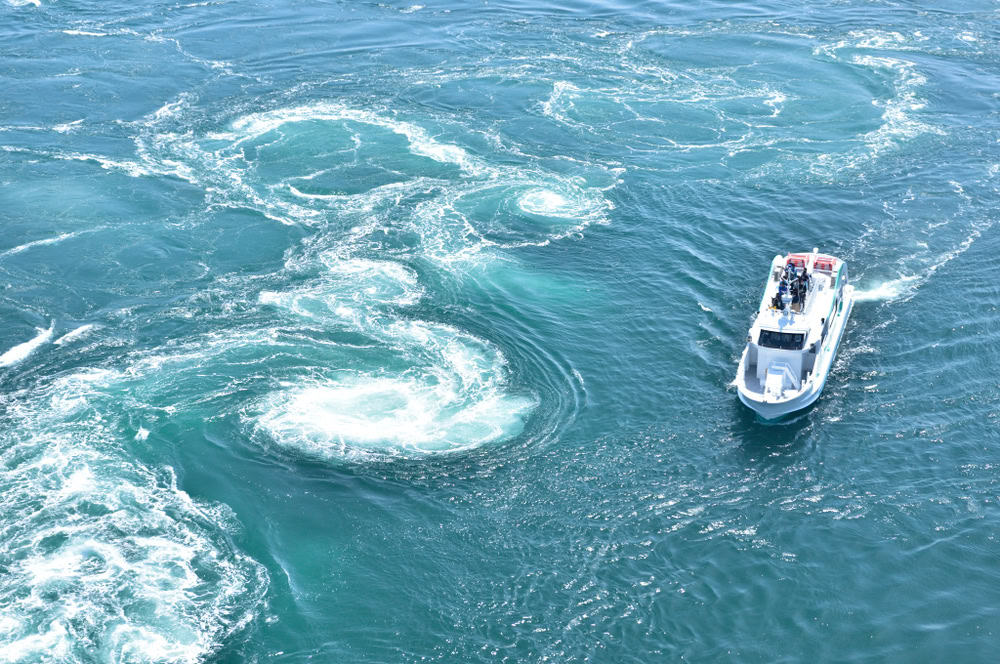
Researchers figured out the migration path of this new species using computer model simulations.
©Japan's Fireworks/Shutterstock.com
Not only did this lead to the discovery of a new species, but it is also the first recorded sighting of a man-of-war so far north off the Japanese coast. As such, the researchers ran several computer models simulating the likely movement of man-of-wars via ocean currents. The results were surprising yet revealing: the models indicated that high sea-surface temperatures were accompanied by unusually warm water from the Kuroshio Current. This current, which has shifted approximately 2 degrees north in latitude between 2023 and 2024, likely pushed the colonies of man-of-war into Sendai Bay.
As researcher Muhammad Izzat Nugraha explained, the simulation used visualizations of red beach balls to represent the man-of-war, tracking their movement as they were carried by different currents and eventually released far away, sometimes days or even months later. This led to some interesting findings regarding man-of-war migration. He said, “We were excited to find that in our simulation, all the beach balls essentially made a trail from Sagami Bay up to right where we found the ‘crescent helmet man-o-war’ in the Tohoku region.”
Deadly Venom

These creatures are responsible for 10,000 sting-related incidents in Australia each summer.
©Shirley Jayne Photography/Shutterstock.com
The findings of these researchers provide new insight into the changing ecosystems of modern oceans. It also opens opportunities for new strategies to prevent man-of-wars from hurting swimmers and beachgoers. Man-of-wars may not be able to move themselves, but they still are carnivores. They obtain their food using long tentacles that hang from their gelatinous bodies and reach down into the water. Some of these tentacles can extend almost 100 feet below the surface.
Remarkably, these tentacles also contain venomous cnidocytes. These are specialized cells that function like spring-loaded capsules. When something brushes against these cells, it shoots out an organic harpoon-like structure that can stick, wrap around, and inject venom into targets. Creatures like man-of-wars use cnidocytes to capture and kill prey. While they normally prey on fish and crustaceans, their stings can cause severe pain and, in extremely rare cases, life-threatening reactions in humans.
To be fair, such incidents are rare, but even a dead man-of-war can be dangerous. A sting will cause severe pain to humans, often lasting for several hours. In rare cases, the venom can travel up a person’s lymph nodes and cause airway blockage, shortness of breath, and cardiac distress. Each summer, man-of-war stings are responsible for up to 10,000 incidents in Australia alone.
Irksome Implications
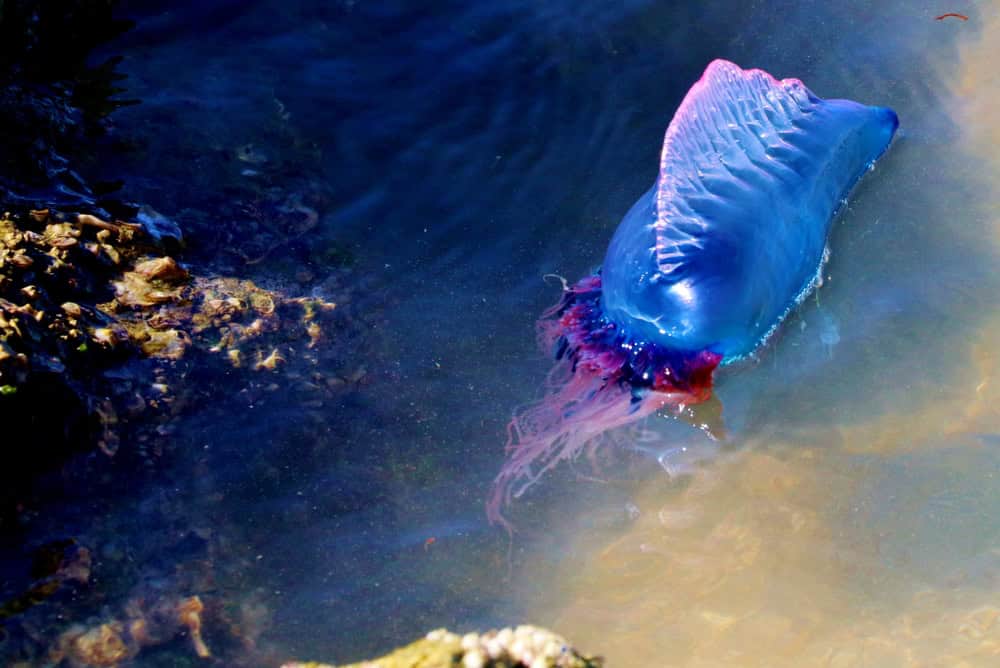
These findings can prevent unnecessary incidents of washed-up man-of-wars stinging people on beaches.
©Laurel A Egan/Shutterstock.com
The discovery of a new man-of-war species and the currents that carry it to unexpected places help scientists better understand the ocean’s changing ecosystems. As water warms, so do the currents that propel these creatures thousands of miles. Eventually, many of these man-of-wars land on beaches, where they pose a serious risk to unsuspecting beachgoers. These computer model simulations can better inform the public about where to watch out for these unassuming but often dangerous siphonophores.
Although their tentacles can reach dozens of feet in length and deliver dangerous venom to anyone who accidentally steps on them, man-of-wars are fascinating creatures that deserve further study. As researcher Ayane Totsu explained, “These jellyfish are dangerous and perhaps a bit scary to some, but also beautiful creatures that are deserving of continued research and classification efforts.”