
Quick Take
- This fish's scientific name secretly encodes two entirely different stories, one of which has nothing to do with the fish itself. Unpack the dual meaning →
- A nearly blind crustacean may be completely dependent on this paperclip-sized fish for survival, though scientists aren't sure yet. See the shrimp connection →
- Two fish can look nearly identical and still be entirely different species, and scientists used a forensic trick to prove it. See the forensic proof →
- Discovering this fish in shallow coastal waters carries an unsettling implication about how many species we've already overlooked. Explore the broader implications →
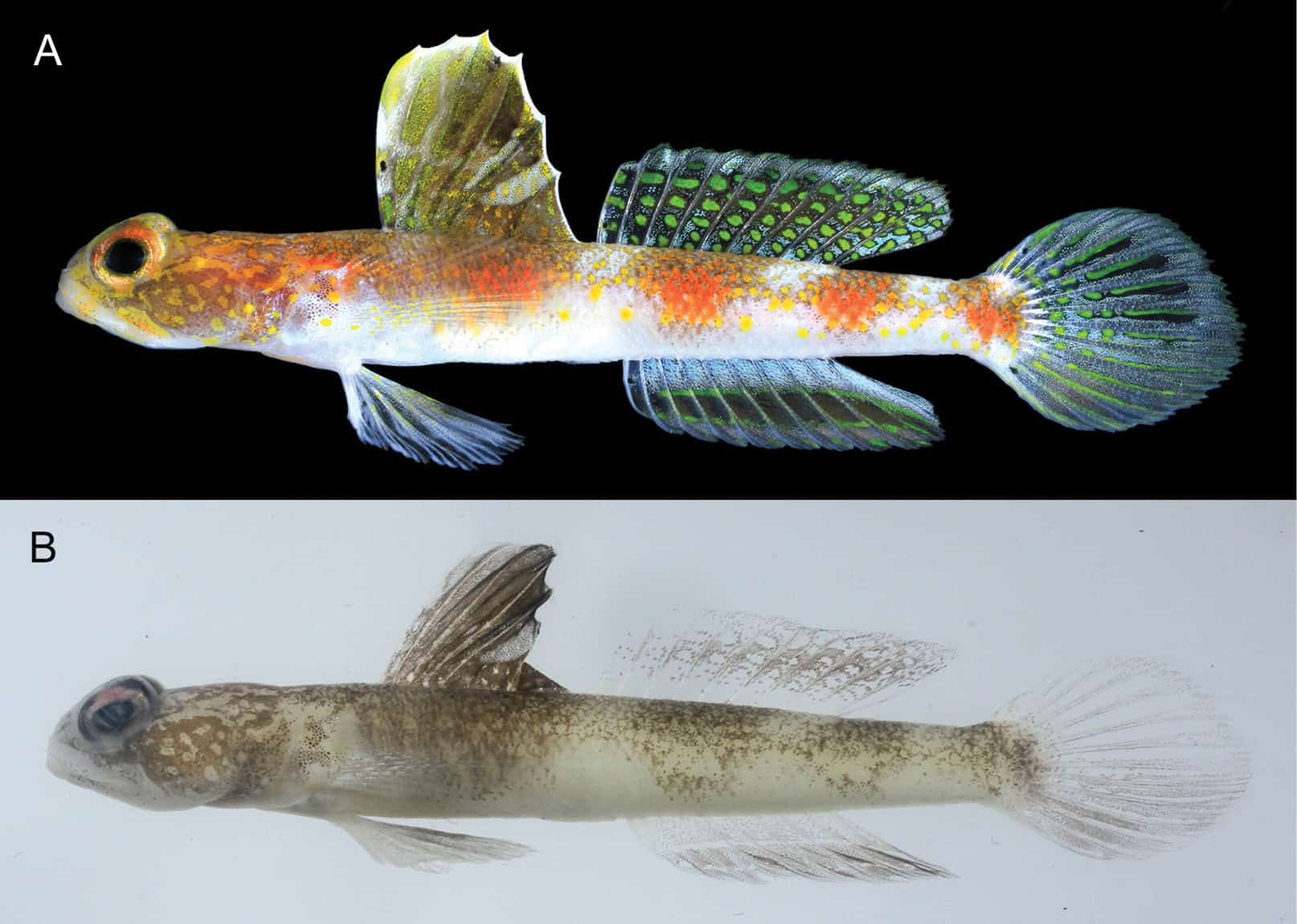
A tiny new species of shrimpgoby has been discovered off the coast of Banyuwangi in East Java, Indonesia. Two fiery orange reef fish were collected by an ornamental fish exporter in shallow waters and obtained by researchers. Named Tomiyamichthys oriens by researchers, the vivid orange-colored reef fish measures only 1.4 inches long, no bigger than a large paperclip. Its name honors both its striking colors and Banyuwangi’s nickname, “The Sunrise of Java.”
“It is always exciting to discover a species that is new to science,” said lead researcher Kunto Wibowo in a press release. “We hope this finding will inspire further exploration of Indonesia’s fish biodiversity, where many small and overlooked species are likely still awaiting discovery.”

Banyuwangi is a coastal town in Indonesia, nicknamed the Sunrise of Java.
©JG ARIF WIBOWO/Shutterstock.com
Why Is It Called Tomiyamichthys oriens?
Scientific names tell fascinating stories about where a species was found or who discovered it. Researchers often use Latin words to preserve geographic or cultural links to newly discovered species. In Tomiyamichthys oriens, oriens means “east” or “rising.” The word was chosen for the shrimpgoby’s fiery coloring and to honor Banyuwangi, where the fish was found.
Banyuwangi is located at the far eastern tip of Java. It’s the first place on the island where you can view the sunrise each day, and is often called the “Sunrise of Java.” The authors of the study also proposed the common name “Oriens Shrimpgoby.”
Tiny Fish With Surprisingly Distinctive Features
The newly discovered shrimpgoby’s standard length is about 1.4 inches, and it has striking orange blotches covering its body. The male of the species has two long filaments that trail gracefully from the first dorsal fin.
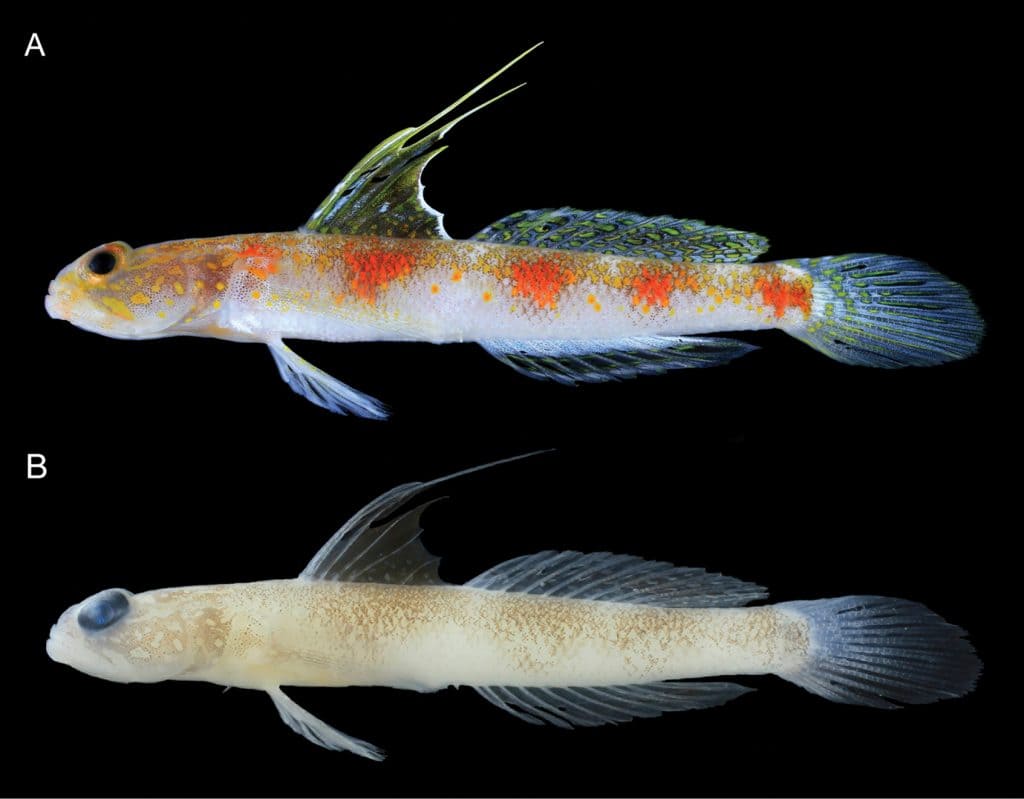
Tomiyamichthys oriens is a newly named species found in the shallow waters off the coast of East Java.
Fish in the genus Tomiyamichthys can be found throughout the tropical Indo-Pacific region. Indonesia has 13 of the 21 known species in the genus, which is more than any other country. Local fishers say they find T. oriens swimming over the sandy seabed in shallow water close to the coast.
A Fish That May Share Its Home With Shrimp
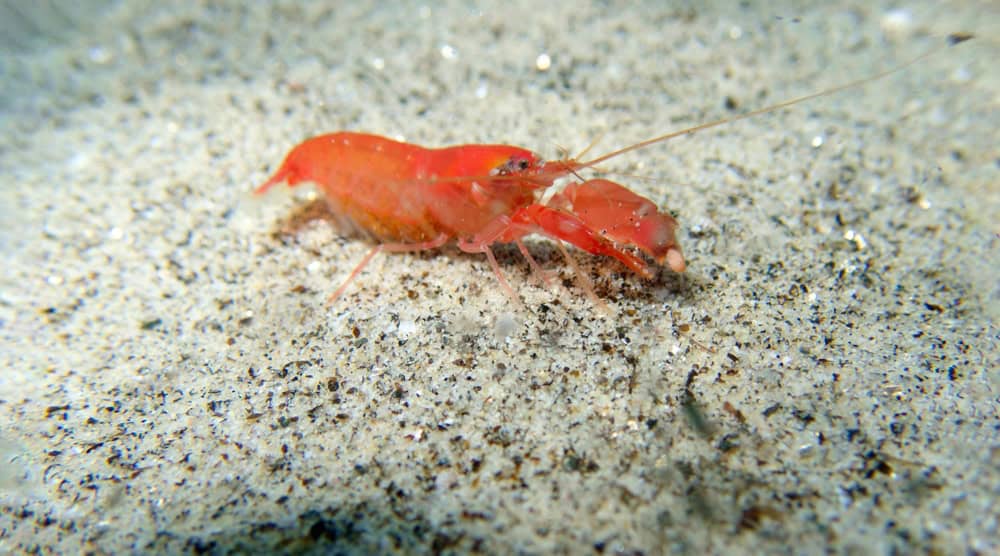
Alpheid shrimps share a mutualistic symbiotic relationship with goby fish.
©Vojce/Shutterstock.com
Tomiyamichthys are shrimp-associated gobies that swim on the sandy ocean floor near coral reefs. They live in burrows that they share with alpheid snapping shrimp. In a symbiotic relationship, the shrimp dig the burrows and maintain them. Tomiyamichthys species share the burrows and take on guard duty for the nearly blind shrimp. However, researchers have not yet confirmed if the new species shares this relationship with alpheid shrimps.
How Scientists Knew It Was a New Species
When researchers suspect they are looking at a species that was previously unknown to science, they compare physical characteristics and use genetic analysis to distinguish it from its closest known relative. Combining genetics with physical traits has become the gold standard in describing new species.
The new species’ closest known relative is Tomiyamichthys hyacinthinus, a small shrimpgoby recently described from southern Japan. Both the Japanese species and the Indonesian fish share nine segmented rays on their second dorsal and anal fins. Also, in both species, the males grow a beautiful, long pair of trailing spines. Though they are similar in appearance, researchers found differences in many physical characteristics such as scale counts, color patterns, and the number of fin rays.
In addition to physical differences, scientists compared the genetic analysis of DNA barcoding between T. oriens and other species in its genus. DNA barcoding works like comparing fingerprints by identifying species from short genetic sequences.
The authors of the study found that a mitochondrial COI gene analysis revealed approximately 3.1% genetic divergence between the new species and the Japanese species. This difference is considered substantial for closely related gobies and supported the finding that this was a previously undocumented species.
Indonesia Continues to Reveal New Marine Species
This discovery highlights Indonesia’s place in the world as one of the richest marine biodiversity hotspots. Indonesia lies in the center of the Coral Triangle, where 30% of the world’s coral reefs and 2,000 reef fish species are found. Scientists continue discovering new reef fishes through genetic analysis, underwater photography, and field collections.
The discovery of the fiery little T. oriens suggests to scientists that many other small reef fish remain undocumented, even in waters close to the coast. Reef fish can tell us a lot about the health of the ocean. Because of their small size, these fish react quickly to pollution or changes in water temperature. Learning more about the animals that live in and near coral reefs can help conservationists focus protection efforts on where it matters most.