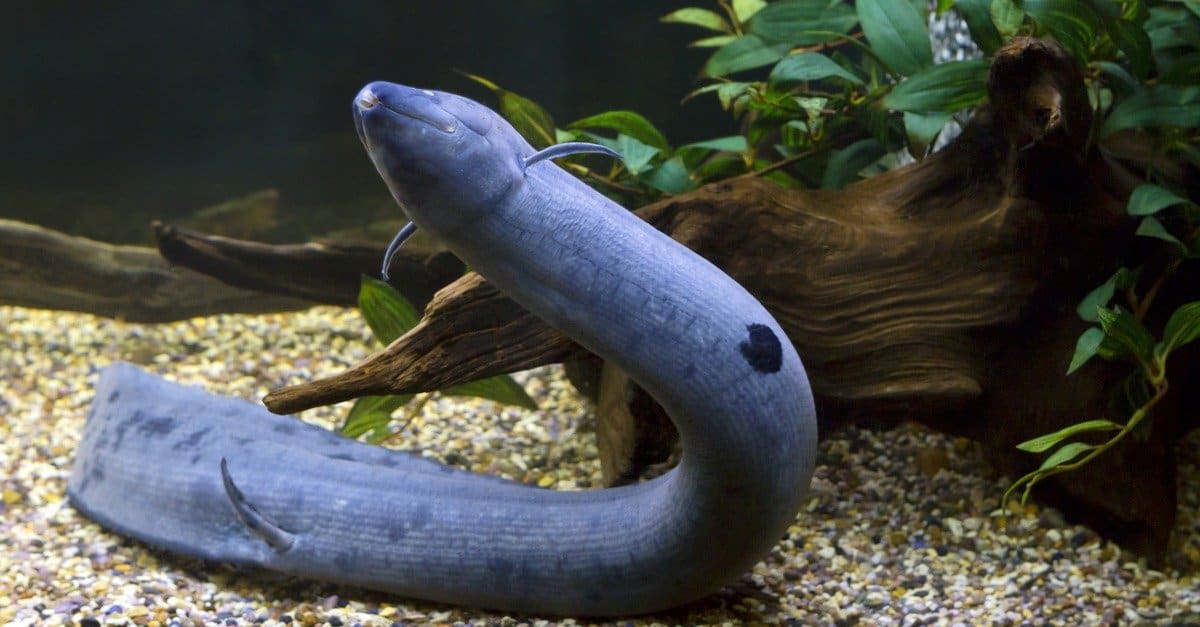

We humans like to think that we are more complex and sophisticated creatures than, for example, a fish, so it may come as a surprise to learn that there is a creature with 30 times more DNA than we have! This remarkable discovery was made by scientists at Julius Maximilians University of Würzburg. It is part of a wider study into the genomes of lungfish to better understand their evolution. Let’s explore what this finding really means.
What Is DNA?

DNA is made up of nucleotides.
©gopixa/Shutterstock.com
DNA stands for deoxyribonucleic acid. It is found in the cells of organisms and contains the instructions for them to develop, survive, and reproduce. This may sound complicated, but there are only four building blocks that make up DNA, called nucleotides. Each nucleotide consists of a sugar, a phosphate group, and a nitrogenous base. There are four different types of bases, which are adenine, cytosine, guanine, and thymine. These appear multiple times in a strand of DNA.
The exact arrangement of these bases controls which proteins are made by a cell, and it is these that determine an organism’s biological traits. The section of DNA that makes a particular protein is called a gene. The entire set of DNA instructions in a cell is called the genome. You might expect that a more complex organism would have more DNA and a larger genome, but as we are about to report, that is not the case.
The Prize for the Biggest Genome
In a paper published in the journal Nature in August 2024, scientists reported that they had sequenced the genomes of African (Protopterus annectens) and South American lungfishes (Lepidosiren paradoxa).
The paper reports that the Lepidosiren genome comprises 91 billion bases, which is 30 times as many as in the human genome! It is the largest animal genome sequenced so far. However, it only has around 20,000 genes and can therefore make about 20,000 different proteins, which is the same as humans. Therefore, they have a lot of non-coding or ‘junk’ DNA.
Repeating Stretches of DNA
Within the lungfish’s genome, there are repetitive stretches called transposable elements. These make up only 40 percent of the human genome but 90 percent of the Lepidosiren genome. This type of DNA can duplicate itself and then insert the copy back into the genome. In many species, other proteins keep this process in check, but in Lepidosiren, these proteins are missing. The downside is that this process takes a lot of energy, and the nucleus that holds the DNA must be larger. The plus side is that transposable elements can lead to new genes being created, which may be advantageous in certain conditions.
The Largest Genome on the Planet?
So, does this lungfish have the largest recorded genome on the planet? No, that award is currently held by a plant. Specifically, the New Caledonian fork fern has 160 billion base pairs in its DNA. There are also other plants, such as the Japanese shrub Paris japonica, that have enormous genomes.