
Quick Take
- Metabarcoding can process millions of DNA sequences at once, yet some common species are nearly invisible to it while others dominate so heavily that they skew the data. Explore species imbalances →
- The refuge had a known species count, but eDNA testing suggested the real number was higher than anyone realized. See the species count →
- Scientists can now detect a duck's presence in water it already left, which raises a harder question about what the DNA count actually tells you about the bird. Understand eDNA limitations →
Montezuma National Wildlife Refuge sits at the intersection of the Cayuga and Black Lakes. It’s connected by the Clyde River and surrounded by all the scenic beauty the Finger Lakes Region is known for. This also makes it the perfect place for birds to rest, make shelter, and migrate. More than 10,000 acres of habitat support roughly 100 resident bird species, while nearly 300 total species have been recorded passing through the refuge over time. Tracking them is an enormous undertaking, but lab testing might make it a little easier.
A new study published in BioRxiv reveals how scientists are now tracking migrations through environmental DNA. These minute cells left behind by birds could revolutionize our understanding of their flight patterns, and it’s all happening in Upstate New York.
How Does Metabarcoding Work?
Every living organism sheds DNA, whether it’s through hair, airborne fluids, or even skin. Anytime an organism touches something, it leaves behind microscopic fragments of itself. In the lab, this is sometimes just as good as leaving behind a fingerprint. In nature, this can be collected and is called eDNA (environmental DNA). Scientists can trace any identifiable double helix back to the species it came from. In the case of bird migrations, this is a worthy venture with a high payoff.

eDNA tells us crucial information about species that have passed through, like a genetic fingerprint.
©STEKLO/Shutterstock.com
Montezuma National Wildlife Refuge is the crossroads for many species, including the rare cerulean warbler, American white pelican, and black tern. It’s challenging to spot these birds since they’re elusive and sightings are infrequent, but a process called metabarcoding could change that.
Once eDNA has been obtained, metabarcoding starts with amplifying short DNA segments. This method is cost-effective and timely, with results coming more quickly than with standard DNA tests. Results provide a wide range of species from one area, rather than one genetic marker per species. Tests can be run on soil, water, or even air, making it highly versatile for refuges like Montezuma. At most, it can run tests on millions of DNA sequences, making it an essential tool for decoding entire ecosystems.
What Birds Were Identified?
Some of the rarest eDNA at Montezuma National Wildlife Refuge belongs to waterfowl. After testing 250 ml water samples against a control sample, the results revealed that Canada goose, wood duck, hooded merganser, mallard, and the American black duck had passed through at some point. To confirm this, scientists also used visual data to accurately match eDNA to bird sightings. The only one unconfirmed by a visual sighting was the hooded merganser. American wigeon, Northern pintail, and redheads were also identified via eDNA at the Huyck Preserve. These matches were drawn from millions of samples, underscoring the accuracy of the metabarcoding tests.
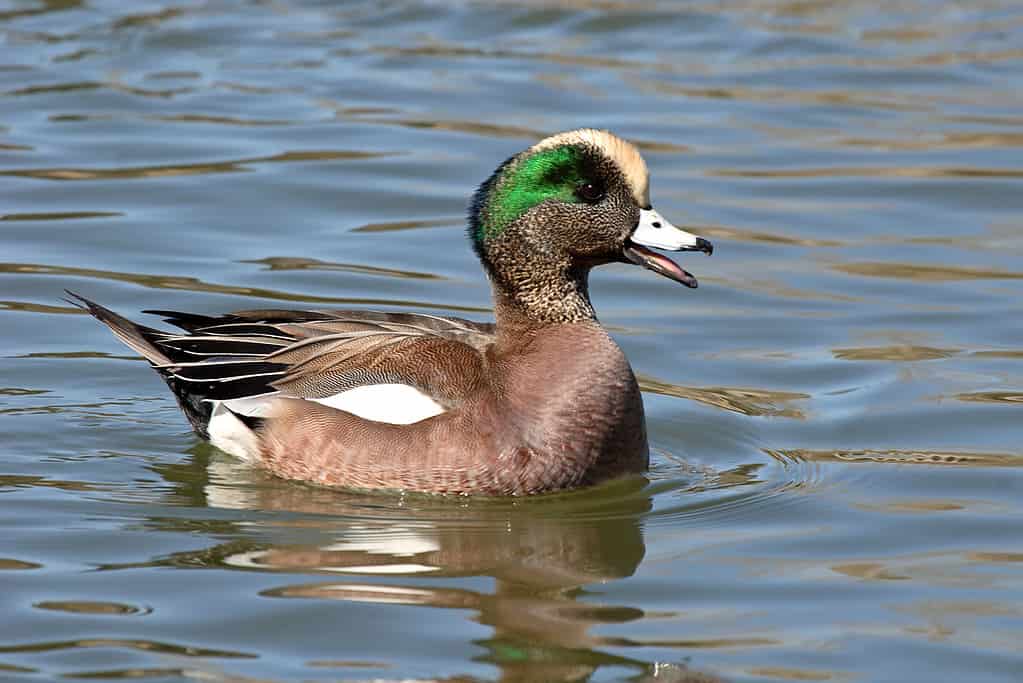
The American Wigeon (Mareca americana) is a frequent visitor to the Finger Lakes.
©iStock.com/gatito33
In total, 25 waterfowl species were identified at Montezuma National Wildlife Refuge. Some of its more common species, such as the American black duck and mallard, tundra swan, trumpeter swan, and greater and lesser scaup, were more difficult to identify. In total, 11 million samples identified 332 species among the datasets. This exceeds the estimated number of species at Montezuma National Wildlife Refuge, implying that more birds pass through than are observed.
How Does This Help Waterfowl Migration?
During eDNA testing, scientists also identified bacteria, which accounted for 72% of reads, and fish, which accounted for 20%. Depending on the primers used, the results varied except for the ND2 primer tests. These identified more Canada geese than any other waterfowl. The process is viable, but it does come with some hurdles. The biggest challenge is determining the eDNA-to-bird-species ratio, as this was woefully out of balance across species.
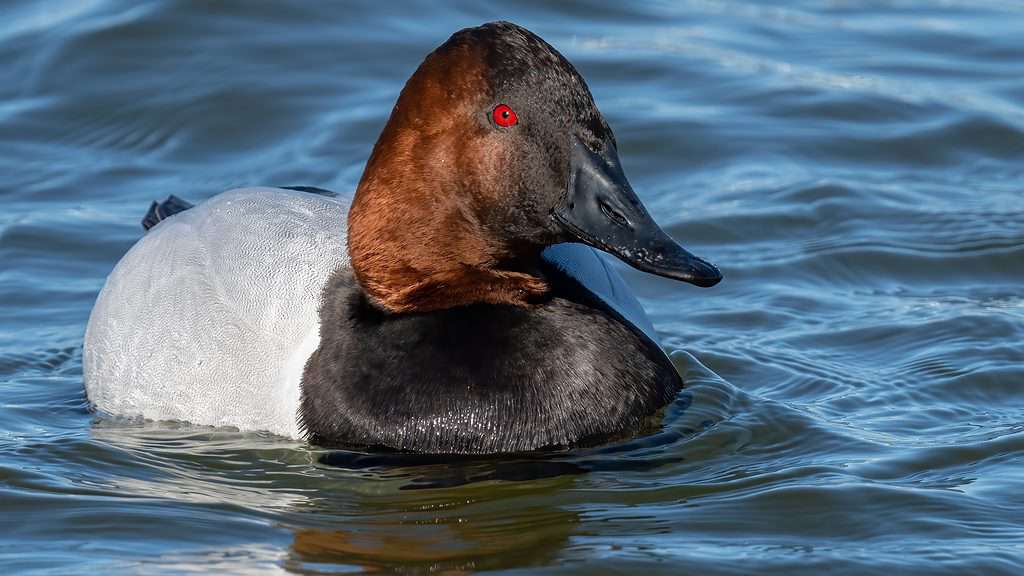
Canvasback ducks are easily identifiable by their red eyes and are commonly seen at Montezuma National Wildlife Refuge.
©Krumpelman Photography/Shutterstock.com
Of the 25 confirmed bird species identified visually, only 8 had individual correlations with their presence at Montezuma National Wildlife Refuge. Blue-winged teal, bufflehead, canvasback, green-winged teal, and wood duck were among those that were not overrepresented by the eDNA data. In comparison, the Canada goose was overrepresented, with individual counts into the thousands. Alternatively, the ring-necked duck data were underrepresented, implying there were fewer individuals than those observed.
Overall, the datasets provided crucial information on bird populations at Montezuma National Wildlife Refuge. While results varied and were not always consistent, the eDNA markers did match an accurate number of confirmed species. This provides a reliable way to track migration patterns and determine which waterfowl stop at the refuge. It also nearly eliminates any possibility a bird can be missed, because if there’s anything science confirms, it’s that DNA doesn’t lie.