
Kittens have the power to change the minds of even self-proclaimed cat haters. Their little fuzzy bodies paired with their awkward sleeping positions can make you whip out your camera and quickly fill your camera roll. The adorable suckling sounds while snoozing are even video worthy! But how do these little ones come about? Learn about cat mating and reproduction by exploring feline reproductive behavior!
Cat Mating and Reproduction
Courtship
Courtship in cats occurs in a variety of ways. Not all cats display the same behaviors, however. Some use different vocalizations to both attract mates and let them know of their availability. For example, a female who is in heat typically lets out a high-pitched call to attract any male cats in the vicinity. Another way that cats communicate during the courtship process is by scent marking.
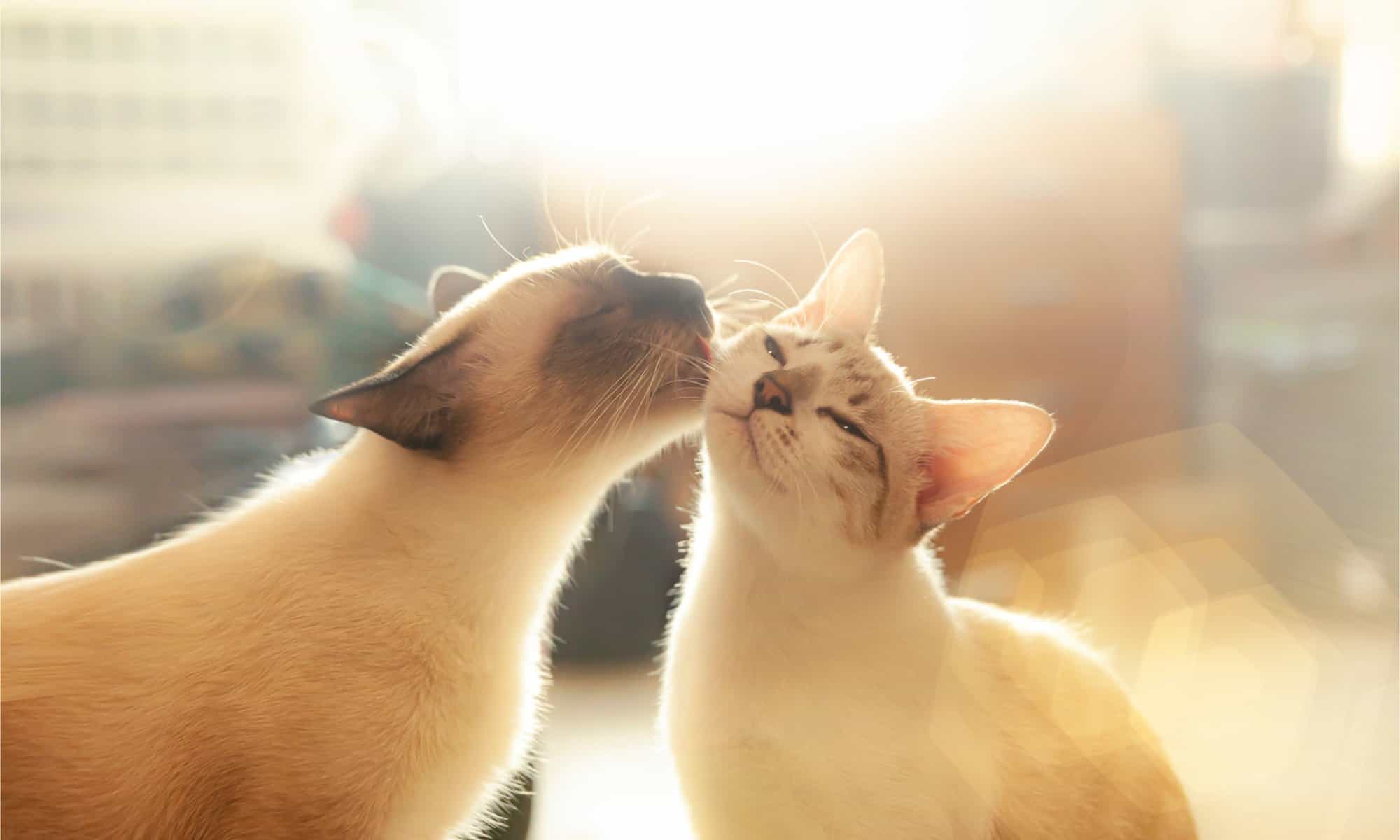
Both females and males release pheromones which are like encoded messages letting other cats know that they are available for mating. When two cats interested in mating encounter one another, they also communicate via body language. A female cat may raise her rear and a male cat may stand upright with its tail erect to signal its interest. Cats flirt, too. Sometimes play fighting is a way for them to establish a bond. They may also engage in grooming, which is also a sign of affection.
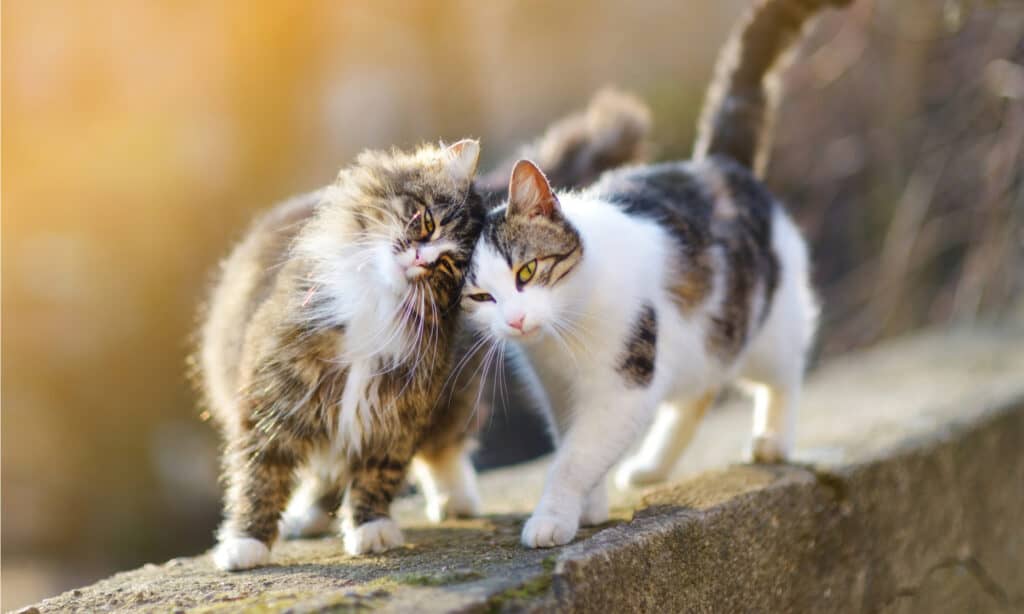
Cats flirt, too.
©MNStudio/Shutterstock.com
Mating and Conception
After the initial attraction and courtship process, the female chooses to accept a specific male. The male cat is known as the tom cat. After receiving the green light, the tom cat mounts the female cat and bites at her neck while he adjusts and enters her. As a result of copulation, the tom cat ejaculates. The act of mating does not last very long. Sometimes, it may only take a single minute. Yet while mating, something unique happens to the female. The female cat’s body begins releasing eggs so that she has a higher chance of fertilization. This process is called induced ovulation.
Female Cats in Heat
While a female cat is still in heat, she may continue mating with other tom cats. By exhibiting this behavior, which is known as polyandry, she ensures a higher chance of fertilization of the eggs she has just released. This means that a female cat may end up with a litter of kittens that has multiple fathers. After a tom cat ejaculates, the sperm finds its way to the female cat’s eggs to fertilize them. Typically, this happens within one or two days after she mates. Once fertilized, the eggs implant into her uterus. At this point, a cat is pregnant and if you’re caring for her, it’s time for a vet visit to ensure a healthy pregnancy through and through.
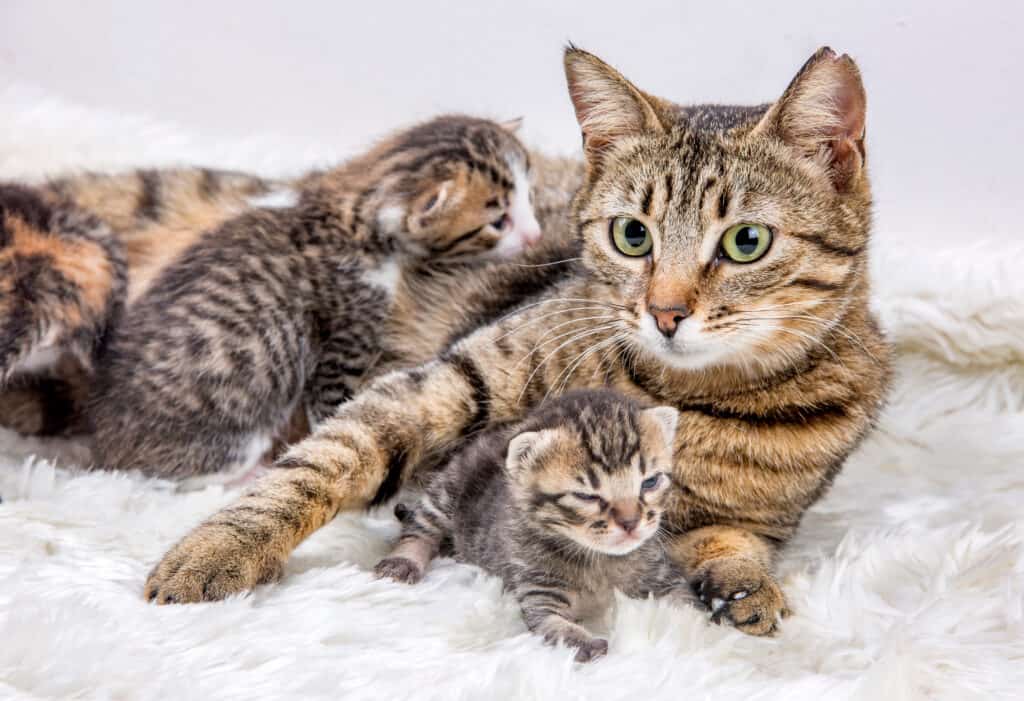
A cat’s gestation period lasts between 63 and 65 days.
©Esin Deniz/Shutterstock.com
Cat Pregnancy
During gestation, which lasts anywhere between 63 and 65 days, there are multiple phases. The early embryonic stage is when the embryos start developing rather quickly. About two weeks after a female cat’s eggs have been fertilized, the embryos are completely attached to her uterine lining. During the middle portion of her pregnancy, the mother’s kittens continue developing.
The period of mid-pregnancy lasts from 18 to 35 days. The female cat (known as the queen) keeps advancing during this gestation period, and the kittens get a bit more defined. They even develop full skeletons! During late pregnancy (which is after the 35th day), The kittens keep growing larger. The female cat’s belly is a lot bigger and if you touch her belly, you can feel the kittens moving inside. At this stage, she’s a lot hungrier because her body requires more nutrients.
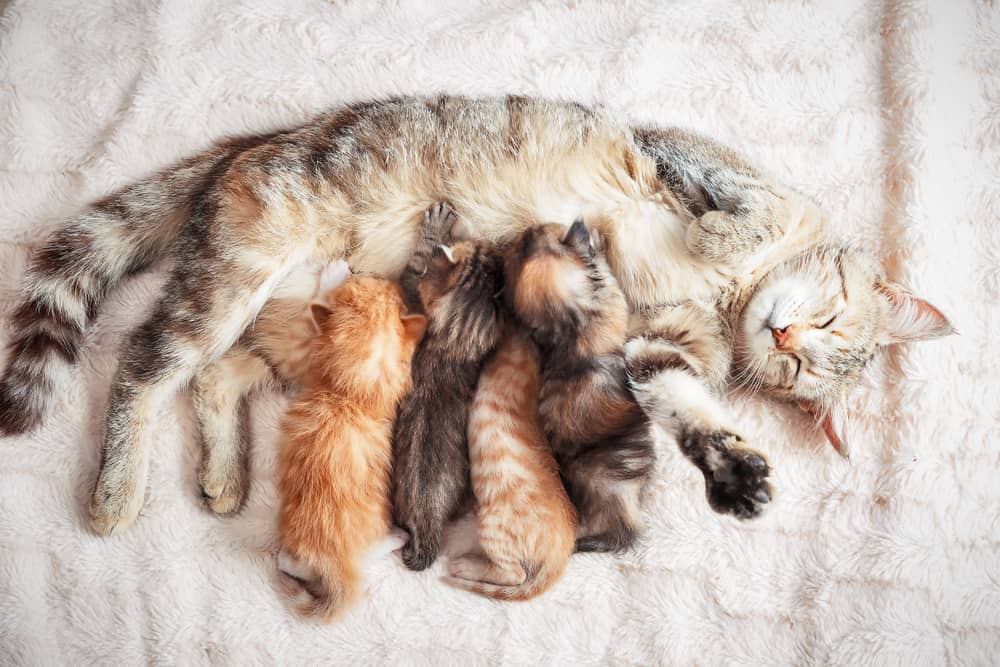
A female cat may end up with a litter of kittens that has multiple fathers.
©Rashid Valitov/Shutterstock.com
Birth
Cat mating and reproduction leads to this final stage. But just before giving birth, the queen starts preparing for labor by nesting. At this point, she’s looking for a secure and cozy environment where she can give birth to her kittens. She may be a bit more reclusive during this stage, preferring to be alone. You might find her rearranging the environment and ‘making biscuits’ (or kneading) on different surfaces. When labor finally starts, you may notice that she gets a bit restless.
The queen may continue with nesting or just walk around while she experiences contractions. During the next phase of labor, however, she starts to push to deliver her kittens. During this process, she helps break the amniotic sac of each kitten and cleans each one individually after birth. After all of her kittens have been born, she moves into full mother mode. She keeps her little ones warm, she nurses them, and she cleans them. From birth forward, she’s a full-time devoted mama.