
Louisiana is situated in the Southeast. During much of its prehistory, the state was exactly the way it is now: typically humid, swampy, and lush. Louisiana contains many biodiverse marshes, although the inland areas are much drier and are dominated by low rolling hills and low prairies.
Louisiana’s fossil records date back to the Late Cretaceous Epoch and document numerous marine creatures, including sharks and the early whale Basilosaurus, whose remains were preserved in Bienville Parish. Later in the Cenozoic, the state became coastal plain wildlife inhabited by megafauna mammals like camels and mastodons.
Sadly, no dinosaurs have ever been documented in Louisiana. It’s thought that the state’s humid subtropical climate cannot allow fossil preservation because it tends to erode rather than add to the geologic sediments where fossils accumulate. Nevertheless, Louisiana was not entirely bereft of prehistoric life. Read on to discover 6 extinct animals that lived in Louisiana.
1. The American Mastodon
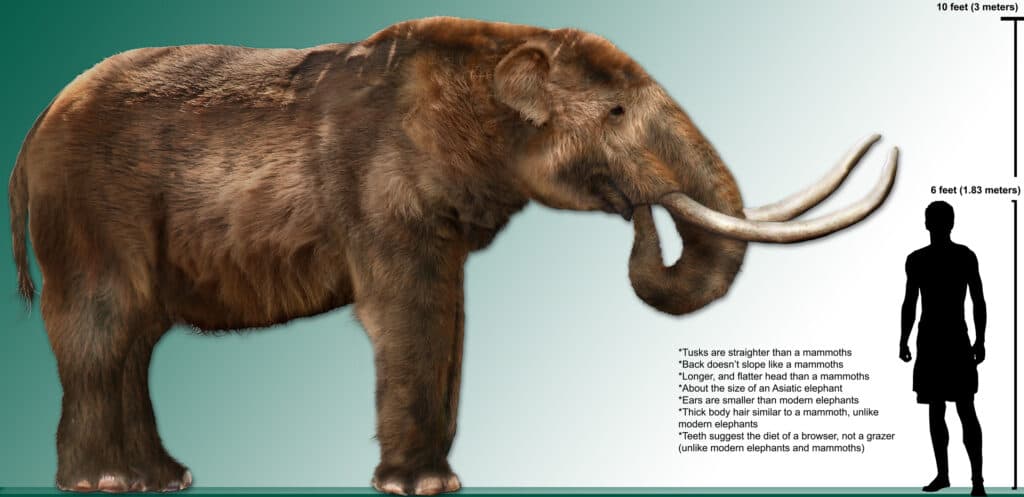
Mastodons were predominantly forest-dwelling animals.
| The American Mastodon | Scientific Name |
|---|---|
| Kingdom | Animalia |
| Phylum | Chordata |
| Class | Mammalia |
| Order | Proboscidea |
| Family | Mammutidae |
| Genus | Mammut |
| Living period | Pleistocene Epoch – 2,580,000 to 11,700 years ago |
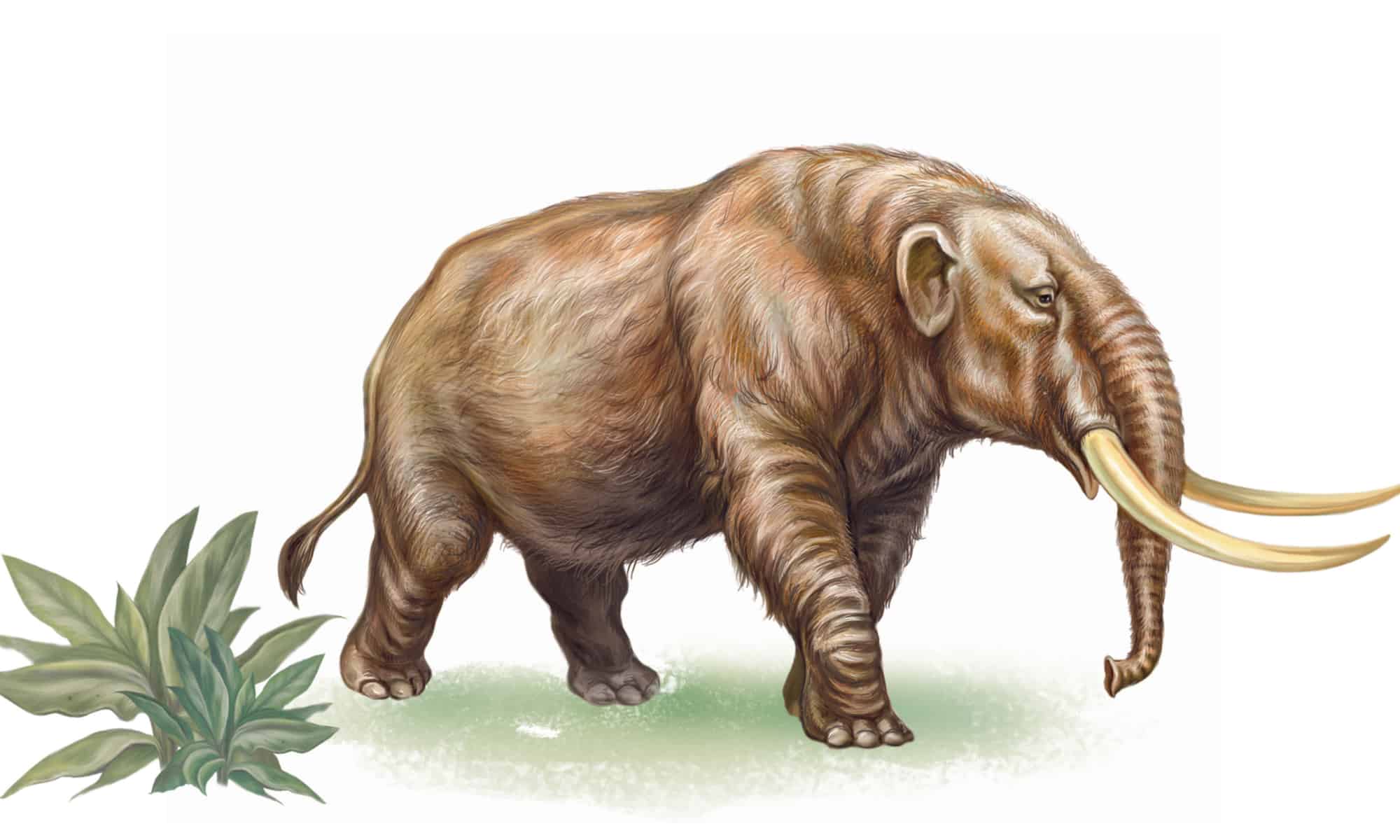
The American mastodon is an extinct member of the proboscidean that disappeared about 10,000 to 11,000 years ago due to climate change and overexploitation by Paleo-Indians. Mastodons were predominantly forest-dwelling animals, and they lived in herds.
The American mastodons were similar in appearance to mammoths and modern elephants, though not closely related to either one. Compared to mammoths, mastodons had shorter and straighter tusks that could grow up to 8 feet long. They were also more heavily muscled, with shorter legs and longer bodies. Modern reconstructions based on partial and complete skeletal remains show that mastodons were 7 to 9 feet tall and weighed approximately 8.6 to 12 tons.
Scattered American mastodon fossils were excavated on a farm in Angola, Louisiana, in the 1960s. It was the first complete plus-sized megafauna mammal ever discovered in the state. Partial mastodon remains were discovered years later within the state.
2. Hipparion
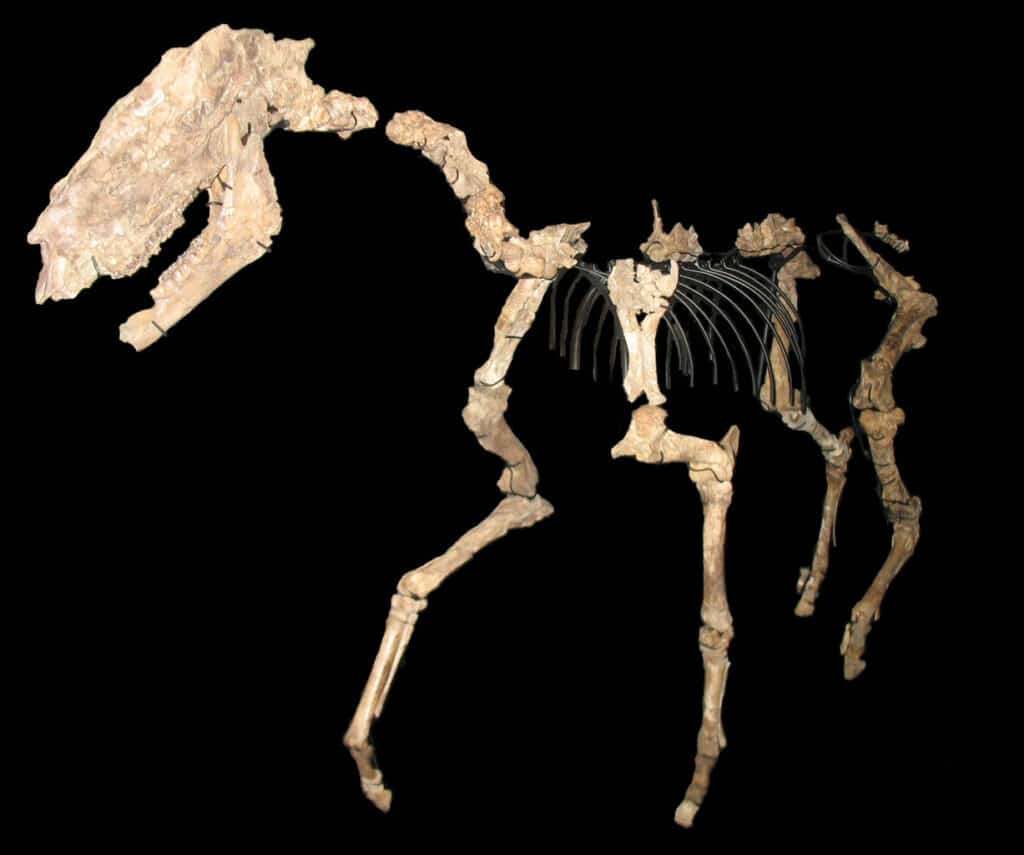
Hipparion is an extinct member of a three-toed horse directly related to the modern horse.
| Hipparion | Scientific Name |
|---|---|
| Kingdom | Animalia |
| Phylum | Chordata |
| Class | Mammalia |
| Order | Perissodactyla |
| Family | Equidae |
| Subfamily | Equinae |
| Genus | Hipparion |
| Living period | About 23 million to 781,000 years ago |
Hipparion is an extinct member of a three-toed horse, directly related to the modern horse. It inhabited North America, Africa, Asia, and Europe during the Miocene and Pleistocene periods, about 23 million years to 781,000 years ago. It was about 4.6 feet tall at the shoulder.
Hipparion fossils, along with a few other three-toed horses, including Nanohippus, Astrohippus, Neohipparion, and Cormohipparion, have been discovered in the Tunica Hills formation located in Louisiana.
3. Basilosaurus
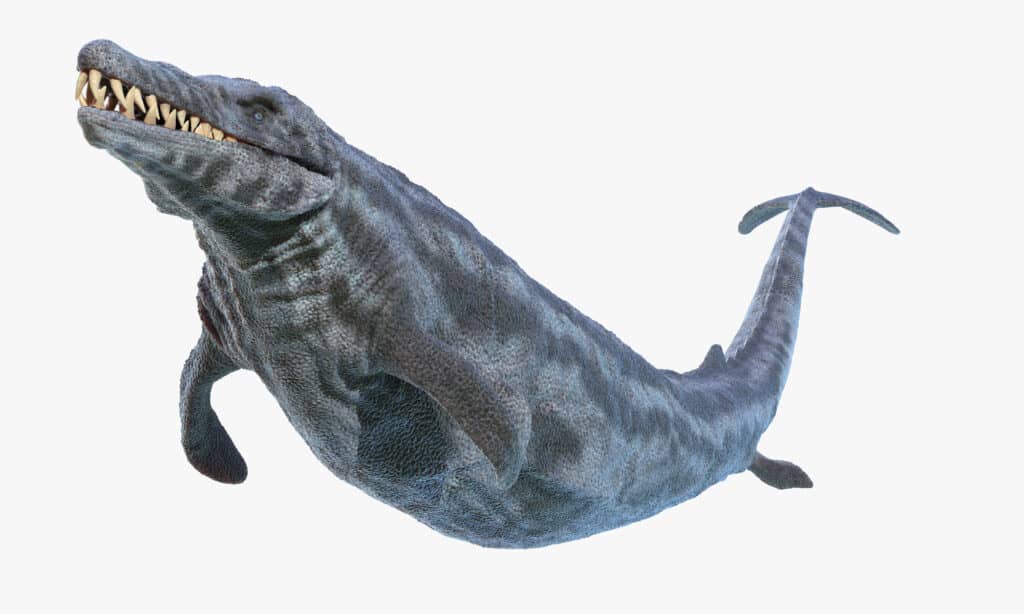
Basilosaurus had more elongated posterior thoracic, lumbar, and anterior caudal vertebrae.
©SciePro/Shutterstock.com
| Basilosaurus | Scientific Name |
|---|---|
| Kingdom | Animalia |
| Phylum | Chordata |
| Class | Mammalia |
| Order | Artiodactyla |
| Infraorder | Cetacea |
| Family | Basilosauridae |
| Subfamily | Basilosaurinae |
| Genus | Basilosaurus |
| Living period | Approximately 41.3 million years to 33.9 million years ago |
Basilosaurus was an extinct giant predatory whale that lived during the late Eocene, about 41.3 million years to 33.9 million years ago. It was the first prehistoric whale known to science. It came by the name Basilosaurus, meaning “King Lizard,” when the paleontologists assumed they were dealing with a giant marine reptile rather than a sea-going cetacean.
It’s estimated that Basilosaurus measured between 49 and 66 feet, making it one of the largest marine mammals. Compared to modern whales, Basilosaurus had more elongated posterior thoracic, lumbar, and anterior caudal vertebrae. Basilosaurus’ brain was smaller in comparison, as well.
Fossil analysis has shown that Basilosaurus had an anguilliform (eel-like) body shape to facilitate movement. It fed solely on fish and large sharks. Heavy wear on the teeth revealed that Basilosaurus chewed the food and then swallowed.
The remains of the prehistoric Basilosaurus have been excavated all over the deep south. It’s thought that its extinction may have coincided with the Eocene-Oligocene extinction event about 33.9 million years ago due to sudden climate change, meteor impacts, and volcanic activity, which might have caused changes in the ocean by disrupting oceanic circulation. Unfortunately, Basilosaurus went extinct without leaving behind any descendants.
4. Glyptodon
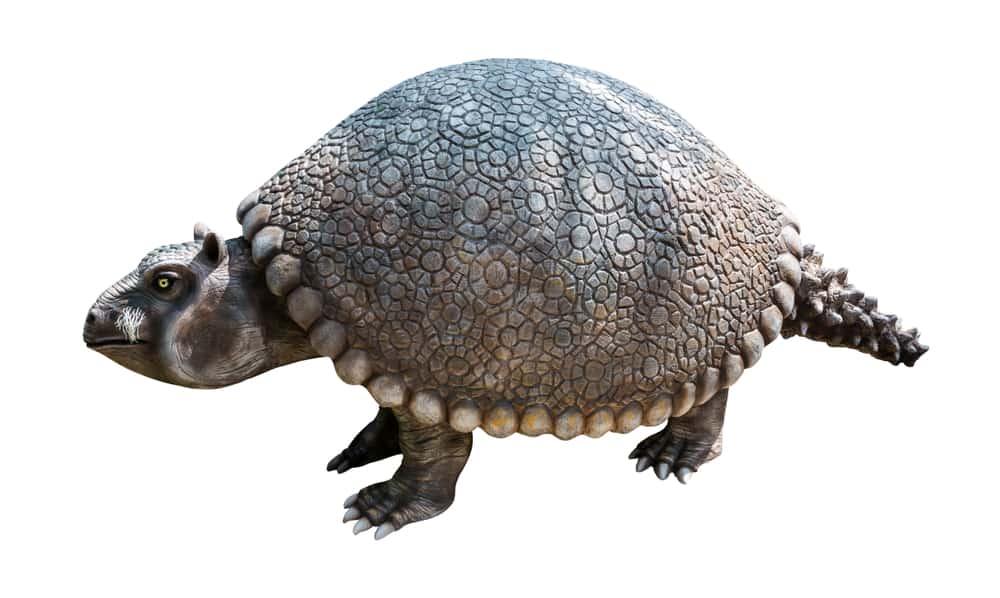
Glyptodon’s habitat ranged from forested and sub-forested areas to warm and humid areas.
©YuRi Photolife/Shutterstock.com
| Glyptodon | Scientific Name |
|---|---|
| Kingdom | Animalia |
| Phylum | Chordata |
| Class | Mammalia |
| Order | Cingulata |
| Family | Chlamyphoridae |
| Subfamily | Glyptodontinae |
| Genus | Glyptodon |
| Living period | From the Pleistocene to the Early Holocene, about 2.5 million years to 11,000 years ago |
Glyptodon is an extinct species of herbivorous armadillo that lived during the Pleistocene until its disappearance in the Early Holocene. It was approximately the same size as a Volkswagen Beetle, weighing about 1,760 to 1,850 pounds, but superficially resembled a turtle due to its rounded, bony shell and squat limbs.
Glyptodon’s habitat ranged from forested and sub-forested areas to warm and humid areas, though some were accustomed to cold grassland areas. The larger glyptodonts were bulky feeders, while the smaller ones were selective feeders. That explains why the larger post-Miocene glyptodonts had wider muzzles, and the smaller-sized glyptodonts had narrower muzzles.
5. Coryphodon
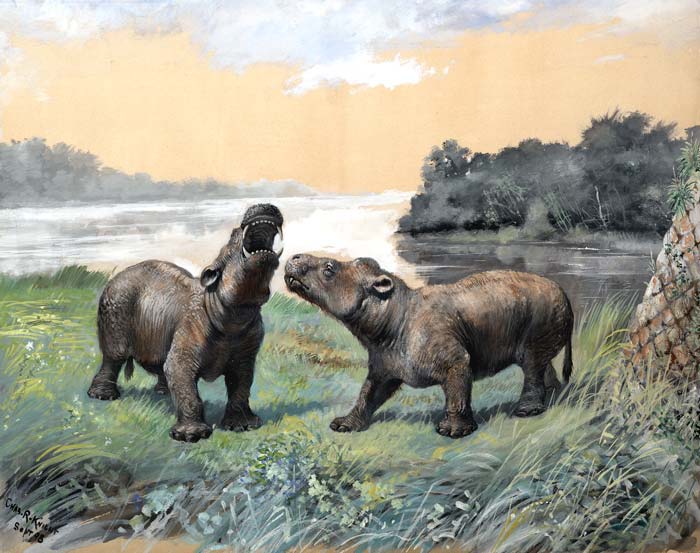
Coryphodon measured approximately 3.3 feet tall at the shoulder and about 8.2 feet in body length.
| Coryphodon | Scientific Name |
|---|---|
| Kingdom | Animalia |
| Phylum | Chordata |
| Class | Mammalia |
| Order | Cimolesta |
| Family | Coryphodontidae |
| Genus | Coryphodon |
| Living period | Late Paleocene to Early Eocene |
The Coryphodon is among the world’s first group of large browsing mammals that went extinct many years ago. It was a semiaquatic animal, living in swamps and marshes like a hippopotamus. It had powerful neck muscles and short tusks, presumed to have been used in uprooting swamp plants. Its teeth were also well adapted for processing plants.
Based on fossil analysis, the Coryphodon measured approximately 3.3 feet tall at the shoulder and about 8.2 feet in body length. It had long upper limbs and short lower limbs, which slowed its movement. Its body mass varied between 750 and 1,300 pounds. The Coryphodon possessed a brain weighing just 3.2 oz, probably one of the most miniature brains of any mammal, whether living or extinct.
Summary of 6 Extinct Animals That Lived in Louisiana
| Rank | Animal |
|---|---|
| 1 | The American Mastodon |
| 2 | Hipparion |
| 3 | Basilosaurus |
| 4 | Glyptodon |
| 5 | Coryphodon |