
Quick Take
- A broken jaw should end a bear's chances at winning a gorging contest, but last year's Fat Bear Week champion managed to pull it off anyway. Meet the injured champion →
- Bears lose a shocking fraction of their body weight every winter, and the only way they survive is by doing something that sounds gloriously unhealthy. See how bears survive winter →
- What looks like a fun internet voting contest is actually a 'dirty trick,' and the man who helped build it is surprisingly candid about why. Discover the strategy behind it →
- Millions of viewers watch the same bears at Brooks River every year, and it turns out those individual bears have personalities as distinct as people in a crowded room. Explore bear personalities →
Every summer through early fall, a quiet corner of southwest Alaska becomes the center of a global phenomenon. Hundreds of thousands of fans glue themselves to screens, eagerly tracking the dramatic physical transformations of some of the largest wild animals on the planet.
Welcome to Katmai National Park and Preserve and the viral sensation known as Fat Bear Week.
To understand why a simple internet tournament celebrating chubby brown bears has captured hearts around the world, we sat down with Mike Fitz. A former National Park Service Ranger at Katmai, Fitz now serves as the resident naturalist for explore.org, the world’s largest live-nature cam network. He literally wrote the book on these majestic animals, The Bears of Brooks Falls: Wildlife and Survival on Alaska’s Brooks River.
Finding a Calling in the Wild
Fitz’s journey to becoming one of the world’s most recognizable bear advocates wasn’t mapped out from the start. “I went to community college, and I didn’t quite know what to do,” Fitz recalls. “I just kind of knew that I should continue school. I understood that I wanted to do something outside or associated with the outdoors at least.” After taking a few parks and recreation classes, he landed internships that eventually led him to Alaska in 2007.
Stepping into Katmai for the first time was a life-altering moment. “The scale of the wildness throughout much of Alaska … was orders of magnitude greater than anything I’d experienced elsewhere,” says Fitz. “When you’re flying over a landscape where you don’t see roads for hours, it’s something else.”
Getting to Know the Bears of Katmai
It was on the banks of Katmai’s Brooks River that he fell in love with brown bears. Katmai is home to roughly 2,200 brown bears, supported by an abundance of wild sockeye salmon. Because the fish return to predictable locations every summer, the same bears return year after year.
That predictability allows human observers to get to know them as individuals. “You look at a brown bear at first and you’re like, ‘That’s just a bear, right?'” Fitz laughs. “But if you pay attention to the details, it’s like going into a room full of people. Everyone is very different in their mannerisms and their physical appearance. It’s the same with brown bears.”
Today, as explore.org’s resident naturalist, Fitz helps translate what millions of viewers see on the park’s famous webcams. While the cameras capture everything from bald eagles to African watering holes, the Brooks Falls bear cam reigns supreme, drawing tens of millions of views every season between June and October.
When you’re flying over a landscape where you don’t see roads for hours, it’s something else.
Mike Fitz, resident naturalist at explore.org
The Feasting Season
Watching the live streams reveals a constantly evolving wilderness drama. Early in the summer, skinny, hungry bears return to the river and sort out their social hierarchy. Young bears test their strength against elders, mothers guard their cubs, and males compete during the mating season.
By late summer, the focus shifts entirely to food. A brown bear’s survival depends on it. Hibernation, after all, is a months-long period of active starvation.
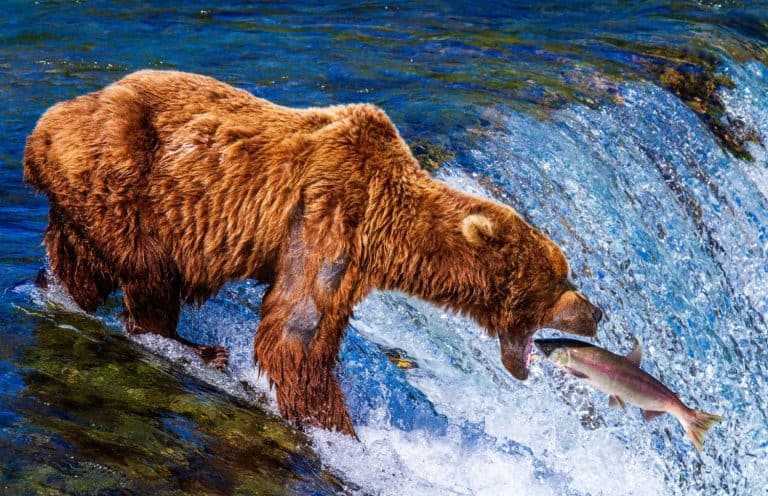
“Bears lose a third of their body weight in hibernation,” Fitz explains. “Body fat is the fuel that allows them to survive. When they come back in early summer, they’re at their skinniest point of the year. When we last see them in October, they’re at their fattest point.” A large adult male can pack on several hundred pounds of fat in just a few months, gorging on salmon at Brooks Falls, where fish sometimes jump directly into their open mouths.
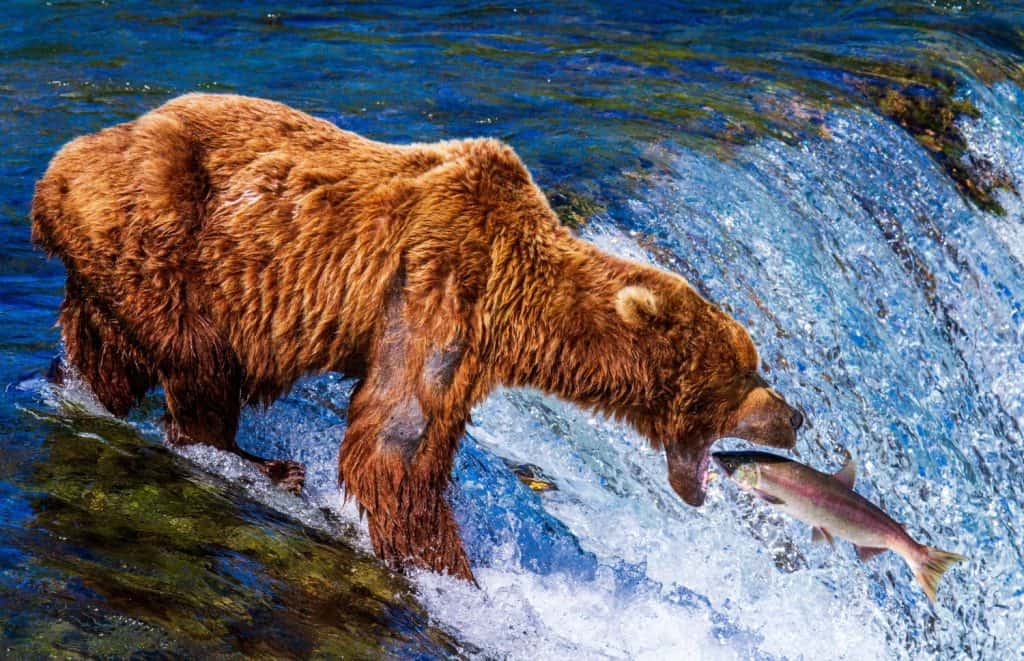
The bears are remarkably thin at the beginning of salmon spawning season. Here, a sockeye meets its fate.
©Patrick Sneed/Shutterstock.com
Resilience in the Face of Nature
Living alongside wild bears also means witnessing the raw, unedited realities of nature. Life on the river is tough, and survival requires immense resilience.
Fitz points to dramatic stories from the river, like a male bear (and last year’s Fat Bear Week champion) named Chunk who managed to gain massive amounts of weight despite a broken jaw, or a young cub that recently spent a painful week limping with porcupine quills stuck in its paw.
While viewers often feel an intense urge to help, Katmai operates under a strict let-nature-take-its-course policy. Park rangers do not provide veterinary care for natural injuries. “Giving the bears the space to be wild really helps us understand just how varied they are in their individuality, their toughness, and the different ways that they make a living,” Fitz explains. “Usually it’s best just to give bears the opportunity to demonstrate their own resilience and heal on their own.”

Fans vote on the fattest bear. Last year, “Chunk” brought in the gold.
Celebrating the Champs
That resilience is precisely what Fat Bear Week celebrates.
What started as a modest single-day event organized by park staff has exploded into a week-long online bracket tournament. Viewers look at before-and-after photos, read up on each bear’s season history, and vote for the animal that best exemplifies the ultimate survival strategy: getting gloriously, unapologetically fat.
“Fat Bear Week is a celebration of the success of brown bears at Brooks River,” Fitz says. “It’s also a fun way — and really kind of just a dirty trick — to get people to think about why bears get fat to survive and how they get fat to survive in the ecosystem that supports their survival.”
Ultimately, Fitz hopes that the joy of watching bears catch salmon on a live stream sparks a deeper commitment to wildlife conservation. “If people learn to fall in love with a bear at Katmai National Park,” he says, “then they’re going to want to protect that bear’s home as well.”
Whether you are a seasoned bear-cam veteran or a first-time viewer, tune into explore.org to watch the action live, and be sure to cast your votes during Fat Bear Week, taking place September 22-29, 2026. And check out the complete interview with Explore.org’s Mike Fitz here.