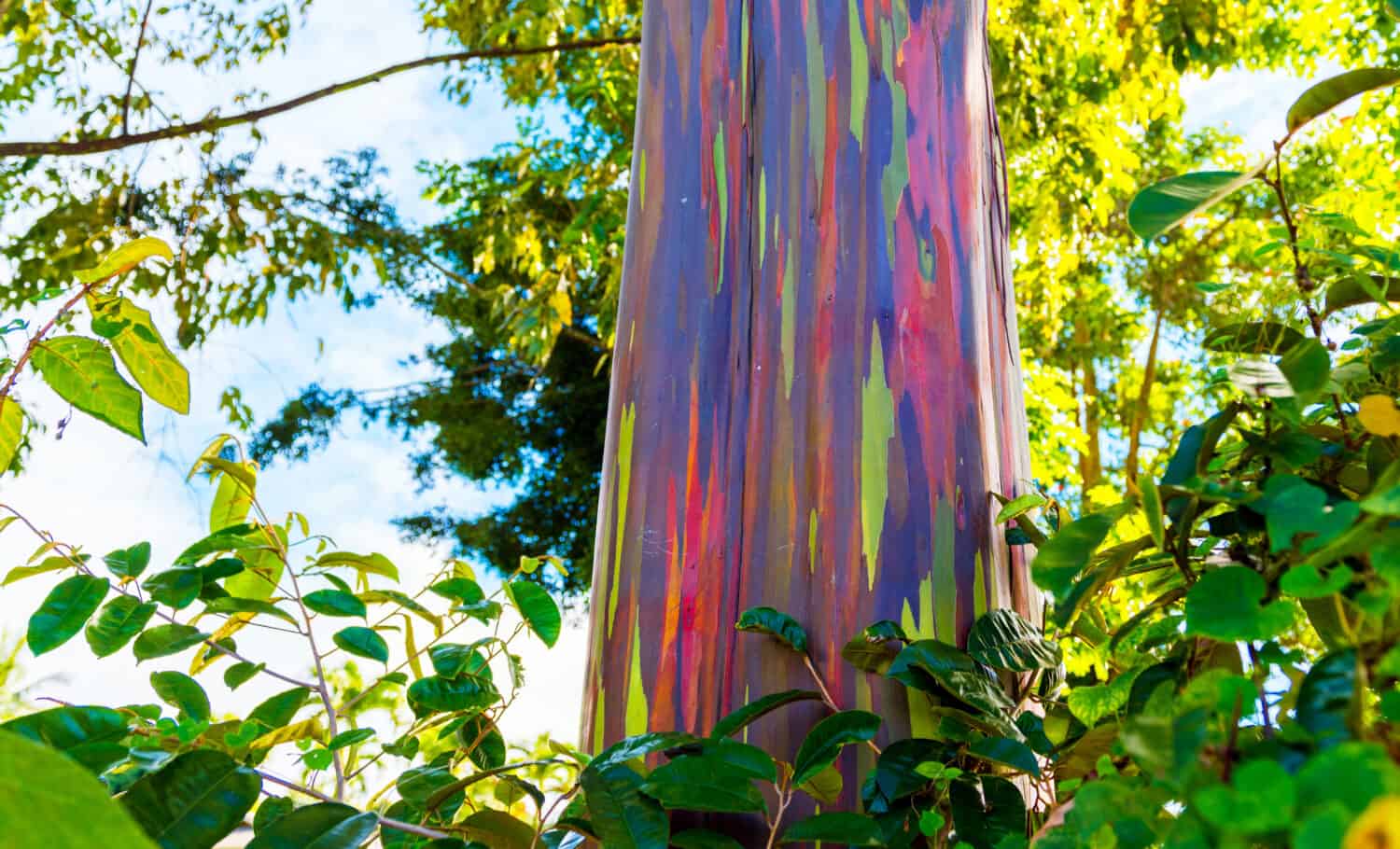

If someone told you that the world’s most colorful tree earned its title for its bark and not its flowers or leaves, would you believe them? If you didn’t, you’d be wrong.
The photos you’ve seen on the internet of the rainbow eucalyptus aren’t entirely doctored — it does have rainbow-colored bark. But how is that possible? What causes such drastic color variation?
In this article, we’ll take a look at just how this unique tree produces such colorful bark. We’ll also talk about where it grows naturally, how it grows, and whether you can grow your very own rainbow eucalyptus.
About the World’s Most Colorful Tree
The rainbow eucalyptus is truly an all-around impressive species. Let’s take a look at what makes this beautiful tree so special.
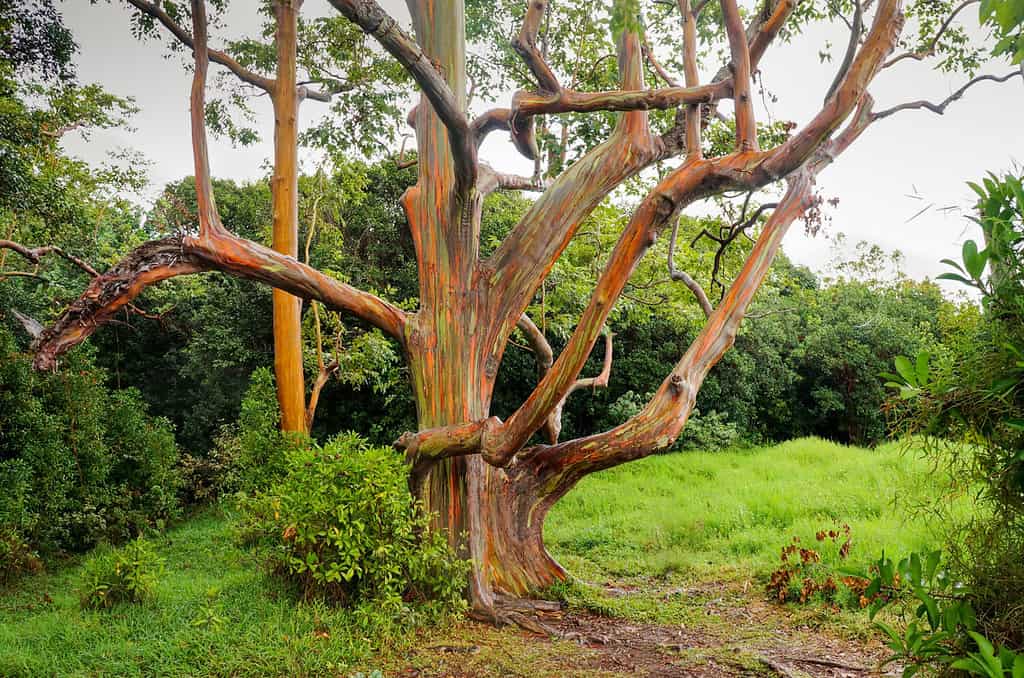
A rainbow eucalyptus in a landscape setting. In tropical areas, these trees produce incredible shade canopies with figures resembling those of live oaks.
©Ilya Images/Shutterstock.com
How and Where Does It Grow?
The rainbow eucalyptus (Eucalyptus deglupta) is native to a small range of the globe, appearing in the wild in the Phillippines, Indonesia, and Papua New Guinea. It is unique for a eucalyptus species in that it is the only member of its genus with a native range that extends into the northern hemisphere. The vast majority of eucalyptus species reside in Australia.
In its native rainforest habitat, the rainbow eucalyptus can grow to towering heights of around 250 feet. Consider this alongside its 100-foot average canopy spread and an impressive maximum trunk diameter of 6 feet and you’ve got quite the behemoth. You might expect that it would take many years for these trees to reach such incredible sizes. However, with a vertical growth rate that can exceed 5 feet per year in ideal conditions, you’d be surprised.
Like other eucalyptus species, the rainbow eucalyptus produces an abundance of lance-shaped leaves that taper to a point. When crushed, they release the characteristic aroma of a eucalyptus tree. At various times of the year, depending on where they are growing, these trees produce many tiny, white, or off-white flowers in loosely clustered umbels.
While its beautiful flowers, scented leaves, and impressive stature are all important aspects of the species, they didn’t earn this tree its esteemed title. The most colorful tree in the world is most famous for its rainbow-striped bark.
What Makes It So Colorful?
The bark of the rainbow eucalyptus is so colorful for a combination of reasons. While some trees create thick layers of outer bark, this one sheds its outer bark in uneven strips throughout the summer. As the thin outer bark peels away, it exposes the tree’s bright green inner bark.
This bright green doesn’t last, however. As the tissue beneath the outer layer of bark comes into contact with the air, it begins to oxidize, causing it to turn various shades of red, orange, gray, purple, and brown. The uneven rate at which the tree peels causes the rainbow-striping effect. Because each strip of bark is exposed to the air for different lengths of time, they change colors at different rates. Over time, as the new outer bark ages, the tree returns to its usual orange-brown color until it begins to shed again.
For such a colorful tree, one of its most common reasons for cultivation adds another line to this tree’s list of surprises. The rainbow eucalyptus serves as a primary source of pulpwood in the Phillippines, where it is grown on plantations. This pulpwood, after processing, frequently goes on to become plain, white paper.
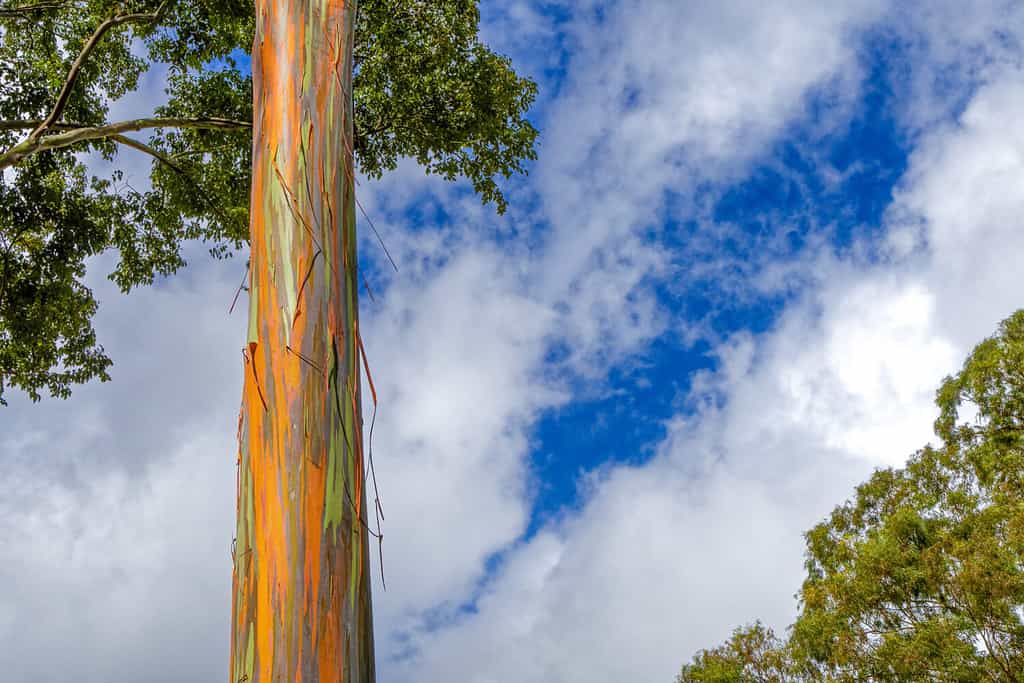
The rainbow eucalyptus above is in the process of shedding its outer bark. As the exposed inner bark oxidizes, the tree will eventually return to its usual orange-brown color.
©Guy Banville/Shutterstock.com
Can I Grow My Own Rainbow Eucalyptus?
If you want to grow the most colorful tree in the world, you had better live in a very warm place. Because they grow in tropical and subtropical rainforest environments, these trees do not tolerate frost. They are generally hardy only in USDA zones 10 and 11.
Rainbow eucalyptus trees fare well in southern and central Florida, southern Texas, and parts of California. The color of the bark is usually less vivid in these locales, however, and trees will usually only reach about 100 feet in height at maturity. Further south, in the island climate of Hawai’i, the rainbow eucalyptus may reach its full potential in terms of height and coloration.
If you’re thinking about planting your rainbow eucalyptus, consider that these trees pose a high invasion risk in some locations. Because they are such fast growers, produce viable seeds, and grow readily on infertile soils, the chance for uncontrolled growth in these locations is strong.