
Quick Take
- One species on this list breaks a fundamental rule of bird biology in that the males have shorter tails than the females. Green hermit's reversed tails →
- One of these hummingbirds looks completely black at first glance, but that changes once light hits it. Velvet-purple coronet's iridescence →
- One high-altitude species ditched the signature hummingbird hover altogether and evolved a completely different feeding strategy to survive. Hillstar's clinging feeding style →
- The most ferociously territorial bird on this list weighs less than four paperclips. Ruby-topaz's fierce territoriality →
Hummingbirds (family Trochilidae) are tiny birds with iridescent plumage and the ability to hover and fly in any direction, while beating their wings up to 80 times per second. There are over 360 recognized species of hummingbirds, making them one of the largest bird families in the world. The vast majority of species are found in Central and South America, with nearly half living within the equatorial belt. Sizes range from the petite bee hummingbird found in Cuba (Mellisuga helenae) to the giant hummingbird (Patagona gigas) found in the Andes. Farther from the equator, there is less diversity, with fewer than two dozen species regularly venturing into the United States and Canada, and only a handful that breed or reside there permanently. Continue reading to discover some of the beautiful hummingbirds that live close to the equator.
Rufous-Breasted Hermit
The rufous-breasted hermit (Glaucis hirsutus) is a relatively large hummingbird, measuring 4-4.5 inches in length and weighing approximately 0.25 ounces. Its plumage consists of bronze-green upperparts, a dark facial mask with pale streaks around the eyes, and a rich, reddish-brown (rufous) throat, breast, and belly.
Highly selective in its diet, this hummingbird primarily consumes nectar from specific tubular understory flowers, such as Heliconia. It supplements this specialized nectar diet by foraging for small invertebrates like spiders gleaned directly from foliage and spiderwebs.
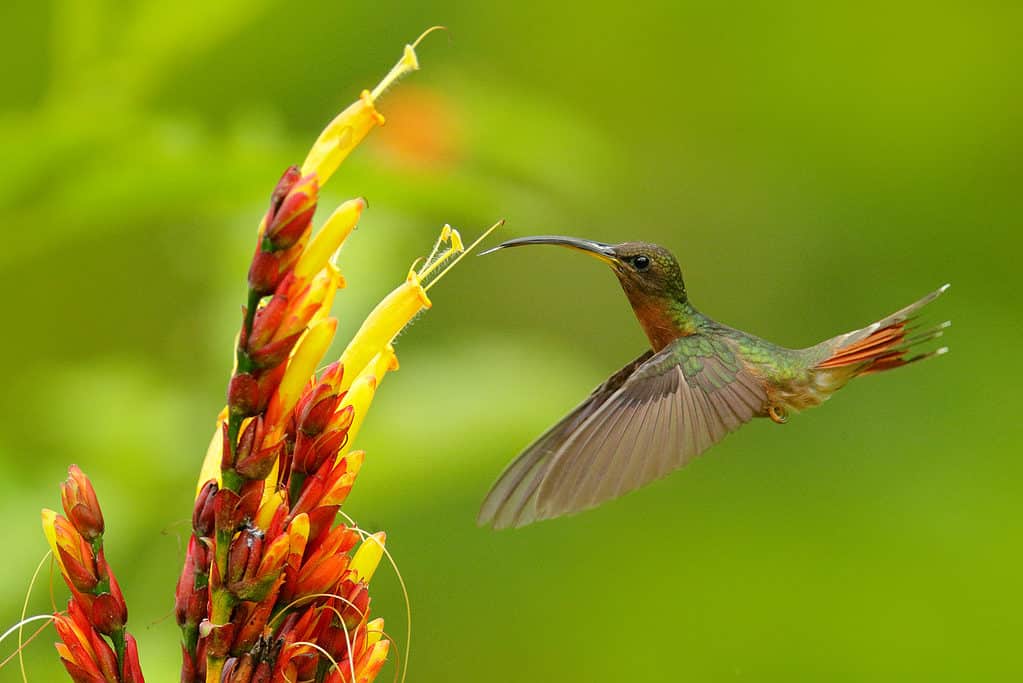
The rufous-breasted hermit is widely distributed from Panama south through much of South America, including Trinidad, Tobago, Grenada, Venezuela, the Guianas, Ecuador, Colombia, Peru, Bolivia, and Brazil.
©Ondrej Prosicky/Shutterstock.com
Marvellous Spatuletail
The marvelous spatuletail (Loddigesia mirabilis) is a near-threatened hummingbird found only in the Utcubamba River Valley in Northern Peru.
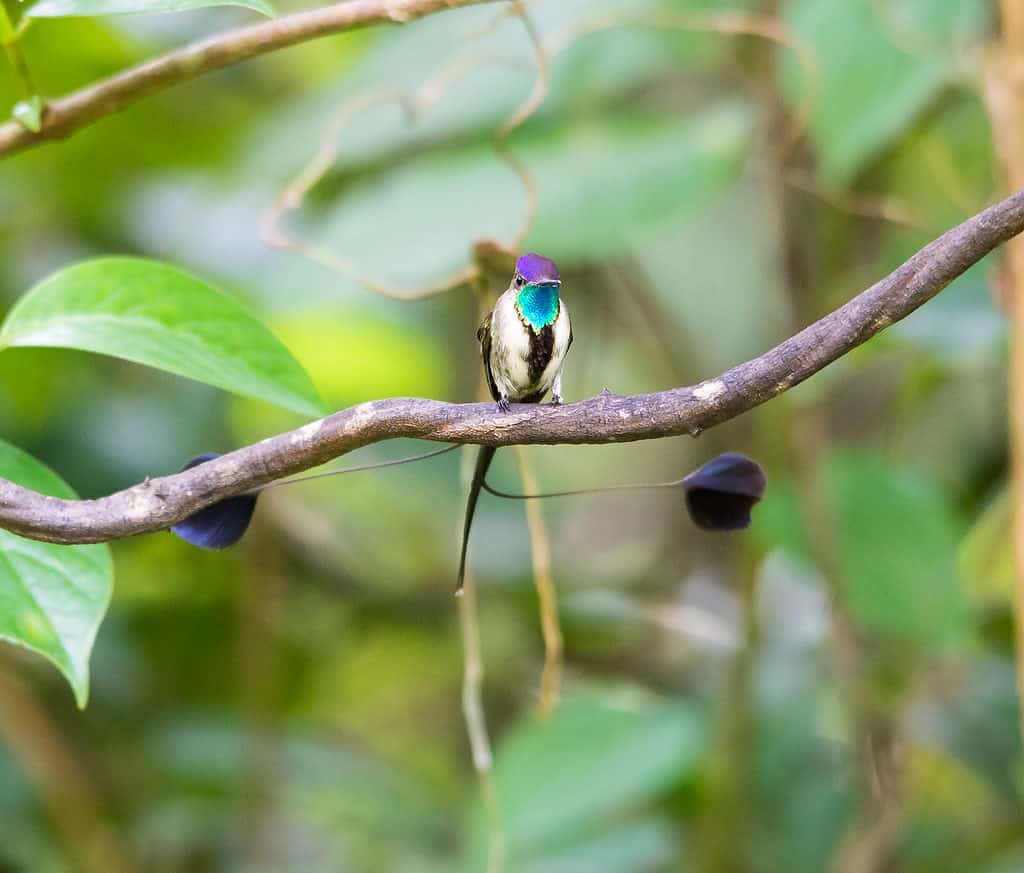
Only male marvelous spatuletails have the eponymous tail.
©Jorge Yamamoto/Shutterstock.com
This tiny bird weighs a mere 0.1 ounce. Females measure about 3.5 to 4 inches in total length, while adult males reach 6 to 7 inches long because of their extraordinary, elongated tail feathers. Both sexes of the marvelous spatuletail have green upperparts and a black bill, but the male is distinguished by a blue crown and an iridescent turquoise throat.
Specialized in its foraging habits, the marvelous spatuletail’s diet relies heavily on the nectar of native flowering plants, which it supplements by catching tiny insects and spiders for vital protein.
White-booted Racket-tail
The white-booted racket-tail (Ocreatus underwoodii ) is a striking hummingbird found in the South American Andes across Venezuela, Colombia, and Northern Ecuador. These birds are exceptionally lightweight, typically weighing a mere 0.09 to 0.11 ounces.
Due to distinct sexual dimorphism, females are much smaller, measuring 3 to 3.5 inches long, while adult males are between 4.3 and 5.9 inches in length because of their elongated outer tail feathers, which have large, purplish-black paddle-shaped discs, or rackets, at the ends.
Both sexes feature shimmering iridescent green upperparts, a short straight black bill, and the puffy, cotton-ball-like tufts of feathers on their legs, from which they get their name.
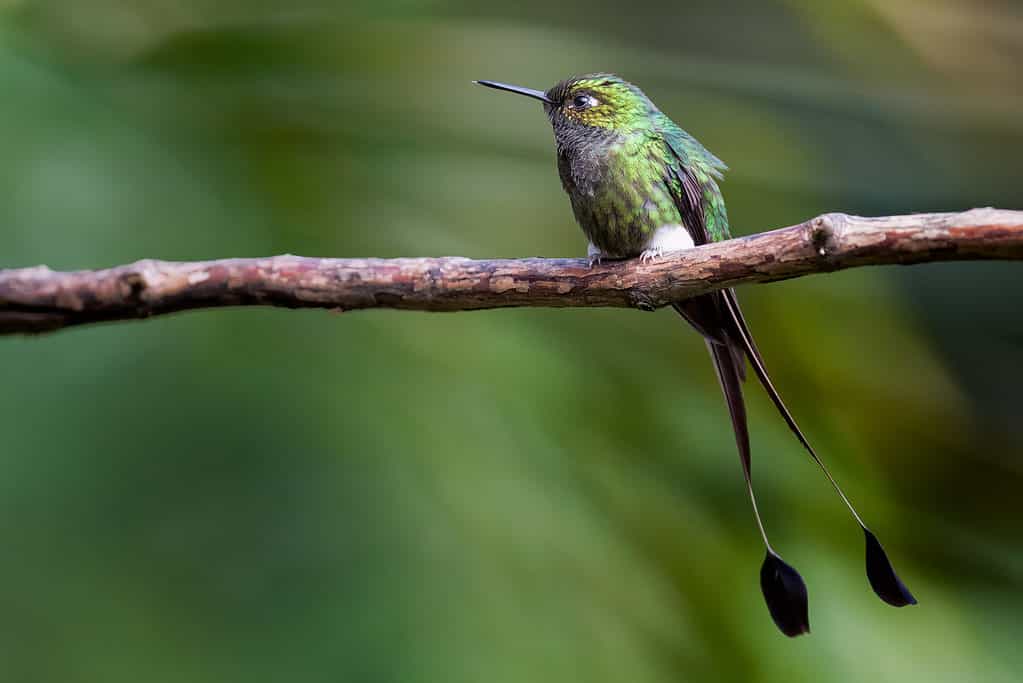
Only male white-booted racket-tails possess elongated outer tail feathers ending in bare shafts with dark oval discs
©NozarIsReal/Shutterstock.com
Long-tailed Sylph
The long-tailed sylph (Aglaiocercus kingii) is widespread across the South American Andes, spanning Venezuela, Colombia, Ecuador, Peru, and West-central Bolivia.
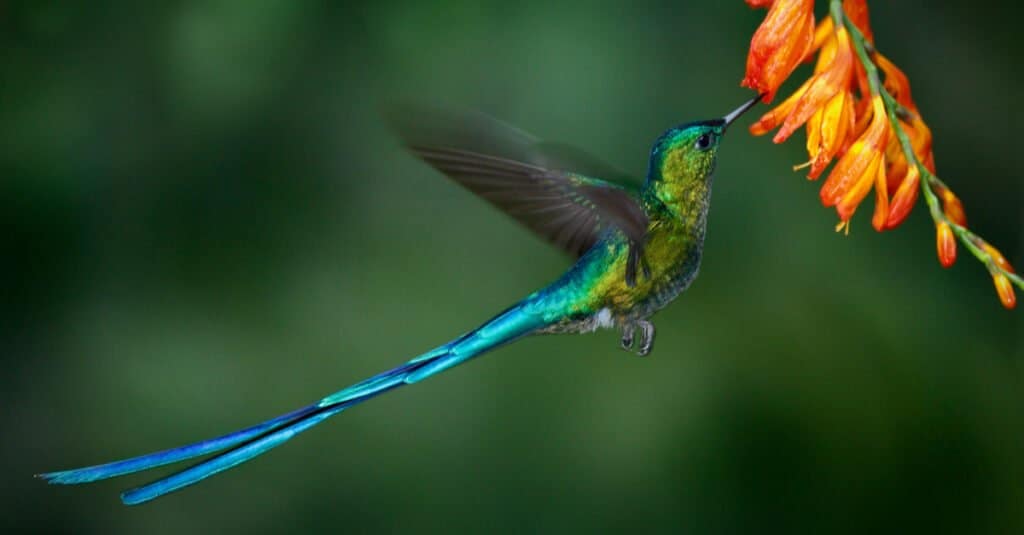
The long-tailed sylph’s coloring is simply breathtaking.
©Ondrej Prosicky/Shutterstock.com
Sexually dimorphic in size and appearance, adult males weigh 0.18 to 0.21 ounces and reach a total length of 6.3 to 7.5 inches, primarily due to their spectacularly elongated, deeply forked outer tail feathers. Females weigh 0.16 to 0.17 ounces (4.5 to 4.7 grams) and measure a much shorter 3.8 to 4.6 inches with a modest, slightly notched tail.
Both sexes have short, straight black bills, but the male boasts a shimmering emerald-green crown, a metallic bronzy-green back, an iridescent blue or violet throat patch, and an incredible tail of sapphire, violet, and green.
Ecuadorian Hillstar
The Ecuadorian hillstar (Oreotrochilus chimborazo) is a high-altitude hummingbird native to the slopes of the high Andes in Ecuador, extending just barely into extreme southern Colombia. They measure approximately 4.7 to 5.1 inches in length and weigh 0.28 to 0.35 ounces, which helps them retain heat in their freezing mountain environment.
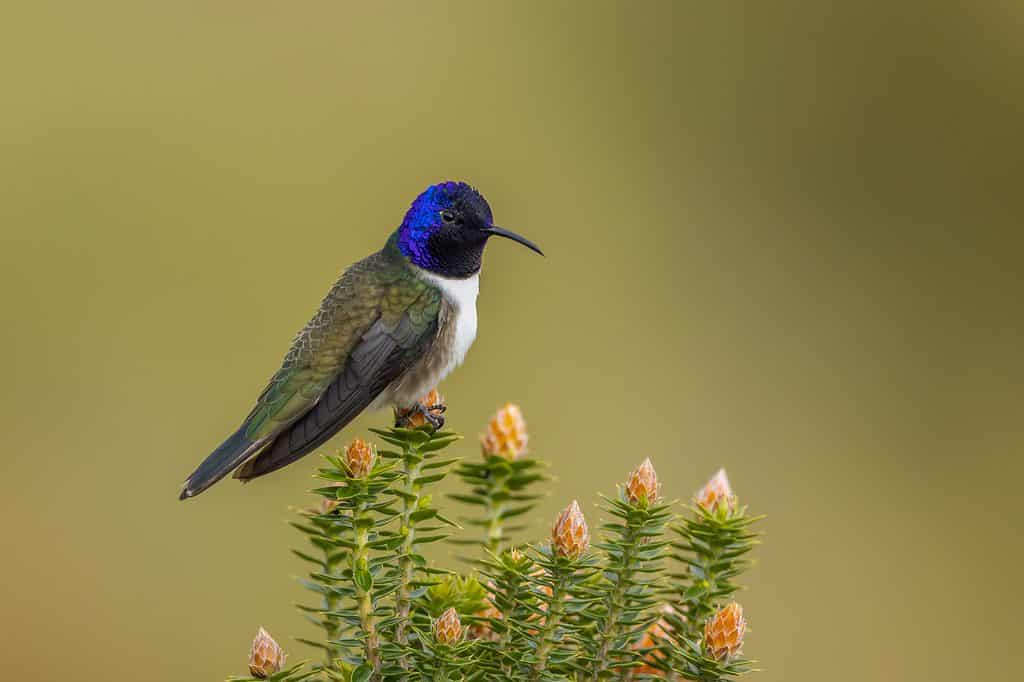
Large hummingbirds, Ecuadorian hillstars inhabit the Andes.
©Wim Hoeck/Shutterstock.com
Adult males feature an iridescent violet-purple hood, dark olive-green upperparts, white underparts divided by a thin black belly stripe, and a slightly curved black bill. Females are much duller with dusty olive-green upperparts and pale grayish-brown underparts.
Their diet consists primarily of nectar from high-altitude tubular flowers, favoring the bright orange blooms of the Chuquiraga shrub, upon which they typically land and cling with their unusually large feet rather than hovering, while also supplementing their caloric intake by catching small insects and spiders.
Rufous-Crested Coquette
The rufous-crested coquette (Lophornis delattrei), one of the tiniest hummingbird species, is only about 2.5 inches long and weighs less than 0.10 ounce. Both sexes have red-brown foreheads that are distinctive, but males have more distinct, spiky crests and shimmering emerald necks.
The rufous-crested coquette is found from southern Central America (Costa Rica and Panama) through the Andes and foothills of Western South America, including Colombia, Ecuador, Peru, and Bolivia. These omnivorous birds eat both small arthropods and flower nectar.
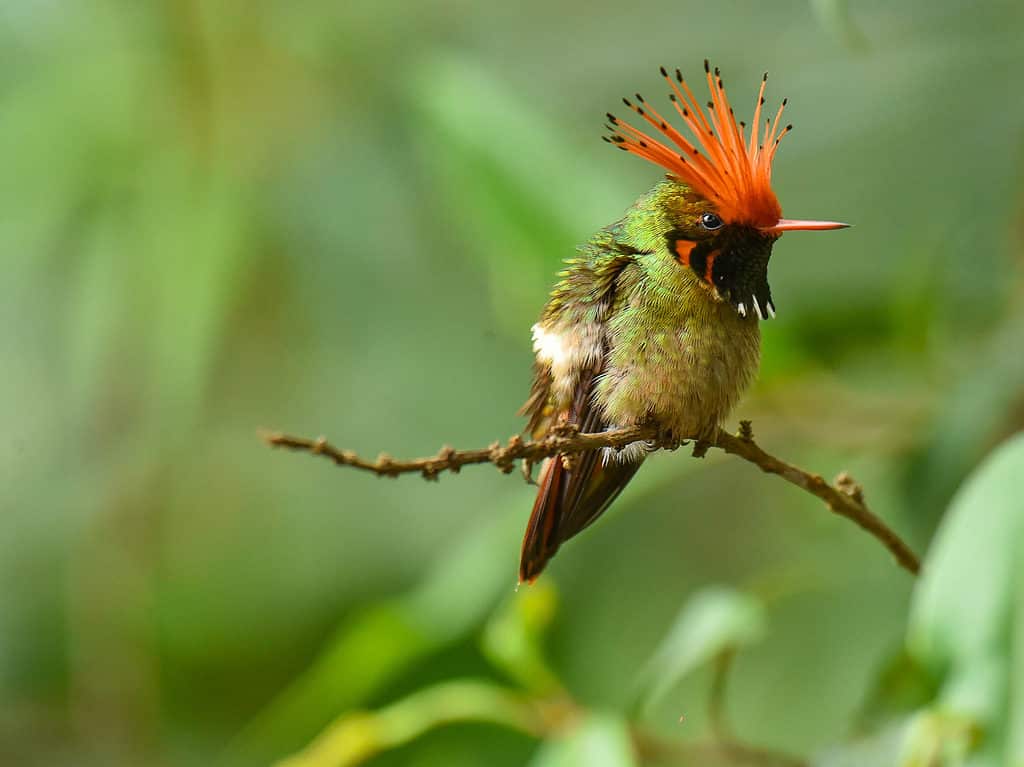
Only male rufous-crested coquettes have the stunning spiked crown.
©Mark Richard Waller/Shutterstock.com
Ruby-Topaz Hummingbird
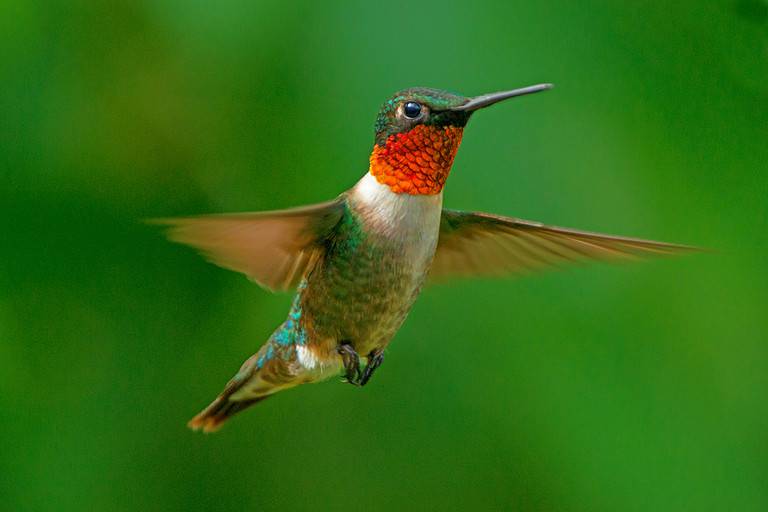
The male ruby-topaz hummingbird (Chrysolampis mosquitus) may become highly aggressive while defending its territory from rivals, despite weighing only 0.12 ounces and measuring 3.1 to 3.7 inches. These birds are found in Trinidad, Tobago, and much of northern South America, including Colombia, Venezuela, the Guianas, and northern Brazil, where they live in flowery meadows. Their primary food source is flower nectar, gathered by hovering or occasionally perching at brightly colored, sugar-rich blossoms of trees, shrubs, and cacti, supplemented by small insects and spiders caught mid-air or from foliage, especially during the breeding season.
Females are slightly less vivid and have green neck streaks, while males have shiny red crowns and necks and brown upperparts covered with a green sheen.
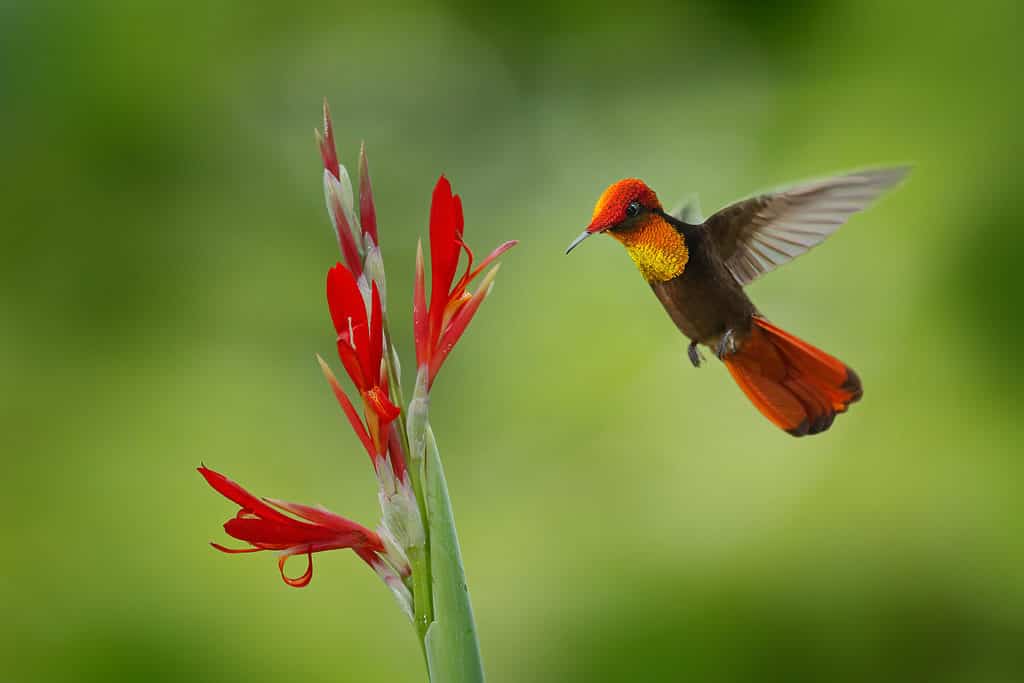
Male ruby-topaz hummingbirds are much more colorful than females.
©Ondrej Prosicky/Shutterstock.com
Green Hermit
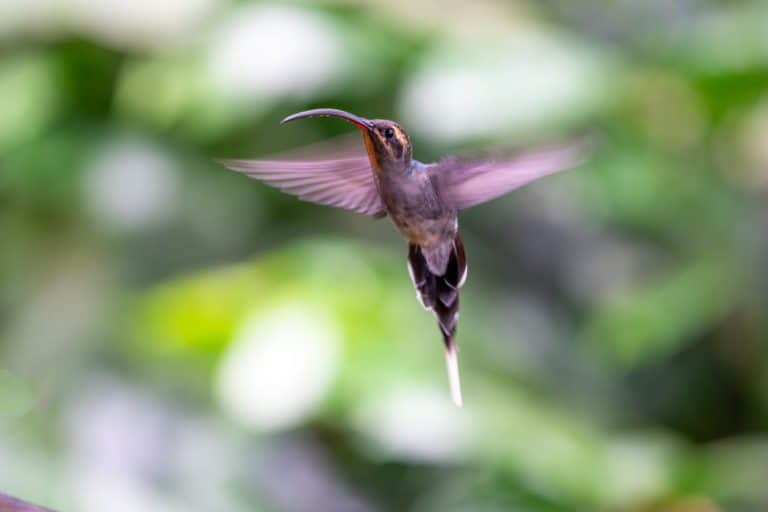
One of the larger hummingbird species, the green hermit (Phaethornis guy), has a body length of roughly 5.3 inches. Unusually among bird species, males have shorter tails than females, whereas males are often more flamboyant in other species. They will, nevertheless, boldly shake their white-tipped tail feathers throughout competitive performances with other males as they compete for prospective mates. Their range extends from southern Central America (Costa Rica and Panama) through Northern South America, including Colombia, Venezuela, Ecuador, Northern Peru, and Northern Brazil.
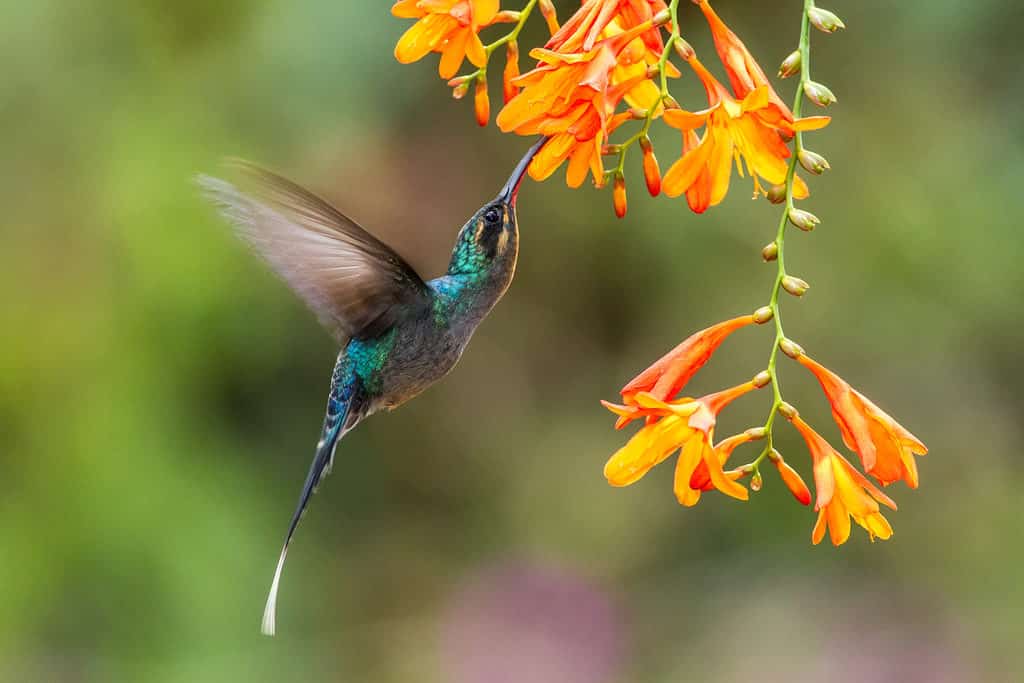
The green hermit hummingbird eats flower nectar using its long, curved bill to probe deep into tubular understory blossoms, while supplementing with protein from spiders and tiny bugs.
©Jiri Hrebicek/Shutterstock.com
White-Necked Jacobin Hummingbird
The white-necked jacobin (Florisuga mellivora) is a striking, medium-sized hummingbird distributed across the humid tropical lowlands from southern Mexico, through Central America, and deep into South America, including Brazil, Bolivia, Peru, and Trinidad and Tobago. These birds are 4.3 to 4.7 inches in length and weigh between 0.21 and 0.32 ounces. Adult males feature an unmistakable dark blue head and chest, a contrasting white collar, a bright green back, and a mostly white tail tipped with black. Females typically have more subdued coloration, although a small percentage of females mimic the bold coloration of males.
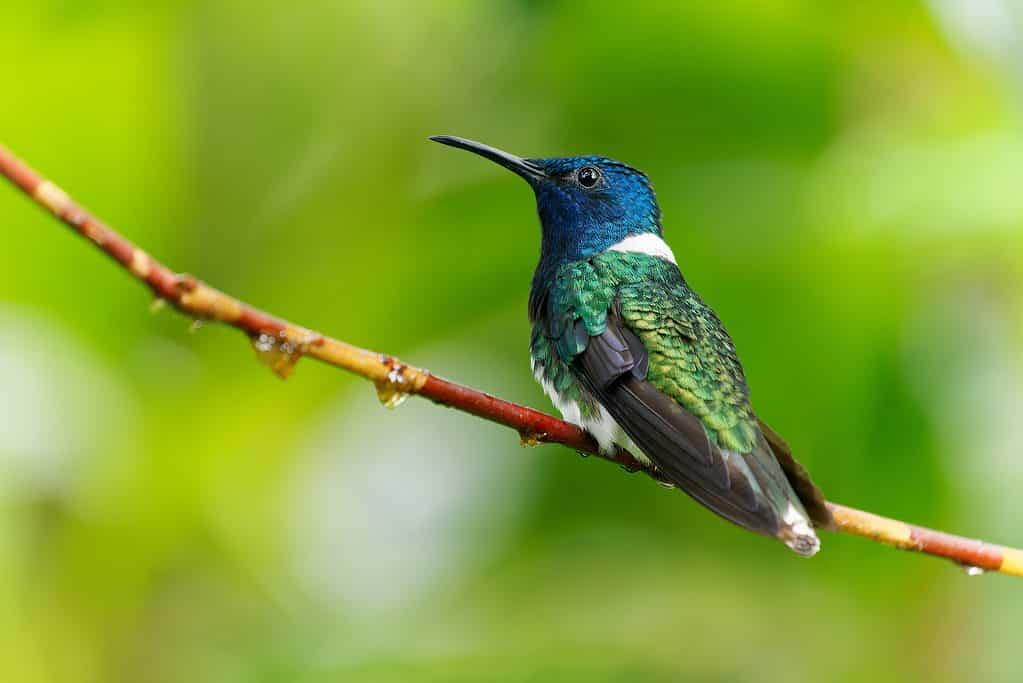
The white-necked jacobin’s diet consists of floral nectar gathered from flowering trees, shrubs, and plants, which it supplements with small flying insects and spiders.
©Martin Pelanek/Shutterstock.com
Black-Throated Mango
The black-throated mango (Anthracothorax nigricollis) is a widespread hummingbird species distributed across Eastern Panama, Trinidad and Tobago, and virtually all of mainland South America except Chile. Measuring approximately 4 inches in length and weighing approximately 0.25 ounces, adult males have iridescent green upperparts paired with a prominent matte-black throat and chest that tapers into a dark stripe down the belly, distinctively bordered with blue-green. Females are less colorful, with bronze-green upperparts and white underparts marked by a central black stripe. Their diet consists primarily of floral nectar supplemented by insects, such as beetles, flies, and small moths, which they frequently catch on the wing.
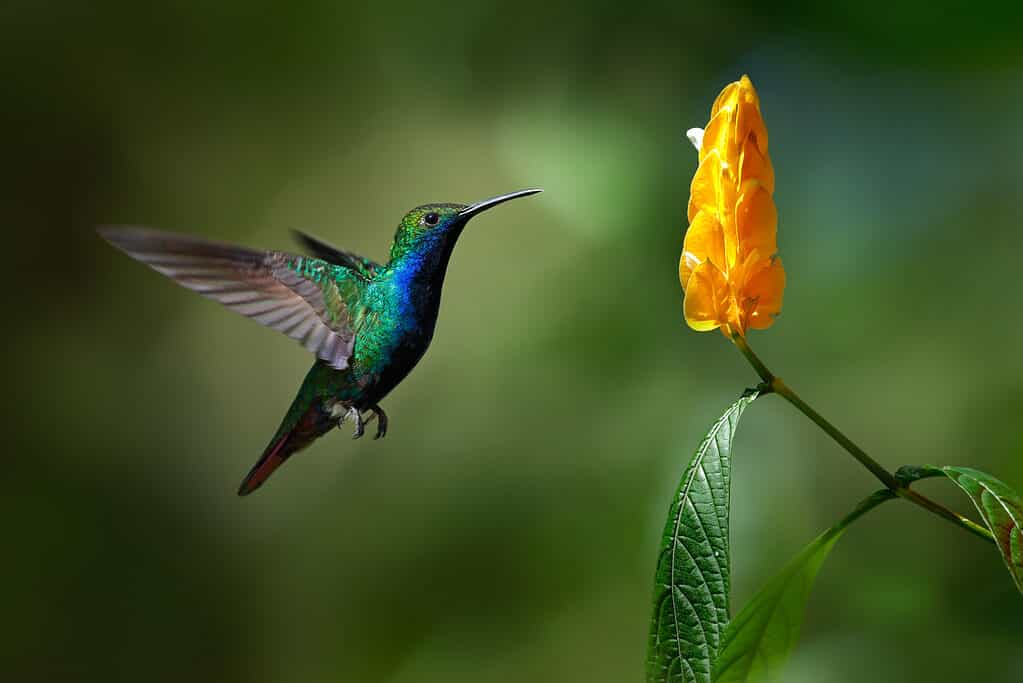
Black-throated mangoes eat nectar and small insects.
©Ondrej Prosicky/Shutterstock.com
Velvet-Purple Coronet
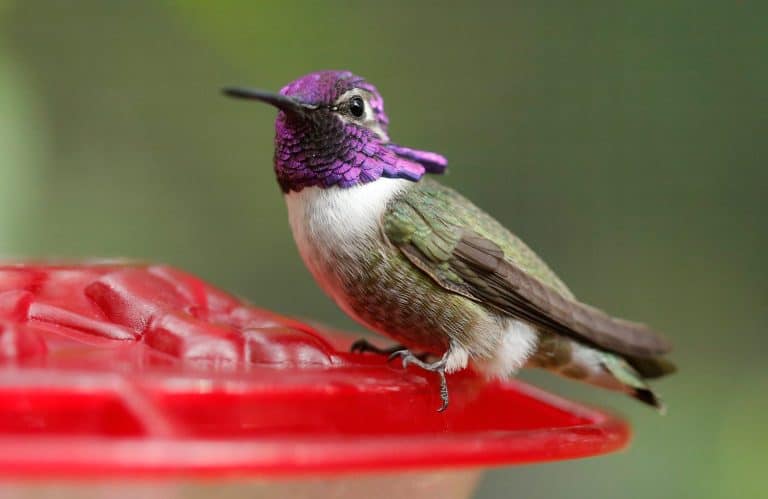
The velvet-purple coronet (Boissonneaua jardini) is indigenous to the moist foothill forests of western Colombia and northwestern Ecuador. Its coloring is so rich that it may initially appear black, but flashes of brilliant violet, blue, and green become visible when light hits its iridescent feathers.
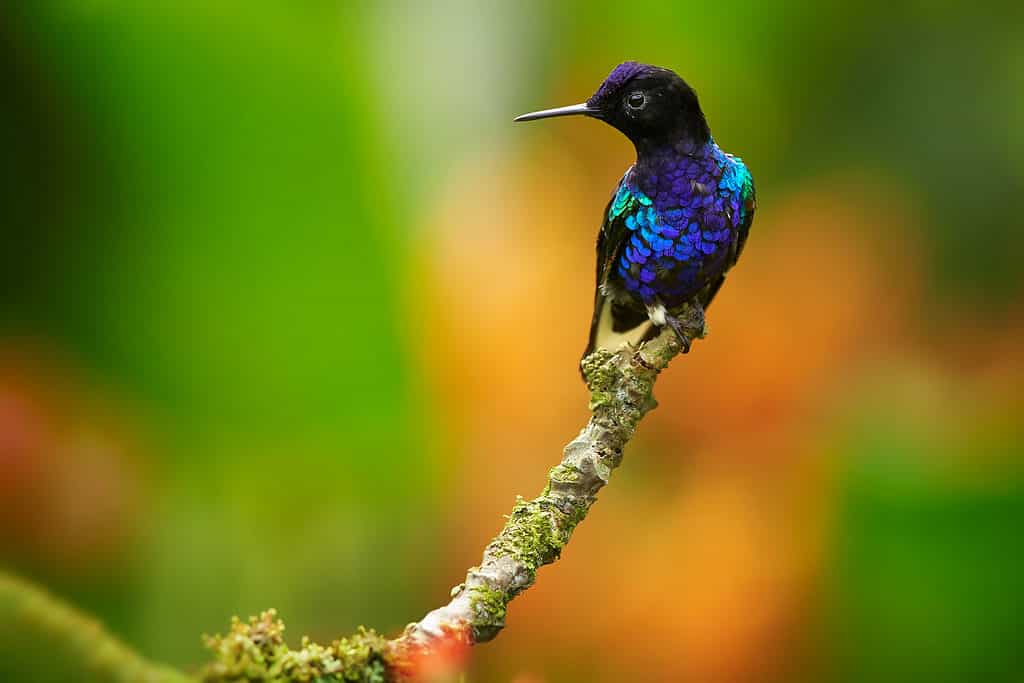
The velvet-purple coronet measures 4.3 to 5.0 inches long and weighs between 0.28 and 0.30 ounces. Their diet consists of a wide variety of sugar-rich flowering plants and small insects and spiders.
©Martin Mecnarowski/Shutterstock.com