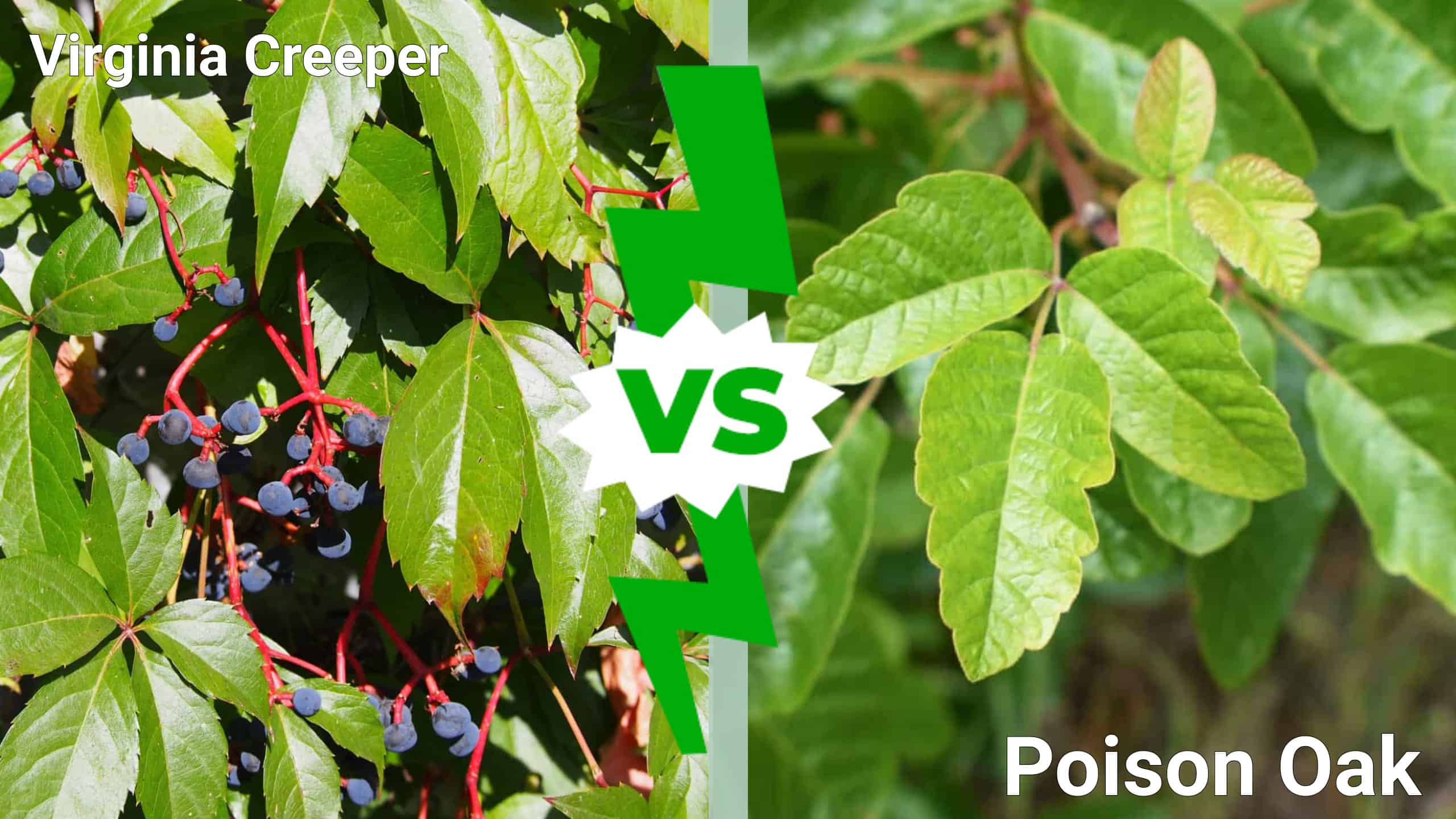

Virginia Creeper and Poison Oak do look similar. However, of the two, Virginia Creeper does not cause the same reaction as Poison Oak. The berries are poisonous. However, touching it won’t result in a rash. When it comes to Virginia Creeper vs. Poison Oak, the more dangerous plant is clearly Poison Oak.
Telling the two apart is also very easy. Poison Oak has three leaves, while Virginia Creeper has five leaves. There is a nice little poem you can remember: “Leaves of three/Let it be.”
That said, there are several other things the average hiker or nature enthusiast should know about these plants before venturing into the woods. We’ll delve into the descriptions, habitats, and physical appearances of Virginia Creeper vs. Poison Oak to help you distinguish between the two confidently.
In addition to identifying them, we will offer you vital safety tips and preventative techniques to avoid coming into contact with these plants altogether. In case of an unfortunate encounter, knowing the appropriate first aid and treatment procedures is crucial for minimizing the impact of the rash and promoting faster recovery.
Virginia Creeper
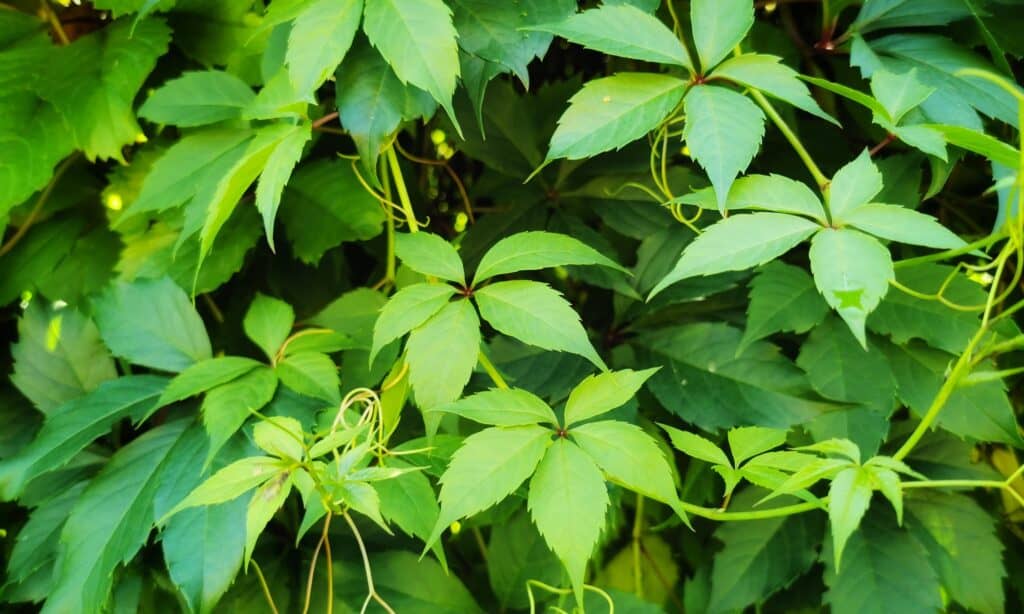
A vine that can quickly cover walls and fences, Virginia creepers can reach up to 100 feet tall.
©iStock.com/drasa
Virginia Creeper is a deciduous woody vine native to eastern and central North America. It belongs to the Vitaceae family, which is where grapevines also belong to. These vines can quickly cover walls, fences, and trees. In the fall, they turn beautiful shades of red, orange, and purple.
The leaves of Virginia Creeper are composed of five leaflets, one of the features contributing to its scientific name “quinquefolia,” derived from Latin, meaning “five-leaved.”
The Virginia Creeper has leaves with serrated edges that resemble fingers. These leaves are arranged in a palmate pattern, encircling a central point. The stem of this plant is equipped with adhesive pads that allow it to climb and cling to various surfaces with ease (that’s why they’re so good at climbing).
Distribution and Habitat
Virginia Creeper is a hardy little plant that thrives in various environments. It can live in woodlands, forests, meadows, and along riverbanks. The plant is particularly prevalent in the eastern and central parts of North America, from Canada down to the Gulf of Mexico.
Toxicity Level
Virginia Creeper is a vining plant commonly associated with Poison Ivy and Poison Oak. However, it is not hazardous. While its berries are poisonous, the plant isn’t considered toxic.
Despite its lower toxicity, Virginia Creeper can cause mild skin irritation in some individuals upon contact. This can manifest as redness, itching, and a rash. However, most people do not experience any reaction to the plant.
Poison Oak
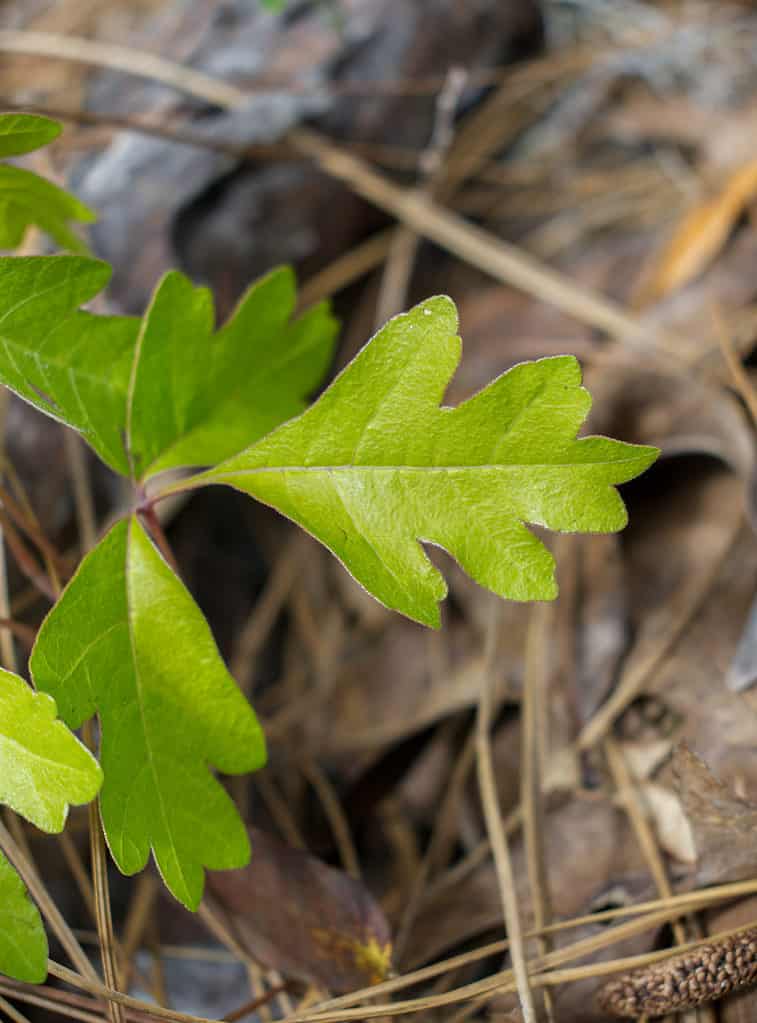
Also known as Atlantic poison oak, oakleaf ivy, or oakleaf poison ivy, Poison Oak is a low-growing, upright shrub.
©iStock.com/Dan Rieck
Poison Oak is a close relative of Poison Ivy and Poison Sumac. It’s a woody shrub or vine found predominantly in western North America. It looks somewhat similar to Virginia Creeper, so it’s easy to incorrectly identify it.
The leaves of Poison Oak are compound and typically consist of three leaflets, hence the familiar phrase, “Leaves of three, let it be.” However, it’s essential to note that some varieties of Poison Oak may have leaf clusters with more leaflets, adding to the confusion in identification.
The edges of the leaflets are variable, ranging from smooth to slightly lobed or toothed. This feature isn’t a good way to identify the plant.
Distribution and Habitat
Poison Oak is prevalent in the western United States, particularly in California, Oregon, Washington, and other states along the Pacific coast. It can also be found in parts of the southeastern United States.
The plant thrives in various habitats, including woodlands, scrublands, and open fields, plus can even grow in residential areas.
Identification of Poison Oak
Identifying Poison Oak can be challenging. However, it’s vital to avoid contact to prevent allergic reactions. Its appearance varies depending on where it is. Once you identify a Poison Oak plant in your area, it becomes much easier to identify it while hiking.
In most cases, the plant has three leaves per leaflet, which is its primary identifying feature. They can be glossy or dull and range widely in color. They also turn red in the fall – just like Virginia Creeper.
However, due to the variation in leaf shapes, it is crucial to also observe the arrangement of the leaflets on the stem. The central leaflet typically has a longer stalk than the two lateral leaflets, which helps differentiate it from Virginia Creeper.
Urushiol and Its Effects
Poison Oak contains urushiol, which is what causes allergic reactions. This chemical is found in the leaves, stems, and roots of the plant. In other words, the whole plant is poisonous and should be avoided.
Contact with Poison Oak can result in a painful, itchy skin rash known as allergic contact dermatitis. The symptoms typically appear within a few hours to several days after exposure and can last for days to weeks.
The rash may vary in severity, with symptoms including redness, swelling, blisters, and intense itching.
Individuals tend to get more sensitive with repeat exposures. Therefore, you can get a rash even if you haven’t before.
Treating Poison Oak Exposure
If you come into contact with poison oak, you need to react right away to minimize the severity of the rash. The affected area should be washed thoroughly with soap and water. Avoid touching other parts of your body or people, as this can spread the oil around.
People with long hair are more vulnerable to poison oak on their faces due to the hair coming in contact with the skin.
Over-the-counter treatments are often plenty for most people. You can find treatments specifically for Poison Oak. Hydrocortisone creams and calamine lotion tend to work best.
In more severe cases or if the rash covers a large area, medical attention may be necessary. A healthcare professional can prescribe stronger medications to alleviate symptoms and promote healing.
Key Differences Between Virginia Creeper vs. Poison Oak
While Virginia Creeper and Poison Oak may share certain characteristics, they are completely different plants. They vary in toxicity, for instance. Therefore, distinguishing between the two plants is important if you’re spending any amount of time outdoors.
Visual Differences
Virginia Creeper has five leaflets arranged like the fingers of a hand. The middle leaflet often has a longer stalk than the two next to it.
Poison Oak has three leaflets, though some varieties may have more. Therefore, there can be some confusion. The edges of the leaflets can vary tons, as well. However, the edges of a Virginia Creeper’s leaflets are typically serrated with distinct teeth.
Virginia Creeper is a woody vine that tends to climb on structures like walls and fences. It is a very good climber. Poison Oak can grow as a low shrub and also climb. However, it isn’t as great of a climber as Virginia Creeper.
Toxicity
Virginia Creeper is not highly toxic, and its sap is not known to cause severe reactions in most people. Poison Oak is highly allergenic due to urushiol, a resin that can cause an allergic skin reaction in susceptible individuals.
Most individuals become allergic to Poison Oak after several exposures. Even if you aren’t sensitive to it, you can become sensitive to it through repeated exposures. Therefore, it’s important to try and avoid it even if you’ve never had a reaction.
Distribution
Sadly, these plants are located in very similar areas. Therefore, misidentification is common. Virginia Creeper is native to eastern and central North America, from Canada to the Gulf of Mexico. On the other hand, Poison Oak is found mostly in western North America.
Both plants live in very similar habitats. They’re very adaptable, so you can find them just about anywhere.